0249 Chapters 11, 12 and 13 are devoted to debunking an agenda, called “the ancient astronaut theory”, proposed by various hucksters starting in the 1950s. This theory is multifaceted, since there is more than one proponent. Basak’s book says that the theory sweeps into public popularity because of the uncertainty following the second battle among the Enlightenment gods, the hot war among fraternal ideologies (1938-1945 AD) and leading into the third battle among the Enlightenment gods, the cold war among materialist ideologies (1945-1989).
0250 Against this interpretation, which explains this social phenomenon in terms of a model where material arrangements after the Second World War and the start of the Cold War [substantiate] conditions ripe for scam-ideas about ancient civilizations, I place a Lotmanist suggestion that the social popularity of the ancient astronaut theories is accounted for by the inadequacies of Marxist-interpretations of archaeological research into the Neolithic period.
0251 Here is a picture of the framework of the latest cycle of Neptune in Aries.
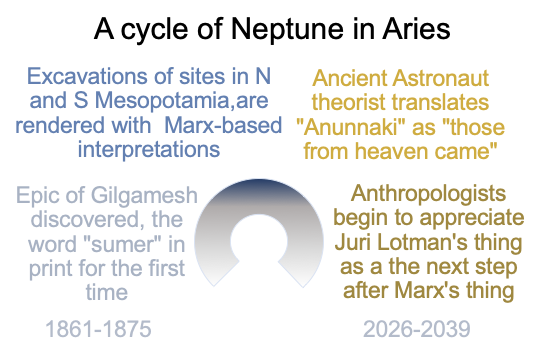
Highly successful excavations by Western archaeologists offer the promise of coming to terms with the rise of ancient civilizations, based on Marxists formulations.
The Marxist thing does not quite do the job, so alternate theories are proposed by hucksters anticipating an explanatory breakthrough. Basak’s exercise in debunking the very entertaining alternatives only replays the Marxist thing. Basak relies on the Marxist thing to debunk the alternatives that arose from the lack of explanatory power of the model that material arrangements [substantiate] human conditions.
Now, anthropologists are starting to realize that all those people who entertained the now-debunked “ancient astronaut theory” were not as stupid as the Marxist thing presumes.
0251 Once again, Razie Mah’s four part blog, Looking at Melinda A. Zeder’s Article (2025) “Unpacking the Neolithic”, offers insights. The results of anthropological research into the so-called “Neolithic” does not… indeed, cannot… account for another trend hidden within the data. That trend is towards unconstrained social complexity. Basak’s AI program (my speculation, of course) trains only on results and discussions produced by researchers interested in looking for the material arrangements that substantiate neolithic conditions. They cannot account for a change in semiotic practices. They cannot account for what Razie Mah’s hypothesis of the first singularity suggests.
0252 Therefore, why not postulate ancient astronauts?
Surely, ancient monumental constructions, such as pyramids, stone circles, and tracks of figures that can only be seen from the sky indicate ways that civilizing humans communicate with these alien beings.
0253 If this is not a cry for a semiotic accounting for the emergence of unconstrained social complexity, I don’t know what is.
0254 Chapter 14 offers a standard summary of the achievements of ancient Sumeria.
0255 Chapter 15 returns to the topic of the Sumerian creation myths. Once again, the text re-iterates established points. On one hand, the Marxist thing can provide an explanation that cannot be challenged because… well… it is supposedly just like a mathematical or mechanical natural science model. On the other hand, the Marxist thing cannot account for the emergence of unconstrained social complexity in southern Mesopotamia.
Lotman’s thing can.
0256 Here is a picture.
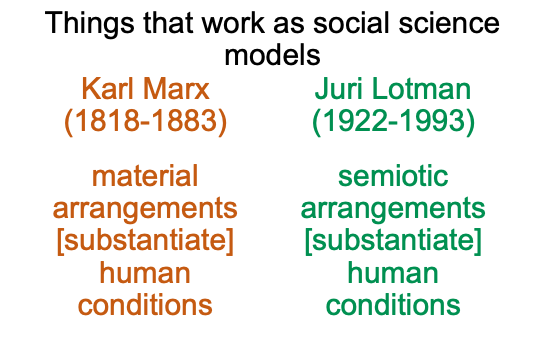
0257 Although this pair of options may appear stunningly simplistic, the ancient astronaut theory shows that stunningly simplistic can work. It can offer an off-ramp to the current academic highway of a publication-based arms race, where young professional archaeologists struggle to pass through the substance called “tenure” only to realize that they have merely passed from antithesis to thesis (see points 0124-0128).
0258 Beck et al.’s manifesto, “Changing the Landscape of Archaeological Publishing” (Current Anthropology 67(1) (2026), https://doi.org/10.1086/739789), is well worth contemplating as a marker for the end of one Neptune in Aries spiral and the beginning of another.