0238 Why is a review of an old (1976) book by an expert on literature be relevant?
0239 If it turns out that synaesthesia is instrumental in adding the voice, as an adornment, to fully linguistic hand-talk at the dawn of our species, Homo sapiens, then the mindset where a spoken word is recognized to image or indicate the same referent as a hand talk word must be of interest. Spoken words do not picture or point to anything. Hand talk words do. So, the automatic transit of spoken word to image and indication suggests that… if a person hears a voice… then that purely symbolic being is automatically taken to be as real as the iconic and indexal beings of hand talk.
Julian Jaynes calls this mind-set, “the bicameral mind”. He argues that Homer’s Iliad portrays the bicameral mind, where the words of the gods (that is, auditory hallucinations) are regarded literally, and the Odyssey portrays modern consciousness, where spoken words are not immediately and literally taken as one would regard a manual-brachial gesture. As it turns out, the same difference applies to Atarasis and Gilgamesh. There is a different in mind-set between the two. The same difference applies to Noah and Abraham.
0240 Here is a picture summarizing the issue.
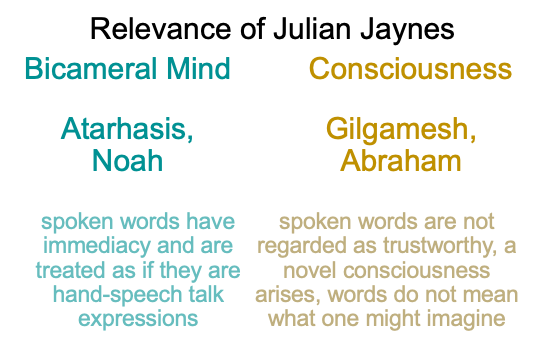
To me, this shows how Lotman’s thing may be more relevant to the discipline of archaeology than Marx’s thing.
0241 Chapter 8 covers the Epic of Gilgamesh.
The tablet containing one chapter of the Epic of Gilgamesh is pieced together by George Smith in 1872. This portion of the epic contains an account of the flood that parallels the Biblical account of Noah (a table appears in chapter 7).
Gilgamesh, a king who lives long after the flood, quests for immortality after the death of his friend. He knows that Utnapishtim (Atarhasis) was granted immortality by the gods after the flood. Gilgamesh makes the dangerous trek to visit him in order to obtain the secret.
Gilgamesh learns that there is no way to get immortality from the gods. But (and this sounds precisely like a sales pitch) there is a plant that grows at the bottom of the sea that produces youthful regeneration. Eat this plant and the promise is youthful renewal. So, Gilgamesh goes to the bottom of the sea, obtains the plant, then takes a nap. A snake eats the plant, then sheds its skin, thereby attaining youthful regeneration. See! The plant works as promised!
0242 Here is a comparison between the mythic tree of life in the Biblical Garden of Eden and the plant that Gilgamesh obtains from the bottom of the sea.
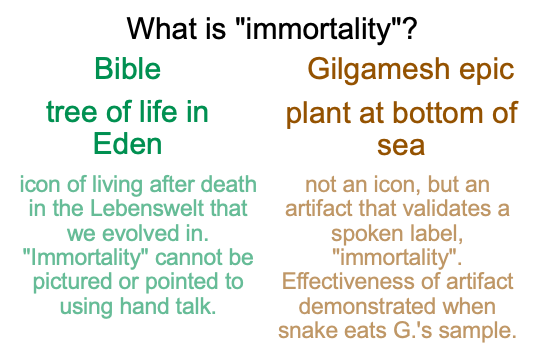
0243 When the word, “immortality”, is taken literally by Marx-informed archaeologists, something is missing.
What is missing?
Where is the semiotic difference between the world of hand- and hand-speech talk (that is, the Lebenswelt that we evolved in) and our current world of speech-alone talk (that is, our current Lebenswelt)?
0244 Chapter 9 covers more spoken-word games.
The Weld-Blundell prism offers an ideological narrative called “the Sumerian King List”. Gilgamesh is one of the kings before the great flood. The kingship descends from heaven. Only one city at a time holds the banner.
The name for this type of narrative is “mytho-history”. The narrative is ideological, but seems to read… well… y like any other story.
The spoken words say, “Take our purely symbolic beings to be icons and indexes that picture and point to their referents.”
0245 Julian Jaynes argues that the invention of writing disrupted the operations of the bicameral mind in the most insidious manner. Writing allows oracular proclamations to be compared. Before writing, a person would hear a voice telling him to do this or that, and, just like Utnapishtim and Noah, the person would create the artifact that the voice was calling for. After writing is invented, one can see that the voices convey different messages.
Even better, the person writing the script is now in a position to be a voice in other people’s heads.
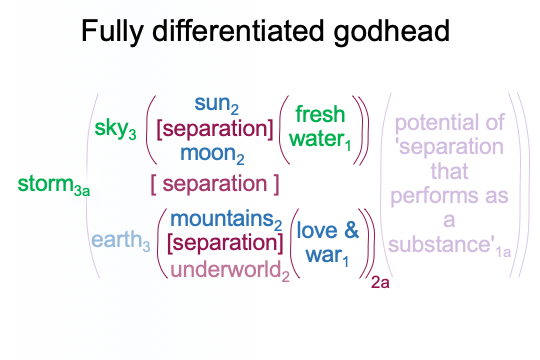
0246 Chapter 10 concerns the divine assembly, the Anunnaki, according to Akkadian script. As already noted the Anunnaki originally have seven members. The big three (in green) are Enlil3, An3 and Enki1. The other four (in blue) are Utu2, Nanna2, Ninhursag2 and Inanna1.
Here are the assignments based on what the gods represent (see list in chapter 5.2).
0247 Early on, in the Sumerian civilization, the Anunnaki compose a divine council. They decree that a great flood should occur. After the flood, they rule that Utnapishtim receives immortality. They also rule that humans should be created to solve the Igigi labor dispute. The Anunnaki declare fate from above.
Once the mantle of civilization passes to the Akkadians, the Anunnaki become judges in the underworld. They work for Ereshlugal, the queen of the underworld.
0248 What a change in jobs. Here is a picture.
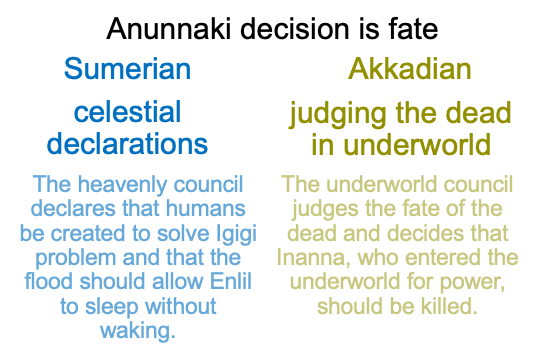
After centuries, maybe millennia, the Anunnaki lose their differentiated nature. They become like a jury, where all the members are technically the same. In this capacity, they serve as the court that condemns Inanna, the goddess of love and war, to death.