0226 Chapter 7 of Basak’s text is titled “When the Heavens Wept: The Great Flood Myth”.
0227 The biblical story of Noah’s flood corresponds to similar stories written about the end of the Uruk archaeological period, often labeled the “Jamdet Nasr” (3600-3800 U0′). If the Uruk starts around 2800 U0′, then the townships of the Uruk period have around 1200 years (or 7 orbits of Neptune) to denude nearby forests in unwitting preparation for catastrophic flooding.
Or, the Uruk townships have 3 transits of Eris in order to destroy their own Lebenswelt from within… er… without. After all, who cares if Uruk deforests the hills that surround Mesopotamia and attacks the nascent civilization forming on the nearby Susa plain and digs holes all over the region in order to extract copper to smelt and sends emissaries to distant lands in order to show how wealthy and powerful the gods of the townships have become?
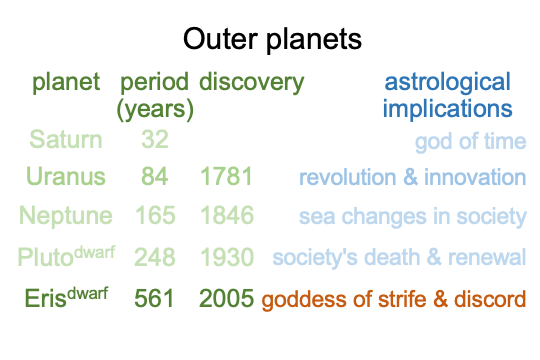
0228 Surely, the long periodicity and the name selected for Eris offers an opportunity to frame a cyclic process beginning and ending in strife and discord.
“Strife and discord” constitute divine punishment. So do catastrophic natural events.
0229 On one hand, no archaeologist knows precisely which flood (among several candidates) informs both the Biblical flood story and the flood story appearing in the Epic of Gilgamesh. So, the Marxist interpretation of the flood stories suffers in that no one can figure out the material arrangements.
0230 On the other hand, at the start of 2026, no archaeologist is aware of Razie Mah’s groundbreaking hypothesis, propounded in the e-book, The First Singularity and Its Fairy Tale Trace, and briefly outlined in points 0162 and 0163 of the exposition at hand. So, none can appreciate the relevance of a Lotmanist interpretation of the causes for the flood according to the ancient texts themselves.
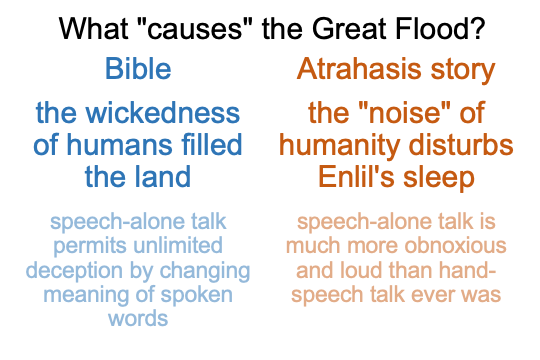
This figure is not accounted for in Basak’s survey of current (up to 2025) literature in the field of archaeology.
0231 It almost makes one wonder, “Could civilization have been potentiated by a semiotic transition from hand-speech talk to speech-alone talk, starting with the Ubaid of southern Mesopotamia?”
0232 If the answer is affirmative, then our current Lebenswelt is not the same as the Lebenswelt that we evolved in.
Plus, the celestial clocks suggested in this commentary start to tick.
0234 In the Lebenswelt that we evolved in, the celestial bodies were used for signs and for marking the seasons.
In our current Lebenswelt, the celestial bodies may be used as time-pieces, whose zodiac return marks the turning of a spiral of revolutions within the trajectories of unconstrained social complexity.
0235 At this point, young professional archaeologists may want to know how Razie Mah gets to the claim that, since the inception of our species, hand-speech talk has been re-organizing the way humans think. The following diagram presents two recent reads that should assist in satisfying that desire.
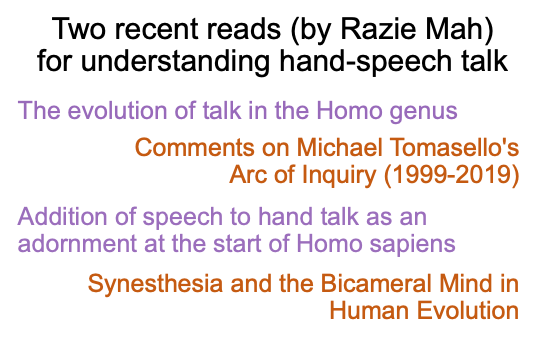
0236 The first commentary reviews a number of books by a (now former) Director of the Department of Evolutionary Anthropology at the Max Planck Institute in Leipzig. Michael Tomasello never adopted a fully semiotic frame of mind. This commentary adds value to his works by showing how relevant the framework of triadic relations can be.
0237 The second commentary reviews Steven Mithen’s 2024 book, The Language Puzzle, as well as Julian Jaynes 1976 book, The Origins of Consciousness in the Breakdown of the Bicameral Mind. Steven Mithen intimates that synaesthesia is instrumental in attaining speech talk, yet refuses to consider that a fully linguistic hand talk need only add the voice as an adornment, using synaesthesia as a guide, to achieve hand-speech talk. The fluid semiotic dynamics of hand-speech talk explains many cultural features of the Late Paleolithic.