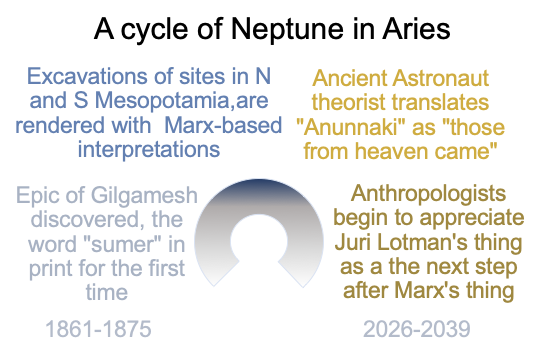
04/30/26

Looking at John H. Walton’s Book (2025) “New Explorations in the Lost World of Genesis”  (Part 1 of 20)

0001 The book before me is published by Intervarsity Press.  The subtitle is “Advances in the Origins Debate”.  This work is the latest in the “Lost World Series” that delves into how Genesis should be regarded in light of the archaeological discoveries of the past three centuries.

Of course, “new explorations” implies “advances”.  Advances adjust previous positions.  The reader is advised to consult the conclusion immediately after the introduction, and before the section on methodology.

An examination of a prior work can be found in Looking at John Walton’s Book (2015) “The Lost World of Adam and Eve” appearing in Razie Mah’s blog in August 2022.  The review is updated and fashioned as the first and fifth chapters in Razie Mah’s 2024 e-book, Exercises In Artistic Concordism, available at smashwords and other e-book venues.

0002 The term, “literature of the ancient Near East” is somewhat awkward, because the writings of the ancient Near East were buried in the ruins of royal libraries throughout Egypt and the Levant.  The writings are in cuneiform, wedge impressions on clay tablets.  The clay fires into brick when the royal library burns, along with the rest of the royal city.  Then, the ruins get buried in vegetation, and later human settlements, and so on.  Then, the tells (or hills) are excavated by modern archaeologists.  Archaeologists discover thousands of cuneiform tablets and learn how to translate them.  These translations constitute “the literature of the ancient Near East”.

0003 Of course, this story sounds implausible.

However, God tends to manifest the implausible.

0004 In fact, if God only performs sensible… what is the correct term?… “interventions”, then no one would notice.  If anyone could turn water into wine, then the miracle at Cana would be ho-hum.

The Uruk culture invents writing by impressing tokens onto the surface of clay balls (which then contain the impressed tokens).  That seems sensible.  Centuries later, a Sumerians scribe uses a reed stylus to create impressions on a clay surface that is curved, like the surface of a ball.  That seems sensible, also.  Then, stylus impressions on a clay tablet become so routine that cuneiform is used for centuries to record transactions and inventories.  Eventually, the same writing is used to record the civilization’s origin myths.

0005 Okay, each of these steps is sensible, although unlikely.

How many unlikely, yet sensible, developments can be strung together before the results may be declared “miraculous”?

0006 So, what is miraculous with respect to Walton’s lost-world propositions?

God provides eighteen centuries of biblical interpretation by Christians before creating the conditions where a challenge to traditional reference and affirmation occurs.

The archaeology of the ancient Near East unearths literature that is (more or less) contemporaneous with the Old Testament.

That is the challenge.

0007 The Old and New Testaments are no longer subject to plain reading as the sole foundation of interpretation.

Why?

How can one conduct an honest reading of the Old and New Testaments and not accommodate the literature of the ancient Near East?

0008 Okay, replace the word, “honest”, with the word, “literal”.

It seems that figurative and allegorical readings are not challenged.

04/8/26

Looking at John H. Walton’s Book (2025) “New Explorations in the Lost World of Genesis”  (Part 20 of 20)

0218 Chapters seven and eight cover the Fall and God’s pronouncements in Genesis 3.

These are more results of Walton’s scientific explorations.

I leave the application of hylomorphe, entanglement, confounding and resolution to the reader.

0219 Recall, a scientific paper contains five elements: introduction, methodology, results, discussion and conclusion.

So does Walton’s book.

0220 Chapter nine offers a discussion on Genesis and science.

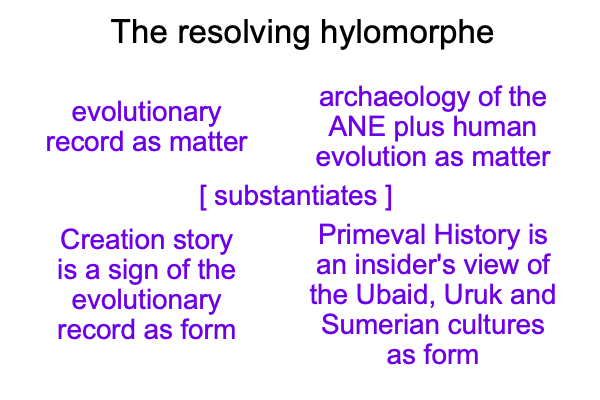
At no point in the discussion does Dr. Walton touch base with the following hylomorphes.

0221 In regards to the Creation Story, Razie Mah’s Looking at Hugh Ross’s Book (2023) “Rescuing Inerrancy” reviews what Walton is trying to avoid.  Walton imagines that the entanglement of a moderate or an artistic concordism will turn out to be… um… dangerous.

Didn’t I say that confoundings are dangerous?

Hugh Ross’s version of moderate concordism cannot rescue the doctrine of biblical inerrancy, because it offers only a miraculous coincidence between what the Genesis text for each day appears to be describing and a corresponding evolutionary epoch.

Razie Mah’s version of artistic concordism changes the character of the doctrine of biblical inerrancy, because it offers a method for showing that each Genesis day offers natural signs of a corresponding epoch.  There are three types of natural signs: icons, indexes and symbols.

0222 If the Bible is supposed to be plainly read, then why would an author write the Creation Story as a vision that depicts the evolution of the Earth on the basis of natural signs?  The author could not possibly had known the natural history of the Earth, unless having been presented with a series of visions.  The text breaks down into natural signsbundled for each day, as images, indicators and symbols.

0223 It is enough to make John H. Walton swoon.

There is no way that Genesis 1-11 can entangle the modern… now… postmodern age.

There is no way… except… for… that ever-churning Christian imagination.

See Razie Mah’s e-book, Exercises in Artistic Concordism.

0224 In regards to the Primeval History, all the written origin stories of the ANE (except for the Creation Story) depict a recent creation of humans, by newly differentiated gods, according to their designs and purposes.

The question is, “Why?”

The civilizations of the ANE cannot see past a theoretical time point corresponding to the start of the Ubaid archaeological period in southern Mesopotamia.  They cannot see from our current Lebenswelt into the Lebenswelt that we evolved in.

0225 The first singularity is currently a hypothesis.

As further research is conducted with this hypothesis in mind, we may eventually feel confident that the Ubaid is the first culture in human evolution to practice speech-alone talk.  8800 years ago, all other cultures practice hand-speech talk, in continuity with the founding of our species 300,000 years ago.

Over a period of a few thousand years, these hand-speech talking cultures convert to speech-alone talk, after being exposed to speech-alone talking cultures.  Why do they adopt the new way of talking?  Hand-speech talk promotes constrained social complexity.  Speech-alone talk removes the constraints.  The semiotic qualities of hand-speech talk and speech-alone talk are hugely different.

0226 The above hylomorphes are resolutions in favor of the entanglement.

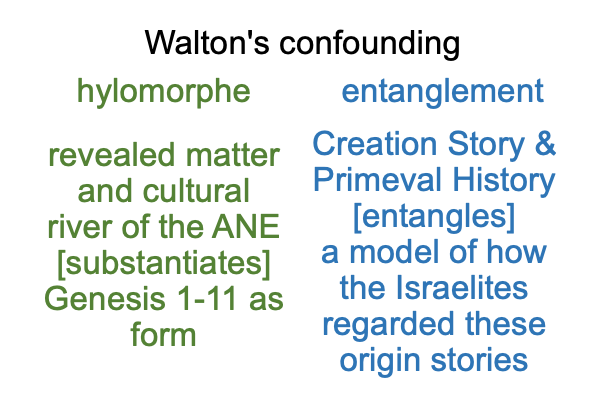
Against this prospect, Walton configures his own confounding.

0227 Will this be sufficient to stop the goofy, science-loving impulses of the Christian imagination?

I don’t think so, because even if Walton’s confounding resolves in favor of his entanglement, the form of the resulting hylomorphe will entangle the Christian imagination.

0228 The Tartu-Moscow School of Semiotics pulls up a fish from the depths of the Christian Slavic civilization.

They open the mouth of the fish.

What do they find?

The golden coin of entanglement.

0229 Welcome to the Fourth Age of Understanding, The Age of Triadic Relations.

0230 I thank John H. Walton for publishing this advance in the origins debate and I wish J. Harvey Walton the best.

01/1/26

Looking at Melinda A. Zeder’s Article (2025) “Unpacking the Neolithic” (Part 1 of 4)

0001 If I may present my conclusion at the beginning, “I suggest the following motto: First the bauplan, then the twist.”

0002 The full title of the essay under examination is “Unpacking the Neolithic: Assessing the Relevance of the Neolithic Construct in Light of Recent Research”.  The article appears in the Journal of World Prehistory (2025) in volume 38:11, pages 1-58 (https://doi.org/10.1007/s10963-025-09198-0).  The author is affiliated with the Department of Anthropology, National Museum of Natural History, Smithsonian Institution in Washington D.C.

0003 The author’s argument follows the Greek tradition of (A) setting out prior propositions, (B) adding further information and assessments and (C) proposing one’s own solution.

Prior propositions (A) are covered in the section titled, “The Origin of the Term ‘Neolithic'”.

Further information (B) includes sections on neolithic emergences in southwest Asia and other regions, including China, Japan, eastern north America, Mesoamerica and the northwest America.

The author’s proposal (C) appears in a section titled, “Repackaging the Neolithic”.

0004 I examine each movement in the sequence A, C then B.

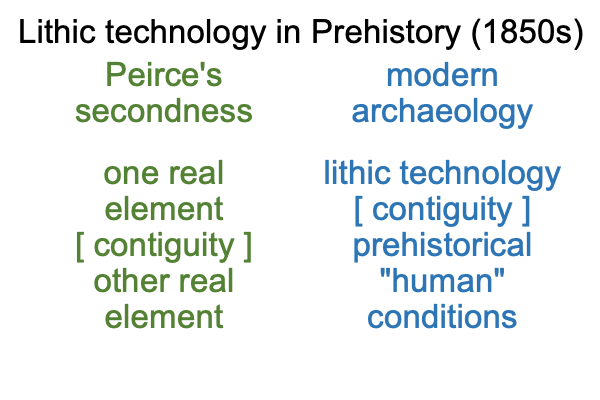
0005 In regards to the historical origin of the term, “neolithic” (A), the word appears in the 1850s in the context of prehistoric lithic technology.  A distinction between old “paleolithic” and new “neolithic” tools reflects a fairly recent change in the human condition.  The Paleolithic extends very far back into the evolution of the Homo genus.  The Neolithic is fairly new and applies only to Homo sapiens.  By “new”, I mean, say, starting less that 20,000 years ago.

0006 As it turns out, stone tools and fossilized bones are the most recoverable items from the distant past.  So, the idea that our kind evolves will of course rely of this type of data.  The implications are significant.  If lithic technologies are like matter, then the archaeologist may speculate on forms of prehistorical human (or “hominid” or “hominin”) conditions.

0007 For example, the earliest paleolithic stone tools are labeled “Oldowan”. These tools can be made on the fly.   If I strike one rock with another, I can fracture off a shard and expose a sharp edge.  Of course, one must choose the right rocks for this trick.  Plus, technique is important.

Later stone tools are labeled “Acheulean”.  These stone tools are made ahead of time, by the same technique of hammering off shards to reveal an intended form that… somehow… is intrinsic to the original rock.

0008 So, what am I suggesting?

Is the actuality of matter and form intrinsic to rocks, and ancestral hominins learn to tamper with one real element (matter) in order to sculpt the other real element (form)?

0009 I am suggesting more than that.

Aristotle’s hylomorphe (hylo = matter, morphe = form) is an exemplar of Peirce’s category of secondness.  Secondness consists of (at least) two contiguous real elements.  For paleolithic hominins, a rock (matter) could be sculpted into a stone tool (form).  From the point of view of the archaeologist, the hylomorphic structure still applies.  The question is, “How?”

Paleolithic stone-tool technology “sculpts” prehistorical human conditions.

0010 Of course, the word, “sculpts”, serves as an aesthetic metaphor for the contiguity between paleolithic technology as matter and hominin conditions as form.

0011 The challenge for nineteenth-century anthropology is clear.  Propose a better, more scientific, or at least, less metaphysical, label for the contiguity.

With only geological strata, stone tools and fossilized bones as evidence, proposals were necessarily speculative.  But, archaeologists continued digging, and by the 1850s could make the distinction between paleolithic and neolithic.  Also, they figured out a reason for why the advance from Oldowan to Acheulean stone tools “sculpted” more advanced hominin conditions.  Man was making himself.

0012 What do these evidential and rational developments suggest?

For a Peircean, secondness is the dyadic realm of actuality.  Secondness is only one of Peirce’s three categories.  The other two are thirdness (the triadic realm of normal contexts, judgments, signs, mediations and so forth) and firstness (the monadic realm of possibility).

Each of these categories manifests its own logic.  Also, each higher numbered category prescinds from the adjacent lower category.  Thirdness prescinds from secondness.  Secondness prescinds from firstness.  Prescission allows the articulation of the category-based nested form, as described in Razie Mah’ e-book, A Primer on the Category-Based Nested Form.

0013 Thirdness bring secondness into relation with firstness.

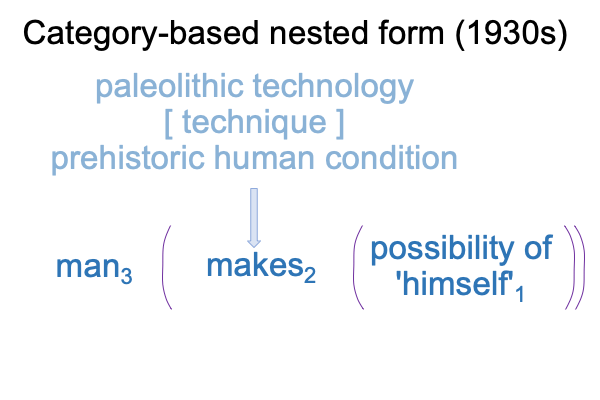
A triadic normal context3 brings a dyadic actuality2 into relation with the possibility of ‘something’1.

0014 Now I can slide the above dyad into the slot for actuality2 for the category-based nested form intimated by the title of V. Gordon Childe’s 1936 book, Man Makes Himself.

0015 The slide clarifies the contiguity, paleolithic technology constellates a substance, which I label, “technique”, that manifests an essence for the conditions of evolving hominins (that is, a substantiated form).

Consequently, the appearance of a new stone tool technology indicates a change in techniques as well as a change in the essence of the prehistoric human condition.

0016 According to Childe (1892-1957), the “neolithic” label encompassed more than a change in lithic technology.  The prehistoric human condition gets entangled with all sorts of other matters, including sedentary communities, economies of delayed returns, various modes of storage and so forth.  A long list of material arrangements gets entangled.

0017 As it turns out, once matter substantiates form, then form can entangle other matter, which is a confounding.  Here, “confounding” is a technical term, precisely labeling one form originating from one matter and entangling another matter.

Historically, a confounding is an idea that belongs to Aristotle’s tradition.  It is stumbled upon long after Aristotle’s campus went out of business.  It is the brainchild of the Byzantine and Slavic civilizations.

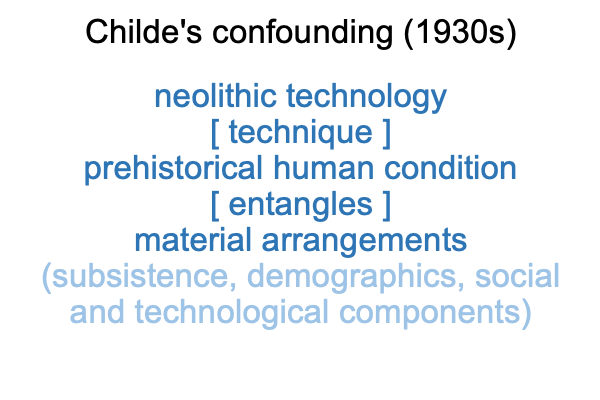
0018 Here is a picture of Childe’s confounding.

0019 The upper three lines presents the neolithic thing.  Neolithic stone-tool technology [substantiates] the prehistoric human condition.  The nature of the [substance] is labeled, “technique”.

The lower two lines presents the entangled matter.  The [entanglement] is difficult to label, because its nature is.. well… a long list of material arrangements.

0020 A list of material arrangements appears in Table 1 of the article.  Even the social components of social mechanism, magico-religious sanctions and trade can be shoved under the rug labeled, “material arrangements”.

0021 As such, the “neolithic” may serve as an adjective to a noun, “revolution”, that appeals to academics sympathetic to Marxist formulations.  Yes, they are the ones who only promote academics with similar sympathies.  Also, Childe was… um… a sympathizer.

The question is not about whether prehistoric folk are “communist” or “fascist”, even though these labels may apply to this or that anthropologist of the 1930s.

The question is whether the Marxist formula applies to prehistoric folk.

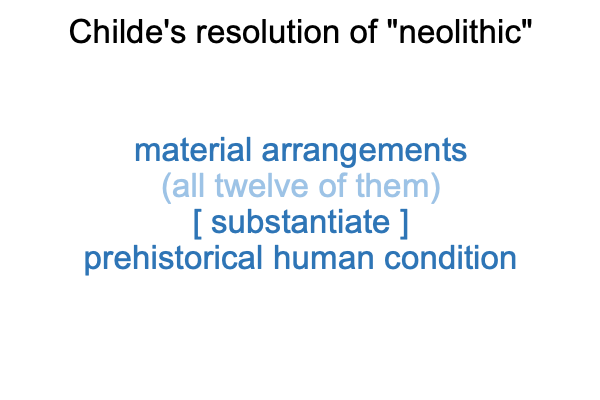
0022 The answer becomes obvious, when Childe’s confounding resolves into the following hylomorphic structure.

0023 The above figure depicts a Marxist version of Aristotle’s hylomorphe, {matter [substantiates] form}.  Childe’s hylomorphe lasts for nine decades (that is, until the present day at the start of 2026).  Man makes himself through a standard Marxist formulation.  Soon, Soviet era archaeologists adopt the stance that the appearance of pottery is a hallmark of neolithic emergence.  Pottery is a material arrangement.  The emergence of the neolithic is a human condition.

01/1/26

Looking at Melinda A. Zeder’s Article (2025) “Unpacking the Neolithic” (Part 4 of 4)

0056 Okay, I will continue drinking my cocktail in the following exposition.

I regard the last two figures, along with the figures that appear in the article under examination.

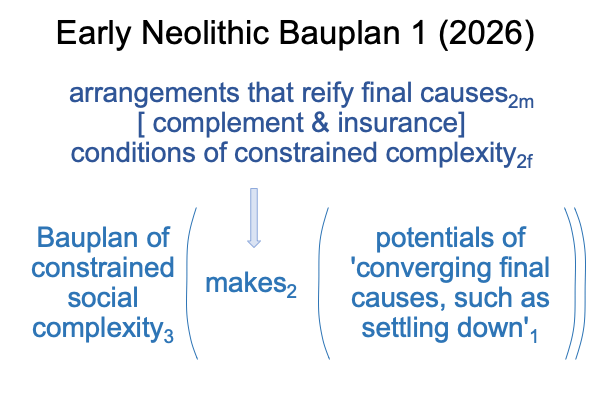
0057 There is something in B that suggests two bauplans3.  Early Neolithic Bauplan 1 marks the terminus of the Lebenswelt that we evolved in.  Late Neolithic Bauplan 2 denotes the start of our current Lebenswelt.

0058 Bauplan 1 looks like this.

The early Neolithic bauplan3 does not permit untrammeled social and labor specializations.  Rather, all social circles2m (family (5), friends (5), teams (15), bands (50), and community (150)) are optimized2f in the pursuit of the final cause of ‘settling down’1.  It is the same way that different organs and organ systems are optimized for ‘settling down’ into an individual.

Details of optimization will be specific to each location (because efficient causes differ), yet produce something ‘general’, that manifests in excavation sites as varied as Catal Hoyuk and Tepe Gobekli.  Domestication includes the local geography, plants and animals.  Domestication may even include settlements more than a day’s walk away.  Domestication may include the heavens.

0059 Once rendered in this manner, the slow, seemingly reversible, spiral into the neolithic thing2 gets depicted as thin dotted horizontal lines along the axes of arrangements versus time.

0060 The late Neolithic bauplan3 permits individual social and labor specializations.  Something significant has changed.  The key final cause of ‘settling down’ remains relevant.  However, another key final cause cannot be ignored.  The optimization of the early Neolithic somehow breaks down and the late Neolithic initiates a search for order1 that continues to this day.

0061 Here is a picture of what Bauplan 2 might look like.

0062 It is as if an individual, having been formed by a bauplan 1 gestation, gets born.

What a rude awakening.

0063 What about the timeline?

If I replace the increasing boldness of the horizontal dotted lines with a slowly rising bauplan 1 slope, and if I depict the most bold horizontal dotted lines as a bauplan 2 phase transition, then I get the following graph.

0064 What does this imply?

Obviously, bauplan 1 ends in a twist, that is, bauplan 2.

I noted this slogan at the start of my examination.

0065 Less obviously, the Neolithic revolution is not in the actuality of {material arrangements [substantiating] the neolithic condition}2

“The Neolithic Revolution” involves a transition from the Lebenswelt that we evolved in to our current Lebenswelt.

0066 Fortunately, for the author, the American Marxist academic candle is about to exhaust itself, just as the Soviet Marxist illumination did decades ago.

Yes, the crisis begins.

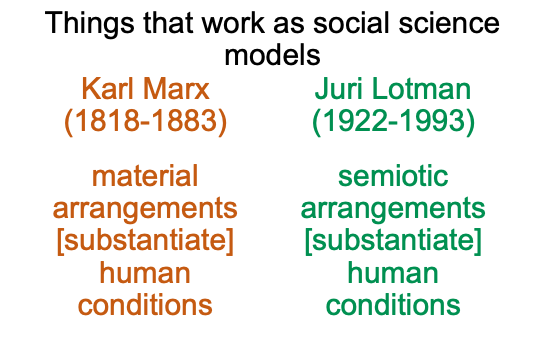
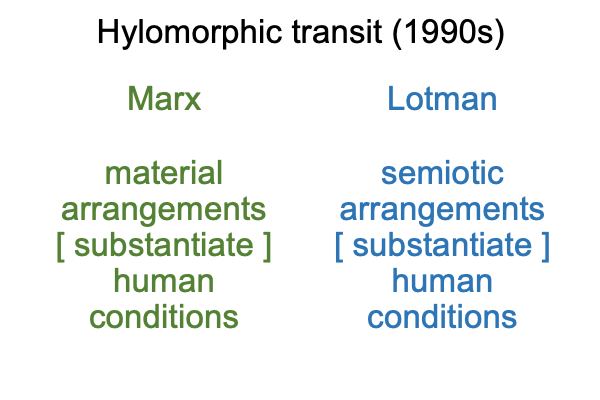
0067 The impending change of cognitive grounds will be at least as great as the following transition from Karl Marx (1818-1883) to Juri Lotman (1922-1993).  This transition goes sigmoidal in 1989.

0068 The following hylomorphic transition is derived in Razie Mah’s blog for December 2025, titled Looking at Igor Pilshchikov and Mikhail Trunin’s Article (2016) “The Tartu-Moscow School of Semiotics”.  

0069 Marx’s actuality2 is supposed to arise from the potential of scientific models1, even though the actuality2 served as doctrine, rather than a mechanical or mathematical formulation.  Remember, Marx’s actuality2 conforms to the structure of Peirce’s secondness.  Secondness is the realm of actuality.  How easy is it to confuse this actuality with the realness of a mechanical or mathematical model?  Yet, they are not the same.

0070 Lotman’s actuality2 arises from the potential of the semiosphere1, the universe of sign-relations.  Semiotic arrangements are not the same as material arrangements.  They are not even close.

0071 So, what am I saying?

The author senses that ‘something’ is coming and she figures out that it must concern a bauplan.

After all, bauplan is a term that is familiar to evolutionary biologists.

0072 Happily, the semiotician, Razie Mah, has already explored human evolution from the point of view of Peirce’s categories.  The human bauplan is an adaptation to the niche (or the potential) of triadic relations.   Plus, human evolution comes with a twist.

Here is a list of works by Razie Mah that pertain to Bauplan 1 and Bauplan 2.

0073 Surely, this is a lot to unpack.  But, that is precisely what Melinda Zeder’s article calls for.

My thanks to the author for publishing this thought piece.

Happy New Year.

11/29/25

Looking at Dennis Venema and Scot McKnight’s Book (2017) “Adam and the Genome” (Part 1 of 22)

0001 This essay comments on a 2017 book by biologist, Dennis Venema, and theologian, Scot McKnight.  The title is Adam and the Genome: Reading Scripture after Genetic Science. The publisher is Brasos Press in Grand Rapids, Michigan.

The book consists of two equal parts.  The geneticist shows that Adam and Eve cannot be a single pair who founded the human species.  The theologian wrestles with how to read Genesis in light of modern archaeology.

0002 My goal is to supplement these arguments in two ways.  I will re-articulate ideas about evolutionary biology using the specialized language of the category-based nested form.  I will present a scientific hypothesis that re-images the Adam and Eve stories as ancient Near Eastern fairy tales.

Perhaps, at the end of these comments, I can declare, “The old historical Adam is dead.  Long live the new historical Adam.”

0003 Before I begin, I attend to some housekeeping items.

‘Words that belong together’ are denoted by single quotes or italics.

Suggested readings include Primer on the Category-Based Nested Form (#1), Primer on Sensible and Social Construction (#2), and the chapter on message in How to Define the Word “Religion”.  These works, by Razie Mah, are available at smashwords and other e-book venues, along with the compilation of this blog, titled, Comments on Dennis Venema and Scot McKnight’s Book (2017) Adam and the Genome.

0004 In order to see where many evangelicals are coming from, consult the September 2010 issue of Perspectives in Science and Christian Faith.  This particular journal of the American Scientific Affiliation presents a snapshot of some of the difficulties posed by the early chapters of Genesis.

0005 The 2017 book, Adam and the Genome: Reading Scripture after Genetic Science, addresses one conundrum with a simple admission: Adam and Eve cannot be the progenitors of all humans, as proposed by Saint Augustine, 1600 years ago.  The admission rebukes Christians striving to locate the primal couple in a genetic bottleneck event between 50 and 150 thousand years ago.

0005 Unfortunately, their solution provides little defense for Christian doctrine. Big government (il)liberals (BGilLs) claim that evolution disproves the second creation story in Genesis, just like the mercantilists, fascists and communists before them.  BGiLs also insist that the Bible is the stuff of myths.

0006 Evangelical communities continue to bleed students.

Why?

Original Sin.

Christians think it describes the human condition.

BGilLs do not.

0007 Christians believe that humans are disoriented.  Jesus provides orientation.  Jesus is the way.

For BGilLs, the human condition is perfectible through a never-ending revolution by an administrative state.  The human condition may be fulfilled by knowing one’s self.  Or, is it – constructing – one’s self?

With Original Sin, we are actors in a theodrama that transcends critical theory.  Indeed, critical theory may typify the corruption of Original Sin.

Without Original Sin, we are foolish players strutting on the world’s stage, full of sound and fury, signifying nothing.  So why not accept the ministrations of a totalitarian government?  Why not construct oneself?

10/4/25

Adam and Eve and Original Sin: The Subject Matters (Part 2 of 2)

AEOS 0011 Yes, there is more.

Here is another online course on the same subject matter.  All parts appear in Razie Mah’s blogs.  Click on the month, then scroll downwards.

0012 These are sample courses.  So, one may pick and choose points and reviews as one pleases.

Plus, there are lots of pictures.  Pictures can be interesting and informative.

How so?

For the most part, the pictures are diagrams of purely relational structures.

0013 What am I selling?

Three online courses that cover the topic of human evolution.  All are offered by Razie Mah.  All are available at smashwords and other e-book venues.  Merely purchase the e-books, print the pdf or read on a tablet.  Each point can be discussed.  The texts are designed to read and discuss.

A Course on the Human Niche contains the masterwork, plus four commentaries.  This course introduces the Lebenswelt that we evolved in.

A Course on An Archaeology of the Fall, contains the masterwork, plus outside reading (Paul’s letter to the Romans and Sura 5).  An instructor’s guide is available.  This course pertains to the hypothesis of the first singularity.

A Course in How To Define the Word “Religion” contains the masterwork, plus 10 primers.  This course concerns our current Lebenswelt, which is not the same as the Lebenswelt that we evolved in.  A “how-to” instruction appears in Razie Mah’s blog in December 2022.

0014 With that said, here is the second online course on this topic.

One: Looking at William Lane Craig’s Book (2021) “In Quest of the Historical Adam”

(September 31-1, 2022, 21 blogs, 120 points)

Two: Looking at John Walton’s Book (2015) “The Lost World of Adam and Eve”

(August 30-1, 2022, 22 blogs, 192 points)

Three: Looking at Andrew Kulokovsky’s Overview (2005) “The Bible and Hermeneutics”

(May 27-16, 2022, 10 blogs, 85 points)

Four: Looking at Carol Hill’s Article (2021) “Original Sin with Respect to Science”

(February 25-7, 2022, 15 blogs, 72 points)

Five: Looking at Roy Clouser’s Article (2021) “… Support of Carol Hill’s Reading…”

(March 8-1, 2022, 6 blogs, 34 points)

Six: Looking at Mark S. Smith’s Book (2019) “The Genesis of Good and Evil”

(January 31-13, 2022, 16 blogs, 100 points)

0015 Total: 90 blogs, 603 points, 10 hours at 1 minute per point.

Maybe, this online course lasts around 2 weeks.

Enjoy this sample and consider purchasing Razie Mah’s online courses.

10/31/22

Looking at Loren Haarsma’s Book (2021) “When Did Sin Begin” (Part 1 of 21)

0001 Loren Haarsma is an old man, a physics professor and a Christian.  As a fellow of the American Science Affiliation, he has lectured on the intersection of science and faith.  He is a scholarly voice in the Biologos network.

The full title of his book is When Did Sin Begin: Human Evolution and The Doctrine of Original Sin (2021, Baker Academic, Grand Rapids, MI).

If one goes to the resources page for the Biologos.org website, then selects the topic, “Bible”, and the subtopic, “Adam and Eve”, one will find an extensive collection of essays on the concerns in Haarsma’s title: timing, evolution and original sin.

0002 How do these concerns fit into a category-based nested form?

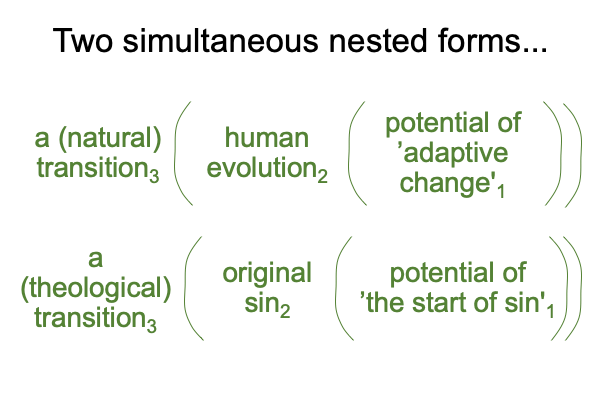
Timing calls forth a normal context3.  The question, “when?”, implies an event.  Here, the event is a transition.  For evolution, the transition is a topic of natural inquiry.  For original sin, the transition is a topic for theologians.

Human evolution and original sin belong to the realm of actuality2.

The only item not mentioned is potential1.  Here, the question mark applies.  For human evolution2, the potential must be adaptive change1.  For original sin2, the potential is the start of sin in our current Lebenswelt1.

0003 To me, these concerns yield two category-based nested forms.

Here is a picture, following the recipe in A Primer on the Category-Based Nested Form.

Figure 01

0004 These two normal contexts exclude one another.

0005 The upper normal context3 associates to evolutionary science.  The focus of attention is on natural history and genetics.

Typically, an adaptive change produces speciation.  However, in human evolution, an adaptive change may be cultural.  Human evolution is both biological and cultural.  Since natural history and genetics do not adequately describe culture, they may not be enough to scientifically describe human evolution.  Indeed, no natural science convincingly addresses cultural change.

0006 The lower normal context3 associates to theological science.  The focus of attention is on special and general revelation.

Special revelation includes Genesis 1-11.  Genesis 1-11 divides into two parts.  In the Primeval History (chapter 2:4-11), Adam is brought to life as the first human, even though um… in the Creation Story (chapter 1-2.3), humans are already intended, created and blessed, in the framework of six days of creation.

General revelation includes Greek philosophy, among other traditions.  Greek philosophy is useful for resolving contradictions.  For example, some theologians resolve the contradiction inherent in the two parts of Genesis 1-11 by claiming that Adam (in Genesis 2.4-4) is the male and female “them” that God intended, created and blessed (in Genesis 1).

Say what?

In the Creation Story, God creates them, male and female.  So, Adam must have had some sort of divided consciousness, one operating in his mind and the other working in his ribs.

Just kidding.

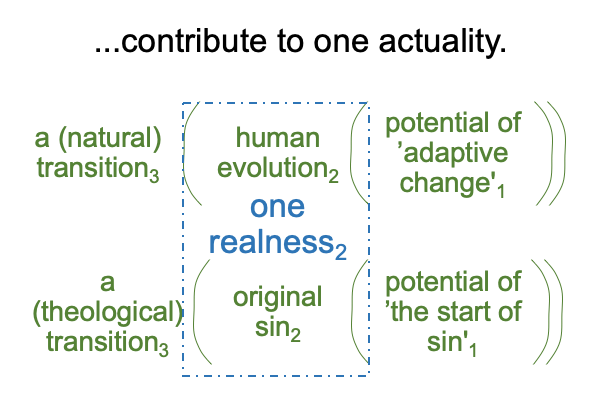
0007 Greek philosophy’s usefulness is not limited to resolving contradictions, no matter how silly the resolution may be.  Greek philosophy may also be used in situations where contradictions cannot be resolved.  Such a situation occurs here. Human evolution2 and original sin2 belong to a single actuality.  They both pertain to one realness2.

Here is a picture.

Figure 02

0008 Two (apparently independent) category-based nested forms intersect in the realm of actuality2.  The two constituting actualities cannot escape the one realness, because they constitute the one realness.  Certain contradictions are accidental. Certain contradictions are essential.  Greek philosophy is useful for separating the accidental from the essential.  A set of essential contradictions is called “a mystery”.

09/30/22

Looking at William Lane Craig’s Book (2021) “In Quest of the Historical Adam” (Part 1 of 21)

0001 William Lane Craig publishes a work of erudition, titled, In Quest of the Historical Adam: A Biblical and Scientific Exploration (Wm. B. Eerdman’s Publishing, Grand Rapids, MI, ISBN 978-0-8028-79911-0).  The bibliography contains over 250 references.  

Part One discusses what is at stake.

Part Two covers the Biblical “data” concerning Adam and runs 210 pages.

Part Three covers scientific evidence about the start of humanity (broadly defined) and runs 117 pages.

0002 Overall, the first two-thirds of the book discusses the importance of the historical Adam and explores what types of stories are contained in Genesis 2.4-11.  Then, the final one-third addresses the question, “If humanity descends from a single couple, then where would we locate that couple in the scientific story of human evolution?”

0003 Clearly, this professor would have been assisted by glancing at the masterworks in the Razie Mah series, The Human NicheAn Archaeology of the Fall and How To Define the Word “Religion”, available at smashwords and other electronic book venues.

0004 Why?

Every sentence in this book is well composed and carefully reasoned.  But, Craig’s quest ends at a location that is anything but.  He writes (more or less), “Adam may be plausibly identified as a member of Homo heidelbergensis, living 750,000 years ago.”

The quest ends where the book should have started.

Then, the title could have been, “What if Adam and Eve are really the first humans?”

What if, indeed.

0006 Craig’s argument presumes, all along, that Adam and Eve are the first humans.

In this examination, I do not neglect the opposing question, “What if they are not?”

09/1/22

Looking at William Lane Craig’s Book (2021) “In Quest of the Historical Adam” (Part 21 of 21)

0112 This is the last blog concerning this particular book.  I post this blog first, because WordPress places the latest blog closest to the top for each month.  Chronologically, the first blog in a series appears last on the month’s list and the last blog eventually appears first.  There is a certain logic to this, which I appreciate and adjust my posts accordingly.  My goal is to limit my examinations to one-month duration.

0113 I summarize.

0114 First, Part Three of Craig’s book associates to Genesis 1:26, the intention of man.  The time frame corresponds to the period after the domestication of fire and before the speciation of anatomically modern humans.  Our religious sensibilities evolve during this period, as discussed in the e-masterwork, The Human Niche.

0115 Second, Part Two of Craig’s book attempts to define Genesis 2:4-11 as mytho-history.  The attempt turns Craig’s definition into an inquiry concerning the first singularity.  The first singularity associates to the start of the Ubaid culture of southern Mesopotamia.  The hypothesis of the first singularity explains why our current Lebenswelt is not the same as the Lebenswelt that we evolved in.  The consequences of the first singularity are captured by the stories of Adam and Eve.  This is a theme in the e-masterwork, An Archaeology of the Fall, by Razie Mah, available at smashwords and other e-book venues.

0116 Third, Part One of Craig’s book sets a path to a category-based nested form, defining3 the stories of Adam and Eve2as emerging from (and situating) Jewish covenantal history (meaning1), the ancient Near East and Genesis 1-11 (presence1), and the notion that Adam originates humanity’s tragic flaw (message1).  The categorical structure of definition is introduced in the e-masterwork, How to Define the Word “Religion”.

0117 Fourth, Part One presents ten family resemblances characterizing the term, “myth”.  These family resemblances associate to all the elements in a three-tier interscope.  The interscope is a relational structure, presented in the e-work, A Primer on Sensible and Social Construction.

0118 Fifth, Part Two fills in the interscope of myth with the ten family resemblances, leading to an understanding that Genesis 2:4-11 and the origin stories of the ancient Near East pertain to the same prehistoric events and processes, occurring during the Ubaid, the Uruk and the Sumerian Dynastic archaeological periods.

0119 Sixth, Part Three fails to capitalize on the fact that both the Genesis Primeval History and the origin stories of the ancient Near East portray a recent creation of humanity.  This failure follows a lacuna in the modern discipline of Anthropology, which does not envision that our current Lebenswelt is not the Lebenswelt that we evolved in.

Why does modern Anthropology not register the first singularity?

Modern Anthropology self-identifies as science.  Modern Anthropology belongs to the waning Age of Ideas.  

The hypothesis of the first singularity belongs to the dawning Age of Triadic Relations.  Peirce’s philosophy opens a new, semiotic consciousness.  That consciousness calls for a postmodern Anthropology radically different from what modern intellectuals call “postmodern”.

0120 My thanks to William Lane Craig, for demonstrating the beauty of good English prose, even while missing the mark in his quest for the historical Adam.

08/30/22

Looking at John Walton’s Book (2015) “The Lost World of Adam and Eve” (Part 1 of 22)

0001 In this series of blogs, I examine John H. Walton’s book, The Lost World of Adam and Eve: Genesis 2-3 and the Human Origins Debate, published in 2015 by Intervarsity Press.  John Walton is a Professor of the Old Testament and has published other commentaries.

0002 I examine this book from the point of views of (A) natural philosophy and (B) the hypothesis of the first singularity.

0003 From the first point of view (A), what Walton calls, “archetypal”, may also be construed as “noumenal”, as opposed to “phenomenal”.   According to Comments on Jacques Maritain’s Book (1935) Natural Philosophy, modern science construes each thing as a noumenon and its phenomena.  A noumenon is the thing itself.   Phenomena are its observable and measurable facets.  Science models phenomena.  Science cannot address the noumenon, the thing itself.

0004 So, how we recognize noumena, things themselves?

Noumena are the subject of philosophical inquiry.  Aristotle’s hylomorphe is the first step in philosophical inquiry.  We perceive the thing itself, directly, as a dyadic relation containing two contiguous real elements.  Aristotle calls the two real elements, matter and form.

What about the contiguity?

The contiguity will be placed in brackets.

I will use another one of Aristotle’s terms for the contiguity.  The term has been the subject of a lot of wooly thinking.  So, the choice is rich, in more ways than one.

0005 According to Charles Peirce, the category of secondness, the realm of actuality, consists in two contiguous real elements.

According to Aristotle, the hylomorphe is (basically) matter [substantiates] form.  The verb, “substantiates”, is the same as the noun, “substance”.

Here is a picture.

Figure 01

0006 Human recognition of hylomorphes is immediate and intuitively natural.

Why?

We evolved to recognize noumena, things themselves.

This is how the ancient world thinks.  Greek philosophers ask, “Why are there things instead of nothing?”  The answer ends up with Aristotle’s proposal.  The hylomorphe is the portal to natural philosophy.  Natural philosophy considers things in themselves.

0007  Today, science-lovers fixate on phenomena, such as the observable and measurable aspects of a thing, called “original sin”.  Then, they they build models for how Adam could be the direct cause of this thing.

In contrast, Walton argues that the civilizations of the ancient Near East look at this issue from the noumenal side.  Adam is contiguous with what is wrong with the world.  Paul wrestles with this hylomorphe in his famous letters to the Corinthians and the Romans.

Figure 02

0008 From the second point of view (B), Walton’s propositions appear more and more like a noumenon whose phenomena yield a novel scientific hypothesis.  This novel hypothesis is formally proposed in the masterwork, An Archaeology of the Fall, available at smashwords and other e-book venues.

In 2015, John Walton and his collaborator, N.T. Wright, are not aware of this novelty.  The hypothesis of the first singularity changes everything.

0009 In the conclusion, Walton states that his book demonstrates that Genesis 1 is concerned with God’s ordering of a grand sacred space with the goal of coming into relation with us.  Genesis 2.4 starts with God planting humans within a sacred space, within the grand sacred space, only to find that we bite.  We bite into the fruit of the tree of the knowledge of good and evil.  Isn’t that smart?

0010 We deceive ourselves.

We introduce chaos into God’s order.

Oh, I meant to say, it is Adam’s fault.

0011 Weirdly, this sounds a lot like all the other origin stories of the ancient Near East, especially the ones recovered by archaeologists from royal libraries that burnt to the ground thousands of years ago.  Cuneiform clay tablets fire into brick.  The bricks retain their integrity even when buried by detritus. Then, they are excavated by modern archaeologists.  Then, archaeologists miraculously find a way to read the script.

0012 Walton has the advantage of these archaeological discoveries.  Walton has the advantage of new scholarship on Paul and the Jewish civilization during the Second Temple Period.  Yet, he writes in the twilight of the Age of Ideas.

0013 This examination brings his propositions into the dawning Age of Triadic Relations.

Walton sets forth 21 propositions.To these, I attend.