01/1/26

Looking at Melinda A. Zeder’s Article (2025) “Unpacking the Neolithic” (Part 1 of 4)

0001 If I may present my conclusion at the beginning, “I suggest the following motto: First the bauplan, then the twist.”

0002 The full title of the essay under examination is “Unpacking the Neolithic: Assessing the Relevance of the Neolithic Construct in Light of Recent Research”.  The article appears in the Journal of World Prehistory (2025) in volume 38:11, pages 1-58 (https://doi.org/10.1007/s10963-025-09198-0).  The author is affiliated with the Department of Anthropology, National Museum of Natural History, Smithsonian Institution in Washington D.C.

0003 The author’s argument follows the Greek tradition of (A) setting out prior propositions, (B) adding further information and assessments and (C) proposing one’s own solution.

Prior propositions (A) are covered in the section titled, “The Origin of the Term ‘Neolithic'”.

Further information (B) includes sections on neolithic emergences in southwest Asia and other regions, including China, Japan, eastern north America, Mesoamerica and the northwest America.

The author’s proposal (C) appears in a section titled, “Repackaging the Neolithic”.

0004 I examine each movement in the sequence A, C then B.

0005 In regards to the historical origin of the term, “neolithic” (A), the word appears in the 1850s in the context of prehistoric lithic technology.  A distinction between old “paleolithic” and new “neolithic” tools reflects a fairly recent change in the human condition.  The Paleolithic extends very far back into the evolution of the Homo genus.  The Neolithic is fairly new and applies only to Homo sapiens.  By “new”, I mean, say, starting less that 20,000 years ago.

0006 As it turns out, stone tools and fossilized bones are the most recoverable items from the distant past.  So, the idea that our kind evolves will of course rely of this type of data.  The implications are significant.  If lithic technologies are like matter, then the archaeologist may speculate on forms of prehistorical human (or “hominid” or “hominin”) conditions.

0007 For example, the earliest paleolithic stone tools are labeled “Oldowan”. These tools can be made on the fly.   If I strike one rock with another, I can fracture off a shard and expose a sharp edge.  Of course, one must choose the right rocks for this trick.  Plus, technique is important.

Later stone tools are labeled “Acheulean”.  These stone tools are made ahead of time, by the same technique of hammering off shards to reveal an intended form that… somehow… is intrinsic to the original rock.

0008 So, what am I suggesting?

Is the actuality of matter and form intrinsic to rocks, and ancestral hominins learn to tamper with one real element (matter) in order to sculpt the other real element (form)?

0009 I am suggesting more than that.

Aristotle’s hylomorphe (hylo = matter, morphe = form) is an exemplar of Peirce’s category of secondness.  Secondness consists of (at least) two contiguous real elements.  For paleolithic hominins, a rock (matter) could be sculpted into a stone tool (form).  From the point of view of the archaeologist, the hylomorphic structure still applies.  The question is, “How?”

Paleolithic stone-tool technology “sculpts” prehistorical human conditions.

0010 Of course, the word, “sculpts”, serves as an aesthetic metaphor for the contiguity between paleolithic technology as matter and hominin conditions as form.
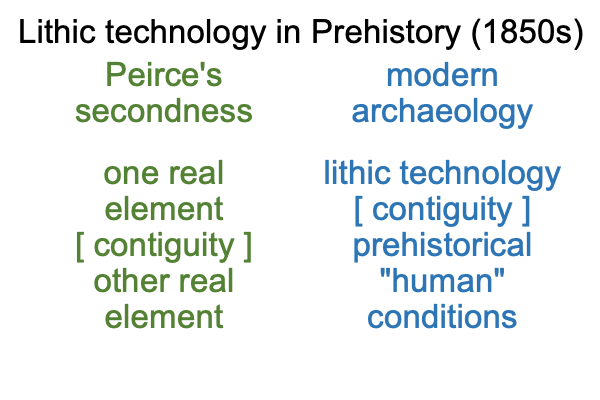
0011 The challenge for nineteenth-century anthropology is clear.  Propose a better, more scientific, or at least, less metaphysical, label for the contiguity.

With only geological strata, stone tools and fossilized bones as evidence, proposals were necessarily speculative.  But, archaeologists continued digging, and by the 1850s could make the distinction between paleolithic and neolithic.  Also, they figured out a reason for why the advance from Oldowan to Acheulean stone tools “sculpted” more advanced hominin conditions.  Man was making himself.

0012 What do these evidential and rational developments suggest?

For a Peircean, secondness is the dyadic realm of actuality.  Secondness is only one of Peirce’s three categories.  The other two are thirdness (the triadic realm of normal contexts, judgments, signs, mediations and so forth) and firstness (the monadic realm of possibility).

Each of these categories manifests its own logic.  Also, each higher numbered category prescinds from the adjacent lower category.  Thirdness prescinds from secondness.  Secondness prescinds from firstness.  Prescission allows the articulation of the category-based nested form, as described in Razie Mah’ e-book, A Primer on the Category-Based Nested Form.

0013 Thirdness bring secondness into relation with firstness.

A triadic normal context3 brings a dyadic actuality2 into relation with the possibility of ‘something’1.

0014 Now I can slide the above dyad into the slot for actuality2 for the category-based nested form intimated by the title of V. Gordon Childe’s 1936 book, Man Makes Himself.
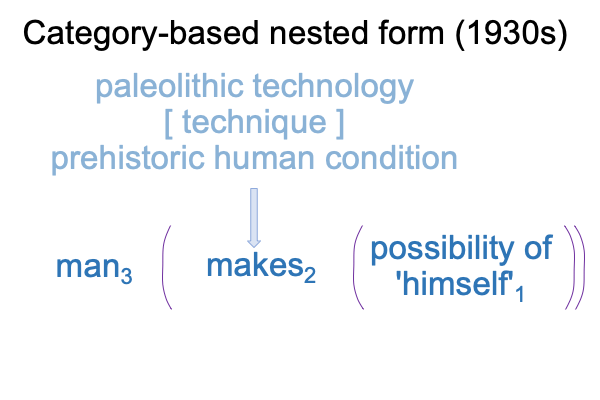
0015 The slide clarifies the contiguity, paleolithic technology constellates a substance, which I label, “technique”, that manifests an essence for the conditions of evolving hominins (that is, a substantiated form).

Consequently, the appearance of a new stone tool technology indicates a change in techniques as well as a change in the essence of the prehistoric human condition.

0016 According to Childe (1892-1957), the “neolithic” label encompassed more than a change in lithic technology.  The prehistoric human condition gets entangled with all sorts of other matters, including sedentary communities, economies of delayed returns, various modes of storage and so forth.  A long list of material arrangements gets entangled.

0017 As it turns out, once matter substantiates form, then form can entangle other matter, which is a confounding.  Here, “confounding” is a technical term, precisely labeling one form originating from one matter and entangling another matter.

Historically, a confounding is an idea that belongs to Aristotle’s tradition.  It is stumbled upon long after Aristotle’s campus went out of business.  It is the brainchild of the Byzantine and Slavic civilizations.

0018 Here is a picture of Childe’s confounding.
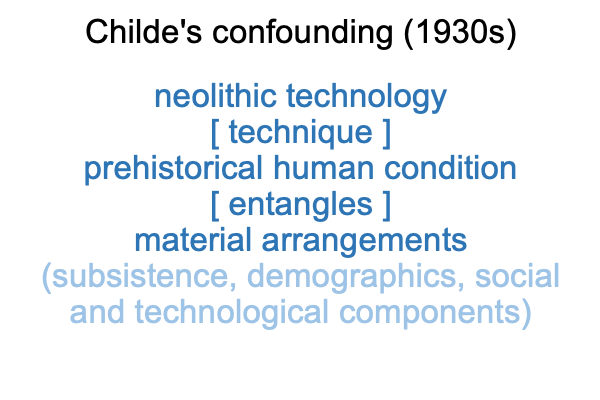
0019 The upper three lines presents the neolithic thing.  Neolithic stone-tool technology [substantiates] the prehistoric human condition.  The nature of the [substance] is labeled, “technique”.

The lower two lines presents the entangled matter.  The [entanglement] is difficult to label, because its nature is.. well… a long list of material arrangements.

0020 A list of material arrangements appears in Table 1 of the article.  Even the social components of social mechanism, magico-religious sanctions and trade can be shoved under the rug labeled, “material arrangements”.

0021 As such, the “neolithic” may serve as an adjective to a noun, “revolution”, that appeals to academics sympathetic to Marxist formulations.  Yes, they are the ones who only promote academics with similar sympathies.  Also, Childe was… um… a sympathizer.

The question is not about whether prehistoric folk are “communist” or “fascist”, even though these labels may apply to this or that anthropologist of the 1930s.

The question is whether the Marxist formula applies to prehistoric folk.

0022 The answer becomes obvious, when Childe’s confounding resolves into the following hylomorphic structure.
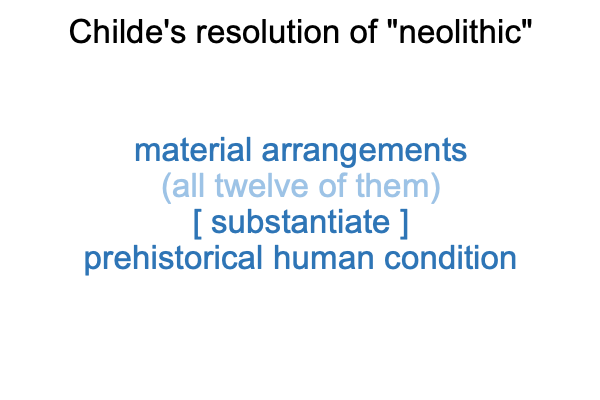
0023 The above figure depicts a Marxist version of Aristotle’s hylomorphe, {matter [substantiates] form}.  Childe’s hylomorphe lasts for nine decades (that is, until the present day at the start of 2026).  Man makes himself through a standard Marxist formulation.  Soon, Soviet era archaeologists adopt the stance that the appearance of pottery is a hallmark of neolithic emergence.  Pottery is a material arrangement.  The emergence of the neolithic is a human condition.
01/1/26

Looking at Melinda A. Zeder’s Article (2025) “Unpacking the Neolithic” (Part 4 of 4)

0056 Okay, I will continue drinking my cocktail in the following exposition.

I regard the last two figures, along with the figures that appear in the article under examination.

0057 There is something in B that suggests two bauplans3.  Early Neolithic Bauplan 1 marks the terminus of the Lebenswelt that we evolved in.  Late Neolithic Bauplan 2 denotes the start of our current Lebenswelt.

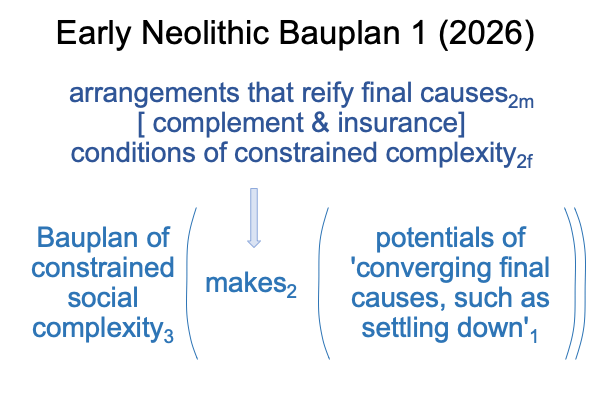
0058 Bauplan 1 looks like this.

The early Neolithic bauplan3 does not permit untrammeled social and labor specializations.  Rather, all social circles2m (family (5), friends (5), teams (15), bands (50), and community (150)) are optimized2f in the pursuit of the final cause of ‘settling down’1.  It is the same way that different organs and organ systems are optimized for ‘settling down’ into an individual.

Details of optimization will be specific to each location (because efficient causes differ), yet produce something ‘general’, that manifests in excavation sites as varied as Catal Hoyuk and Tepe Gobekli.  Domestication includes the local geography, plants and animals.  Domestication may even include settlements more than a day’s walk away.  Domestication may include the heavens.

0059 Once rendered in this manner, the slow, seemingly reversible, spiral into the neolithic thing2 gets depicted as thin dotted horizontal lines along the axes of arrangements versus time.

0060 The late Neolithic bauplan3 permits individual social and labor specializations.  Something significant has changed.  The key final cause of ‘settling down’ remains relevant.  However, another key final cause cannot be ignored.  The optimization of the early Neolithic somehow breaks down and the late Neolithic initiates a search for order1 that continues to this day.

0061 Here is a picture of what Bauplan 2 might look like.

0062 It is as if an individual, having been formed by a bauplan 1 gestation, gets born.

What a rude awakening.

0063 What about the timeline?

If I replace the increasing boldness of the horizontal dotted lines with a slowly rising bauplan 1 slope, and if I depict the most bold horizontal dotted lines as a bauplan 2 phase transition, then I get the following graph.

0064 What does this imply?

Obviously, bauplan 1 ends in a twist, that is, bauplan 2.

I noted this slogan at the start of my examination.

0065 Less obviously, the Neolithic revolution is not in the actuality of {material arrangements [substantiating] the neolithic condition}2

“The Neolithic Revolution” involves a transition from the Lebenswelt that we evolved in to our current Lebenswelt.

0066 Fortunately, for the author, the American Marxist academic candle is about to exhaust itself, just as the Soviet Marxist illumination did decades ago.

Yes, the crisis begins.

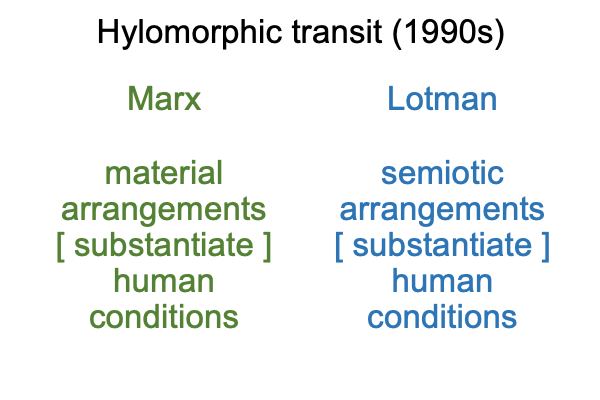
0067 The impending change of cognitive grounds will be at least as great as the following transition from Karl Marx (1818-1883) to Juri Lotman (1922-1993).  This transition goes sigmoidal in 1989.

0068 The following hylomorphic transition is derived in Razie Mah’s blog for December 2025, titled Looking at Igor Pilshchikov and Mikhail Trunin’s Article (2016) “The Tartu-Moscow School of Semiotics”.  

0069 Marx’s actuality2 is supposed to arise from the potential of scientific models1, even though the actuality2 served as doctrine, rather than a mechanical or mathematical formulation.  Remember, Marx’s actuality2 conforms to the structure of Peirce’s secondness.  Secondness is the realm of actuality.  How easy is it to confuse this actuality with the realness of a mechanical or mathematical model?  Yet, they are not the same.

0070 Lotman’s actuality2 arises from the potential of the semiosphere1, the universe of sign-relations.  Semiotic arrangements are not the same as material arrangements.  They are not even close.

0071 So, what am I saying?

The author senses that ‘something’ is coming and she figures out that it must concern a bauplan.

After all, bauplan is a term that is familiar to evolutionary biologists.

0072 Happily, the semiotician, Razie Mah, has already explored human evolution from the point of view of Peirce’s categories.  The human bauplan is an adaptation to the niche (or the potential) of triadic relations.   Plus, human evolution comes with a twist.

Here is a list of works by Razie Mah that pertain to Bauplan 1 and Bauplan 2.

0073 Surely, this is a lot to unpack.  But, that is precisely what Melinda Zeder’s article calls for.

My thanks to the author for publishing this thought piece.

Happy New Year.

08/30/25

Looking at Slavoj Zizek’s Book (2024) “Christian Atheism” (Part 1 of 33)

0001 The book before me is a paperback, published in 2024 by Bloomsbury Academia (London, Dublin, New York) with the subtitle: How to Be a Real Materialist.  The author, Slavoj Zizek, is one of the most entertaining intellectuals on the circuit for the contemporary left.

The inner panel of the cover claims that this book is Zizek’s most extensive treatment of theology and religion to date.

This is enough to inspire me to test out Zizek’s analytic expertise.

Surely, Zizek offers food for thought.

0002 In order to pluck the… um… fruit from Zizek’s tree of knowledge, one should proceed to the final chapter, titled, “Conclusion: The Need for Psychoanalysis” (pages 235-266).  I know that that sounds like cheating, but a more extensive examination of the remainder of the book is promised.

0003 What does the label “Christian atheism” imply?

First, when the Son dies on the cross, the Father dies as well.

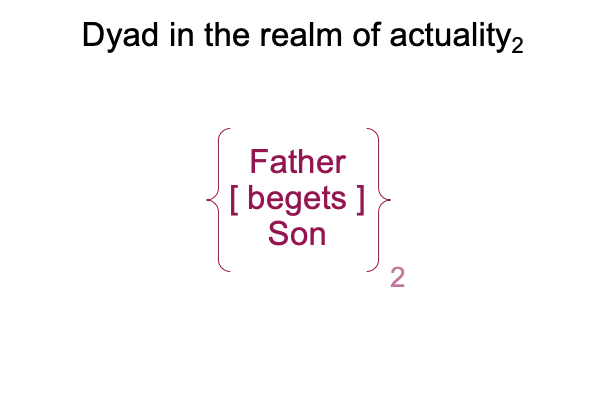
If I frame the relation of Father [and] Son as a hylomorphe, a dyad consisting of two contiguous real elements, the two real elements are Father and Son and the contiguity, placed in brackets for proper notation, should be something like [begets].  Here is the resulting hylomorphic structure.

0004 This actuality… er… hylomorphe… is typical for Peirce’s category of secondness.  Secondness consists of two contiguous real elements, as discussed in A Primer on the Category-Based Nested Form, by Razie Mah, available at smashwords and other e-book venues.

Secondness is the dyadic realm of actuality.  Secondness prescinds from firstness, the monadic realm of possibility.  Thirdness, the triadic realm of normal contexts, signs, mediations, judgments and so on, channels this precission.  Thirdness brings secondness into relation with firstness.   Such is the nature of the category-based nested form.

0005 So what happens when the Father, the thesis of the Old Testament, begets His Son, Jesus, his antithesis in the New Testament?  Well, the good book tells the stories.  Jesus ends up dying on a cross after crying out, “Father, why have you abandoned me?”

Surely, this is a psychic trauma that Lacanian psychoanalysis might be interested in.  But above, there is only the divine actuality2.  Actuality2 is encountered, it is not understood.  In order to understand an encountered actuality2, one needs to figure out a normal context3 and potential1.  The category-based nested form has all the ingredients for understanding (that is, all three categories get labeled and constitute a single triadic relation).

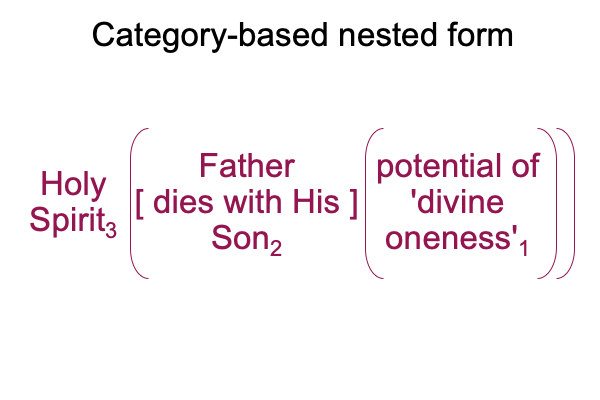
0006 Zizek says that, when the Son dies, so does the Father.

Here is a picture of this actuality2, along with my guesses concerning the normal context3 and potential1.

0007 The normal context of the Holy Spirit3 brings the dyadic actuality of {the Father [dies with His] Son}2 into relation with the monadic possibility of ‘divine oneness’1that some Christians want to call “Love”.  But, Muslims seem to call, “Allah”.

Even though Zizek is well-trained in Lacan’s psychoanalysis, he is also versed in Hegel’s philosophy and Marx’s materialism.  So, he notes that after Jesus dies… and the Father dies too… Christ becomes the Holy Spirit, as a new emancipatory collective (page 242).  Well, he calls the Holy Spirit, “the Holy Ghost”, so it makes sense that Jesus would be the Ghost instead of His Father, if that helps.

0008 So who or what is this emancipatory collective?

Uh oh, is it the so-called “bride of Christ”?

0009 The actuality of Father [begets] Son2 associates to an encounter in the Real.

How real?  

0010 On one hand, Protestants make the point that the Old and the New Testaments are more real than the Catholic church.  But, there is a distinction between an encounter (actuality2) and understanding (a complete category-based nested form).  Surely, the Old and New Testaments witness encounters.  I wonder whether the Protestants can pass to understanding. There are questions about the words.  What do the words in the text signify?

Zizek takes the words literally when he says that Jesus, the Christ, becomes the Holy Ghost.  But, there is a lacunae, because the Holy Spirit3 is the one who speaks from the cloud above the soon-to-be severed head of John the Baptist.  There, in the Jordan River, the king of kings is baptized.  The Holy Spirit3 is already present as a purely relational being, the normal context for the actuality of {Father [and] Son}2.

0011 The Catholic church, on the other hand, codifies one particular encounter, the Eucharistic sacrament (otherwise called “the Mass”).  Yes, Catholics can join in the potential of divine oneness1 through this sacrament2, which celebrates the simultaneous death of the Son and Father.

“Father, forgive them, for they know not what they do.” applies to the Father as well as all humanity.  Just as elites of Roman Guard and Second Temple are monsters for murdering Christ under the pretext of their laws, the Father is a monster for offering his own Son as a sacrifice.  During the Mass, we humans remind ourselves of our own culpabilities and the Father, too, reminds Himself of His own, by transubstantiating the consecrated bread and wine into the Body and Blood of Christ.  Yes, the Father brings Jesus back to life, at the Resurrection and the consecration.

0012 The Mass is far more twisted than most theologians will admit.  But, a Lacanian can concede the deal.  The Father allows us into mystical union through the Son while saying, “If you eat of my monstrosity, I will accept your monstrosities.”

Of course, some qualifications apply.

That is what the sacrament of confession is for.

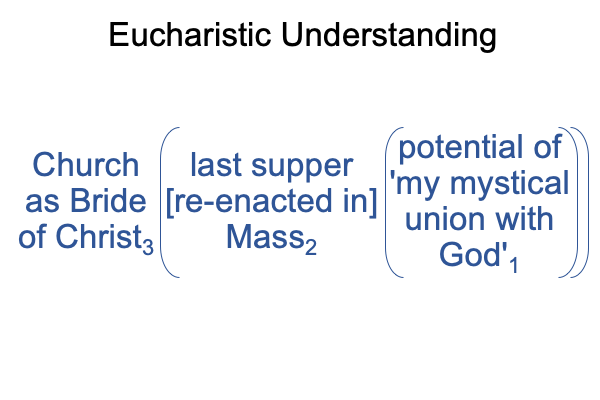
Here is a picture for the emancipated collective that associates to the Holy Ghost.

The triadic normal context of the church, as the Bride of Christ3, brings the dyadic actuality of {Jesus’ last supper [re-enacted in] the Mass}2 into relation with the potential of ‘my (human) mystical union with God’1.  The sacraments are mediators between human and divine.

0013 Well, this is not precisely what Zizek has in mind.

Zizek mentions the Holy Ghost in light of Freud’s death drive.  Freud uses the term, “death drive”, to label repetition disorders that basically say, “I am still alive.”  Or maybe, “If I keep doing this, I will not die.”

It’s like the fellow who loves fishing, encounters a massive illness that almost kills him, then returns to fishing.  I am still alive.  The death drive creatively sublimates the trauma.  Fishing becomes an obsession.  Fishing borders on the sublime.  The fish that struggles against the line is a symbol.  The life that the fish fights for is imaginary, because all of us are mortal.  But, one never knows until death arrives.  The death drive continues to repeat until we have reached the destination.

0014 So, what precisely does Zizek have in mind?

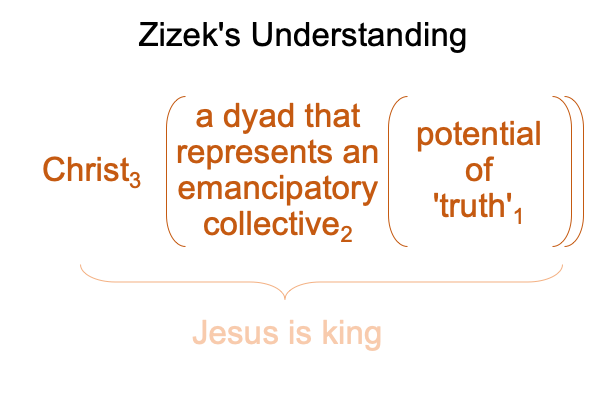
Well, I suppose that Zizek wants to capitalize on the idea of the Holy Spirit as an “emancipated collective” for his socialist theory.  Does Zizek buy into the hocus-pocus of the Catholic church as the Bride of Christ3?  Or, does he want to make Christ2, who belongs to the category of secondness, into a figure3, belonging to the category of thirdness, that operates on the potential of ‘truth’1?

0015 Zizek’s configuration is corroborated at the very end of the chapter (page 265) when he comments on a 1918 poem, titled “Twelve”, by Aleksandr Blok.  At the end of this poem, an apparition of Jesus walks before a team of twelve Red Guards, patrolling the snow-filled streets of revolutionary Petrograd.  Christ is not a leader2 (in the realm of actuality2), Christ3 is a shadow who contextualizes the actuality of a group of comrades2 who, in turn, both emerge from (and situate) their Cause1 (the potential of truth1).

So, I wonder, what type of king is this?

Does the kingdom of God dwell among us in such a strange and mysterious manner?