04/30/26

Looking at John H. Walton’s Book (2025) “New Explorations in the Lost World of Genesis”  (Part 1 of 20)

0001 The book before me is published by Intervarsity Press.  The subtitle is “Advances in the Origins Debate”.  This work is the latest in the “Lost World Series” that delves into how Genesis should be regarded in light of the archaeological discoveries of the past three centuries.

Of course, “new explorations” implies “advances”.  Advances adjust previous positions.  The reader is advised to consult the conclusion immediately after the introduction, and before the section on methodology.

An examination of a prior work can be found in Looking at John Walton’s Book (2015) “The Lost World of Adam and Eve” appearing in Razie Mah’s blog in August 2022.  The review is updated and fashioned as the first and fifth chapters in Razie Mah’s 2024 e-book, Exercises In Artistic Concordism, available at smashwords and other e-book venues.

0002 The term, “literature of the ancient Near East” is somewhat awkward, because the writings of the ancient Near East were buried in the ruins of royal libraries throughout Egypt and the Levant.  The writings are in cuneiform, wedge impressions on clay tablets.  The clay fires into brick when the royal library burns, along with the rest of the royal city.  Then, the ruins get buried in vegetation, and later human settlements, and so on.  Then, the tells (or hills) are excavated by modern archaeologists.  Archaeologists discover thousands of cuneiform tablets and learn how to translate them.  These translations constitute “the literature of the ancient Near East”.

0003 Of course, this story sounds implausible.

However, God tends to manifest the implausible.

0004 In fact, if God only performs sensible… what is the correct term?… “interventions”, then no one would notice.  If anyone could turn water into wine, then the miracle at Cana would be ho-hum.

The Uruk culture invents writing by impressing tokens onto the surface of clay balls (which then contain the impressed tokens).  That seems sensible.  Centuries later, a Sumerians scribe uses a reed stylus to create impressions on a clay surface that is curved, like the surface of a ball.  That seems sensible, also.  Then, stylus impressions on a clay tablet become so routine that cuneiform is used for centuries to record transactions and inventories.  Eventually, the same writing is used to record the civilization’s origin myths.

0005 Okay, each of these steps is sensible, although unlikely.

How many unlikely, yet sensible, developments can be strung together before the results may be declared “miraculous”?

0006 So, what is miraculous with respect to Walton’s lost-world propositions?

God provides eighteen centuries of biblical interpretation by Christians before creating the conditions where a challenge to traditional reference and affirmation occurs.

The archaeology of the ancient Near East unearths literature that is (more or less) contemporaneous with the Old Testament.

That is the challenge.

0007 The Old and New Testaments are no longer subject to plain reading as the sole foundation of interpretation.

Why?

How can one conduct an honest reading of the Old and New Testaments and not accommodate the literature of the ancient Near East?

0008 Okay, replace the word, “honest”, with the word, “literal”.

It seems that figurative and allegorical readings are not challenged.

04/8/26

Looking at John H. Walton’s Book (2025) “New Explorations in the Lost World of Genesis”  (Part 20 of 20)

0218 Chapters seven and eight cover the Fall and God’s pronouncements in Genesis 3.

These are more results of Walton’s scientific explorations.

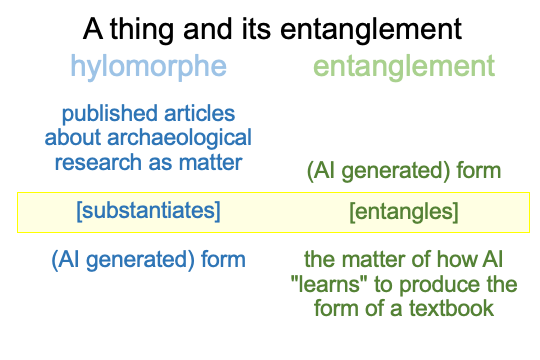
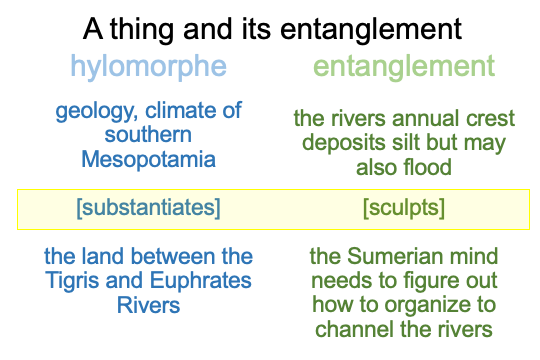
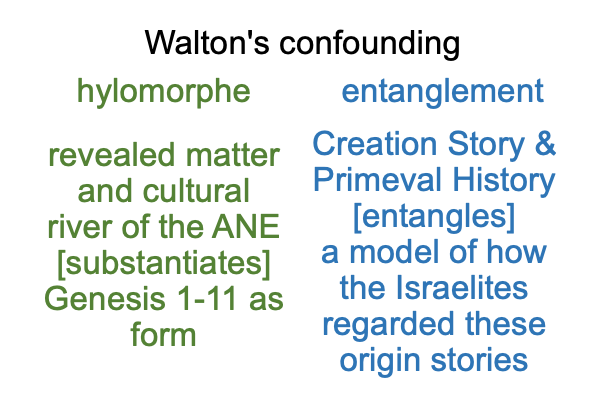
I leave the application of hylomorphe, entanglement, confounding and resolution to the reader.

0219 Recall, a scientific paper contains five elements: introduction, methodology, results, discussion and conclusion.

So does Walton’s book.

0220 Chapter nine offers a discussion on Genesis and science.

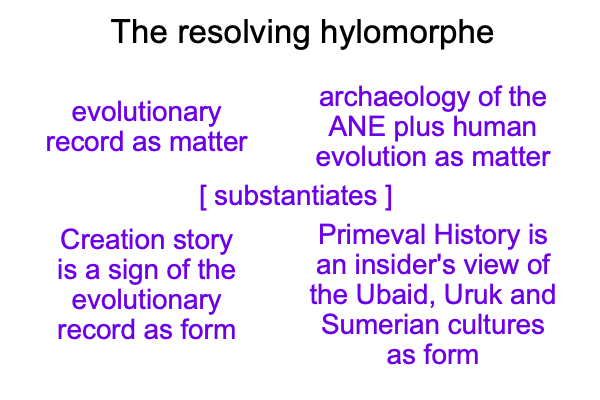
At no point in the discussion does Dr. Walton touch base with the following hylomorphes.

0221 In regards to the Creation Story, Razie Mah’s Looking at Hugh Ross’s Book (2023) “Rescuing Inerrancy” reviews what Walton is trying to avoid.  Walton imagines that the entanglement of a moderate or an artistic concordism will turn out to be… um… dangerous.

Didn’t I say that confoundings are dangerous?

Hugh Ross’s version of moderate concordism cannot rescue the doctrine of biblical inerrancy, because it offers only a miraculous coincidence between what the Genesis text for each day appears to be describing and a corresponding evolutionary epoch.

Razie Mah’s version of artistic concordism changes the character of the doctrine of biblical inerrancy, because it offers a method for showing that each Genesis day offers natural signs of a corresponding epoch.  There are three types of natural signs: icons, indexes and symbols.

0222 If the Bible is supposed to be plainly read, then why would an author write the Creation Story as a vision that depicts the evolution of the Earth on the basis of natural signs?  The author could not possibly had known the natural history of the Earth, unless having been presented with a series of visions.  The text breaks down into natural signsbundled for each day, as images, indicators and symbols.

0223 It is enough to make John H. Walton swoon.

There is no way that Genesis 1-11 can entangle the modern… now… postmodern age.

There is no way… except… for… that ever-churning Christian imagination.

See Razie Mah’s e-book, Exercises in Artistic Concordism.

0224 In regards to the Primeval History, all the written origin stories of the ANE (except for the Creation Story) depict a recent creation of humans, by newly differentiated gods, according to their designs and purposes.

The question is, “Why?”

The civilizations of the ANE cannot see past a theoretical time point corresponding to the start of the Ubaid archaeological period in southern Mesopotamia.  They cannot see from our current Lebenswelt into the Lebenswelt that we evolved in.

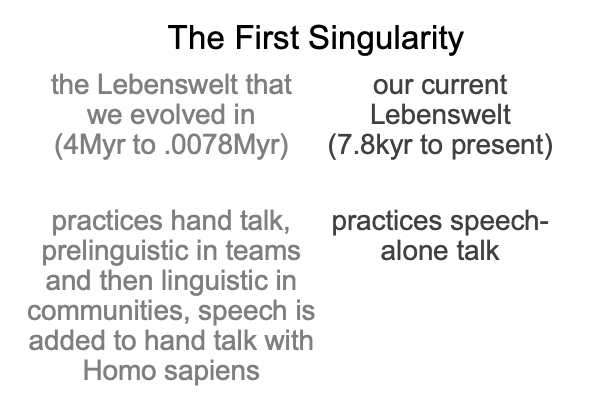
0225 The first singularity is currently a hypothesis.

As further research is conducted with this hypothesis in mind, we may eventually feel confident that the Ubaid is the first culture in human evolution to practice speech-alone talk.  8800 years ago, all other cultures practice hand-speech talk, in continuity with the founding of our species 300,000 years ago.

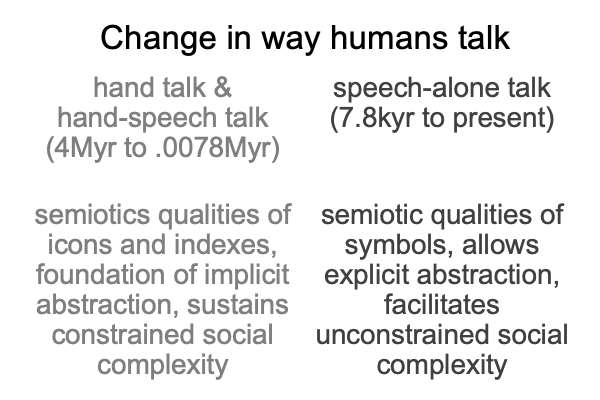
Over a period of a few thousand years, these hand-speech talking cultures convert to speech-alone talk, after being exposed to speech-alone talking cultures.  Why do they adopt the new way of talking?  Hand-speech talk promotes constrained social complexity.  Speech-alone talk removes the constraints.  The semiotic qualities of hand-speech talk and speech-alone talk are hugely different.

0226 The above hylomorphes are resolutions in favor of the entanglement.

Against this prospect, Walton configures his own confounding.

0227 Will this be sufficient to stop the goofy, science-loving impulses of the Christian imagination?

I don’t think so, because even if Walton’s confounding resolves in favor of his entanglement, the form of the resulting hylomorphe will entangle the Christian imagination.

0228 The Tartu-Moscow School of Semiotics pulls up a fish from the depths of the Christian Slavic civilization.

They open the mouth of the fish.

What do they find?

The golden coin of entanglement.

0229 Welcome to the Fourth Age of Understanding, The Age of Triadic Relations.

0230 I thank John H. Walton for publishing this advance in the origins debate and I wish J. Harvey Walton the best.

10/31/24

Looking at N. J. Enfield’s Book (2022) “Language vs. Reality” (Part 1 of 23)

0841 This is an encore performance to the sequence of blogs on the post-truth condition.

As such, this examination wraps up Part Two of Original Sin and the Post-Truth Condition (available at smashwords and other e-book venues).

Take a gander at the full title of Enfield’s text, Language vs. Reality: Why Language Is Good For Lawyers and Bad For Scientists

Surely, that sounds like a book that belongs to a set of books on the post-truth condition.

So, the numbers continue to build from the last examination.

0842 The book is published by MIT Press, Cambridge, Massachusetts.

The author is a professor of linguistics at the University of Sydney and the Director of the Sydney Centre for Language Research.  

0843 The title of the book is a play on John B. Carroll’s (editor) collection of essays by Benjamin Lee Whorf (1897-1941 AD), published in 1956 under the title, Language, Thought and Reality.

To me, this implies that “thought” has transubstantiated into “versus”.  The substance of the word has changed, so to speak.  The word, “versus”, derives from the same root as the word, “adversary”.  So, if “thought” once used to nominally stand between “language” and “reality”, then today, “thought” is confounded with “adversary”, and that might serve as a hint concerning the nature of our adversity.

Perhaps, this is not the only notable feature of the title.

Then again, a book titled, Language, Adversary and Reality, might not fly off the shelves in feel-good book-outlets.  It is not as if, next to the Self-Help section, there is a Come To Grips With Your Doom section.

So, expect me to play with the title throughout this examination.

0844 Another notable feature of this book, at least to me, is that the author is not acquainted with Razie Mah’s re-articulation of human evolution, in three masterworks, The Human Niche, An Archaeology of the Fall and How To Define the Word “Religion” (available at smashwords and other e-book venues).  The evolution of talk is not the same as the evolution of language.  Language evolves in the milieu of hand talk.  Plus, the evolution of talk comes with the twist, humorously called, “the first singularity”.

So, Enfield’s work serves as a marker for the twilight of the Age of Ideas and the dawning of the Age of Triadic Relations.

0845 Okay, let me dwell on the idea that the evolution of language is not the same as the evolution of talk.

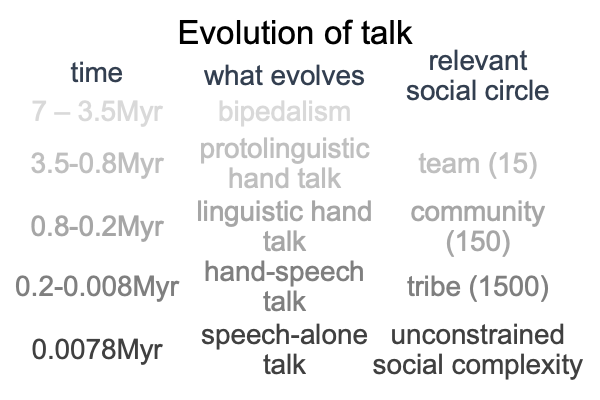
Comments on Michael Tomasello’s Arc of Inquiry (1999-2019) (by Razie Mah, available at smashwords and other e-book venues, and also, for the most part, appearing in Razie Mah’s blog for January, February and March, 2024) divides the evolution of talk in the following manner.

0846 The first period starts with the divergence of the chimpanzee and human lineage (7 million of years ago) and ends with the bipedalism of the so-called “southern apes” (around 3.5 to 4 million years ago).

In the second period, australopithecines adapt to mixed forest and savannah by adopting the strategy of obligate collaborative foraging.  Eventually, Homo erectus figures out the controlled use of fire, leading to the domestication of fire, starting (perhaps) around 800 thousand years ago.

The third period, lasts from the domestication of fire to the earliest appearance of anatomically modern humans.  During this period, hand talk becomes fully linguistic, religion evolves as an adaptation to large social circles (of 150 individuals and more) and hominins use the voice for synchronization during seasonal mega-band and occasional tribal gatherings.  Then, sexual selection does the rest and the voice comes under voluntary neural control.

0847 The fourth period starts when the voice, now under voluntary control, joins hand-talk, resulting in a dual-mode way of talking, hand-speech talk.  Hand talk retains the iconicity and indexality that grounds reference in things that can be pictured or pointed to.  But, speech adds a symbolic adornment, which starts as a sing-along and ends up taking a life of its own.  Four centuries ago, the North American Plains Indians and the Australian aborigines still practiced hand-speech talk, with full fledged sign and verbal languages.  Now, their hand-speech talk is all but dead.

0848 That death, along with the demise of all hand-speech talking languages, comes (and came) due to exposure to speech-alone talk, which has significantly different semiotic qualities than hand-talk and hand-speech talk.  Hand-talk is iconic and indexal.  The referent precedes the gestural word.  Speech-alone talk is purely symbolic.  The spoken word labels ‘something’, and sometimes that ‘something’ cannot be imaged or indicated.

Well, it must be real because speech-alone talk provides a label for an explicit abstraction!

0849 Here is a picture of the transition labeled, “the first singularity”.

0850 Consider the words, “language”, “adversary” and “reality”.  Each word is a label for ‘something’ that cannot be pictured or pointed to.  These words do not exist in hand-talk or hand-speech talk, because the referent cannot be imaged or indicated using a manual-brachial gesture.  What does this imply?  Does a referent exist because a label has been attached to it?  Or, does an explicit abstraction properly label referents that exist irrespective of the spoken word?  This type of question is addressed in Razie Mah’s masterwork, How To Define The Word “Religion”.

Fortunately, the author of the book under examination is unaware of the first singularity and the difficulties that a change in the way that humans talk poses.  Human evolution comes with a twist.

0851 So why examine this work?

Well, I expect to see the evolution of talk manifesting in this book, even though the author is not aware of Razie Mah’s academic labors.

Surely, Enfield’s work details recent scientific research in linguistics and cognitive psychology, in an attempt to provide the reader with a coherent view of how language is good for lying lawyers and bad for honest scientists.

What will this examination reveal?