0026 I review.
0027 The Tartu-Moscow School of Semiotics grows within the repression of the USSR then blossoms with the fall of the Soviet empire. Boris Uspenskij and Juri Lotman participate in that end-of-an-era flourishing. That is the end of the story. What about the start?
Uspenskij and Lotman begin their careers in Slavic studies by proposing atheist materialist explanations for the nature of Russian (and Slavic) literature. Uspenskij’s model of the candle-illuminated Russian icon is an example. However, the vocabulary of atheist materialism proves inadequate, so they supplant their explanations with semiology and structuralism.
0028 This fits the pattern of a confounding.
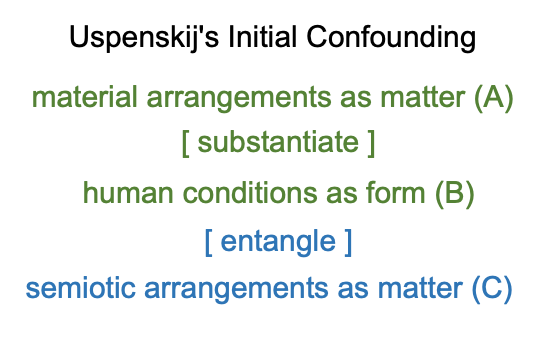
0029 By the time the USSR ends (along with the incentives for atheist material explanations), their confounding is refined into the following script for inquiry into aesthetics.
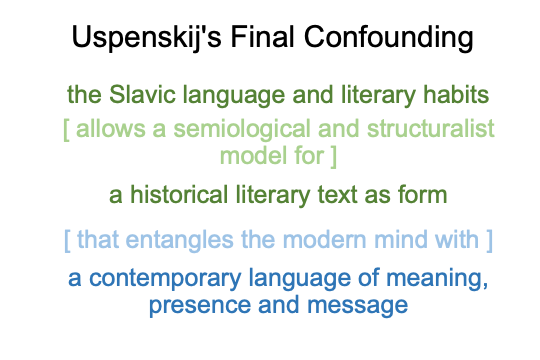
0029 This is not the same as the original confounding.
Instead, the above figure matches Uspenskij’s original insight arguing that Russian icons should be regarded in candlelight.
B: The form is a literary historical text (which is like the Russian icon).
A: The originating matter is the Slavic language and literary genres (which is like the material for the substance of the flame of a semiological and structuralist model).
C: The entangled matter is a contemporary (and, yes, academically inclined) language of meaning, presence and message.
0030 Independently, E. Michael Jones learns to practice these steps in the USSA, using a model that is not associated with semiology or structuralism.
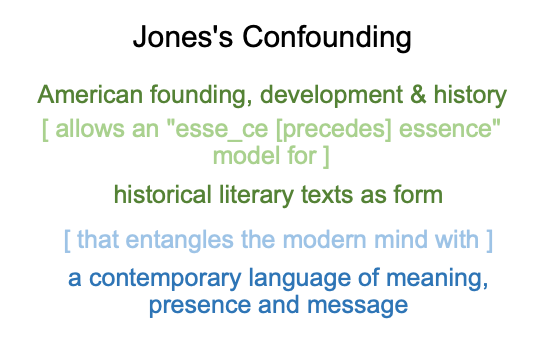
0031 To me, the parallel is striking.
The Tartu-Moscow School of Semiotics develops a practice that coheres to the categorical structure of a confounding. They do so in order to plumb the beauty and insights of Slavic arts and literature. Yet, no one in that school explicitly articulates that structure.
Similarly, E. Michael Jones develops a practice that coheres to the categorical structure of a confounding. He does so in order to plumb the charisma of the American identity, as expressed historically in its arts and literature. Yet, he does not explicitly articulate the structure of the confounding.
0032 I wonder, “What is the esse_ce that calls forth the essence of the title of this book?”