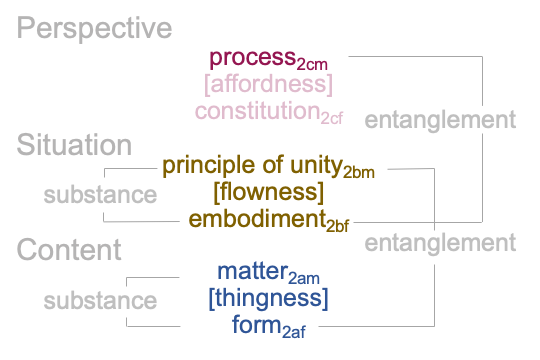
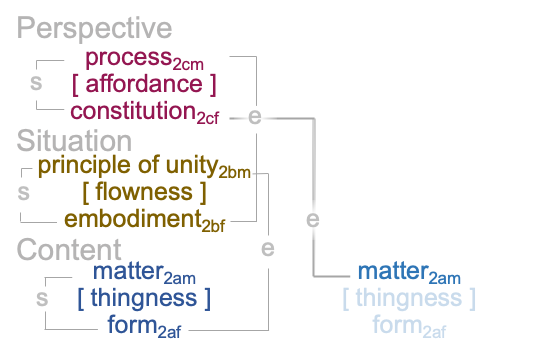
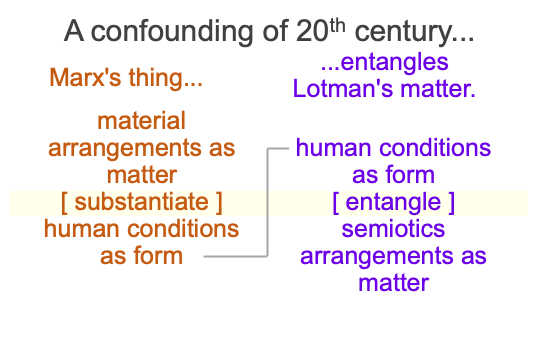
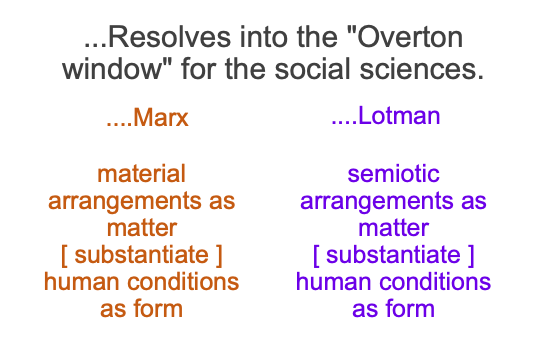
0286 From this examination, I have demonstrated that Hodder’s sociological and anthropological appreciation of “entanglement” mirrors, so to speak, a philosophical definition of a confounding. Using Aristotelian terminology, a confounding occurs when the form of a thing entangles other (non-originating) matter. Form is contiguous with two matters, one originating and one entangled. The two contiguities are “substantiation” and “entanglement”.
0287 This applies to content-level and situation-level hylomorphes. In the following figure, entanglement connects form on one level with matter on the adjacent higher level. This connection also occurs in the sign-relations isolated by scholastics of the Latin Age.
0288 Clearly, this expression of entanglement theory stands outside the Hegel-Marx Overton window.
This expression stands outside of the range of ideation among modern anthropologists in 2026.
0289 The story is even more complicated. The three-level interscope fully contains two sign-relations, the specifying and the exemplar, familiar to Latin Age scholastics. Even that is not enough.
There is one more confounding that resolves into a sign-relation. The interventional sign connects the perspective-level of one interscope with the content-level of another. What is constituted2cf in one interscope stands for matter3am in another interscope. The discovery of the interventional sign-relation completes a line of thought that started during medieval times.
0290 The Hegel-Marx approaches that the author discusses in chapters 10 and 11 (C10 and C11) need to be adjusted in order to account for phenomena regarded as observable and measurable facets of a noumenon characterized by substances, confoundings and sign-relations.
0291 The story of the emergence of Lotman’s thing is told in Razie Mah’s blog for December 2025, titled Looking at Igor Pilshchikov and Michael Trunin’s Article (2016) “The Tartu Moscow School of Semiotics” as well as follow-up examinations appearing in January through March of 2026.
0292 Juri Lotman (1922-1993) is a Soviet era academic with expertise in the arts of the Slavic civilization. He and a collaborator, Boris Uspenskij (1937-present), find that Marxist vocabulary is inadequate to discuss the phenomena of Slavic historical art production. So, they adopt semiology and structuralism in order to build models of artistic and literary productions. The models allow them to discuss Slavic art-works according to modern, scientific sensibilities.
0293 In sum, for Juri Lotman and Boris Uspenskij, Marx’s thing entangles the matter of semiotics.
0294 The confounding resolves in… what appears to me… to be the new Overton window for the social sciences for the twenty-first century.
0295 I wrap up with three noteworthy conclusions.
0296 First, Hodder’s anthropological theory of entanglement associates with Marx’s thing. Razie Mah’s hypothesis that the human niche is the potential of triadic relations associates with Lotman’s thing.
Second, despite occupying different poles of the twenty-first century Overton window, Hodder’s sociological theory of entanglement and the philosophical definition of “entanglement” as a component of a “confounding” do not exclude one another. They either complement or align.
Third, excavations at Catal Hoyuk permit the suggestion that cultural emissaries from the Ubaid of southern Mesopotamia influence a change in things2a, embodiments2bf and processes2cm associated with Level VII (starting around 6600 B.C.). This suggestion is consistent with the hypothesis of the first singularity proposed by Razie Mah.
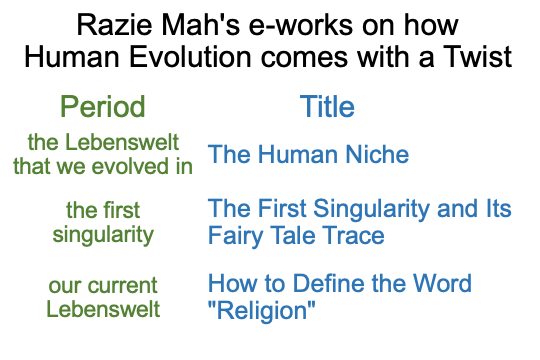
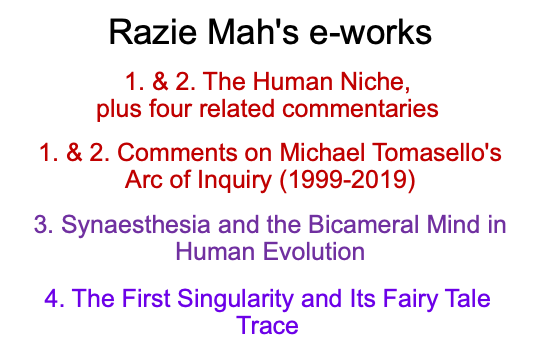
0297 Here is a summary of Razie Mah’s e-works on human evolution.
0298 My thanks to Dr. Ian Hodder for this book, as well his many collaborators. I hope that this examination adds value to his inquiries.
0002 In 2012, the European Science Foundation convened an exploratory workshop, titled, “The Neolithic of Arabia: New Paradigms and Future Perspectives”. The schema is available online.
In the section on the main objectives of the workshop, the organizers (Dr. Remy Crassard and Dr. Phillipp Drechsler) note that the fragmentary characteristics of scientific knowledge to date favors the persistence and acceptance of current theories and precludes the development of new paradigms, along with comprehensive and coherent approaches to the Neolithic.
0003 This “favoring” and “precluding” is intrinsic to a recent essay in the journal, Prehistory, which is examined in Razie Mah’s blogs on January 1, 2026, titled Looking at Melinda Zeder’s Article (2025) “Repackaging the Neolithic”.
0004 While the workshop organizers do not call for a novel global vision, they do call for a synthetic approach that encourages the integration of diverse research on the topic.
0005 This open letter calls for more comprehensive research into the link between the early Holocene infilling of the Arabian Gulf and the emergence of two spheres of interaction for the Ubaid (southern Mesopotamia and the western Gulf littoral). The addendum provides an introduction.
0006 How comprehensive?
0007 Consider the questions raised by Razie Mah in the e-book, The First Singularity and Its Fairy Tale Trace.
0008 First, does the forced migration induced by the early Holocene marine transgression explain the ‘Ubaid phenomenon, where this culture may be considered to be the first to practice speech-alone talk?
0009 Second, does speech-alone talk spread from the Ubaid, along established paths of down-the-line trading, to the rest of Eurasia? Why do all hand-speech talking cultures adopt speech-alone talk after coming into contact with a speech-alone talking culture? Are there archaeological markers indicating that, not only has contact occurred, but the transition is underway. Artifacts that might demand labels, like copper, certain types of pottery (such as the white pottery of the Archaic Hassuna), changing habits of lithic-tool knapping, might serve as markers.
0010 Third, what are the semiotic natures of hand-talk, hand-speech talk and speech-alone talk? Does hand- and hand-speech talk constrain social complexity? Does speech-alone talk potentiate unconstrained social complexity?
0011 These questions can be bundled into one grand question, which, ironically, is what the workshop specifically forbade.
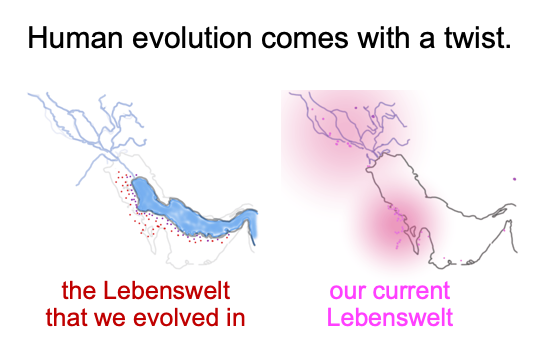
Is our current Lebenswelt the same as the Lebenswelt that we evolved in?
Are we who we evolved to be?
0012 I hope this call is heard by all people of good will. The time has come to set aside the swords and pick up where European Science Foundation’s exploratory workshop left off.
0010 Earnestly yours,
The Desk of Razie Mah
September 2-15, 2026
0011 Addendum: Looking at Richard Cuttler’s Article (2013) “Considering Marine Transgression as a Mechanism for Enforced Migration and the Littoral Gulf ‘Ubaid Phenomenon” in Razie Mah’s blog, September 1, 2026
0001 The citation for this article is: Cuttler, R. (2013). Considering marine transgression as a mechanism for enforced migration and the littoral Gulf ʿUbaid phenomenon. Arabian Archaeology and Epigraphy, 24(1), 37–43.
I obtained my copy from Wiley online. Thank you.
0002 In the early 2010s, Dr. Richard Cuttler smells a very interesting intellectual aroma, but is unable to sense where the trail leads. What is the link between the infilling of the Persian Gulf and the appearance of the Ubaid culture of southern Mesopotamia?
0003 The titular “consider” is one way of saying, “Imagine the possibility.”
If the marine transgression into the Arabian… or is it Persian?.. Gulf enforces a migration of the people who originally settled the fresh water marshes of the Ur Shatt (that’s “Ur Schatt” for Germans) waterway, then does that account for the Ubaid appearing in both Mesopotamia and on the shoreline of central Arabia?
0004 Why would an archaeologist consider such an if-then scenario?
During the glacial period, the Euphrates and Tigris Rivers flowed together into a waterway, the Ur-Shatt, that fed a corridor of lakes and marshes (now underwater “basins”) into the sea. Such a concourse would be a favorable place for Epipaleolithic enthnoses to settle, taking advantage of diverse natural resources.
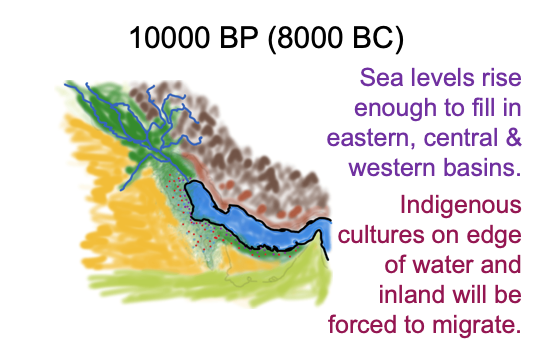
0005 Little did they realize that the Ur-Shatt waterway, a veritable oasis during the glacial period, would slowly be covered with around 70 meters of sea-water. By “slowly”, I mean thousands of years. At the same time, the rise in sea-level has a horizontal dimension. After filling the basins, sea-water spreads into a shallow geological bowl.
0006 Here is a picture of the scenario once the low-lying basins are full.
The indigenous settlements are represented by red and purple dots.
The sea-rise will force these people to migrate.
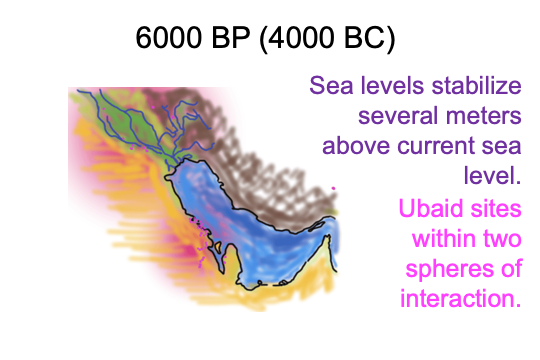
0007 Here is a picture once the Gulf is filled to the brim (as far as the sea-rise would go, which is several meters above the present sea-level).
The Ubaid settlements are represented by magenta dots. Plus, the background color has taken on a magenta hue, denoting two spheres of interaction, the central Arabian Gulf and southern Mesopotamia. This is my rendition of Figure 1 of the article.
0008 How does anyone know that there are two spheres of Ubaid settlements?
Originally, the term, “Ubaid”, labels a type of pottery found in excavations throughout southern Mesopotamia. Why did archaeologists not also look at the central Arabian Gulf region?
The author is perhaps too embarrassed to say that late-nineteenth and early-twentieth century archaeologists focused on this region because… well… that is where the Garden of Eden is supposed to be. That is where Noah’s flood took place. That is where Judah was taken into exile in ancient times. So, of course, Protestant Christians are going to pay for exorbitant excavations in order to reveal… you know… something about justification by faith alone, scripture alone, and grace alone.
0009 Okay, I am just guessing on that one.
0010 Then, in 1968, G. Burkholder discovers Ubaid pottery in the western Gulf littoral.
0011 What a surprise.
The Ubaid is the lowest level excavated in southern Mesopotamia, which means that it has the deepest time horizon. Now, the Ubaid shows up near Bahrain. Doesn’t that smell like a great research project? To an archaeologist, it sure smells good… but, how does one follow the scent when the trail goes under the waters of the Gulf?
Professor Richard Cuttler, who I am sure has some good stories to tell, seeks funding for seismic reflection maps of the Gulf’s underwater landscape, in order to obtain better placed sediment cores of the sea-floor. He wants to investigate, but he does not know that there is another component to the puzzle. Also, big funding is hard to come by.
0012 If the project is funded, what will he find?
Among other points, the sediment cores would provide pollen-based clues to the changing climate of the time.
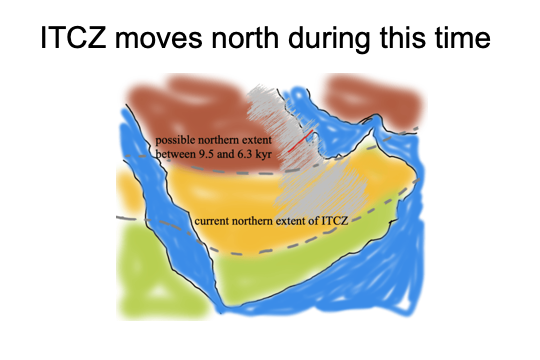
0013 At the start of the current interglacial, the Inter-Tropical Conversion Zone (ITCZ) shifts north, then back, then north again, in a most fickle manner. For the time under consideration, the ITCZ moves north, but not as far north as the gulf-to-be.
Here is a picture.
0014 The two dotted gray lines indicate the furthest extend of the ITCZ currently, and between 9.5 and 6.3 thousands of years ago (kyr). South of the line, the monsoons deliver plenty of rain water. North of the line, the westerlies lose all their water before arriving in Arabia.
0015 Curiously, all the Ubaid sites develop north of the early Holocene ITCZ line, suggesting that water was not a crucial issue. That makes no sense. Southern Mesopotamia obviously has lots of fresh water because of the Euphrates and Tigris and other rivers. What provides water to the pre-Ubaid sites in the central western Gulf?
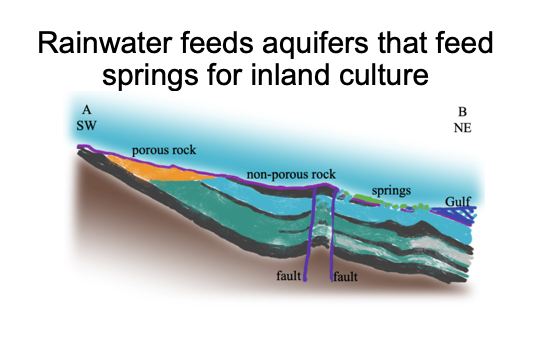
0016 Take a look again at the above figure. The gray brushstrokes and the red line denote a massive aquifer that is tilted. It is high in the west and low in the east. The Dammam label is a concatenation of the saying, “That’s a damn aquifer, ma’am.” Am I kidding? This aquifer relies on a huge tilted fault-riddled plate of non-porous rock supporting porous layers that allow rain water, falling south of the northernmost ITCZ line, to flow underground and come to surface in springs that stand outside the low-lying basins.
0017 Here is my version of the article’s Figure 2.
Note how water flows downhill in the Dammam aquifer then comes up in springs further inland from the sea-water filled basins.
0018 Why is this so important for this examination?
This examiner wants to show that… in the land surrounding the freshwater marshes and salt-water depths of the basins at 10,000 BP… there are two cultures: a Mesolithic culture that lives right along the water and uses fresh and salt water resources and a Neolithic culture that exploits the water from Dammum-fed springs to engage in rudimentary agriculture and stockbreeding.
0019 The question is, “Why would I want to establish two disparate cultures in the same region?”
Wouldn’t that just complicate the story of an enforced migration?
0020 Here, I review.
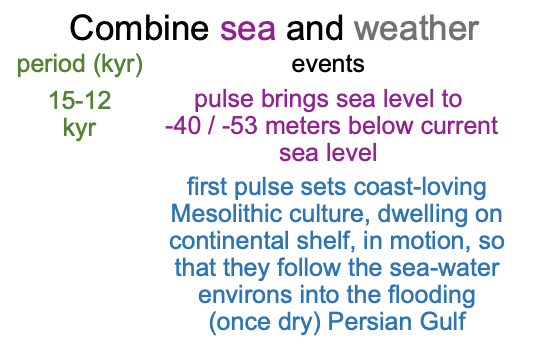
0021 First, the sea level starts to rise, if there is not a paleolithic culture already on the fresh-lakes of the Ur-Shatt waterway, then a Mesolithic culture displaced from living on the continental shelf could enter into the environs. Such a culture would simply follow the water into the eastern, central and western basins, since they already know how to exploit fresh-water and marine resources.
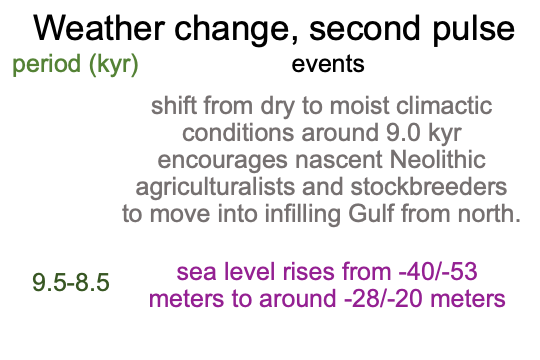
0022 Second, there is a shift from dry to wet climactic conditions, as the intertropical convergence zone (ITCZ) shifts north. Does it shift north enough to provide water directly to lands around the infilling Gulf? The author establishes that even if it does not, the ITCZ shifts north enough to feed the Dammum aquifer which would provide fresh water to a Neolithic agricultural and stockbreeding culture that migrates in from the north and settles in the dry-lands just beyond the marshes.
0023 Then the sea-level rises more, overfilling the basins and entering into the flat-bowl terrain of the surrounding landscape. Now, both the Mesolithic and Neolithic culture are forced to migrate in response to the rising seas.
0024 Here is where I introduce an idea that Dr. Cuttler did not think of and may have never heard about until this moment.
The economies of the Mesolithic and the Neolithic culture are different. They do not depend on the same resources. Practical reason predicts that these cultures should mingle with one another and eventually become one.
However, each culture practices its own hand-speech talking language. That means that they have a serious impediment to talking with one another. Both practice a dual-mode style of language. How are they going to get around that?
0025 Let me step back and say that the evolution of talk is not the same as the evolution of language. Almost every book available on human evolution discusses the evolution of language as a facet of hominin communication. Only Razie Mah’s books discuss the evolution of talk as a semiotic adaptation.
0026 Here is a brief overview.
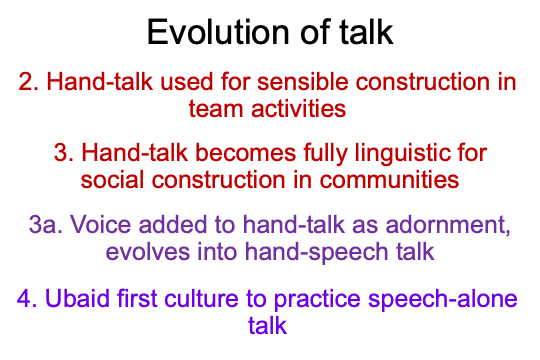
0027 The first period ranges from the separation of the chimpanzee and human lineages (around 7 Myr) to the start of bipedalism (around 3.5 Myr). The hominin lineage communicates in two small and one larger social circles. The small social circles are family (5) and friends (5). The larger social circle is the band (50).
0028 The second period ranges from the start of bipedalism to the domestication of fire (around 0.6 Myr). Michael Tomasello says that this period is dominated by “obligatory collaborative foraging”. That means that the social circle under the most intense selection pressure is the team (15). Hominins forage in teams. Pre-linguistic hand-talk is an adaptation to team work. Pre-linguistic hand-talk relies on sensible construction. Sensible construction relies on content and situation.
0029 The third period ranges from the domestication of fire to the first singularity (around 9kyr). The social circle under the most intense selection pressure is the community (150), the team of teams. This period is dominated by, what Razie Mah calls, “obligatory social-circle harmonizing”. Hand-talk becomes fully linguistic as an adaptation to the semiotic dynamics of social construction. Social construction involves content, situation and perspective.
0030 Prior to the evolution of Homo sapiens, the voice comes under voluntary neural control for singing. Why sing? There are two social circles larger than the community, the seasonally gathering mega-band (500) and the occasionally gathering tribe (1500). Their episodic gatherings require rapid synchronization. The voice was recruited to do precisely this. Singing identifies each participant within these larger social circles as belonging to the group. Plus, singing synchronizes all participants to the tasks at hand.
Sexual selection does the rest.
0031 With the evolution of Homo sapiens, the voice is systematically adapted for use as an adornment to hand-talk. In liminal lighting, communal hand-talk is difficult to instantly recognize. The voice is added as an adornment. Sound-word adorns gestural-word. The semiotics of the union remains grounded in hand-talk. However, the semiotic qualities of the sound-word (speech) are unique. So, cultural evolution produces two independent channels of talk, hand and speech talk, that are highly socially regulated.
In short, the transition from the voice as an adornment to hand-talk to fully elaborated hand-speech talk occurs over hundreds of thousands of years during the Paleolithic. My guess is that archaeological evidence of adornment parallels the development of this cultural adaptation.
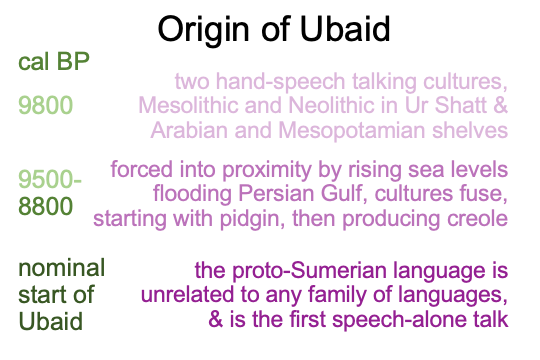
0032 The fourth period begins when two hand-speech talking cultures, one Mesolithic and one Neolithic, are forced into the same migration. These cultures have different economies, so they do not fight over resources. Rather, they trade and get along. They intermarry. They engage in interactions familiar to anthropology. They start with a pidgin. Then, later generations establish a creole. That creole is the proto-Sumerian language. Sumerian is unrelated to any large family of languages.
0033 Plus, that creole is the first speech-alone talk on Earth.
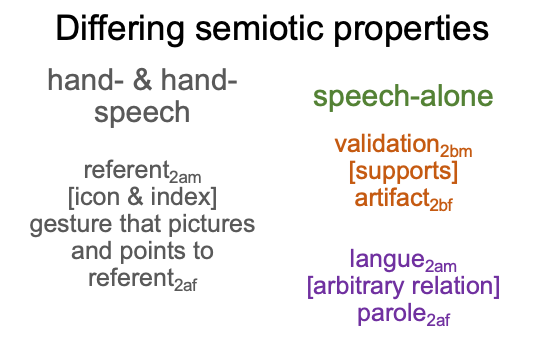
The semiotic properties of hand- (and hand-speech) talk and speech-alone talk are significantly different. The following figure presents dyads (characteristic of the Charles Peirce’s category of secondness) that may be read as Aristotle’s dyad of {matter [substance] form}.
0034 Hand- (and hand-speech) talk requires only one hylomorphe. A referent as matter substantiates, by way of icon and index, a manual-brachial word-gesture as form. The fact that word-gestures become routinized, and thereby instantly recognized, does not detract from this semiotic grounding. The referent precedes the hand-talk word.
0035 Speech-alone talk requires two hylomorphes, one on the content and one on the situation level. In terms of content, Ferdinand de Saussure (1859-1913) defined spoken language as “two arbitrarily related” systems of differences. What I think is arbitrarily related to what I say. So, where does the referent come in?
The referent comes on the situation-level, because each content-level word-utterance2af must be validated2bm(as situation-level matter) by the form of an artifact2bf. The spoken word precedes its referent.
0036 While this explanation sounds like gibberish to any newcomer to the field of semiotics, including many anthropologists and archaeologists in 2026, there is clearly method to the madness.
0037 Here is a list of Razie Mah’s e-works that are pertinent to this topic.
0038 The bottom line?
Hand- and hand-speech talk constrain social complexity.
Speech-alone talk facilitates unconstrained social complexity.
0039 This is precisely the theory that Dr. Cuttler needs in order to bring his research proposals to the next level.
0040 The origin of the Ubaid is the first step in a huge research project that is intrinsic to The First Singularity and Its Fairy Tale Trace.
0041 Cuttler’s analysis concerns the material arrangements that set in motion a dramatic shift in semiotic reality.
0042 Our current Lebenswelt is not the same as the Lebenswelt that we evolved in.
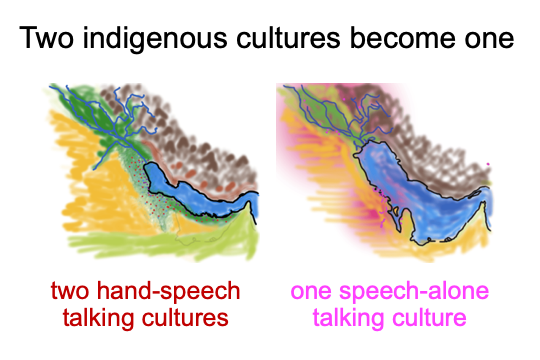
The image on the left represents two hand-speech talking cultures that belong to the Lebenswelt that we evolved in.
The image on the right represents one speech-alone talking culture that initiates our current Lebenswelt.
0043 I suspect that the Ubaid narod knows that they are different. They are surrounded by ethnoses that are poor and disorganized, in comparison to the wealth and the power that comes from (even a little) labor and social specialization.
The Ubaid does not know why it is special, it only knows that the surrounding hand-speech talking cultures talk with their hands. The hand-speech talking culture cannot help but notice the inverse. The Ubaid emissaries do not talk with their hands. However, they have the best dried fish. Plus, they want to give us their pottery, but it seems that they expect something in return.
Soon enough, the Ubaid strains at maintaining communality, or whatever it was that they had before their creation. Meanwhile, their way of talking encourages them to create artifacts that validate their spoken words, condemning them to further social complexity.
0044 It is hard to imagine what it was like, when every youth is ready to move past the tired artifacts that validate their grand-parent’s words.
Or, maybe it is not hard to imagine.
0045 Nor is it hard to imagine Abdullah Hassan Masry’s 1974 “sphere of interaction” hypothesis. Each Ubaid site belongs to a sphere of interaction, where it takes on its own “specialties”, its own gods, and its own ways of accommodating its labor and social specializations.
Doesn’t that sound like the contemporary term, “multipolar world”?
0046 Here is a picture.
0047 What is the second research project demanded by the hypothesis of the first singularity?
From the spheres pictured above, speech-alone talk spreads to the four corners of the world.
Imagine the research project needed to establish whether that claim is plausible!
0048 Dr. Richard Cuttler, the door is open. Follow your nose. Thank you for publishing your considerations.
0001 The book before me is published by Fidelity Press. The subtitle is “The Rise, Fall and Return of American Identity”. The author is editor of Culture Wars Magazine. And, everyone knows what “culture wars” means.
For students who are pursuing Semiotics and History, please have a copy of this book at hand. Look at the title and read the table of contents. The instructions in this examination should be clear.
Dr. E. Michael Jones, the author, reads and comments on literature from a Catholic point of view. His works are iconic, in so far as he is orthodox. “Ortho” means “right”. What about “dox”? Here, I mix terminology. Orthodox love icons. You know, those paintings that adorn the churches with names like “Saint Basil’s”.
0002 Of course, for the semiotics of Charles S. Peirce, an icon is one of three types of natural signs. An icon is a triadic sign-relation whose sign-object is based on the qualities of similarity, imagery, pantomime, likeness and so on. In other words, an icon offers a sign-vehicle that allows me to visualize its sign-object.
0003 But what about the icon rendered in E. Michael Jones’s text?
What about the icon on the wall of St. Basil’s?
Razie Mah’s blog appearing in January 2025, Looking at Boris Uspenskij’s Article (2016) “Semiotics and History”, contains a hypothesis about Russian icons.
0004 Boris Uspenskij (1937-present) is a Soviet era expert on Slavic literature who, along with Juri Lotman (1922-1993), proposes that semiotic arrangements substantiate the human condition. He does so in the 1990s, after the Soviet political system lost all credibility. The Soviet system enshrined Marx’s slogan: Material arrangements substantiate the human condition. How well did that thing work?
0005 Boris Uspenskij’s journey into semiotics begins in the 1950s, when the Soviet empire is intimidating and everyone senses that Marx’s slogan applies. After all, it sounds so scientific.
Uspenskij wants to offer a materialist explanation for the power of Russian iconography. Russian icons are portraits and scenes painted on the foreground with a background of thinly hammered gold foil. Uspenskij figured that icons are meant to be viewed by candlelight. The flickering light of candles produce the aesthetic effect associated with Russian icons.
0006 Of course, this is a materialist explanation for Russian iconography, fully congruent with the central slogan of the Marxist thing: material arrangements [substantiate] human conditions.
However, from the Korean War until the fall of the Berlin Wall, Uspenskij (along with Lotman) reach the conclusion that Marxism does not have the vocabulary to explain Slavic literature. Instead, they figure out the aesthetic effects of Slavic art by using the vocabularies of semiology and structuralism.
“Figuring out” means “bricolage”. They practice what they figure out. The vocabularies of semiology and structuralism hammer out a model. Then, when the form of the work of art is viewed in the flickering light of that model, an aesthetic effect is reproduced as matter. The work of art entangles the contemporary language of the positivist mind.
0007 In the flickering illumination of a semiological and structuralist model, the work of art begins to speak to the viewer.
The Tartu-Moscow School of Semiotics is discussed in Razie Mah’s blogs, spanning from December 2025 to May 2026. These blogs initialize an online course titled “Semiotics and History”. See Razie Mah’s blogs for October 3-6, 2025 for an introduction.
0008 This is confounding.
“Confounding” is a technical term, labeling a single form (B) that originates from one matter (A), yet entangles another matter (C)
A historical literary text (or a work of art, such as a Russian icon, A&B) becomes a form (from the perspective of a semiological and structuralist model, B alone) that entangles a voice (matter within the viewer, speaking to the viewer, in a contemporary vocabulary of meaning, presence and message, C).
0009 A as matter [substantiates] B as form. {A[&]B} constitutes a thing.
B as form [entangles] C as matter. {A[&]B[entangles]C} is a confounding.
0010 The question that I pose is this.
Does Dr. E. Michael Jones construct a similar cognitive apparatus in the USSA, during the years preceding the collapse of its big government (il)liberal and neoconservative Marxist ideations?
0011 I know what you are thinking.
USSA?
United Sycophantic States of America?
I love acronyms.
But, what the hell is a “sycophant”?
Okay, the author has another word that begins with “S”.
0337 The colonies expanded into the wilderness of the frontier west.
The states expanded into the wilderness of nature.
The United States of America expanded into the wilderness of empire.
Now, we, the people, expand into the wilderness of a house of mirrors.
0338 The final three chapters and the epilogue convey a sense of resignation. Is the fiction that critical theorists write to be regarded as a comedy or a tragedy? Or is it a liberation or a trap? Nothing is as it appears to be. Not even the author remains undistorted.
0339 Even though Jones does not label the house of mirrors that constitutes Critical Theory “the new postmodern American fiction”. Jones’s treatment of Joe Ritchey tells of someone who was not only canceled, but ruined, because of his American Identity.
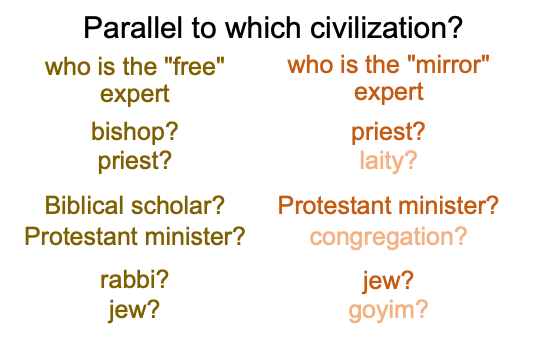
0340 Without explicitly asking the question, Jones poses the quandary, “Do the institutions that support critical theory as a way to turn their world into a fiction have historical precedent?”
Which of the following pairs of comparisons does it parallel?
0341 The student is left to formulate an answer to the question.
0342 My own epilogue begins with a cheer for E. Michael Jones for this thought-provoking exercise.
0343 My examination begins with the introduction of a model through which I (the reader in 2026) can appreciate contemporary meaning, presence and message within historic American literature. This is discussed in points 0027-0042.
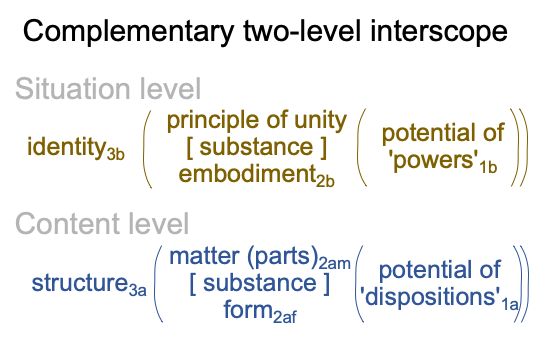
As it turns out, a big picture of his original model of “existence precedes essence” may be diagrammed as a two-level interscope where identity3b virtually situates structure3a.
0344 Here is a picture.
This examination has been informed by a postmodern version of Jones’s Thomistic insight.
0345 What about Jones’s provocative writing style?
Readers from Catholic backgrounds might have a little difficulty accepting the text as written, because it (sort of) sounds like apologetics. My own difficulty? The model application, although consistent, does not shine, as it does in this examination. Jones applies the model. He does not articulate it. In this, my examination adds value to Jones’s text.
Readers from Protestant backgrounds may have serious difficulties with Jones’s text, in so far as the author does not respect Martin Luther, John Calvin, King Henry VIII and other founders. Plus, there is continuous mention of Satan as the hero of John Milton’s Paradise Lost. Plus, Jones seems to have no fondness for the situational import of sola fide, sola scriptura and sola gratia. This slogan situates the title of Jones’s book.
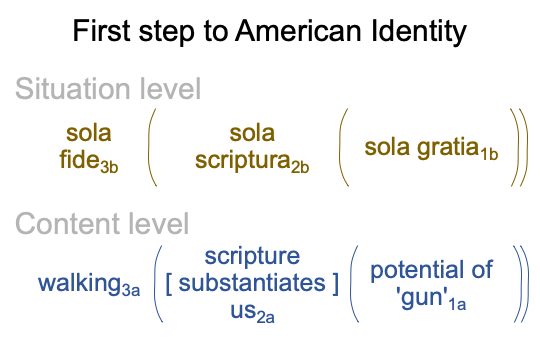
0346 Indeed, the first historical step to the American Identity contains the Protestant slogan as situation level and the title of Jones’s book as content level, as shown below.
0347 A meditation on this nested form tells me that Jones presents a gift to the Protestant and the American. Here is the first expression of the American Identity conforming to the scholastic ideation that existence precedes essence. Existence associates to the content level. Essence associates to the situation level.
At the same time, the esse_ce of scripture2a is contiguous with the essence of us2a, as Americans to be.
0348 And the gun?
Is it really a talisman for self-protection from those who pretend to be absolved of the doctrine of original sin, that is, from those who deny the fall of man?
Surely, this question will inspire future inquiry.
0349 Overall, Puritanism (Calvinism) ran its course for a century before the American Revolution. Then the romantic rehabilitation of nature ran its course for a century before the Civil War. Then, the nemesis and its mirror of abolitionist and northern aggressor, democratic theorist and voter-rights advocate, secular scholar and value-free administrator, aggrieved theorist and agenda-pushing educator, and (lest I forget) rabbi and jew, has run its course for a over a century.
What is a good title for the coming end of the current saeculum?
Here is my suggestion.
A Shattering of the House of Mirrors.
Or maybe, A Reconstitution of the American Identity, will do.
0350 My thanks to E. Michael Jones for this work. I hope that this examination adds value to his exposition and serves as a companion for the student interested in the topic.
SaH0047 The following essay, originally written in 2016, comments on a book by a Lutheran Pastor about heretical influences in contemporary American society. The author is Peter Burfeind. The title of the work is Gnostic America: A Reading of Contemporary American Culture according to Christianity’s Oldest Heresy (Pax Domini Press, 2014). Please have this book at hand for the full story.
These comments are not a close reading. They situate Burfeind’s text with category-based models. These models were proposed and developed in How to Define the Word “Religion”, plus Primers 1 through 10. They were refined in the Course on Implicit and Explicit Abstraction. They portray relational and logical structures.
Also, my discussion presumes the first singularity. Gnosticism was cultivated in an early ancient civilization. As such, I expect its origin myth to be a fairy tale about the first singularity. The first singularity is discussed in the Crystallizations of the Fall series plus An Archaeology of the Fall, available at www.smashwords.com and other e-book venues.
In short, these comments apply a suite of postmodern scholastic hypotheses to Burfeind’s excellent text. They are different from, yet complementary to, Burfeind’s passionate argument.
SaH0048 This exposition constitutes a strand in the Razie Mah’s online course: Semiotics and History.
The various strands are listed in Razie Mah’s blog for February 3, 2026
‘Words that belong together’ are denoted by single quotes or italics.
0001 Peter Burfeind wrote Gnostic America: A Reading of Contemporary American Culture according to Christianity’s Oldest Heresy (Pax Domini Press, 2014).
This book is composed of four parts. The first part covers the fundamentals of Gnosticism as a Christian heresy. The second and third parts explore cultural manifestations. The fourth part applies these fundamentals and explorations to contemporary American Neo-Evangelical Christian churches.
0002 Burfeind argues that two Gnostic movements contend for sovereign power, progressives and Neo-Evangelical Christians.
To me, big government (il)liberals (BG(il)Ls) beat these Christians to the punch. The federal government has established a religion. It is not Christian. BG(il)Ls run Gnostic bureaucracies where authorities deny that they are religious at all. BG(il)Ls are the self-anointed angels (or more accurately, daemons) of a New Age dawning in America.
Christians who self-describe themselves as “spiritual, but not religious” accommodate BGL’s increasing sovereign power and aggression.
0003 Burfeind is not alone in this awareness. Over 60 years ago, Eric Voegelin expressed similar ideas in his short but significant book, The New Science of Politics.
This raises a question. What is the meaning, the presence and the message underlying the word “Gnosticism”?
With this question in mind, I turn my attention to Burfeind’s text.
Students should read chapter 1 of Burfeind’s text before proceeding.
0004 From Burfeind’s introduction, I know that Gnosticism is a very old heresy.
How old?
From chapter 1, I suspect that Gnosticism predated Christianity. Indeed, the death and the resurrection of Jesusrebuked Gnostic intuition. Why would Jesus retain the evil material shell of His body?
Jesus highlights all the ways that the Mosaic tradition offended Gnostic sensibilities. Both Christians and Jews are enamored of the material world. Gnostics, not so much.
0005 The Judeo-Christians believe in one God. So do the Gnostics. But, the one God of the Judeo-Christians is not the same as the Gnostic Source. The Source is a Monad, a complex singularity capable of putting everything into perspective. The Monad is the source of meaning.
0006 The Monad plays a key role in the Gnostic origin myth. The myth begins with the Source, beyond spoken language and in eternal time. From the Monad, male and female pairs emanated, each according to its aeon. The totality of theaeons is called the “pleroma”.
For the last era, our own, the female of the pair acted without her male consort. He was missing in action, so to speak. Sophia became pregnant with Yaltabaoth, half lion and half snake. She thought to herself, “This is not me.” So she took action, ripping the monster from her womb and hiding him in a cloud.
0007 Born yet aborted, living in a fog, Yaltabaoth decided to build his own world. He decided to create. What else was this demiurge supposed to do? He constructed his own world, which is our universe. He assigned archons (powers and governors) to rule his cosmos.
He was proud of his accomplishments.
Here I make an admission, there is more than one way to spell Yaltabaoth. That exercise is left to the reader.
Okay, back to the story.
0008 What else does this builder god do?
He manufactures our physical bodies. He steals a spark from the Monad (a soul) and pulls it into his world. As the soul descends, Yaltabaoth adds matter. At birth, each person is a spark wrapped in a mortal cloak. The spark is not material. The body is material. The two will war with one another.
0009 Therefore, Sophia pities us and offers this myth. The Self has a mission: Return to the Source. Sophia offers secret knowledge, gnosis, opening a path out of Yaltabaoth’s apparently all-encompassing cloud.
In fact, this myth, which joins cosmic and personal origins, contains a secret. It describes a location where you can find your Self.
0010 Clearly, this origin myth provides meaning. This meaning coincides with the model of social construction in Razie Mah’s How to Define the Word “Religion”. This model is further detailed in A Primer on the Category-Based Nested Form and A Primer on Sensible and Social Construction.
0011 The model is an interscope, a nested form of category-based nested forms. The interscope offers nine slots. Features in the above myth associate with different slots.
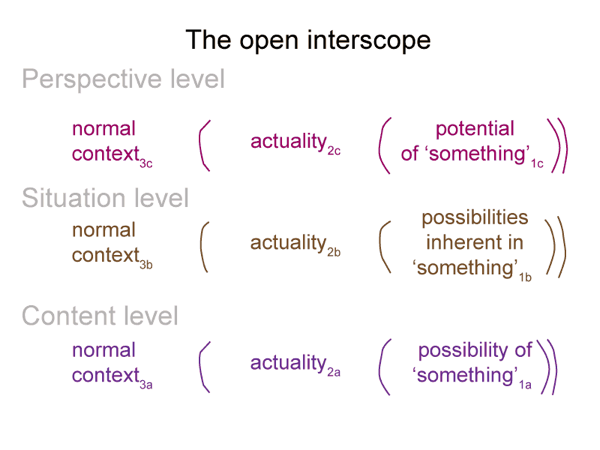
Here is the open interscope, before any associations.
0012 My intent is to associate elements of the Gnostic origin myth with slots in the interscope of social construction.
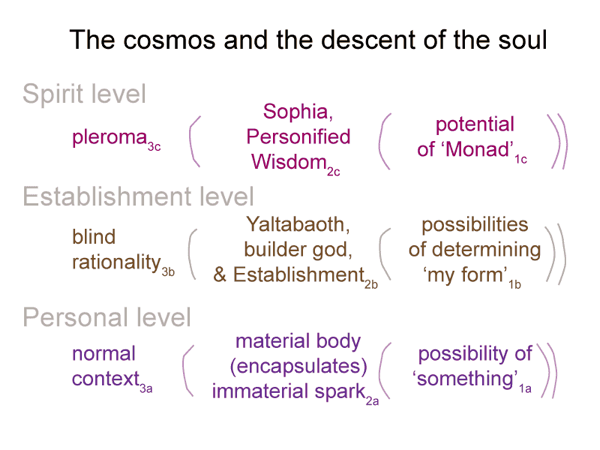
0013 My first association concerns the Monad. The Source has the potential to put the situation into perspective, so it goes into slot 1c. The pleroma automatically becomes the normal context of the perspective level (slot 3c). The pleroma3c brings the possibilities inherent in the Monad1c into relation with the actuality of Sophia2c.
0014 So what is the secret about Sophia?
Sophia is Personified Wisdom. It is not much of a secret. After all, philosophy is rooted in love (philos) and Wisdom (sophia).
0015 If Sophia2c is the mother of the builder god, Yaltabaoth, then I should put the builder god into slot 2b. Yaltabaoth2b situates our universe within the normal context of blind rationality (slot 3b).
Or should I say, “mindless rationality”?
The builder god lives in a cloud, isolated, without awareness of even his own mother. Sure, he snatches sparks from the Monad. He does this blindly. Who knows what spark goes into what body? Yaltabaoth operates in a fog. His archons are like bureaucrats, always following their rulebooks. His social norms? They constitute the Establishment.
The Establishment is the social arm of Yaltabaoth’s evil material world of blind chance and mindless necessity. For teenage Gnostics, that includes all parents. For big-government Gnostics, this includes everything associated with the American Founding.
0016 So, why does the builder god need a spark from the Source in order to animate the human body?
Yaltabaoth is so clueless. He does not realize that the spark comes from the Monad. It is just another thing at his disposal. Obviously, there is no better way to animate humans. He snatches an unwitting soul from its contemplation of Sophia and uses it to bring breath to a breathless body. Inspire. Hold it. Expire. I can feel it.
0017 Here, let me put my associations into the open interscope.
0465 A type 1 Gnostic, who has been indoctrinated to be your Self, has an ego that says, “I am inadequate.” Otherwise, why would I need a Self-help book, or a drink, or a hit? Why would Sophia call to me?
Sophia says, “Escape. Return to the Monad.”
0466 A type 2 Gnostic, who may be so far into the conflict that the Self has won, projects her fallen ego onto others. She demeans others as puppets of a rigid, doctrinaire, paranoid, traditional, Yaltabaoth-worshipping superego.
The ego of the Self-anointed is no longer responsible for the Self. The Self may use her body for whatever purposes suits her proclivities.
0467 What do I mean by “her”?
I am “she” when my Self is my normal context. My Self is an image of Sophia.
If everything is determined by culture, why can’t I declare my own culture?
My Self-wish transforms into a program for development.
My ego is like my ex-. My superego is like his paranoid delusions. My idreal is like a golden ring, serving as a gilded cage.
0468 A type 2 Gnostic sees others as marionettes of Yaltabaoth and the Establishment. She stands beyond freedom and responsibility. She serves another master. She works for an institution. She supports a cause. She stands righteous among the Self-anointed.
She knows about Freud. She adores Jung. She is a Marxist. She is a big government liberal, demanding sovereign power. Does that make her il-liberal? Not in a world where “liberal” means “anything goes”.
Sovereign power constellates Personified Wisdom.
The type 2 Gnostic strives to grasp sovereign power. She will master social evil. Her Self-wish is to control the builder gods and the Establishment, forcing them to work for her organizational objectives. Her Self-wish is to regulate and educate the pathetic ego-driven masses.
She is a post-religious social activist.
0469 A type 2 Gnostic will contextualize himself as a member of a New Age, the next emanation of the pleroma.
0470 What do I mean by “him”?
Is “he” the missing ingredient?
By “him”, I suppose, I mean Sophia-Self gives birth to… or rather, gives abortion to… the next Yaltabaoth. She will put him into a cloud. He will create the next age, even if he is a she, whatever that means.
0471 The next age comes in like a lion, then out like a snake.
Or, should it be, in like an ego, then out like a Self?
0472 Gnosticism is a religion of secret knowledge.
The Gnostic origin myth, itself, opens like lockbox, when the key is fashioned in truth.
0478 Ah, then, here we have it: What is truth?
On one hand, the words of the Gnostic are never to be taken literally. They are symbols evoking fantasies that inform the Self. The Self reads word-gestures. The Self relies on touch.
Sophia interpellates the Self through desire.
On the other hand, the possibilities inherent in the truth support the perspective-level actuality of the Holy Spirit.
The Father virtually situates the Son[redeeming] me.
0478 I can put my hands together, with this conclusion:
The origin stories of Gnosticism and the Bible both point to a transition from the Lebenswelt that we evolved in to our current Lebenswelt.
The Gnostic origin story mythically re-creates a repetition disorder characteristic of unconstrained social complexity.
The Biblical origin story mythically portrays the transition as an actual historic event, serving as a fountainhead for disaster after disaster.
0480 Aren’t both these origin myths about Original Sin?
SaH0045 This strand of Semiotics and History considers the rise of capitalism in early modernism in terms of changes of political theology.
Oh, I meant to say “mercantilism”.
Okay, how about a label for whatever Shakespeare’s Merchant of Venice and income taxes in twenty-first century Americahave in common?
Also, I should have also said, “political economy”, instead of “political theology”.
Be that as it may, please enjoy the following commentary on Eric Santner’s challenging book.
This strand starts with of Looking at Daniel Novotny’s Article (2016) Izquierdo and Universals (and appears in Razie Mah’s blog in May 7-1, 2026, for orientation, see Razie Mah’s blog for May 7, 2026).
As well as Looking atEric Santner’s Book (2016) The Weight of All Flesh (appearing in Razie Mah’s Blog in June, 2026, go to month and scroll down).
SaH0046 For a full list of strands in the course on Semiotics and History, see Razie Mah’s blog for February 3, 2026.
0001 The following 2017 essay comments on a recent book by a Professor of Literature about the subject matter of the political economy. Eric Santner tries to figure out its immaterial measure.
Why do I say immaterial measure?
Consider the complete title: The Weight of All Flesh: On the Subject Matter of Political Economy.
Weight is a measure of something material. However, weight itself is not material.
Similarly, matter ought to be material. But, subject matter is not.
Also, the economy processes materials. Politics does not.
Will literalism do under these circumstances?
Once the flesh has weight, then it is no longer simply what it is.
Once matter is taken to be a subject, then it is no longer merely what it is.
Once the economy is taken to be political, then it is no longer only what it is.
0002 To me, the category-based nested form applies.
The actualities of flesh, matter and economics exist by themselves. But, humans evolved to consider more than what is at hand. We are designed to put actuality into a nested form.
So, these actualities exist, for us, in the normal contexts of weight, subject and politics. These are not the only normal contexts. They are the contexts raised by the author.
The contextualization of actuality raises another question.
What potentiates the weight of flesh, subject matter and political economy?
You may already know the answer. I do not. Consequently, I turn to this text to see what I may discover. This will be a fairly close reading, so have Santner’s book at hand.
‘Words that belong together’ are denoted by single quotes or italics.
0003 Eric Santner wrote The Weight of All Flesh: On the Subject-Matter of Political Economy (Oxford University Press, 2016). The main body of the book consists in a preface and two lectures. The two lectures constitute chapters 1 and 2. These chapters are broken into parts.
Santner’s presentations are works of art, composing the 2014 Tanner Lectures on Human Values at the University of California, Berkeley.
0004 The front piece is an introduction by Kevis Goodman. The end piece is a suite of comments by Bonnie Honig, Peter E. Gordon and Hent de Vries, followed by a reply by Eric Santner.
The responses are very challenging. How does one reply to something that sounds like free association?
Unfortunately, the front and end pieces will not be covered in these comments. However, the end piece may be used as an exercise in the methodology that composes these comments.
0005 Why is this interesting?
My interest is obvious once one looks at How To Define the Word “Religion” plus the first ten associated primers.
The tenth primer ends before the majesty of sovereign power. Primers 8, 9 and 10 tell of the difficulty of seeing beyond these mountains. Anyone who argues about politics can stir up an avalanche.
What does Primer 8 tell me?
Infrasovereign religions grasp for sovereign power in order to impose their organizational objectives on those outside their organization.
What about Primer 9?
Socrates had to drink hemlock. Why did he have to do that?
Primer 10?
Rene Girard proposes that a scapegoat mechanism is apparent in all civilizations. Plus, the mechanism comes into play when power structures try to preserve themselves.
Overall, politics and religion map a dangerous landscape. Eric Santner walks where angels fear to tread.
0006 Primers 8, 9 and 10 explore the presence underlying the word “religion”.
Institutions occupy the content level of the society tier. They contextualize the organization tier. These institutions harbor organizational objects, objectsorganization, that call the individual into organization. These objectsorg are virtually situated by sovereign acts, laws and decrees.
0007 Eric Santner reads literature. He observes art. He sees that something changed in the West over the past few centuries.
What is this something?
It is completely missed by the current social and political sciences. However, it appears in Western paintings, poems, novels, plays, and other artistic works. This is the stuff that Eric Santner studies.
0008 Subject matter. What is it?
“Matter” is stuff. “Subject” is something that ends up objectified.
Okay, now what?
Does subject matter signal the objectification of matter?
Or does subject matter signify the objectification of something that matters?
0009 At the end of the Latin Age and the beginning of the Age of Ideas, around the 1600s AD, the subject matter of political theology was the king’s two bodies. One body was mortal. The other was sublime.
The object of the king’s glorious body supplemented the subject of the king’s mortal body. Santner labels the process spectral (glorious body) materiality (mortal body).
0010 To me, the glorious body is the normal context for the actuality of the king’s mortal body.
The nested form looks like this:
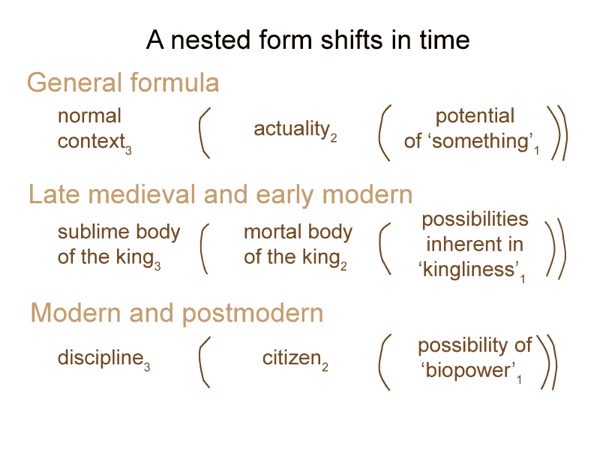
Sublime body3( mortal body2( potential of kingly being1))
0011 Does this express the character of the subject matter?
The mortal body is matter. The sublime body is the normal context that objectifies the mortal body. Thus, the king’s mortal body becomes a subject for political theology. The something that underlies the mortal body, giving its flesh weight, is the quality of being king.
0012 Moving to the present day, the matter of political theory falls to the people, rather than the king. The subject gets dispersed from one king to many citizens. The glorious body translates into what Michel Foucault calls “discipline”. The qualities that weight the mortal body of the king turn into “biopower”.
To me, modern political theory translates into the following nested form:
Discipline3( citizen2( possibilities inherent in biopower1))
0013 The two nested forms are shown below:
Normal context3 and possibility1 surcharge actuality2.
0014 The mortal body of the king is more than it otherwise would be in any other context. Its actuality possesses a surplus of immanence because it now has potential.
Similarly, one citizen may heroically rise above others as an expression of the biopower released by discipline. Other citizens are weighed and measured in the exercise of biopower.
0015 The pressure cooker of the royal person expanded to the business of the citizen. Medieval and early modern political theology gave way to modern political economy.
0016 Take a look at a painting. Jacques Louis David painted the extraordinary Death of Marat, during the French Revolution.
Compare this image to a wax effigy of a dead medieval king, or some other memorial, placed on the throne during official mourning.
0017 Jean-Paul Marat, the citizen, dies in his tub. David paints the death scene.
The king’s mortal body is buried. An icon of his sublime body is placed on the throne.
Clearly, David paints the equivalent to the sublime body of the citizen, Marat.
0018 One could say that this represents a loss of enchantment. After all, Marat, the revolutionary, hardly behaved royally.
This lack of royalty aligns with the emptiness above Marat, the corpse. The upper half of David’s painting is empty. If Marat had been royalty, the upper register would be full of angels and saints welcoming the glorious king.
What happened to the angels and saints?
0019 Heck, not even Marat’s fellow citizens are in the upper frame, registering the emotions of shock, grief, and, perhaps, relief. Critics have called the nondescript space above the dead Marat oppressive, abstract and unmotivated, characteristic of a representational deadlock.
0020 Perhaps, the cunning and ambitious artist was saying, “Do not let this be you.”, while painting, “This fellow was a citizen hero.”
Santner does not tell why Marat got knifed in his enclosed bathtub, filled with medicinal waters. Marat was a radical agitator. He named his newspaper, “The People’s Friend”. He was murdered by a woman who had come to him, claiming news from one of the districts of France.
During her trial, she testified that she killed one man in order to save one hundred thousand. She was found guilty. Her head was chopped off with a guillotine.
0021 Jacques-Louis David was charged with organizing Marat’s funeral. Surely, Marat was a martyr for the Revolution. Yet, despite the acclamation, no other figure appears in the painting.
0022 Why?
The reason is simple.
No sane person (whether angel, saint or fellow citizen) wanted to be associated with this crazy person, who was typical of the Jacobins, the party that celebrated the Cult of Reason and the Cult of the Supreme Being.
0023 David’s painting is both a warning and a paean.
0024 To Santner, the empty upper register of the painting associates to the impossibility of transcendence in the modern age. Business is busy-ness.