10/31/25

A First Look at Julian Jaynes’s Book (1976) “The Origin of Consciousness in the Breakdown of the Bicameral Mind” (Part 1 of 21)

0236 Why do I examine this work?

I reviewed Steven Mithen’s book, The Language Puzzle: Piecing Together The Six-Million-Year Story Of How Words Evolved (2024, Basic Books, New York).  See Razie Mah’s blog for September 2025.  The examination concludes on point 0235.

During the examination, I recall a book that Julian Jaynes publishes in 1976. 

I wonder, “Why does Mithen’s book remind me of Jaynes?”

I now have a copy of The Origin of Consciousness in the Breakdown of the Bicameral Mind (First Mariner edition (2000), New York, New York) before me.

This explains why I start the current examination on point 0236.

0237 Julian Jaynes (1920-1997 AD) earned master and doctoral degrees in psychology at Yale University.  He lectured in psychology at Princeton from 1966 to 1990.  In 1990, he writes a postscript that appears in the Mariner edition.

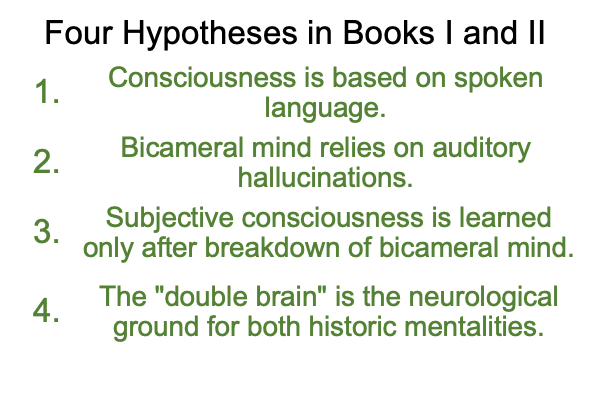
This afterward lists the four hypotheses in Books I and II.  Plus, the postscript expands on Part III, by discussing the psychological transition from the bicameral mind to subjective consciousness at the end of the Bronze Age in the Near East.

0238 Here is the list.
0239 So, why does Mithen’s book remind me of Jaynes’s work?

My review of The Language Puzzle led me to conclude that Mithen’s explicit rejection of a gestural origin of languageprevents him from realizing that his information implicitly supports the very position that um… he rejects.

Yes, if I ignore his declaration against a gestural origin to language, then I can start to recognize that speech is added to fully linguistic hand-talk after the domestication of fire, when the community becomes a social circle under pressure from natural selection.

0240 That reminds me of a curious pun that seems to have import in the year 2025AD.

The Russian word for “no” is “nyet”.

To the American ear, “nyet” sounds like “not yet”.  And, that means, “Yes, but not now.”

So, when Mithen says, “nyet”, to the gestural origins of language, his English speaking bicameral mind hears, “not yet”.  So, Mithen unwittingly drops clues to his nyet hypothesis within his own subjectively conscious argument.  These hints offer a weird twist to Looking at Steven Mithen’s Book (2024) The Language Puzzle.  It is as if Mithen’s own bicameral mind offers – what I will call – “a nyet hypothesis”.

0241 Now, consider the first two hypothesis (A and B) in Jaynes’s Books I and II.

First (A), subjective consciousness relies on spoken language.  Mithen consciously proposes that spoken words are built over millions of years through synaesthesia, cross modal “leakage” of sensations, from visual things and events to auditory vocalizations.

0242 Of course, this proposal comes across as sketchy.  Why would early hominins, such as the australopithecines and the early species in the Homo genus (3.5 to 0.6Myr – millions of years ago) do this?  And how?  The voice is most likely not under voluntary control.  Involuntary calls rule the day.

But, the vocal tract changes over time.  Most likely, the voice is on the verge of coming under voluntary control by the time that Homo heidelbergensis appears in the fossil record (perhaps, over 600kyr – thousands of years ago).

On top of that, Homo heidelbergensis shows up during the period when hominins domesticate fire (800-400kyr).  So, Mithen consciously and cautiously suggests that the synaesthesia business really takes off around that time.

0243 The nyet hypothesis?

Well, of course, proto-linguistic hand talk has plenty of time to evolve without cross-modal leakage during the early period (3.5 to 0.6Myr) and even has a couple of hundred-thousand years to become fully linguistic after hominins start to play with fire (0.8 to 0.6My).

So, synaesthesia would not make a jump from things themselves to vocal utterances, but from manual-brachial word-gestures to vocal utterances.

Suddenly, synaesthesia no longer seems implausible.

0244 Second (B), compare Mithen’s nyet hypothesis with Jaynes’s proposal of the bicameral mind.
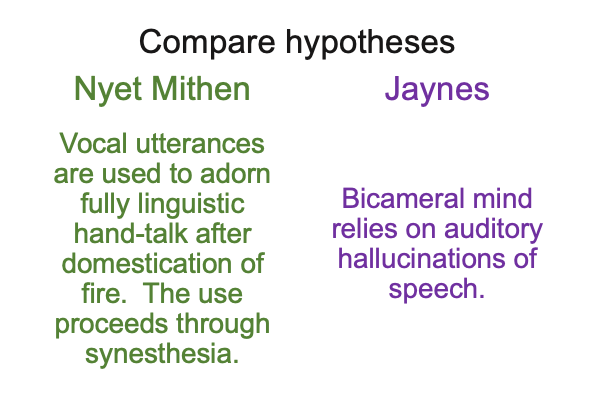
To me, the idea that manual-brachial word-gestures provide stimuli allowing synaesthetic crossover from visual to auditory sensations seems like “auditory hallucinations”.

0245 My goal in this first examination is to develop this impression.
10/3/25

The Evolution of Talk: A Note on How to Proceed (Part 1 of 1)

EOT 0001 The evolution of talk is not the same as the evolution of language.

Language evolves in the milieu of hand-talk.

So, what is the story?

0002 A course on the topic of human evolution is already on the market.

See Razie Mah’s, A Course on the Human Niche, consisting of the masterwork, plus four commentaries.

The Human Niche

Comments on Clive Gamble, John Gowlett and Robin Dunbar’s Book (2014) Thinking Big

Comments on Derek Bickerton’s Book (2014) More Than Nature Needs

Comments on Robert Berwick and Noam Chomsky’s Book (2016) Why Only Us?

Comments on Steven Mithen’s Book (1996) The Prehistory of Mind.

0003 The works are available for purchase at various e-book venues.  In order to conduct the course, purchase the e-book to read on a tablet (or as a PDF to print).  The class is not didactic.  It is Socratic.  The style is read and discuss.  The text is broken into points.  Each point can be discussed.  So, a leisurely class may open the text, read out loud and ask what the point suggests.

0004 The masterwork came out in 2018 and is still highly relevant to inquiry into the Lebenswelt that we evolved in.

How so?

The human niche is the potential of triadic relations.

No other course on human evolution poses this ground-breaking hypothesis.

0005 Nonetheless, six years later, Razie Mah adds to the first course with a second, consisting in two sequences of blogs.  This blog-inclusive (as well as e-book exclusive) course serves as a supplement to the master course, especially in regards to the evolution of talk.

0006 The first sequence is collated and rounded out in a compilation, titled, Comments on Michael Tomasello’s Arc of Inquiry (1999-2019), making the blogs and the compilation ideal for a guided- and home-schooling course.

Michael Tomasello worked at the Max Planck Institute for Evolutionary Anthropology for twenty years.  He wrote a series of books on the evolution of human cognition, communication, thinking, morality and so on.  In short, his books cover the evolution of the stuff of talk.

0007 Here is a list of the five commentaries in this first sequence.

One: Looking at Michael Tomasello’s Book (1999) “The Cultural Origins of Human Cognition”

(January 18-31, 2024, 12 blogs, 0-82 points)

Two: Looking at Michael Tomasello’s Book (2008) “Origins of Human Communication”

(January 17-4, 2024, 12 blogs, 83-186 points)

Three: Looking at Michael Thomasello’s Book (2014) “A Natural History of Human Thinking”

(February 29-5, 2024, 22 blogs, 187-388 points, completes Part 1 of Comments, see below)

Four: Looking at Michael Tomasello’s Book (2016) “A Natural History of Human Morality”

(March 26-1, 2024, 22 blogs, 389-600 points)

Five: Comments on Michael Tomasello’s Book (2019) “Becoming Human”

(points 601-793 are in Comments on Michael Tomasello’s Arc of Inquiry (1999-2019) Part 2, by Razie Mah, available at smashwords and other e-book venues)

0008 Yes, to complete the course, one needs to purchase Part 2.

How sneaky is that?

So, that is the meaning of “blog-inclusive and e-book exclusive”.

0009 The second sequence is collated in the compilation, titled, Synaesthesia and The Bicameral Mind in Human Evolution.   This compilation packages two commentaries on human evolution and sets the scene for a study of the first singularity.

This list continues the previous numbering.

Six: Looking at Steven Mithen’s Book (2024) “The Language Puzzle”

(September 29-4, 2025, 23 blogs, 0-235 points)

Seven: A First Look at Julian Jaynes’s Book (1976) “The Origin of Consciousness in the Breakdown of the Bicameral Mind”.

(October 31-8, 2025, 21 blogs, 235-525 points)

0010 Overall, this hybrid online-onsale course on the evolution of talk, by Razie Mah, are available for sampling (on the blog) and may be purchased at any e-book venue.

Comments on Michael Tomasello’s Arc of Inquiry (1999-2019), Parts 1 and 2 contains 753 points.

Synaesthesia and the Bicameral Mind in Human Evolution contains 525 points.

0011 Total: 1278 points, 21 hours at 1 minute per point.

Perhaps, this online course lasts around 4 to 5 weeks.

Enjoy this sample and consider purchasing other Razie Mah’s online courses, especially the one on the human niche.

09/30/25

Looking at Steven Mithen’s Book (2024) “The Language Puzzle” (Part 1 of 23)

0001 The full title of the book before me is The Language Puzzle: Piecing Together The Six-Million-Year Story Of How Words Evolved (2024, Basic Books, New York).  Dr. Mithen is a Professor of Early Prehistory at the University of Reading.  He has published before.  More on that later.

The book works on the metaphor of a jigsaw puzzle.  Fourteen chapters present the pieces.  The introduction and conclusion stage and arrange them.

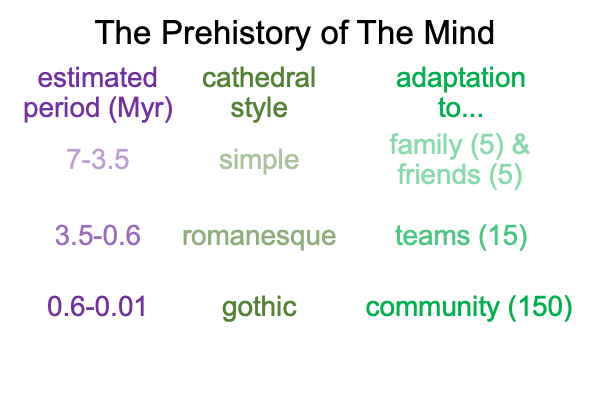
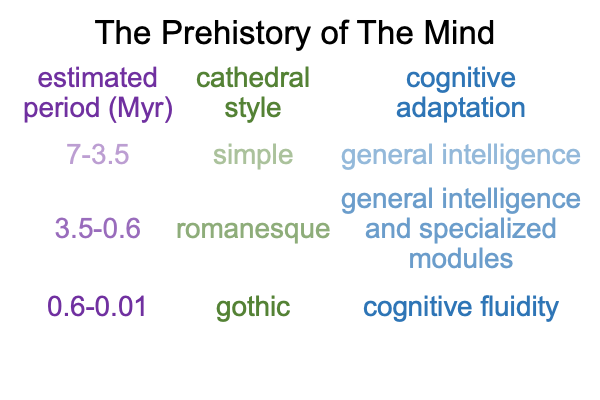
0002 This current metaphor is very different than a glorious historical metaphor used in a book published almost three decades earlier.  The Prehistory of The Mind (1996) offers the historical development of the architecture of cathedrals in Europe as a lens for considering cognitive evolution.  The metaphor works well because the nave associates to general intelligence and side chapels associate to specialized mental modules.

0003 From the genetic divergence from chimpanzees to the start of bipedalism, the simple nave of general intelligenceadapts to cognitive challenges.

From the appearance of bipedalism to the domestication of fire, specialized modules are added to general intelligence, but the two do not integrate.  Indeed, both specialized modules and general intelligence are supported by their own, thick, walls.  The metaphor is the Romanesque cathedral.

From the domestication of fire until the first singularity (think, “the potentiation of civilization”), general intelligence integrates with specialized modules, presumably due to talk becoming fully linguistic.  Language becomes the walls, supported by flying buttresses of automatic decoding.   The metaphor is the Gothic cathedral.

0004 Here is a picture.

0005 The metaphor is so wonderful that Razie Mah publishes the e-book, Comments on Steven Mithen’s Book (1996) The Prehistory of The Mind as one of the readers that accompanies the masterwork, The Human Niche, in the series A Course On The Human Niche (available at smashwords and other e-book venues).

0006 Mithen’s approach is also echoed in the work of another evolutionary anthropologist, Michael Tomasello, working at the Max Planck Institute in Leipzig, Germany, as discussed in Comments on Michael Tomasello’s Arc of Inquiry (1999-2019) (by Razie Mah, also see blogs for January through March, 2024).

0007 Mithen’s approach is also reflected in another review that belongs to the series, A Course On The Human Niche.  The title is Comments on Clive Gamble, John Gowlett and Robin Dunbar’s Book (2014) Thinking Big.  In this review, social circles turn out to be very important in hominin evolution.  Mammalian brain size roughly correlates to group size.  So, the larger the hominin brain grows, the larger the group.

Not surprisingly, Mithen’s metaphor indicates the social circle under the most intense selection pressure, irrespective of group size.

0008 What does this imply?

Obviously, group size is not the crucial factor in hominin evolution.

Whatever is increasing hominin brain size is.

0006 To me, it is not surprising that Mithen has not encountered Razie Mah’s review of his 1996 work, even though it is one of the few more-than-surface reflections on The Prehistory of The Mind available.

Perhaps, the same will go for this blog, which will take Mithen’s metaphor of a jigsaw puzzle quite literally. 

09/4/25

Looking at Steven Mithen’s Book (2024) “The Language Puzzle” (Part 23 of 23)

0229 So, what is The Language Puzzle about, in an implicit sort of way?

It is about how speech gets added to hand talk after the domestication of fire.

The irony of the work is found in Mithen’s explicit denial of the gestural origins of language, while…

… at the same time, the author provides a solution to a question that he cannot even pose.

0230 Examinations don’t get better than this.

This examination adds value to Mithen’s work in a surprising fashion.

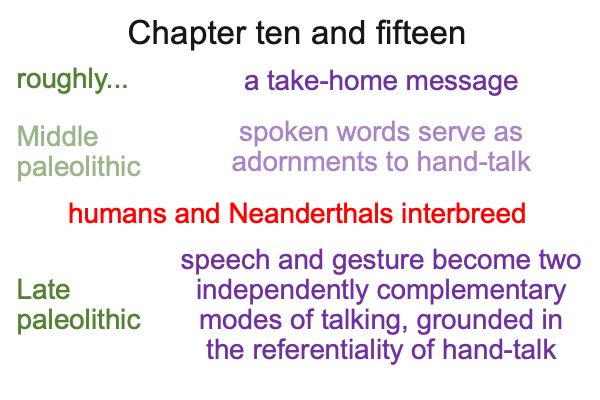
0231 This examination suggests that a tremendous amount of theoretical reformulation needs to be done.  In particular, the following juxtaposition of events is suggestive.

0232 I ask, “Does Homo sapien’s encounter, love affair, then divorce from the Neanderthals create a condition where speech becomes more and more independent as a mode of talking?  Does speech become capable of operating linguistically, independent of hand talk, yet remain integrated into the natural-sign references of hand-talk?”

0233 Take a look at the artifact of the lion-man, pictured in figure 3 on page 28 of Mithen’s text.

Maybe, we can ask him.

Do you think that he has something to say to us?

Surely, he cannot perform hand-talk.

So, the lion-man must speak for itself.

0233 Yes, it’s like synaesthesia gone wild.

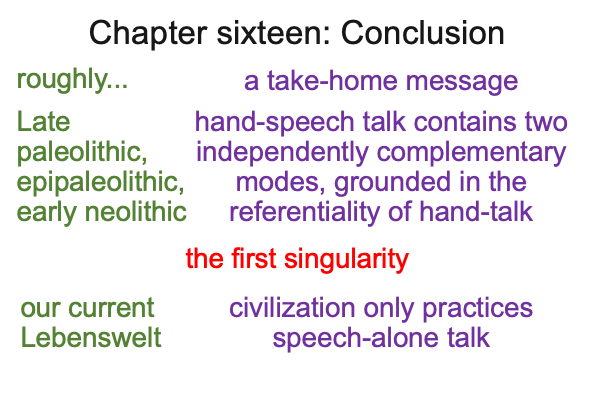
0234 But, “wild” is not even close to this last implication, which tells me that our current Lebenswelt is not the Lebenswelt that we evolved in.

What about the item in red?

See Razie Mah’s e-books, The First Singularity and It’s Fairy Tale Trace (for a technical proposal) and An Archaeology of the Fall (for a dramatic rendering), available at smashwords and other e-book venues.

0235 With that said, I thank Steven Mithen for publishing a book that can be fruitfully read both explicitly and implicitly.

Also, the story does not end here, because this examination plays a prominent role in the next commentary, Looking at Julian Jaynes’s Book (1976) “The Origin of Consciousness in The Breakdown of the Bicameral Mind”.