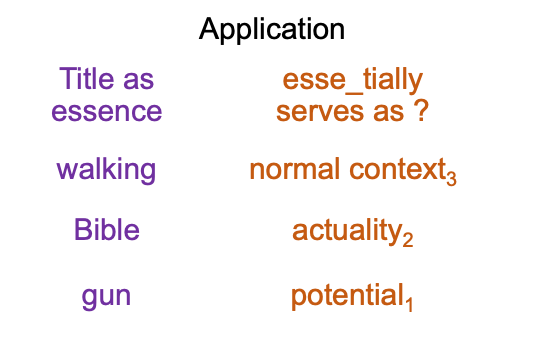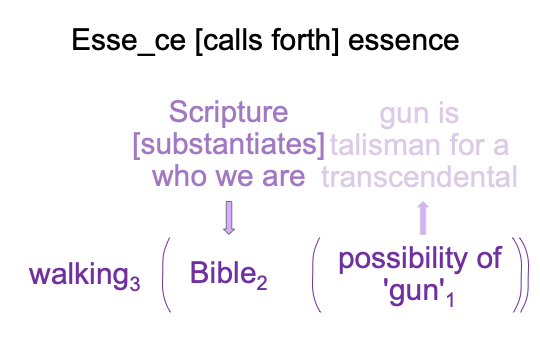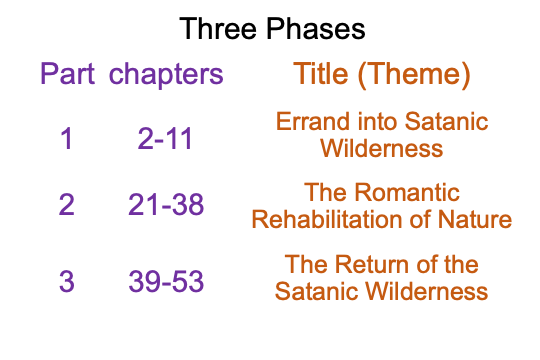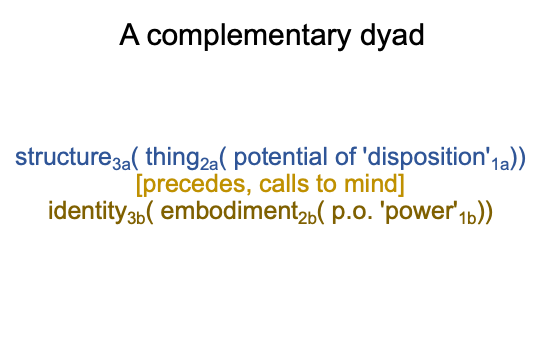
03/31/26

Looking at Mikhail Trunin’s Article (2017) “Semiosphere and history”  (Part 1 of 8)

0841 The article before me is published by Sign System Studies (volume 45(3/4), 2017, pages 335-360) by Mikhail Trunin in the School of Humanities at Tallinn University, Estonia.  The full title is “Semiosphere and history: Towards the origins of the semiotic approach to history”.  This particular volume is dedicated to semiotics and history.

0842 Juri Lotman (1922-1993 AD) and Boris Uspenskij (1937-present) are central characters in the first ascent of the Tartu-Moscow School of Semiotics during the 1960s through the 1980s.

Lotman’s treatment of a semiotics of history connects to his conceptualization of the semiosphere.  Of course, “semiotics” stands in the place of “semiology”.

Uspenskij’s treatment of the semiotics of history starts with the Latin phrase, “historia sub species semioticae”.  The phrase transliterates (more or less) into “history as a species of semiotics”.

Or maybe, “historical under the semiotic species”.

Of course, “semiotics” stands in the place of “semiology”.

0843 Previous examinations of articles in this and other volumes of Sign System Studies provide a way to appreciate what these semiologists have in common.

0844 So, let me briefly review.

The academic development of semiological consciousness for humanities scholars starts in the Departments of Slavic languages, during the so-called “Cold War”, since the Union of Soviet Socialist Republics casts its dominant ideology as that of science.  These humanities scholars begin to frame their interpretations of Slavic literature in terms of Saussure’s semiology and structuralism.  After all, semiology and structuralism are scientific, aren’t they?

0845 Semiology deals with content, the relation between parole (spoken words) and langue (corresponding ideation).  Technically, the relation between speech and thought is not motivated (hence the qualifier, “arbitrary”), since spoken words do not image or point to their referents.  Nonetheless, civilized humans behave as if they do.  But, that behavior may be attributed to grammatical structure (for a mother tongue) or a style system (for specialized discourse).

0846 Structuralism deals with how content is situated. Humans do not behave as if a spoken word is arbitrarily related to a mental act (or thought).  Humans act as if words and thoughts are one thing.  

Rather than attributing this behavior to an innate trait evolved under conditions where a parole (manual-brachial word gesture) images and indicates its referent (by way of the natural sign-qualities of icons and indexes, respectively), the modern scientist must attribute the behavior to truncated material and efficient causes.

In this case, the situating efficient and material causes are due to a system3b. Both mother tongue and specialized discourses3b operate on the potential of ‘laws of the system’1b.

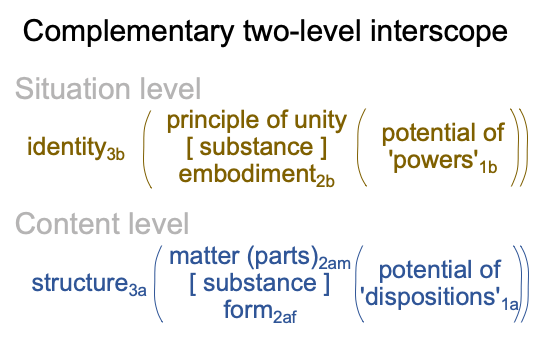
0847 Here is a fundamental interscope containing semiology3a and structuralism3b.

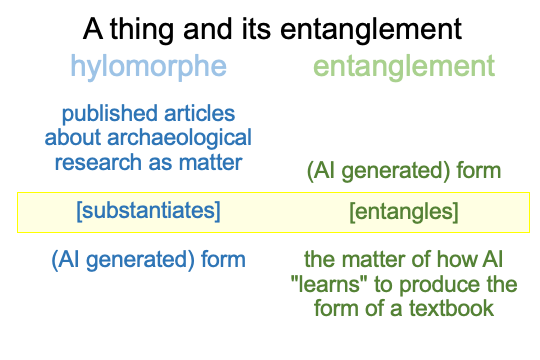
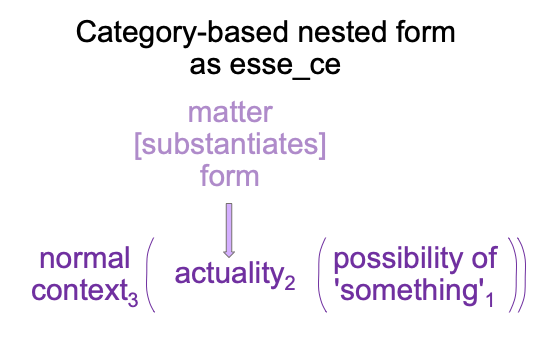
0848 On the content level, the normal context of Saussure’s semiology3a brings the actuality of the dyad {langue as matter2am [substantiates] parole as form2af}2a into relation with the potential of ‘signifier and signified’1a.

Cleverly, the content-level potential1a buries the evolution of language in the milieu of hand-talk in the ambiguity of the co-existence of signifier and signified.  Can a signifier exist without a signified?  Of course not. They must be belong to a monad, a single element.

Can a thought about ‘something’ exist without an image or indication of that ‘something’?

Does a manual-brachial word-gesture picture or point to its referent?

0849 Ironically, both Charles Peirce (1839-1914 AD) and Ferdinand de Saussure (1857-1913) live right before the monumental, civilization transforming battles among the enlightenment gods.  Peirce focuses on the nature of signs as triadic relations.  Saussure focuses on language as a thing (that is, a dyadic actuality).  

0850 The above figure tells the tale.  The content and situation level actualities2 are dyads, as suggested by Saussure. Normal contexts3 and potentialsare presumed in Saussure’s tradition, but explicit in terms of Peirce’s categories.

The category-based nested form is a triadic relation.  Triadic relations constitute the human niche.  Hominins adapt into the potential of triadic relations.

The content-level appears to be a reasonable expression of Saussure’s semiology because it expresses a triadic relation.  Not only that, but the content-level category-based nested form manifests all four of Aristotle’s causalities.  The dyadic actuality, corresponding to Peirce’s category of secondness, parallels Aristotle’s hylomorphe, the home of material causes and one terminus for efficient causation.

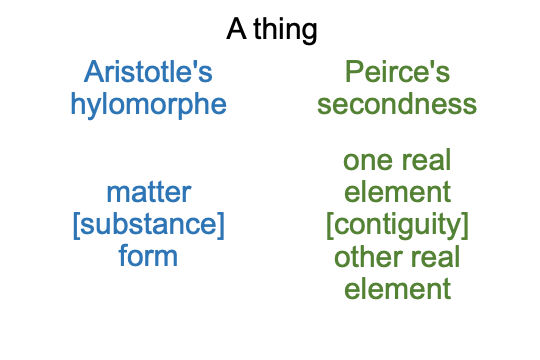
0851 Here is a picture of the category-based nested form as a manifestation of Aristotle’s causalities.  Peirce’s category of secondness contains two contiguous real elements.  For Aristotle’s hylomorphe, the one real element is matter.  The other real element is form.  The contiguity is [substantiates] or [substance].

0852 So, what does this imply?

First, Lotman and Uspenskij start out as scholars of Slavic literature in Russia, under a socialist regime, which extols its scientific credentials.  Academics in literature adapt to regime incentives by adopting Saussure’s scientific approach to language.  Saussure’s semiology is regarded as a scientific theory explaining the phenomena of language in our civilized world.

Second, the fundament interscope starts with Saussure’s semiology3a as a content-level nested form.  The actuality2 is {langue2am [substantiates] parole2af}.

Third, the category-based nested form manifests all three of Peirce’s categories as well as all four of Aristotle’s causalities.

Fourth (and yet to be discussed), Lotman’s and Upsenskij’s treatment of history and semiology starts with the fundament interscope.  Semiology characterizes a content-level interscope.  History enters the picture as a literature-based situation-level form2bf.  

0853 If these implications stand, then Upsenskij’s Latin title, “history as a species of semiotics”, will convert into “history as a species of literary text”.

03/23/26

Looking at Mikhail Trunin’s Article (2017) “Semiosphere and history”  (Part 8 of 8)

0935 What happens next?

Lotman and Uspenskij publish an article in Russian (in 1971), which is translated into English (in 1978), titled “On the semiotic mechanism of culture”.

This is followed by intense study of Vernadskij’s language of life-pressure, then the publication of Lotman’s seminal paper, “On the semiosphere”, in Russian (in 1984).

0936 The author goes to some length to distance Lotman’s concept of the semiosphere and Teilhard de Chardin’s (1881-1955) framework of Alpha-Omega Points.

Why?

De Chardin’s concept does not put the dyad, {cognition as matter2bm [substantiates] social interaction as form2bf}, into a semiological message1c.  De Chardin packages this actuality2b into a theological message1c.  A theological message1cdoes not comport with the TMS positivist intellect3a.

0937 Or does it1c now that the USSR no longer reigns?

That is question for another day.

0938 For this examination, I must stay with a positivist-loving message1c.

The crucial point is that culture-pressure2b is like life-pressure2b and the perspective-level model1c that is appropriate for this culture-pressure2b is esse_tially semiotic.

Esse_tailly?

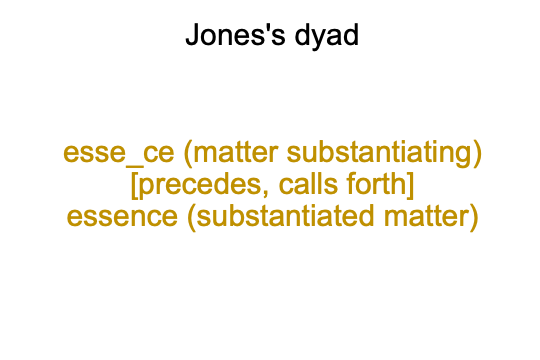
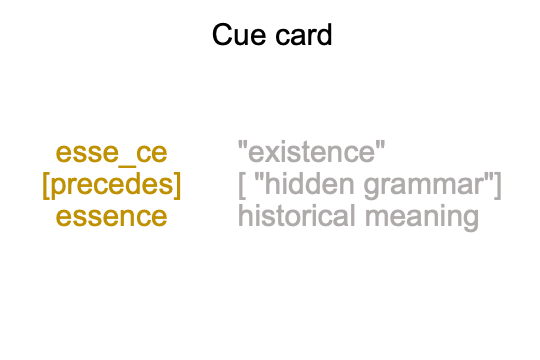
Yes, esse_ce is matter substantiating and essence is substantiated form.

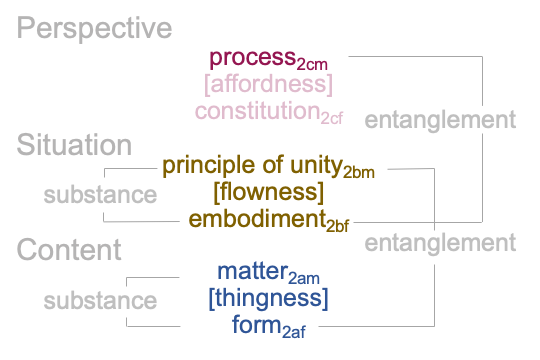
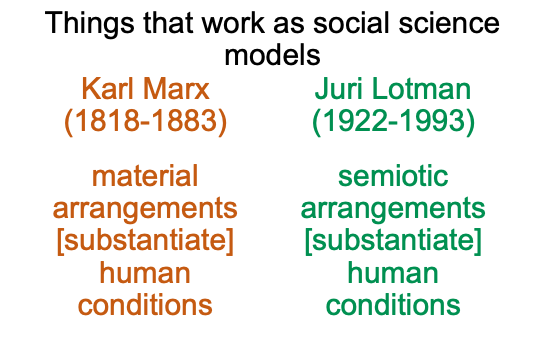
So, semiotic arrangements as matter2cm [substantiate] human conditions as form2cf.

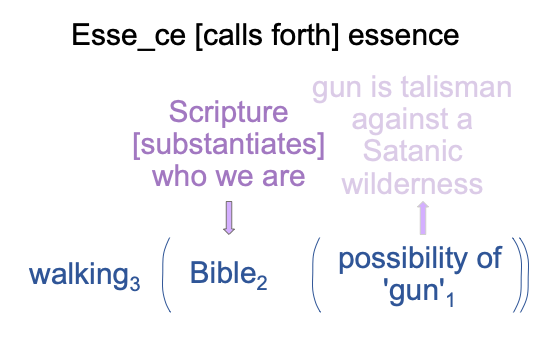
0939 Here is a picture.

0940 Esse_ce is {semiotic arrangements as matter2cm [substantiating]}.

Essence is {[substantiated] human conditions as form2cf}.

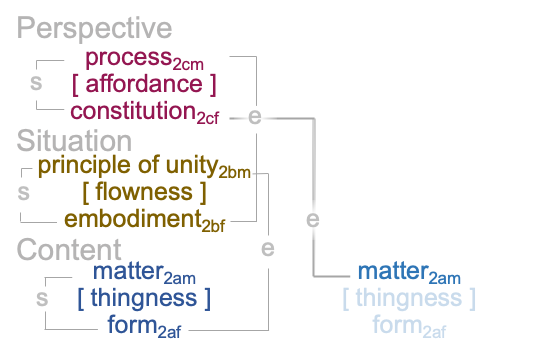
0941 Do I need to note that the universe of messages1c is Lotman’s “semiosphere1c“?

0942 The semiosphere1c parallels the concept of biosphere1c.

One can say that the semiosphere1c contains the totality of individual texts and independent languages.  They all relate to one another.

Why?

All texts and statements are forms2af that entangle matters of the language of meaning2am.  The presence of the language of meaning2am has the potential1b of engendering the matter of cognition2bm.  Cognition as matter2amsubstantiates social interactions as form2bf.  These forms2bf are contextualized as messages1cA universe of messages1cundergirds the doctrine2c that semiotic arrangements2cm substantiate human conditions2cf, in the normal context of mind theory3c.

0943 And what else?

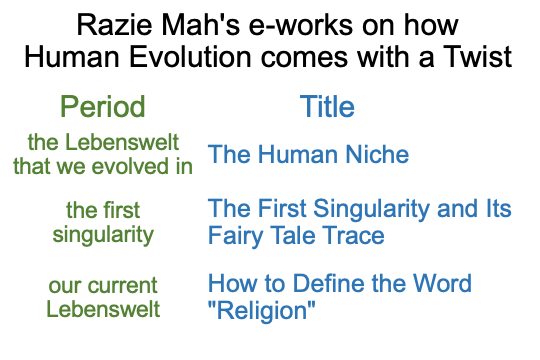
This explanation also applies to the Lebenswelt that we evolved in.  See Razie Mah’s e-book, The Human Niche.   The human niche is the potential of triadic relations.

0944 According to the author, Lotman and Uspenskij agree.

They also disagree.

That is the nature of intellectual discourse and discovery.

The author tells some of the story in a section titled, “How Lotman and Uspenskij influence each other”.

0945 In our current Lebenswelt, cultural studies3b (the situation-level normal context in the derivative interscope) always involve historical processes and texts2bf (situation-level actualities of the fundament interscope).

0946 How so?

The normal context of cultural processes3b brings the dyadic actuality2b of {cognition2bm [substantiates] social interaction2bf} into relation with the possibility of presence1b.

The presence1b of what?

Literary texts2af [entangling] a language of meaning2am.

0947 In the twentieth volume of Sign Systems Studies (1987), Uspenskij publishes “On the problem of the genesis of the Tartu-Moscow School of Semiotics”.

This examination adds value by commenting on Mikhail Trunin’s 2017 review of Uspenskij’s conflation of semiotics and history.

0948 The subtitle of the twenty-fifth volume of Sign Systems Studies (1992), the last volume edited Juri Lotman, is “Semiotics and history”.

Twenty-five years later, the forty fifth volume (2017) contains a special issue on semiotics and history.

0949 Finally, in 2025, Kaveli Kull and Ekaterina Velmezova publish Sphere of Understanding: Tartu Dialogues with Semioticians.  The book contains interviews with several of the figures mentioned in this article (volume 23 of Semiotics, Communication and Cognition, edited by Paul Cobley and Kalevi Kull, Walter De Gruyter, Boston/Berlin).

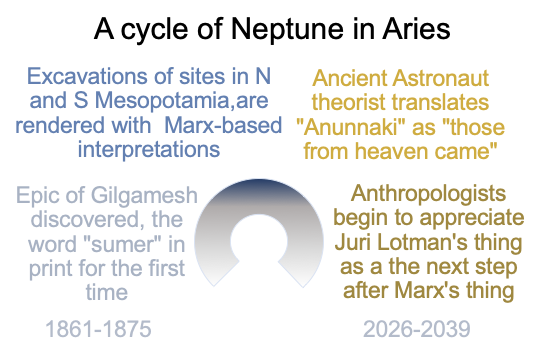
0950 One wonders whether the Tartu-Moscow School of Semiotics will find a path to a second ascent.

0951 Surely the scenery will differ.

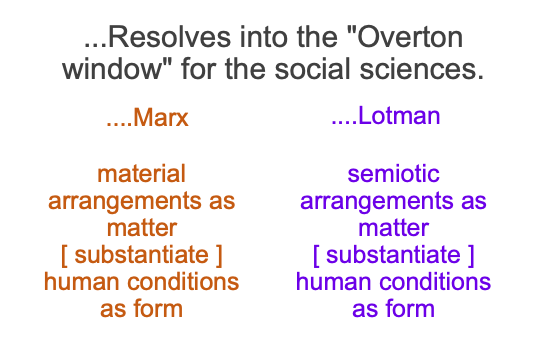
In the first ascent, science is god and {material arrangements [substantiate] human conditions}2c.

In the second, the divine Trinity is God and {semiotic arrangements [substantiate] human conditions}2c.

0952 So, what I am I suggesting?

Is Juri Lotman the Karl Marx of a new era?

History is a species of semiotics.

03/21/26

Looking at Augustin Fuentes’s Article (2016) “The Extended Evolutionary Synthesis…” (Part 1 of 16)

0001 The full title of the article before me is “The Extended Evolutionary Synthesis, Ethnography, and the Human Niche: Toward an Integrated Anthropology”.  The work is published in Current Anthropology (volume 57, supplement 13, June 2016, pages S13-S26; DOI: 10.1086/685684).  At the time of publication, the author is a Professor at the Department of Anthropology at the University of Notre Dame, Indiana.  He has since been scooped up by Princeton.

Scooped?

Ask anyone in Human Resources what that term means.

0002 The material for this thought-piece is developed at the Center for Theological Inquiry in 2012-13, in a collaborative titled, “Inquiry on Human Nature”, and presented to a Wenner-Gren symposium in 2014.

0003 This is the time when the much-vaunted program of “niche construction” is in the Zeitgeist… er… air.  The author seeks to capitalize on this extension of the evolutionary synthesis.  The first extension, starting fifty years earlier, is from natural history into genetics, and is now called “Neodarwinism”.

And what does he want to invest that capital in?

An integrated anthropology.

0004 Integrated anthropology?

I suppose that anthropology is to integrate with evolutionary science.

This is precisely an interest of Razie Mah, as witnessed in his three masterworks: The Human Niche (2018), An Archaeology of the Fall (2012), and How To Define the Word “Religion” (2015).

0005 But, that is not the references that I really should be pointing to.

I should be indicating two primers, by Razie Mah, available at smashwords and other e-book venues.  These are A Primer on the Category-Based Nested Form and A Primer on Sensible and Social Construction.

0006 Why?

The terms in the title of the work under examination associate to elements in a category-based nested form.

I associate “integration” to the normal context3.

I associate “anthropology” to the actuality2.

I associate “evolutionary science” to the potential1.

0007 The category-based nested form derives from the philosophy of Charles Peirce.  It consists in four statements.  The fourth is paradigmatic.  A triadic normal context3 brings a dyadic actuality2 into relation with the monadic possibility of ‘something’1.  The subscripts correspond to Peirce’s three categories.

0008 Here is a picture of my associations, along with how each element gets specified by the title of this article.

0009 What do these associations imply?

The human niche3 is the “integration3” of an “integrated anthropology”.

As such, the human niche3 should contextualize ethnography2 (as a specific application of anthropology2).

0010 The formal causation in these statements seems reasonable.

But, does the efficient causation seem plausible?

Does anthropology2 emerge from the potential of evolutionary science1?

Can ethnography2 situate the potential of ‘niche construction (as a case-study for an extended evolutionary synthesis)’1?

0011 The following figure distills the author’s challenge.

03/4/26

Looking at Augustin Fuentes’s Article (2016) “The Extended Evolutionary Synthesis…” (Part 16 of 16)

0163 Consequently, a pattern of domestication and entanglement is an appropriate darwinian model for the adaptations involved in discipline of ethnography.

0164 On one hand, the ethnographer is an emissary from a society with wealth and power and serves as an actuality independent of the adapting narod-folk2a.

The potential of intergroup competition1b says that fear should be the appropriate adaptation2b, in the course of natural and cultural selection3b.

0165 But this does not happen.  Instead, the narod-folk3b,1b adapt by losing their fear of the ethnographer’s society2b.  This is the nature of domestication.

0166 On the other hand, the narod-folk2a are the actuality independent of the adapting species for anthropologists within Western academies3b who are trained by (and train) ethnographers on the methods of mapping the cognitive spaces of narod-folk1b.  The very act of mapping the cognitive spaces of a narod (whether historically given or spontaneously generated) exhibits the anthropology of substantiation and entanglement.

0167 I conclude by returning to the snarky comment at point 119 and apologizing.

Yeah, semioticians have teeth.

0168 The author notes, in the final paragraph, that the human niche is a basal framework that enables the inquirer to include the salient features, forces and processes at multiple levels of… um… organization.  Surely, that description fits the idea of using the purely relational structure of the category-based nested form as a tool for inquiry.  All that this examiner has done is transpose elements from the author’s argument into the empty slots of a category-based nested form.

This suggests that category-based nested forms satisfy Bourdieu’s enigmatic phrase, of “structured structures predisposed to function as structuring structures”.  Category-based nested forms are purely relational (triadic) structures that gather material through the intuitive use of association, followed by an exploration of the implications.

0169 My thanks go to the author of this article, who undoubtedly has published more academic literature since this work from 2016, without the value that this examination adds.  Perhaps, this 2026 review may add to a re-illustration of the envisioned integrated anthropology.

02/28/26

Looking at Mihhail Lotman’s Article (2017) “History as Geography”  (Part 1 of 8)

0744 The article before me is published by Sign System Studies (volume 45(3/4), 2017, pages 263-283) by Mihhail Lotman in the Department of Semiotics at Tartu University, Estonia.  The full title is “History as Geography: In Search for Russian Identity”.  This particular volume is dedicated to semiotics and history.

0745 The year is 2026.  Hundreds of thousands of young men from the currently sovereign states of Ukraine and Russia are now buried in the geography of their sovereign states.  The war is senseless to anyone who is not moving money or armaments.  A theoretically defensive NATO (North Atlantic Treaty Organization) covets a vulnerable ember of the former USSR (Union of Soviet Socialist Republics).  Or is this a proxy war between the USDB (Unsuspecting Subjects Dominated by Bigilibs) and the CCP (Communist Chinese Party)?

Bigilib?

Big-government (il)liberal.

0746 Is Estonia’s geography its history?

Surely, the way the map of sovereign territories alters over the past few centuries is a sign of historical turmoil.

But, do not expect the corporate media to broadcast any information that does not comport with the interests of their clients.

You know, the ones moving money and armaments.

History appears to be irrelevant.  Geography and client interests are all that matter.

The form is war.

0747 And, the most important territory to be occupied seems to be what people say.

Corporate broadcasters talk about territory. Territory establishes that we all agree upon the ideology.  If we speak the same rhetoric about geography in a time of war, then we must all think the same.  How obvious is that?

The hylomorphe, where what I say (as form) is substantiated by what I think (as matter), turns out to be very useful for empirio-normative domination.  See Razie Mah’s three part e-book, Original Sin and the Post-Truth Condition, available at smashwords and other e-book venues.

0748 So, what are the interests of the citizen?

Who is the citizen?

The citizen is the subject (the empowerer) and the object (the um… “subject”) of sovereign power.

The truth serves the interests of the citizen.

0749 If truth serves the interests of the citizen, then what serves the interests of the unelected bureaucrats?

Oh, it must be the will of the citizen.

0750 Is the citizen reasonable3a, when allowing experts to decide which tidbits of what I say2af shall be ascribed to um… the citizen’s will1a?

Here is the category-based nested form.

If perplexed, consult Razie Mah’s e-books, A Primer on the Category-Based Nested Form and A Primer on Sensible and Social Construction.

0751 I ask, “What is the author, Mihhail Lotman, searching for?”

Intellect3a conveys identity.  There are two types of identity.  One is potentiated by truth1a.  The other is potentiated by my will1a.

Notice, that the term, “identity”, which labels my intellect3a based of the potentials of truth or my will1a, cannot be pictured or pointed to.  Like all normal contexts and potentials, identity is crucial for understanding.  But, what is understanding?  Understanding comes when an actuality2 is placed into its proper normal context3 and potential1.

0752 Identity3a is a style of understanding.  Is3a it not?

After all, it3a changes with potential1a.  Does it3a not?

One cannot picture or point to identity3a.

If one searches for it3a, it3a will always prove elusive, because it3a contextualizes3 and potentiates1 what I think2am and what I say2af.

Better to think2am and speak2af about geography.

02/20/26

Looking at Mihhail Lotman’s Article (2017) “History as Geography”  (Part 8 of 8)

0827 The next section of the essay is titled, “Russian space”.

Consider the contrasts (B) to Russian identity3a (A) that have appeared in this examination.

Each of these dyads embody an Aristotelian thing.  We encounter things.  Things are composed of matter and form.  Things can serve as matter for other things.  Things can serve as form for other things.  

0828 Perhaps, it is no surprise that geography is a thing that serves as matter, allowing me to form the way that I orient myself in Russian space.  At the same time, geography is implicated in what I say, especially when I say, “Moscow is first of all, a tsardom, not a city, and that tsardom is oriented to Constantinople, that is Byzantium.”  Geography, as a matter of cognition, substantiates “Russian space”, in the form of historic belongings.

No wonder the author describes Russian geography as a mystical historiosophy.

0829 Nothing is quite fixed, because directions are confounded with historical processes and so are… um… borders.  Russia, is a form, with an expanse without borders as originating matter.  Yet, Russia, as a form, is regarded as a nation.

Here is the geography of Russia, writ-large.

0830 The original thing is Russian space.  An expanse without borders [substantiates] Russian space.

From page 274 to 279, the author dwells on the way that Russia, as a civilization, wrestles with Russia, as a nation.

The reason is clear.  The Russian space, as form, entangles (through alliances and conflicts) the matter of borders.

Confoundings are dangerous.

0831 In the author’s historical telling, in its infancy, Russian civilization does not so much worry or fixate on borders.  East and West offer principles that can be adopted or rejected.  The West is logical, blabbering and deceitful.  The East is none of these, because the East does not speak, and that can be sort of scary.

0832 The author does not detect a resolution of the entanglement in favor of the Western formulation of nations with borders.  And yet, a particular closure is anticipated.

0833 Here is a picture.

0834 What is the promise?

Russia will join the West.

0835 What is the problem?

A nation-child is born at the same time as the mechanical philosophers of the 1600s.  This child of the British Empirereaches adolescence.  This adolescent breaks free.  One orbit of Pluto later, the adult-nation is now a cacophonous grasping, manipulative and technologically savvy minion of oligarchs.  The financial manipulators demand total submission as the price of being rewarded as promised.  The USCB is now the Union of Socialist-Capitalist Bigilibs.

Please, conform to our empirio-normative domination.

AI guides iron hands within velvet gloves.

0836 So, now Russia, acting as a nation with borders is entangled in another matter, the need to become a nation without borders2a, through alliances, rather than through lines on a map.

0837 Yes, something is different.

The Russians are now a people.

And, the people advocate for Eurasian convergence (D).

See Comments on Alexander Dugin’s Book (2012) The Fourth Political Theory, by Razie Mah, available at smashwords and other e-book venues.

0838 Accordingly, Lotman’s typology of relations of cultural betweenness, depicted in the purely relational structure of the Greimas square, conjures an opportunity.

0839 Take a look at D in the last two figures and wonder, “What type of matter is thus entangled?”

0840 My thanks to the author, Mihhail Lotman, for publishing this article, whose full title is “History as geography: In search of Russian identity”.

02/19/26

Looking at Peeter Torop’s Article (2017) “Semiotics of Cultural History”  (Part 1 of 11)

0953 The article before me is published by Sign System Studies (volume 45(3/4), 2017, pages 317-334) by Peeter Torop in the Department of Semiotics at Tartu University, Estonia. This particular volume is dedicated to semiotics and history.

0002 Amazingly, this article has no subtitle.

Perhaps, I may add one: An Inquiry into the Chronotope.

0954 At first, I thought that the word, “chronotope”, coined by Mikhail Bakhtin (1895-1975 AD), was “chronotrope”, where “trope” is a label for a rhetorical trick that belies the complexity of things.  Tropes change over time.

0955 For example, the Latin trope, “ens reale“, has been translated as “being that is real”, as well as “mind-independent being”.  Add time, and the parole of the chronotrope stays the same, but the matter, the langue, shifts.  “Ens reale” migrates from what the scholastics pursue in their philosophical discourses to what?… a being that is mind-independent?  Does mind independence (as matter) somehow substantiate a form (that is the elusive goal of philosophical inquiry)?

0956 If I use Aristotle’s hylomorphe as an exemplar of Peirce’s secondness, I can diagram the following “chronotrope”.

0957 Peirce’s category of secondness consists of two contiguous real elements.  For Aristotle’s hylomorphe, the real elements are matter and form.  The contiguity, placed in brackets for proper notation, is [substance] or [substantiates].  Either noun or verb is appropriate, because the contiguity can be construed as either.

0958 Does Aristotle’s hylomorphe transmogrify, over time, into mind-independence as a real element and the term, “ens reale” as another real element?

Perhaps, mind-independence could work as matter that substantiates ens reale as form.

Or, maybe, mind-independence could associate to langue and ens reale could go with parole.

0959 I suppose that tropes can shift (in time) in awkward ways.

0960 That leaves me with Bakhtin’s term, “chronotope”.

In chemistry, the nucleus of an element contains protons and neutrons.  The word, “element”, precisely labels a fixed number of protons in its nucleus.  The number of neutrons may vary, resulting in different atomic masses for two different isotopes of the same element.  The word, “isotope” labels a fixed number of protons (characterizing the element) and neutrons (contributing to the isotopic mass).  Some isotopes have too few or too many neutrons, making the nucleus unstable and subject to radioactive decay.

0961 Here is a picture.

0962 By analogy, a “chronotope” is the same element, but its placement in time may vary.

Is that correct?

0963 Is time neutronic?

Maybe the analogy of radioactive decay can introduce time into the elemental thing by producing a confounding, in the following manner.

Yes, a confounding labels one form associated with two matters, one originating and one entangled.

0964 The problem is that radioactive decay as matter cannot resolve into a substantiation of the element as form, since it changes the elemental form by altering the miox of neutrons and protons in the atom.

Well, certainly the elemental thing, {protons and neutrons as matter [substantiate] a radioactive isotope}, is subject to decay.  But, does decay itself constitute an entangled matter, especially when the occasion of radioactive decay changes the original element into another element plus a radioactive emission?

0965 In other words, if radioactive decay occupies the slot for entangled matter, then the original elemental thingchanges form upon resolution of the confounding.

0966 What a weird analogy.

Nevertheless, allow me to continue.

02/7/26

Looking at Peeter Torop’s Article (2017) “Semiotics of Cultural History”  (Part 11 of 11)

1088 The final section, on cultural semiotics as semiotics of cultural history offers the trope… er… slogan… saying, “Culture is memory.”

On the fundament, the literary text2bf offers something to remember, if for no other reason than it is encoded as a text. Texts may survive to be available to the future.  Parole2af is often not so lucky.

Time is cruel

So many texts have been lost.  Precious few oral traditions remain intact.

The issue is twofold.  The text or the oral tradition needs to survive.  Also, a code for translation must be retained… or… recoverable.

This is one of the problems with the writing of ancient Mesopotamia, where there are few texts that have more than one script in a single document.

1089 Lotman spends many hours reflecting on text and code.

Some of his reflections end up in his book, Universe of the Mind.

1090 The author presents a table on Lotman and Uspenskij’s views of the temporal aspect of chronotopical analysis.

1091 Of course, the above table does not correspond to Torop’s original table2bf (fundament and derivative, Figure 1).

Perhaps, this table further develops and refines Bakhtin’s semiological structuralist model2c (Figure 2).  

However, it is hard not to imagine that the above figure translates into an interscope.

1092 Say what?

1093 The Tartu-Moscow School expresses two interscopes, the fundament culminates in the semiological structuralist model2c and the derivative rises to a yet-to-be-determined perspective-level actuality2c.

1094 Bakhtin’s notes and scribbles express two interscopes as well.  These two interscopes constitute two adjacent tiers within a model more expansive than the semiological2a structuralist2b model2c.  The construction of Torop’s article intimates that this expanse is well worth investigating.

1095 The way that Lotman’s thing includes time shows how Torop’s tables2af entangle a language2am of presence1b (as well as meaning1a).  Lotman recognizes2bm time2af as a formal requirement of the chronotope2am and forces Torop to construct his own table (Figure 4 on page 330) as a way to situate2bf that entanglement2a.

1096 Here is a juxtaposition of the virtual nested form in the category of secondness for the derivative interscope and Torop’s reconstruction of Lotman’s approach.

1097 A virtual nested form proceeds down a column in a three-level interscope.

Here are the columns in the realm of actuality2.

1098 In the general form of the derivative interscope, a perspective-level actuality2c (to be determined) brings the situation-level actuality of {cognition2bm [substantiates] social interaction2bf} into relation with the possibility of {a literary text2af [entangling] a language2am of meaning1a, presence1b and message1c}.

1099 For Torop’s table addressing Lotman (Figure 4), the perspective-level actuality2c of {semiotic arrangements2cm[substantiate] human conditions2cf} virtually brings the situation-level actuality of {Lotman’s recognition of time2bm[substantiates] Lotman’s thing with respect to time (as a three-level table)2bf} into relation with the content-level possibility that {Torop’s tables as text2af [entangle] the chronotope’s formal requirements2am of the normal context of the Tartu-Moscow School3a}.

1100 Oh yeah, that makes sense.

Cultural history manifests in the framework of the semiotics of the text, where the text is a representation of culture.

Bakhtin’s culture, that is.

Lotman’s culture, too.

1101 If Bakhtin’s insights are formalized as text by Torop’s tables, then Torop’s tables constitute a semiological structuralist model2c of Bakhtin’s insights2af and support the entanglement of a language2am that sounds very much like any language of interpretation.

What is the meaning1a, presence1b and message1c of the chronotope?

Lotman’s thing focuses on time and produces a variation of the fundament interscope.

Torop’s table of Lotman’s consideration of time produces a categorical stairway to a perspective-level actuality2c in the derivative interscope.

1102 Once again, what is Lotman’s thing?

Oh, yes, it is the archaeological recovery of an insight that is present… at least in potential… since the very origins of Slavic civilization.

In the beginning is the Word, and the Word as matter substantiates the human condition as form.

1103 Here is a picture.

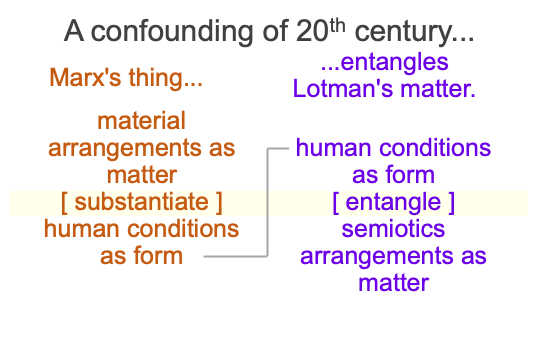
Such is the resolution, of the confounding where history substantiates culture and culture entangles semiotics.

1104 My thanks to Peeter Torop, for putting pen to paper and for building the tables that demonstrate the fecundity and the surprising beauty of the first iteration of the Tartu-Moscow School of Semiotics.  May a second iteration follow.

02/6/26

Looking at Kalevi Kull and Ekaterina Velmezova’s Book (2025) “Sphere of Understanding” (Part 1 of 3)

SaH 0001 The full title of the book before me is Sphere of Understanding: Tartu Dialogues with Semioticians.  The book is volume 23 of the series, Semiotics, Communication and Cognition, edited by Paul Cobley and Kalevi Kull, published in 2025, by Walter de Gruyter GmbH, Berlin/Boston.  

Kalevi Kull is a biologist who joined the Department of Semiotics at the University of Tartu in 1997.  Ekaterina Velmezova is a linguist and historian who graduated from Moscow State University.  Each, in their own way, represents the two poles of the Tartu-Moscow School of Semiotics.

0002 The question is: Does this book mark the end of the first ascent or the beginning of the second ascent for the Tartu Moscow School of Semiotics.

0003 After the introductory chapter, extolling the virtues of dialogue, the authors offer a brief history of semiotics in Estonia.  The arrival of Juri Lotman, a scholar of Slavic literature, initiates a transnational collaboration within the old USSR.  The summer school at Tartu University proves seductive.  Here is a place where scholars in Slavic literature are free to play.

0004 So, one aspect of the sphere that the authors desire to understand is a historical conception, sired from the intellectual loins of Juri Lotman, that has taken a life of its own.  The only question is: Who is she?

0005 Kalevi Kull wrestles with emergence in biological systems.  What about this semiotically inclined child of history?

0006 Ekaterina Velmezova performs translation into English, as well as, I imagine, editing in Russian.  After all, these are times when Estonians may want to hedge their bets.

0007 Who knows?

Can the Tartu-Moscow School of Semiotics be born again?

The interviews provide clues.  They are gems framed in their historical moments.

0008 So how do I, a crypto semiotician, respond?

0009 First, I look at back issues of the journal that Juri Lotman founded, Sign System Studies, and find a special issue in 2017 bearing the title: Semiotics and History.

Second, I review several of the articles, plus one from 2016, in order to produce my contribution to the book’s dialogue.

Third, I package the results into an online independent mini-course, the first in a series titled, “Semiotics and History”, by Razie Mah, starting in December, 2025.

0010 The editors of the journal, Sign System Studies, have permission to scrape the blogs of this mini-course for a special on-line issue, as well as permission translate the blogs into other languages.  After all, time is cruel.  If the blog goes off-line, then the editors will retain a response that addresses what the authors seek.

0011 What do the authors seek?

0012 First, they seek a “sphere”.  Shall I add… “of influence”?  Or, shall I be satisfied with “of understanding”.

The interviewers ask semioticians questions.  After the year, 2008, these queries include how the semiotician came into contact or awareness of the (first ascent of) the Tartu-Moscow School of Semiotics (1960s-1980s).  The authors want to appreciate the school’s sphere of influence.

0013 Second, they seek understanding.

Here is where the discrepancy between Saussure and Peirce comes in.  Today, practitioners of both traditions are called, “semioticians”.   But, Saussure called his path of inquiry, “semiology”.  And structuralism?  Structuralism virtually situates semiology.  Structuralism is semiology as matter substantiating aesthetics as form.

0014 So, what am I doing?

I follow the path of Peirce, into the labyrinth of triadic relations, and attempt to identify the normal contexts (thirdness) and potentials (firstness) of the actualities (secondness) of semiology and structuralism.

0015 What do I find?

I find that “she” is Slavic civilization, herself.

0016 My examination of articles in the 2017 special issue of Sign System Studies, titled “Semiotics and History”, pays tribute to the authors’ search, embodied in the title, and provides a way to understand the Tartu-Moscow School’s sphere of influence, for both the first iteration in the old USSR and its second iteration in the upcoming Eurasian convergence.

02/5/26

Looking at Kalevi Kull and Ekaterina Velmezova’s Book (2025) “Sphere of Understanding” (Part 2 of 3)

SaH 0017 The authors quest for a sphere of understanding.  They seek the egg, so to speak, impregnated by Juri Lotman’s genius.  In the interviews in chapter 2.1, Lotman is spent, although still alive.  He is old.  The interviewer is a youth, a personification of the metaphysical love-child born after Slavic civilization reveals herself to Lotman’s circumspection.

0018 The miracle of Lotman’s arrival in Estonia is, weirdly, recounted in the last interview (2.14) with psychologist and cultural theorist, Jaan Valsiner.  As it turns out, Valsiner’s step-father was instrumental in getting Juri Lotman to Estonia after the Second World War.

0019 Jaan Valsiner demonstrates that the Tartu-Moscow’s sphere of influence is diffuse.  His testimony is seconded by Paul Cobley (2.13), Terrence Deacon (2.12), Jesper Hoffmeyer (2.11) and Stuart Kauffman (2.10).

0020 The sphere becomes less diffuse in interviews with Roland Posner (2.9), Gunther Kress (2.8) and Wilfred Noth (2.7).

Notably, Noth conducts a discourse on the crucial potential of truth, as opposed to the potential of will.  Indeed, the contrast between truth and will turns out to be integral to my examination of a 2017 article on Russian identity.

0021 Finally, the sphere becomes tangible with interviews with American anthropologist, Myrdene Anderson (2.6), who researched indigenous people in Sweden, Italian semiotician Paolo Fabbri (2.5), who railed against the wooly thinking that passes for “models” in contemporary humanities, and the Italian know-it-all Umberto Eco, who noted the importance of iconicity in semiotic humanity.

What?

“Semiotic humanity”?

What about semiology?

0022 Contemporary academic discourse is currently conducted with expert-coined spoken words, but these utterancescannot picture or point to their referents.  Academics swim in a pool of differences… er… two arbitrarily related pools of differences.  No one can tell where he or she flotates.

Flotates?

This is what happens when spoken words are placeholders in two arbitrarily related systems of differences.

0023 Finally, the interviews engage a still-living member of the original Tartu-Moscow School of Semiotics, Boris Uspenskij (2.2).  This interview gets a full examination in the course on Semiotics and History.  Uspenskij stands within the sphere that the authors aspire to understand.

0024 So, what does Razie Mah’s contribution under the banner of Semiotics and History offer?

0025 For the diffuse sphere, these examinations will present a historical narrative of ideas in the style of diagrams of purely relational structures.  In short, Peirce-inspired diagrams offer a new way to narrate intellectual history.

0026 For the almost tangible sphere, these examinations practice a method of association, followed by a discussion of the implications.  The articles provide material to fill in the empty slots of relational structures.  When associations are made, implications become apparent.

0027 For the sphere itself, one unexpected insight is that, as the first ascendant of the Tartu-Moscow School of Semiotics struggles to fulfill the political mandate of the USSR (to make all fields of inquiry “scientific”), the researchers excavate the recently-buried remains of the civilization that is their subject of inquiry.

Imagine a scientific investigation of Russian language, history and literature, as a archaeological excavation into the being of Slavic civilization.

0028 Is that the same “she” that… um… you know… captured the attention of Juri Lotman?

How confounding.

0029 The next blog offers an introduction to Semiotics and History: The Tartu-Moscow School of Semiotics.