0002 In 2012, the European Science Foundation convened an exploratory workshop, titled, “The Neolithic of Arabia: New Paradigms and Future Perspectives”. The schema is available online.
In the section on the main objectives of the workshop, the organizers (Dr. Remy Crassard and Dr. Phillipp Drechsler) note that the fragmentary characteristics of scientific knowledge to date favors the persistence and acceptance of current theories and precludes the development of new paradigms, along with comprehensive and coherent approaches to the Neolithic.
0003 This “favoring” and “precluding” is intrinsic to a recent essay in the journal, Prehistory, which is examined in Razie Mah’s blogs on January 1, 2026, titled Looking at Melinda Zeder’s Article (2025) “Repackaging the Neolithic”.
0004 While the workshop organizers do not call for a novel global vision, they do call for a synthetic approach that encourages the integration of diverse research on the topic.
0005 This open letter calls for more comprehensive research into the link between the early Holocene infilling of the Arabian Gulf and the emergence of two spheres of interaction for the Ubaid (southern Mesopotamia and the western Gulf littoral). The addendum provides an introduction.
0006 How comprehensive?
0007 Consider the questions raised by Razie Mah in the e-book, The First Singularity and Its Fairy Tale Trace.
0008 First, does the forced migration induced by the early Holocene marine transgression explain the ‘Ubaid phenomenon, where this culture may be considered to be the first to practice speech-alone talk?
0009 Second, does speech-alone talk spread from the Ubaid, along established paths of down-the-line trading, to the rest of Eurasia? Why do all hand-speech talking cultures adopt speech-alone talk after coming into contact with a speech-alone talking culture? Are there archaeological markers indicating that, not only has contact occurred, but the transition is underway. Artifacts that might demand labels, like copper, certain types of pottery (such as the white pottery of the Archaic Hassuna), changing habits of lithic-tool knapping, might serve as markers.
0010 Third, what are the semiotic natures of hand-talk, hand-speech talk and speech-alone talk? Does hand- and hand-speech talk constrain social complexity? Does speech-alone talk potentiate unconstrained social complexity?
0011 These questions can be bundled into one grand question, which, ironically, is what the workshop specifically forbade.
Is our current Lebenswelt the same as the Lebenswelt that we evolved in?
Are we who we evolved to be?
0012 I hope this call is heard by all people of good will. The time has come to set aside the swords and pick up where European Science Foundation’s exploratory workshop left off.
0010 Earnestly yours,
The Desk of Razie Mah
September 2-15, 2026
0011 Addendum: Looking at Richard Cuttler’s Article (2013) “Considering Marine Transgression as a Mechanism for Enforced Migration and the Littoral Gulf ‘Ubaid Phenomenon” in Razie Mah’s blog, September 1, 2026
0001 The citation for this article is: Cuttler, R. (2013). Considering marine transgression as a mechanism for enforced migration and the littoral Gulf ʿUbaid phenomenon. Arabian Archaeology and Epigraphy, 24(1), 37–43.
I obtained my copy from Wiley online. Thank you.
0002 In the early 2010s, Dr. Richard Cuttler smells a very interesting intellectual aroma, but is unable to sense where the trail leads. What is the link between the infilling of the Persian Gulf and the appearance of the Ubaid culture of southern Mesopotamia?
0003 The titular “consider” is one way of saying, “Imagine the possibility.”
If the marine transgression into the Arabian… or is it Persian?.. Gulf enforces a migration of the people who originally settled the fresh water marshes of the Ur Shatt (that’s “Ur Schatt” for Germans) waterway, then does that account for the Ubaid appearing in both Mesopotamia and on the shoreline of central Arabia?
0004 Why would an archaeologist consider such an if-then scenario?
During the glacial period, the Euphrates and Tigris Rivers flowed together into a waterway, the Ur-Shatt, that fed a corridor of lakes and marshes (now underwater “basins”) into the sea. Such a concourse would be a favorable place for Epipaleolithic enthnoses to settle, taking advantage of diverse natural resources.
0005 Little did they realize that the Ur-Shatt waterway, a veritable oasis during the glacial period, would slowly be covered with around 70 meters of sea-water. By “slowly”, I mean thousands of years. At the same time, the rise in sea-level has a horizontal dimension. After filling the basins, sea-water spreads into a shallow geological bowl.
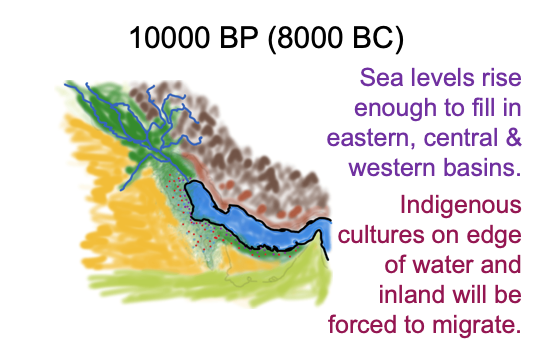
0006 Here is a picture of the scenario once the low-lying basins are full.
The indigenous settlements are represented by red and purple dots.
The sea-rise will force these people to migrate.
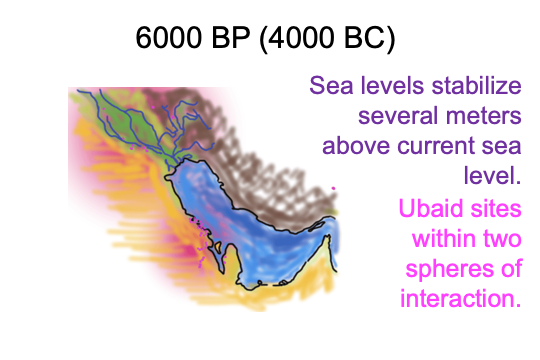
0007 Here is a picture once the Gulf is filled to the brim (as far as the sea-rise would go, which is several meters above the present sea-level).
The Ubaid settlements are represented by magenta dots. Plus, the background color has taken on a magenta hue, denoting two spheres of interaction, the central Arabian Gulf and southern Mesopotamia. This is my rendition of Figure 1 of the article.
0008 How does anyone know that there are two spheres of Ubaid settlements?
Originally, the term, “Ubaid”, labels a type of pottery found in excavations throughout southern Mesopotamia. Why did archaeologists not also look at the central Arabian Gulf region?
The author is perhaps too embarrassed to say that late-nineteenth and early-twentieth century archaeologists focused on this region because… well… that is where the Garden of Eden is supposed to be. That is where Noah’s flood took place. That is where Judah was taken into exile in ancient times. So, of course, Protestant Christians are going to pay for exorbitant excavations in order to reveal… you know… something about justification by faith alone, scripture alone, and grace alone.
0009 Okay, I am just guessing on that one.
0010 Then, in 1968, G. Burkholder discovers Ubaid pottery in the western Gulf littoral.
0011 What a surprise.
The Ubaid is the lowest level excavated in southern Mesopotamia, which means that it has the deepest time horizon. Now, the Ubaid shows up near Bahrain. Doesn’t that smell like a great research project? To an archaeologist, it sure smells good… but, how does one follow the scent when the trail goes under the waters of the Gulf?
Professor Richard Cuttler, who I am sure has some good stories to tell, seeks funding for seismic reflection maps of the Gulf’s underwater landscape, in order to obtain better placed sediment cores of the sea-floor. He wants to investigate, but he does not know that there is another component to the puzzle. Also, big funding is hard to come by.
0012 If the project is funded, what will he find?
Among other points, the sediment cores would provide pollen-based clues to the changing climate of the time.
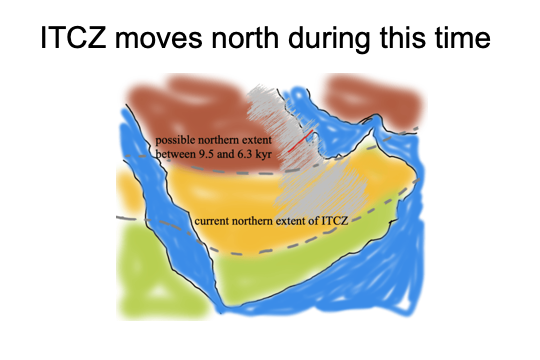
0013 At the start of the current interglacial, the Inter-Tropical Conversion Zone (ITCZ) shifts north, then back, then north again, in a most fickle manner. For the time under consideration, the ITCZ moves north, but not as far north as the gulf-to-be.
Here is a picture.
0014 The two dotted gray lines indicate the furthest extend of the ITCZ currently, and between 9.5 and 6.3 thousands of years ago (kyr). South of the line, the monsoons deliver plenty of rain water. North of the line, the westerlies lose all their water before arriving in Arabia.
0015 Curiously, all the Ubaid sites develop north of the early Holocene ITCZ line, suggesting that water was not a crucial issue. That makes no sense. Southern Mesopotamia obviously has lots of fresh water because of the Euphrates and Tigris and other rivers. What provides water to the pre-Ubaid sites in the central western Gulf?
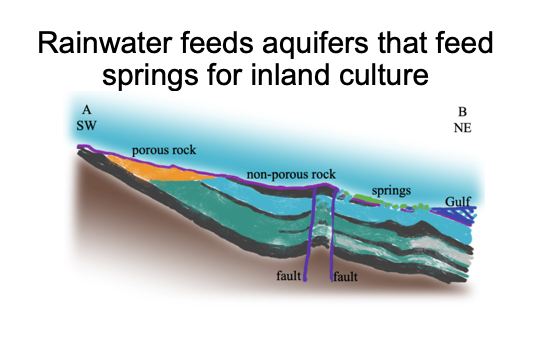
0016 Take a look again at the above figure. The gray brushstrokes and the red line denote a massive aquifer that is tilted. It is high in the west and low in the east. The Dammam label is a concatenation of the saying, “That’s a damn aquifer, ma’am.” Am I kidding? This aquifer relies on a huge tilted fault-riddled plate of non-porous rock supporting porous layers that allow rain water, falling south of the northernmost ITCZ line, to flow underground and come to surface in springs that stand outside the low-lying basins.
0017 Here is my version of the article’s Figure 2.
Note how water flows downhill in the Dammam aquifer then comes up in springs further inland from the sea-water filled basins.
0018 Why is this so important for this examination?
This examiner wants to show that… in the land surrounding the freshwater marshes and salt-water depths of the basins at 10,000 BP… there are two cultures: a Mesolithic culture that lives right along the water and uses fresh and salt water resources and a Neolithic culture that exploits the water from Dammum-fed springs to engage in rudimentary agriculture and stockbreeding.
0019 The question is, “Why would I want to establish two disparate cultures in the same region?”
Wouldn’t that just complicate the story of an enforced migration?
0020 Here, I review.
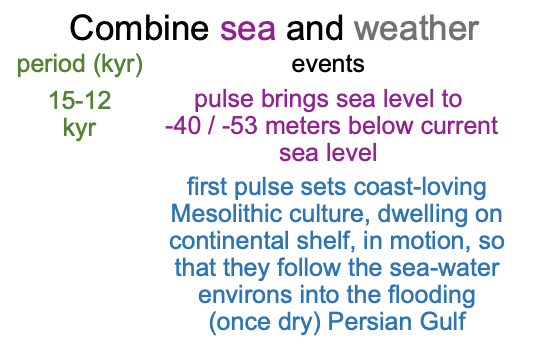
0021 First, the sea level starts to rise, if there is not a paleolithic culture already on the fresh-lakes of the Ur-Shatt waterway, then a Mesolithic culture displaced from living on the continental shelf could enter into the environs. Such a culture would simply follow the water into the eastern, central and western basins, since they already know how to exploit fresh-water and marine resources.
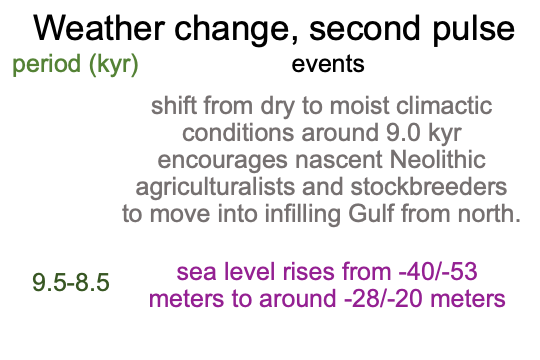
0022 Second, there is a shift from dry to wet climactic conditions, as the intertropical convergence zone (ITCZ) shifts north. Does it shift north enough to provide water directly to lands around the infilling Gulf? The author establishes that even if it does not, the ITCZ shifts north enough to feed the Dammum aquifer which would provide fresh water to a Neolithic agricultural and stockbreeding culture that migrates in from the north and settles in the dry-lands just beyond the marshes.
0023 Then the sea-level rises more, overfilling the basins and entering into the flat-bowl terrain of the surrounding landscape. Now, both the Mesolithic and Neolithic culture are forced to migrate in response to the rising seas.
0024 Here is where I introduce an idea that Dr. Cuttler did not think of and may have never heard about until this moment.
The economies of the Mesolithic and the Neolithic culture are different. They do not depend on the same resources. Practical reason predicts that these cultures should mingle with one another and eventually become one.
However, each culture practices its own hand-speech talking language. That means that they have a serious impediment to talking with one another. Both practice a dual-mode style of language. How are they going to get around that?
0025 Let me step back and say that the evolution of talk is not the same as the evolution of language. Almost every book available on human evolution discusses the evolution of language as a facet of hominin communication. Only Razie Mah’s books discuss the evolution of talk as a semiotic adaptation.
0026 Here is a brief overview.
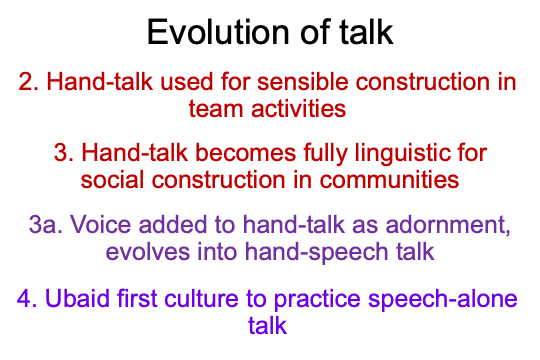
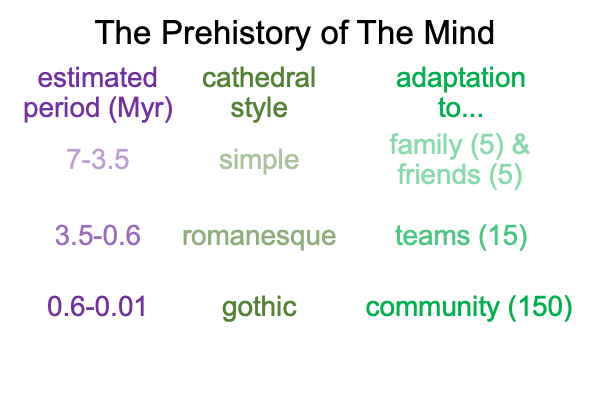
0027 The first period ranges from the separation of the chimpanzee and human lineages (around 7 Myr) to the start of bipedalism (around 3.5 Myr). The hominin lineage communicates in two small and one larger social circles. The small social circles are family (5) and friends (5). The larger social circle is the band (50).
0028 The second period ranges from the start of bipedalism to the domestication of fire (around 0.6 Myr). Michael Tomasello says that this period is dominated by “obligatory collaborative foraging”. That means that the social circle under the most intense selection pressure is the team (15). Hominins forage in teams. Pre-linguistic hand-talk is an adaptation to team work. Pre-linguistic hand-talk relies on sensible construction. Sensible construction relies on content and situation.
0029 The third period ranges from the domestication of fire to the first singularity (around 9kyr). The social circle under the most intense selection pressure is the community (150), the team of teams. This period is dominated by, what Razie Mah calls, “obligatory social-circle harmonizing”. Hand-talk becomes fully linguistic as an adaptation to the semiotic dynamics of social construction. Social construction involves content, situation and perspective.
0030 Prior to the evolution of Homo sapiens, the voice comes under voluntary neural control for singing. Why sing? There are two social circles larger than the community, the seasonally gathering mega-band (500) and the occasionally gathering tribe (1500). Their episodic gatherings require rapid synchronization. The voice was recruited to do precisely this. Singing identifies each participant within these larger social circles as belonging to the group. Plus, singing synchronizes all participants to the tasks at hand.
Sexual selection does the rest.
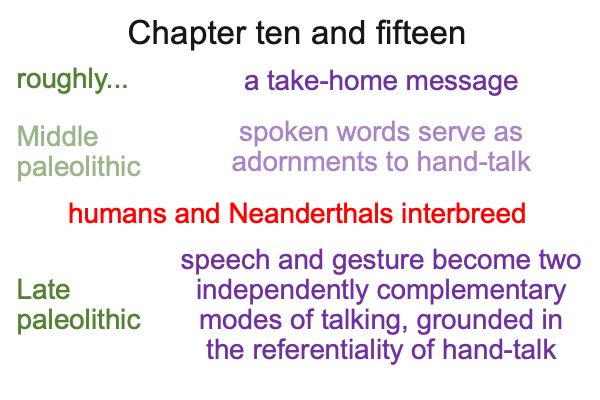
0031 With the evolution of Homo sapiens, the voice is systematically adapted for use as an adornment to hand-talk. In liminal lighting, communal hand-talk is difficult to instantly recognize. The voice is added as an adornment. Sound-word adorns gestural-word. The semiotics of the union remains grounded in hand-talk. However, the semiotic qualities of the sound-word (speech) are unique. So, cultural evolution produces two independent channels of talk, hand and speech talk, that are highly socially regulated.
In short, the transition from the voice as an adornment to hand-talk to fully elaborated hand-speech talk occurs over hundreds of thousands of years during the Paleolithic. My guess is that archaeological evidence of adornment parallels the development of this cultural adaptation.
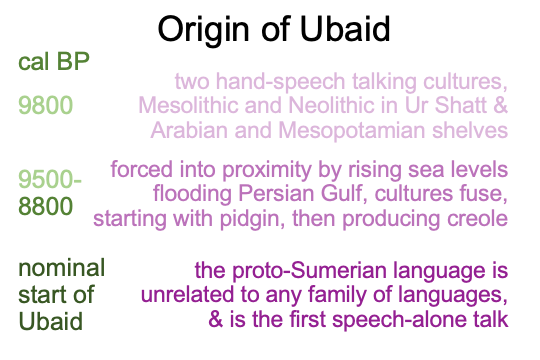
0032 The fourth period begins when two hand-speech talking cultures, one Mesolithic and one Neolithic, are forced into the same migration. These cultures have different economies, so they do not fight over resources. Rather, they trade and get along. They intermarry. They engage in interactions familiar to anthropology. They start with a pidgin. Then, later generations establish a creole. That creole is the proto-Sumerian language. Sumerian is unrelated to any large family of languages.
0033 Plus, that creole is the first speech-alone talk on Earth.
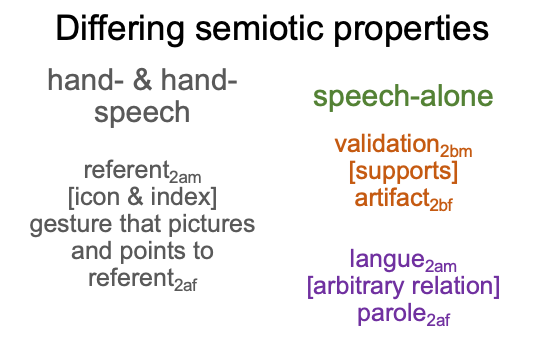
The semiotic properties of hand- (and hand-speech) talk and speech-alone talk are significantly different. The following figure presents dyads (characteristic of the Charles Peirce’s category of secondness) that may be read as Aristotle’s dyad of {matter [substance] form}.
0034 Hand- (and hand-speech) talk requires only one hylomorphe. A referent as matter substantiates, by way of icon and index, a manual-brachial word-gesture as form. The fact that word-gestures become routinized, and thereby instantly recognized, does not detract from this semiotic grounding. The referent precedes the hand-talk word.
0035 Speech-alone talk requires two hylomorphes, one on the content and one on the situation level. In terms of content, Ferdinand de Saussure (1859-1913) defined spoken language as “two arbitrarily related” systems of differences. What I think is arbitrarily related to what I say. So, where does the referent come in?
The referent comes on the situation-level, because each content-level word-utterance2af must be validated2bm(as situation-level matter) by the form of an artifact2bf. The spoken word precedes its referent.
0036 While this explanation sounds like gibberish to any newcomer to the field of semiotics, including many anthropologists and archaeologists in 2026, there is clearly method to the madness.
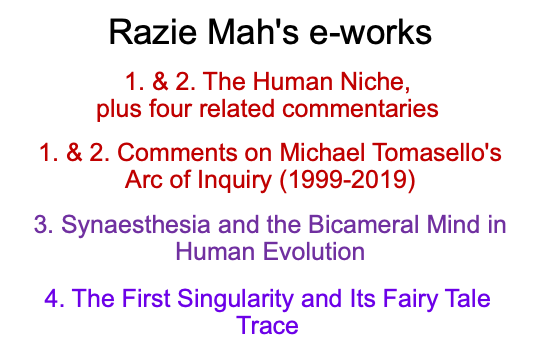
0037 Here is a list of Razie Mah’s e-works that are pertinent to this topic.
0038 The bottom line?
Hand- and hand-speech talk constrain social complexity.
Speech-alone talk facilitates unconstrained social complexity.
0039 This is precisely the theory that Dr. Cuttler needs in order to bring his research proposals to the next level.
0040 The origin of the Ubaid is the first step in a huge research project that is intrinsic to The First Singularity and Its Fairy Tale Trace.
0041 Cuttler’s analysis concerns the material arrangements that set in motion a dramatic shift in semiotic reality.
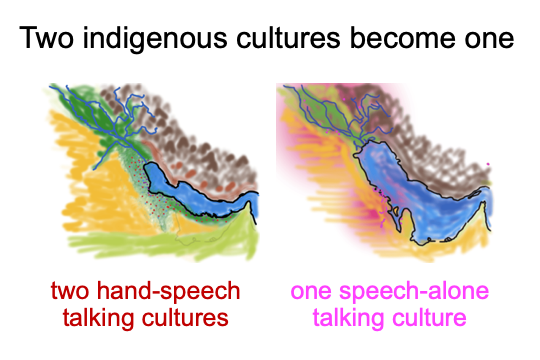
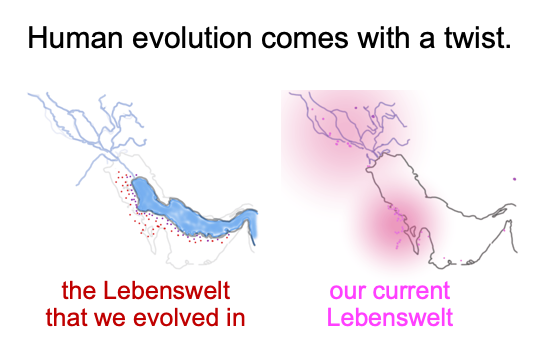
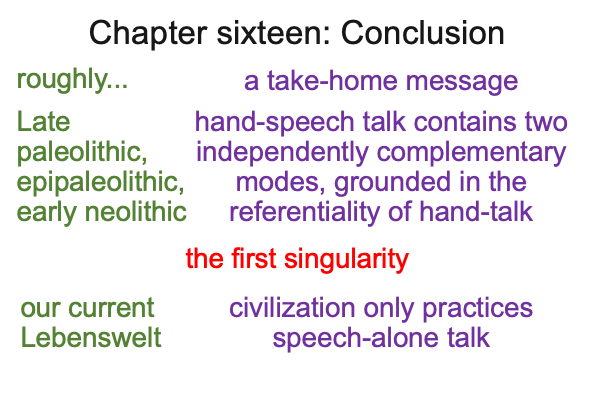
0042 Our current Lebenswelt is not the same as the Lebenswelt that we evolved in.
The image on the left represents two hand-speech talking cultures that belong to the Lebenswelt that we evolved in.
The image on the right represents one speech-alone talking culture that initiates our current Lebenswelt.
0043 I suspect that the Ubaid narod knows that they are different. They are surrounded by ethnoses that are poor and disorganized, in comparison to the wealth and the power that comes from (even a little) labor and social specialization.
The Ubaid does not know why it is special, it only knows that the surrounding hand-speech talking cultures talk with their hands. The hand-speech talking culture cannot help but notice the inverse. The Ubaid emissaries do not talk with their hands. However, they have the best dried fish. Plus, they want to give us their pottery, but it seems that they expect something in return.
Soon enough, the Ubaid strains at maintaining communality, or whatever it was that they had before their creation. Meanwhile, their way of talking encourages them to create artifacts that validate their spoken words, condemning them to further social complexity.
0044 It is hard to imagine what it was like, when every youth is ready to move past the tired artifacts that validate their grand-parent’s words.
Or, maybe it is not hard to imagine.
0045 Nor is it hard to imagine Abdullah Hassan Masry’s 1974 “sphere of interaction” hypothesis. Each Ubaid site belongs to a sphere of interaction, where it takes on its own “specialties”, its own gods, and its own ways of accommodating its labor and social specializations.
Doesn’t that sound like the contemporary term, “multipolar world”?
0046 Here is a picture.
0047 What is the second research project demanded by the hypothesis of the first singularity?
From the spheres pictured above, speech-alone talk spreads to the four corners of the world.
Imagine the research project needed to establish whether that claim is plausible!
0048 Dr. Richard Cuttler, the door is open. Follow your nose. Thank you for publishing your considerations.
0001 The book before me is published by Intervarsity Press. The subtitle is “Advances in the Origins Debate”. This work is the latest in the “Lost World Series” that delves into how Genesis should be regarded in light of the archaeological discoveries of the past three centuries.
Of course, “new explorations” implies “advances”. Advances adjust previous positions. The reader is advised to consult the conclusion immediately after the introduction, and before the section on methodology.
An examination of a prior work can be found in Looking at John Walton’s Book (2015) “The Lost World of Adam and Eve” appearing in Razie Mah’s blog in August 2022. The review is updated and fashioned as the first and fifth chapters in Razie Mah’s 2024 e-book, Exercises In Artistic Concordism, available at smashwords and other e-book venues.
0002 The term, “literature of the ancient Near East” is somewhat awkward, because the writings of the ancient Near East were buried in the ruins of royal libraries throughout Egypt and the Levant. The writings are in cuneiform, wedge impressions on clay tablets. The clay fires into brick when the royal library burns, along with the rest of the royal city. Then, the ruins get buried in vegetation, and later human settlements, and so on. Then, the tells (or hills) are excavated by modern archaeologists. Archaeologists discover thousands of cuneiform tablets and learn how to translate them. These translations constitute “the literature of the ancient Near East”.
0003 Of course, this story sounds implausible.
However, God tends to manifest the implausible.
0004 In fact, if God only performs sensible… what is the correct term?… “interventions”, then no one would notice. If anyone could turn water into wine, then the miracle at Cana would be ho-hum.
The Uruk culture invents writing by impressing tokens onto the surface of clay balls (which then contain the impressed tokens). That seems sensible. Centuries later, a Sumerians scribe uses a reed stylus to create impressions on a clay surface that is curved, like the surface of a ball. That seems sensible, also. Then, stylus impressions on a clay tablet become so routine that cuneiform is used for centuries to record transactions and inventories. Eventually, the same writing is used to record the civilization’s origin myths.
0005 Okay, each of these steps is sensible, although unlikely.
How many unlikely, yet sensible, developments can be strung together before the results may be declared “miraculous”?
0006 So, what is miraculous with respect to Walton’s lost-world propositions?
God provides eighteen centuries of biblical interpretation by Christians before creating the conditions where a challenge to traditional reference and affirmation occurs.
The archaeology of the ancient Near East unearths literature that is (more or less) contemporaneous with the Old Testament.
That is the challenge.
0007 The Old and New Testaments are no longer subject to plain reading as the sole foundation of interpretation.
Why?
How can one conduct an honest reading of the Old and New Testaments and not accommodate the literature of the ancient Near East?
0008 Okay, replace the word, “honest”, with the word, “literal”.
It seems that figurative and allegorical readings are not challenged.
0218 Chapters seven and eight cover the Fall and God’s pronouncements in Genesis 3.
These are more results of Walton’s scientific explorations.
I leave the application of hylomorphe, entanglement, confounding and resolution to the reader.
0219 Recall, a scientific paper contains five elements: introduction, methodology, results, discussion and conclusion.
So does Walton’s book.
0220 Chapter nine offers a discussion on Genesis and science.
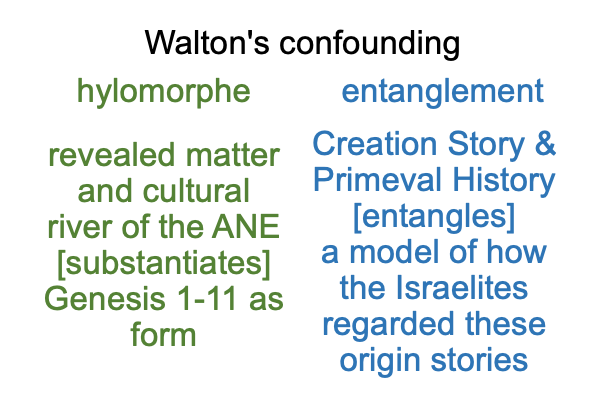
At no point in the discussion does Dr. Walton touch base with the following hylomorphes.
0221 In regards to the Creation Story, Razie Mah’s Looking at Hugh Ross’s Book (2023) “Rescuing Inerrancy” reviews what Walton is trying to avoid. Walton imagines that the entanglement of a moderate or an artistic concordism will turn out to be… um… dangerous.
Didn’t I say that confoundings are dangerous?
Hugh Ross’s version of moderate concordism cannot rescue the doctrine of biblical inerrancy, because it offers only a miraculous coincidence between what the Genesis text for each day appears to be describing and a corresponding evolutionary epoch.
Razie Mah’s version of artistic concordism changes the character of the doctrine of biblical inerrancy, because it offers a method for showing that each Genesis day offers natural signs of a corresponding epoch. There are three types of natural signs: icons, indexes and symbols.
0222 If the Bible is supposed to be plainly read, then why would an author write the Creation Story as a vision that depicts the evolution of the Earth on the basis of natural signs? The author could not possibly had known the natural history of the Earth, unless having been presented with a series of visions. The text breaks down into natural signsbundled for each day, as images, indicators and symbols.
0223 It is enough to make John H. Walton swoon.
There is no way that Genesis 1-11 can entangle the modern… now… postmodern age.
There is no way… except… for… that ever-churning Christian imagination.
See Razie Mah’s e-book, Exercises in Artistic Concordism.
0224 In regards to the Primeval History,all the written origin stories of the ANE (except for the Creation Story) depict a recent creation of humans, by newly differentiated gods, according to their designs and purposes.
The question is, “Why?”
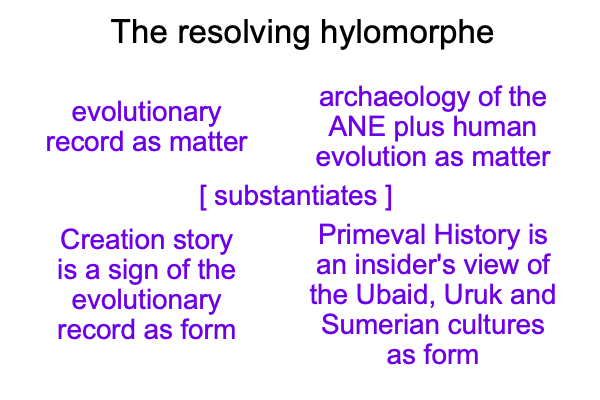
The civilizations of the ANE cannot see past a theoretical time point corresponding to the start of the Ubaid archaeological period in southern Mesopotamia. They cannot see from our current Lebenswelt into the Lebenswelt that we evolved in.
0225 The first singularity is currently a hypothesis.
As further research is conducted with this hypothesis in mind, we may eventually feel confident that the Ubaid is the first culture in human evolution to practice speech-alone talk. 8800 years ago, all other cultures practice hand-speech talk, in continuity with the founding of our species 300,000 years ago.
Over a period of a few thousand years, these hand-speech talking cultures convert to speech-alone talk, after being exposed to speech-alone talking cultures. Why do they adopt the new way of talking? Hand-speech talk promotes constrained social complexity. Speech-alone talk removes the constraints. The semiotic qualities of hand-speech talk and speech-alone talk are hugely different.
0226 The above hylomorphes are resolutions in favor of the entanglement.
Against this prospect, Walton configures his own confounding.
0227 Will this be sufficient to stop the goofy, science-loving impulses of the Christian imagination?
I don’t think so, because even if Walton’s confounding resolves in favor of his entanglement, the form of the resulting hylomorphe will entangle the Christian imagination.
0228 The Tartu-Moscow School of Semiotics pulls up a fish from the depths of the Christian Slavic civilization.
They open the mouth of the fish.
What do they find?
The golden coin of entanglement.
0229 Welcome to the Fourth Age of Understanding, The Age of Triadic Relations.
0230 I thank John H. Walton for publishing this advance in the origins debate and I wish J. Harvey Walton the best.
0001 If I may present my conclusion at the beginning, “I suggest the following motto: First the bauplan, then the twist.”
0002 The full title of the essay under examination is “Unpacking the Neolithic: Assessing the Relevance of the Neolithic Construct in Light of Recent Research”. The article appears in the Journal of World Prehistory (2025) in volume 38:11, pages 1-58 (https://doi.org/10.1007/s10963-025-09198-0). The author is affiliated with the Department of Anthropology, National Museum of Natural History, Smithsonian Institution in Washington D.C.
0003 The author’s argument follows the Greek tradition of (A) setting out prior propositions, (B) adding further information and assessments and (C) proposing one’s own solution.
Prior propositions (A) are covered in the section titled, “The Origin of the Term ‘Neolithic'”.
Further information (B) includes sections on neolithic emergences in southwest Asia and other regions, including China, Japan, eastern north America, Mesoamerica and the northwest America.
The author’s proposal (C) appears in a section titled, “Repackaging the Neolithic”.
0004 I examine each movement in the sequence A, C then B.
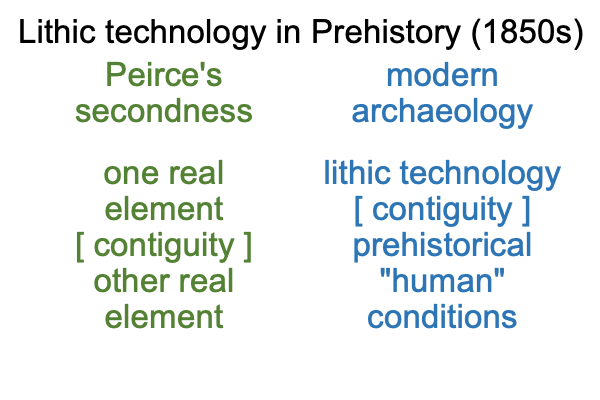
0005 In regards to the historical origin of the term, “neolithic” (A), the word appears in the 1850s in the context of prehistoric lithic technology. A distinction between old “paleolithic” and new “neolithic” tools reflects a fairly recent change in the human condition. The Paleolithic extends very far back into the evolution of the Homo genus. The Neolithic is fairly new and applies only to Homo sapiens. By “new”, I mean, say, starting less that 20,000 years ago.
0006 As it turns out, stone tools and fossilized bones are the most recoverable items from the distant past. So, the idea that our kind evolves will of course rely of this type of data. The implications are significant. If lithic technologies are like matter, then the archaeologist may speculate on forms of prehistorical human (or “hominid” or “hominin”) conditions.
0007 For example, the earliest paleolithic stone tools are labeled “Oldowan”. These tools can be made on the fly. If I strike one rock with another, I can fracture off a shard and expose a sharp edge. Of course, one must choose the right rocks for this trick. Plus, technique is important.
Later stone tools are labeled “Acheulean”. These stone tools are made ahead of time, by the same technique of hammering off shards to reveal an intended form that… somehow… is intrinsic to the original rock.
0008 So, what am I suggesting?
Is the actuality of matter and form intrinsic to rocks, and ancestral hominins learn to tamper with one real element (matter) in order to sculpt the other real element (form)?
0009 I am suggesting more than that.
Aristotle’s hylomorphe (hylo = matter, morphe = form) is an exemplar of Peirce’s category of secondness. Secondness consists of (at least) two contiguous real elements. For paleolithic hominins, a rock (matter) could be sculpted into a stone tool (form). From the point of view of the archaeologist, the hylomorphic structure still applies. The question is, “How?”
Paleolithic stone-tool technology “sculpts” prehistorical human conditions.
0010 Of course, the word, “sculpts”, serves as an aesthetic metaphor for the contiguity between paleolithic technology as matter and hominin conditions as form.
0011 The challenge for nineteenth-century anthropology is clear. Propose a better, more scientific, or at least, less metaphysical, label for the contiguity.
With only geological strata, stone tools and fossilized bones as evidence, proposals were necessarily speculative. But, archaeologists continued digging, and by the 1850s could make the distinction between paleolithic and neolithic. Also, they figured out a reason for why the advance from Oldowan to Acheulean stone tools “sculpted” more advanced hominin conditions. Man was making himself.
0012 What do these evidential and rational developments suggest?
For a Peircean, secondness is the dyadic realm of actuality. Secondness is only one of Peirce’s three categories. The other two are thirdness (the triadic realm of normal contexts, judgments, signs, mediations and so forth) and firstness (the monadic realm of possibility).
Each of these categories manifests its own logic. Also, each higher numbered category prescinds from the adjacent lower category. Thirdness prescinds from secondness. Secondness prescinds from firstness. Prescission allows the articulation of the category-based nested form, as described in Razie Mah’ e-book, A Primer on the Category-Based Nested Form.
0013 Thirdness bring secondness into relation with firstness.
A triadic normal context3 brings a dyadic actuality2 into relation with the possibility of ‘something’1.
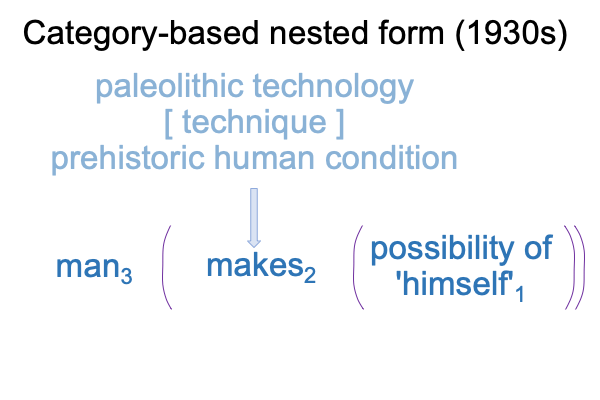
0014 Now I can slide the above dyad into the slot for actuality2 for the category-based nested form intimated by the title of V. Gordon Childe’s 1936 book, Man Makes Himself.
0015 The slide clarifies the contiguity, paleolithic technology constellates a substance, which I label, “technique”, that manifests an essence for the conditions of evolving hominins (that is, a substantiated form).
Consequently, the appearance of a new stone tool technology indicates a change in techniques as well as a change in the essence of the prehistoric human condition.
0016 According to Childe (1892-1957), the “neolithic” label encompassed more than a change in lithic technology. The prehistoric human condition gets entangled with all sorts of other matters, including sedentary communities, economies of delayed returns, various modes of storage and so forth. A long list of material arrangements gets entangled.
0017 As it turns out, once matter substantiates form, then form can entangle other matter, which is a confounding. Here, “confounding” is a technical term, precisely labeling one form originating from one matter and entangling another matter.
Historically, a confounding is an idea that belongs to Aristotle’s tradition. It is stumbled upon long after Aristotle’s campus went out of business. It is the brainchild of the Byzantine and Slavic civilizations.
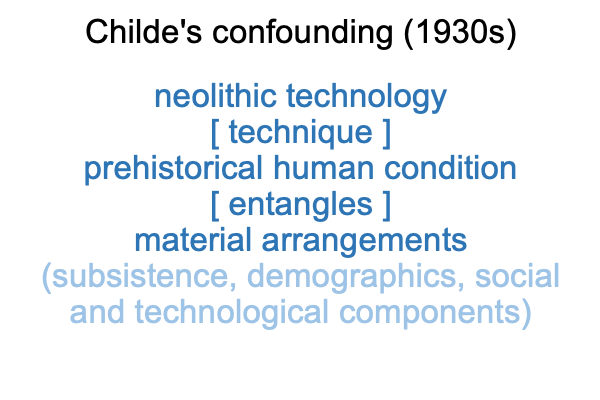
0018 Here is a picture of Childe’s confounding.
0019 The upper three lines presents the neolithic thing. Neolithic stone-tool technology [substantiates] the prehistoric human condition. The nature of the [substance] is labeled, “technique”.
The lower two lines presents the entangled matter. The [entanglement] is difficult to label, because its nature is.. well… a long list of material arrangements.
0020 A list of material arrangements appears in Table 1 of the article. Even the social components of social mechanism, magico-religious sanctions and trade can be shoved under the rug labeled, “material arrangements”.
0021 As such, the “neolithic” may serve as an adjective to a noun, “revolution”, that appeals to academics sympathetic to Marxist formulations. Yes, they are the ones who only promote academics with similar sympathies. Also, Childe was… um… a sympathizer.
The question is not about whether prehistoric folk are “communist” or “fascist”, even though these labels may apply to this or that anthropologist of the 1930s.
The question is whether the Marxist formula applies to prehistoric folk.
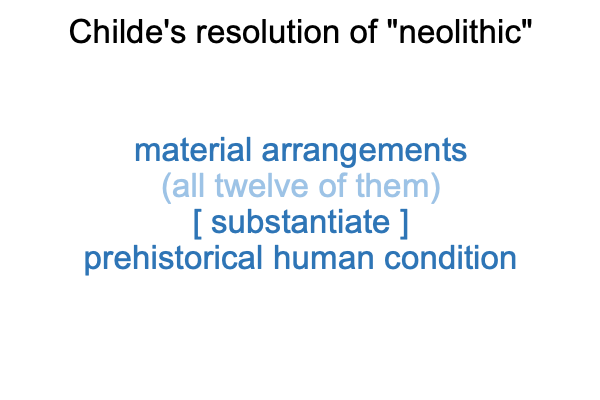
0022 The answer becomes obvious, when Childe’s confounding resolves into the following hylomorphic structure.
0023 The above figure depicts a Marxist version of Aristotle’s hylomorphe, {matter [substantiates] form}. Childe’s hylomorphe lasts for nine decades (that is, until the present day at the start of 2026). Man makes himself through a standard Marxist formulation. Soon, Soviet era archaeologists adopt the stance that the appearance of pottery is a hallmark of neolithic emergence. Pottery is a material arrangement. The emergence of the neolithic is a human condition.
0056 Okay, I will continue drinking my cocktail in the following exposition.
I regard the last two figures, along with the figures that appear in the article under examination.
0057 There is something in B that suggests two bauplans3. Early Neolithic Bauplan 1 marks the terminus of the Lebenswelt that we evolved in. Late Neolithic Bauplan 2 denotes the start of our current Lebenswelt.
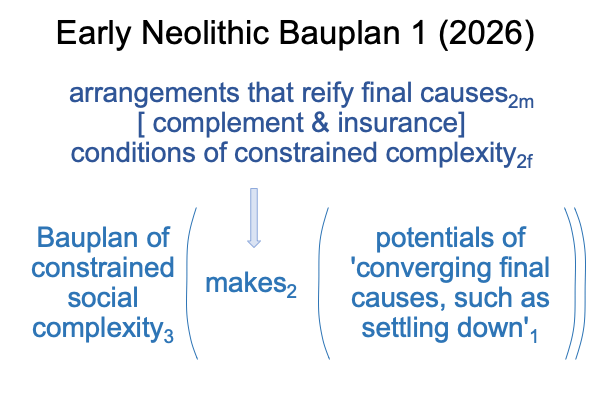
0058 Bauplan 1 looks like this.
The early Neolithic bauplan3does not permit untrammeled social and labor specializations. Rather, all social circles2m (family (5), friends (5), teams (15), bands (50), and community (150)) are optimized2f in the pursuit of the final cause of ‘settling down’1. It is the same way that different organs and organ systems are optimized for ‘settling down’ into an individual.
Details of optimization will be specific to each location (because efficient causes differ), yet produce something ‘general’, that manifests in excavation sites as varied as Catal Hoyuk and Tepe Gobekli. Domestication includes the local geography, plants and animals. Domestication may even include settlements more than a day’s walk away. Domestication may include the heavens.
0059 Once rendered in this manner, the slow, seemingly reversible, spiral into the neolithic thing2 gets depicted as thin dotted horizontal lines along the axes of arrangements versus time.
0060 The late Neolithic bauplan3 permits individual social and labor specializations. Something significant has changed. The key final cause of ‘settling down’ remains relevant. However, another key final cause cannot be ignored. The optimization of the early Neolithic somehow breaks down and the late Neolithic initiates a search for order1 that continues to this day.
0061 Here is a picture of what Bauplan 2 might look like.
0062 It is as if an individual, having been formed by a bauplan 1 gestation, gets born.
What a rude awakening.
0063 What about the timeline?
If I replace the increasing boldness of the horizontal dotted lines with a slowly rising bauplan 1 slope, and if I depict the most bold horizontal dotted lines as a bauplan 2 phase transition, then I get the following graph.
0064 What does this imply?
Obviously, bauplan 1 ends in a twist, that is, bauplan 2.
I noted this slogan at the start of my examination.
0065 Less obviously, the Neolithic revolution is not in the actuality of {material arrangements [substantiating] the neolithic condition}2.
“The Neolithic Revolution” involves a transition from the Lebenswelt that we evolved in to our current Lebenswelt.
0066 Fortunately, for the author, the American Marxist academic candle is about to exhaust itself, just as the Soviet Marxist illumination did decades ago.
Yes, the crisis begins.
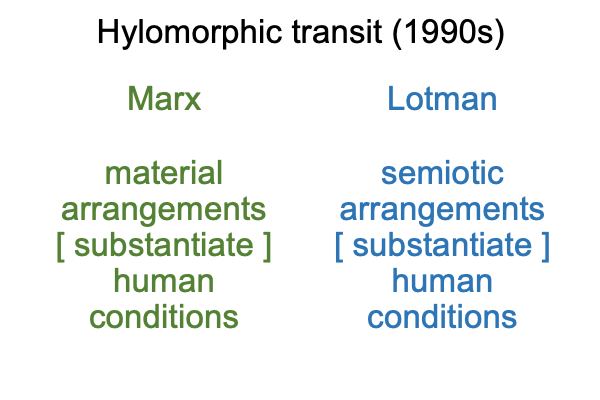
0067 The impending change of cognitive grounds will be at least as great as the following transition from Karl Marx (1818-1883) to Juri Lotman (1922-1993). This transition goes sigmoidal in 1989.
0068 The following hylomorphic transition is derived in Razie Mah’s blog for December 2025, titled Looking at Igor Pilshchikov and Mikhail Trunin’s Article (2016) “The Tartu-Moscow School of Semiotics”.
0069 Marx’s actuality2 is supposed to arise from the potential of scientific models1, even though the actuality2 served as doctrine, rather than a mechanical or mathematical formulation. Remember, Marx’s actuality2 conforms to the structure of Peirce’s secondness. Secondness is the realm of actuality. How easy is it to confuse this actuality with the realness of a mechanical or mathematical model? Yet, they are not the same.
0070 Lotman’s actuality2 arises from the potential of the semiosphere1, the universe of sign-relations. Semiotic arrangements are not the same as material arrangements. They are not even close.
0071 So, what am I saying?
The author senses that ‘something’ is coming and she figures out that it must concern a bauplan.
After all, bauplan is a term that is familiar to evolutionary biologists.
0072 Happily, the semiotician, Razie Mah, has already explored human evolution from the point of view of Peirce’s categories. The human bauplan is an adaptation to the niche (or the potential) of triadic relations. Plus, human evolution comes with a twist.
Here is a list of works by Razie Mah that pertain to Bauplan 1 and Bauplan 2.
0073 Surely, this is a lot to unpack. But, that is precisely what Melinda Zeder’s article calls for.
My thanks to the author for publishing this thought piece.
I reviewed Steven Mithen’s book, The Language Puzzle: Piecing Together The Six-Million-Year Story Of How Words Evolved (2024, Basic Books, New York). See Razie Mah’s blog for September 2025. The examination concludes on point 0235.
During the examination, I recall a book that Julian Jaynes publishes in 1976.
I wonder, “Why does Mithen’s book remind me of Jaynes?”
I now have a copy of The Origin of Consciousness in the Breakdown of the Bicameral Mind (First Mariner edition (2000), New York, New York) before me.
This explains why I start the current examination on point 0236.
0237 Julian Jaynes (1920-1997 AD) earned master and doctoral degrees in psychology at Yale University. He lectured in psychology at Princeton from 1966 to 1990. In 1990, he writes a postscript that appears in the Mariner edition.
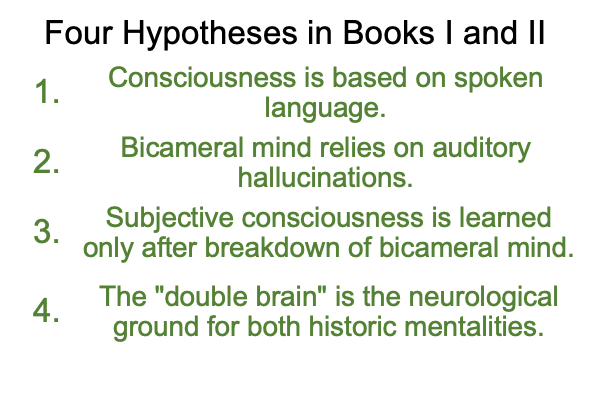
This afterward lists the four hypotheses in Books I and II. Plus, the postscript expands on Part III, by discussing the psychological transition from the bicameral mind to subjective consciousness at the end of the Bronze Age in the Near East.
0238 Here is the list.
0239 So, why does Mithen’s book remind me of Jaynes’s work?
My review of The Language Puzzle led me to conclude that Mithen’s explicit rejection of a gestural origin of languageprevents him from realizing that his information implicitly supports the very position that um… he rejects.
Yes, if I ignore his declaration against a gestural origin to language, then I can start to recognize that speech is added to fully linguistic hand-talk after the domestication of fire, when the community becomes a social circle under pressure from natural selection.
0240 That reminds me of a curious pun that seems to have import in the year 2025AD.
The Russian word for “no” is “nyet”.
To the American ear, “nyet” sounds like “not yet”. And, that means, “Yes, but not now.”
So, when Mithen says, “nyet”, to the gestural origins of language, his English speaking bicameral mind hears, “not yet”. So, Mithen unwittingly drops clues to his nyet hypothesis within his own subjectively conscious argument. These hints offer a weird twist to Looking at Steven Mithen’s Book (2024) The Language Puzzle. It is as if Mithen’s own bicameral mind offers – what I will call – “a nyet hypothesis”.
0241 Now, consider the first two hypothesis (A and B) in Jaynes’s Books I and II.
First (A), subjective consciousness relies on spoken language. Mithen consciously proposes that spoken words are built over millions of years through synaesthesia, cross modal “leakage” of sensations, from visual things and events to auditory vocalizations.
0242 Of course, this proposal comes across as sketchy. Why would early hominins, such as the australopithecines and the early species in the Homo genus (3.5 to 0.6Myr – millions of years ago) do this? And how? The voice is most likely not under voluntary control. Involuntary calls rule the day.
But, the vocal tract changes over time. Most likely, the voice is on the verge of coming under voluntary control by the time that Homo heidelbergensis appears in the fossil record (perhaps, over 600kyr – thousands of years ago).
On top of that, Homo heidelbergensis shows up during the period when hominins domesticate fire (800-400kyr). So, Mithen consciously and cautiously suggests that the synaesthesia business really takes off around that time.
0243 The nyet hypothesis?
Well, of course, proto-linguistic hand talk has plenty of time to evolve without cross-modal leakage during the early period (3.5 to 0.6Myr) and even has a couple of hundred-thousand years to become fully linguistic after hominins start to play with fire (0.8 to 0.6My).
So, synaesthesia would not make a jump from things themselves to vocal utterances, but from manual-brachial word-gestures to vocal utterances.
Suddenly, synaesthesia no longer seems implausible.
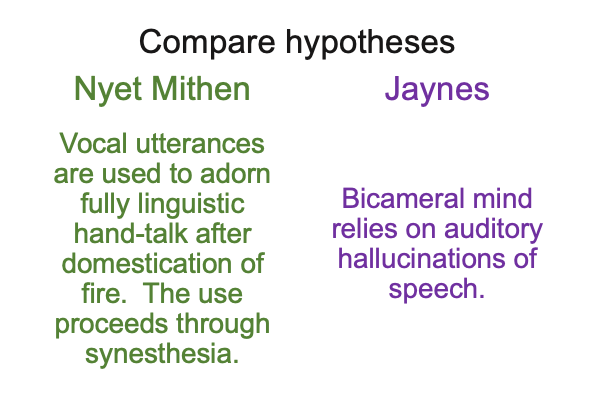
0244 Second (B), compare Mithen’s nyet hypothesis with Jaynes’s proposal of the bicameral mind.
To me, the idea that manual-brachial word-gestures provide stimuli allowing synaesthetic crossover from visual to auditory sensations seems like “auditory hallucinations”.
0245 My goal in this first examination is to develop this impression.
0001 The full title of the book before me is The Language Puzzle: Piecing Together The Six-Million-Year Story Of How Words Evolved (2024, Basic Books, New York). Dr. Mithen is a Professor of Early Prehistory at the University of Reading. He has published before. More on that later.
The book works on the metaphor of a jigsaw puzzle. Fourteen chapters present the pieces. The introduction and conclusion stage and arrange them.
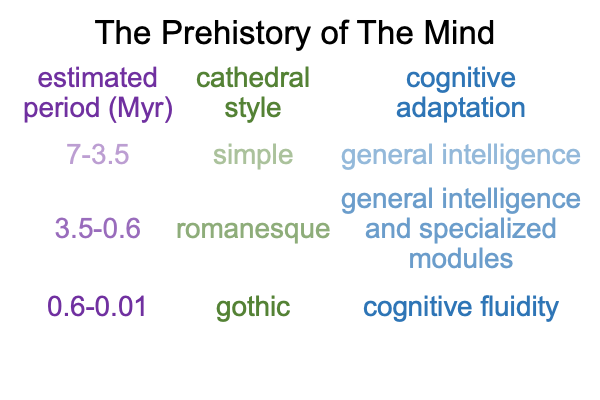
0002 This current metaphor is very different than a glorious historical metaphor used in a book published almost three decades earlier. The Prehistory of The Mind (1996) offers the historical development of the architecture of cathedrals in Europe as a lens for considering cognitive evolution. The metaphor works well because the nave associates to general intelligence and side chapels associate to specialized mental modules.
0003 From the genetic divergence from chimpanzees to the start of bipedalism, the simple nave of general intelligenceadapts to cognitive challenges.
From the appearance of bipedalism to the domestication of fire, specialized modules are added to general intelligence, but the two do not integrate. Indeed, both specialized modules and general intelligence are supported by their own, thick, walls. The metaphor is the Romanesque cathedral.
From the domestication of fire until the first singularity (think, “the potentiation of civilization”), general intelligence integrates with specialized modules, presumably due to talk becoming fully linguistic. Language becomes the walls, supported by flying buttresses of automatic decoding. The metaphor is the Gothic cathedral.
0004 Here is a picture.
0005 The metaphor is so wonderful that Razie Mah publishes the e-book, Comments on Steven Mithen’s Book (1996) The Prehistory of The Mind as one of the readers that accompanies the masterwork, The Human Niche, in the series A Course On The Human Niche (available at smashwords and other e-book venues).
0006 Mithen’s approach is also echoed in the work of another evolutionary anthropologist, Michael Tomasello, working at the Max Planck Institute in Leipzig, Germany, as discussed in Comments on Michael Tomasello’s Arc of Inquiry (1999-2019) (by Razie Mah, also see blogs for January through March, 2024).
0007 Mithen’s approach is also reflected in another review that belongs to the series, A Course On The Human Niche. The title is Comments on Clive Gamble, John Gowlett and Robin Dunbar’s Book (2014) Thinking Big. In this review, social circles turn out to be very important in hominin evolution. Mammalian brain size roughly correlates to group size. So, the larger the hominin brain grows, the larger the group.
Not surprisingly, Mithen’s metaphor indicates the social circle under the most intense selection pressure, irrespective of group size.
0008 What does this imply?
Obviously, group size is not the crucial factor in hominin evolution.
Whatever is increasing hominin brain size is.
0006 To me, it is not surprising that Mithen has not encountered Razie Mah’s review of his 1996 work, even though it is one of the few more-than-surface reflections on The Prehistory of The Mind available.
Perhaps, the same will go for this blog, which will take Mithen’s metaphor of a jigsaw puzzle quite literally.
0229 So, what is The Language Puzzle about, in an implicit sort of way?
It is about how speech gets added to hand talk after the domestication of fire.
The irony of the work is found in Mithen’s explicit denial of the gestural origins of language, while…
… at the same time, the author provides a solution to a question that he cannot even pose.
0230 Examinations don’t get better than this.
This examination adds value to Mithen’s work in a surprising fashion.
0231 This examination suggests that a tremendous amount of theoretical reformulation needs to be done. In particular, the following juxtaposition of events is suggestive.
0232 I ask, “Does Homo sapien’s encounter, love affair, then divorce from the Neanderthals create a condition where speech becomes more and more independent as a mode of talking? Does speech become capable of operating linguistically, independent of hand talk, yet remain integrated into the natural-sign references of hand-talk?”
0233 Take a look at the artifact of the lion-man, pictured in figure 3 on page 28 of Mithen’s text.
Maybe, we can ask him.
Do you think that he has something to say to us?
Surely, he cannot perform hand-talk.
So, the lion-man must speak for itself.
0233 Yes,it’s like synaesthesia gone wild.
0234 But, “wild” is not even close to this last implication, which tells me that our current Lebenswelt is not the Lebenswelt that we evolved in.
What about the item in red?
See Razie Mah’s e-books, The First Singularity and It’s Fairy Tale Trace (for a technical proposal) and An Archaeology of the Fall (for a dramatic rendering), available at smashwords and other e-book venues.
0235 With that said, I thank Steven Mithen for publishing a book that can be fruitfully read both explicitly and implicitly.
Also, the story does not end here, because this examination plays a prominent role in the next commentary, Looking at Julian Jaynes’s Book (1976) “The Origin of Consciousness in The Breakdown of the Bicameral Mind”.
0001 The book before me is published by Archaic Lens Publishing (North Carolina). The author posts podcasts on youtube, writes on twitter, and has a website, www.archaiclens.com. The book’s subtitle is The Thread that Connects the Ancient World.
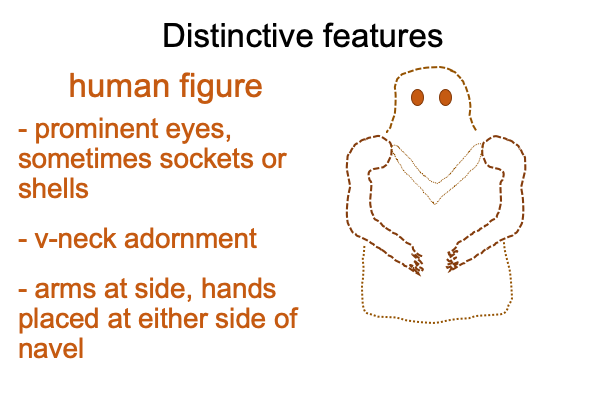
0002 The author documents navel idols that are readily identifiable to the human eye on the basis of several characteristics, as shown below.
0003 They appear at the dawn of history, in regions that will end up civilized, but before any advances in the direction of labor and social specializations. Later, the idols will associate to the Chalcolithic (the Copper Age), corresponding to the era before the Bronze Age (when copper is mixed with other ingredients to create effective weapons).
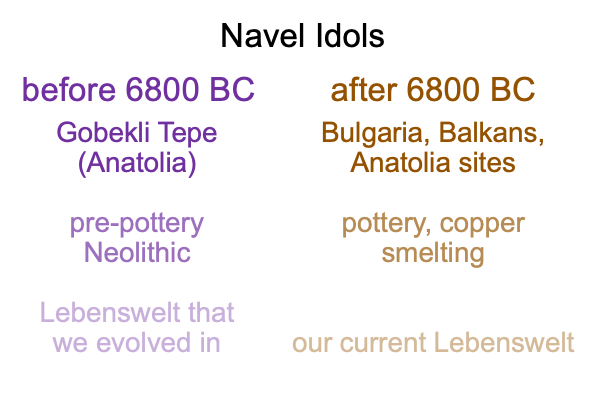
The oldest navel figure is Urfu man, recovered from Gobekli Tepe in Turkey (Anatolia) and dating to around 10,000 B.C. This is long before the end of the last interglacial. The megastructure site associates to the pre-pottery Neolithic, which comes before the pottery Neolithic. Subsequent Neolithic cultures throughout southwestern Asia will be labeled and identified on the basis of their pottery.
Also, Gobekli Tepe is not associated with a sedentary settlement, such as the contemporaneous Catal Huyuk.
0004 So, what am I saying?
Gobekli Tepe, Catal Huyuk and similar sites do not end up constellating into a tangle of unconstrained social and labor specializations, where social circles transmogrify into networks of economic and political-religious affiliations.
0005 In the section on Turkey, the author makes an interesting point. The body habitus of Urfu man appears in statuary and figurines in early civilizations around the world. The further from Gobekli Tepe, the later in time these navel idols appear.
Ironically, this point is precisely the rule of thumb held by archaeologists during the early twentieth century. The further from southern Mesopotamia, the later an early civilization forms.
0006 Coincidence?
Or is one observation swept up in the other?
0007 In the section on Turkey, the author includes a watercolor image of an awkward looking small artifact, with enormous alien-like eyes, v-neck adornment and hand on either side of navel. This clay figurine dates to around 5,000 B.C., during the copper age, according to the British Museum.
This artifact dates to 5,000 years after Gobekli Tepe.
The prehistoric cultures associated with the later artifact occur on the cusp of civilization, where the term, “civilization” is characterized by unconstrained labor and social specialization.
0008 A look at the sections on the Kosovo, Serbia and the Balkans support this association. The navel idols of the Vinca culture (5850-5750 B.C.) appear similar to the latter Turkey artifact. The Vinca culture practices farming, animal husbandry and copper smelting. A similar pattern occurs in Bulgaria. These cultures are on their way to increasing social complexity.
0009 The pattern will hold for all navel idols found to the west of the Aegean Sea. The navel idols and the Chalcolithic and other features, such as astronomy-related megalithic arrangements, spread west from southwestern Asia.
Since Gobekli Tepe is pre-pottery and pre-Chalcolithic, it cannot be the direct inspiration for the navel idol figures located the West, five millennia later. So, the old archaeologists’ saying of the early 20th century applies. Something from southern Mesopotamia sends out emissaries bearing the news of not talking with one’s hands, as well as copper manufacture and astronomy.
Indeed, it may be that the cultural efflorescence that builds Gobekli Tepe and other Anatolian sites spreads into northern, then southern Mesopotamia as the glacial climate gives way to the Wet Neolithic of southwestern Asia and northern Africa.
0010 The sea-level rise serves as a good way to demark the navel idols before pottery and copper and the navel idols after.