0041 Tell me whether the following seems vaguely familiar.
The question is, “What is a thing?”
The question is addressed in a recent article by Mariusz Tabaczek, eliciting a response by a capable semiotician, who posted a draft in the website academia.edu titled Response to Mariusz Tabaczek’s Article (2025) “Contemporary and Classical Versions of Hylomorphism”.
The response relies on the definition of “entanglement” developed in Razie Mah’s blog in December, 2025, titled Looking at Igor Pilshchikov and Mikhail Trunin’s Article (2016) “The Tartu-Moscow School of Semiotics”.
The term, “entanglement” stands like a mirror of the term, “substantiation”, thereby confounding the structure of Peirce’s category of secondness.
0042 If it does, then smile.
There are two versions of entanglement, Hodder’s sociological version and Razie Mah’s Peircean version. This examination shows how the latter complements the former..
0043 In chapter 1 (C1), the author argues that things and flows are entangled.
The following figure shows the process. I will call Aristotle’s hylomorphe “the little noumenon”. I will call the resolution of the entanglement “the big noumenon”. Perhaps, “the middle noumenon” may be a better appellation.
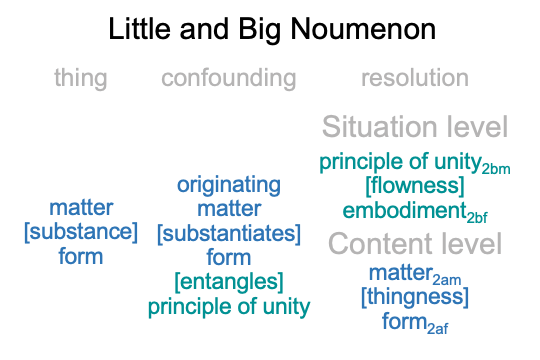
0044 The little noumenon entangles matter. That matter is a principle of unity. The entanglement almost seems inevitable. Of course, if the thing has form, than that form will entangle a principle of unity. For example, a brick wall has form that exhibits a principle of unity that can be visually assessed, particularly when the wall starts to slump. The wall is still there. The principle of unity is compromised. At some point, the issue must be addressed.
For the residents of Catal Hoyuk, the way that it is addressed is to coat the wall with plaster.
0045 What is going on in the assessment?
Well, the assessment involves the matter that goes into building the wall (mud-clay bricks)2am and the shape of the wall2af. Bricks made of mud and clay have the correct structure to build a wall. The question is whether they are disposed to keep that structure.
In short, the assessment may be diagrammed using Peirce’s category-based nested form. An introduction may be found in Razie Mah’s e-works, A Primer on the Category-Based Nested Form and A Primer on Sensible and Social Construction. After that introduction, the following nested form makes sense.
0046 The wall2 emerges from (and situates) the potential of ‘the dispositions of the building materials’1.
The normal context of structure3 puts the actuality of the wall2 into context.
The normal context of structure3 brings the actuality of the wall2 into relation with the potential of ‘the dispositions of the building materials’1.
0047 Note how the little noumenon2, the thing itself2, enters the category-based nested form as either a single label2 or as a hylomorphe2.
The fact that a thing2 may serve as an actuality2 in a category-based nested form comports with the author’s claim that there is not such thing as a “thing in itself”. This is a tricky aspect of a noumenon. Does it take the title, “the thing itself”, even when it is an actuality2 in a category-based nested form? I suppose so. Even worse, it2 may be itself, only within in a category-based nested form.
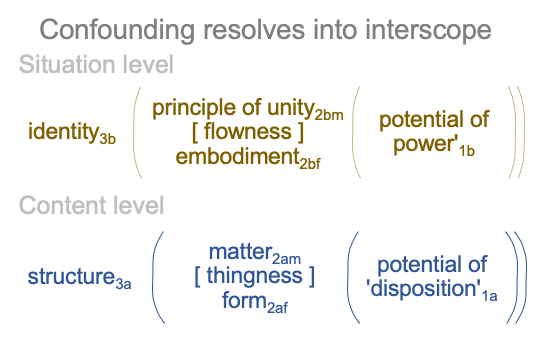
0048 Consider the old-time mechanical clock, mentioned earlier. The form of a clock2af entangles a principle of unity (that is, time measurement)2bm that serves as situation-level matter2bm that substantiates (on the basis of flow) the embodiment of a schedule2bf. With a mechanical clock, a person3b has the power1b to be on time3b.
So, a clock is a thing itself2a on the basis of its normal context3a and potential1a.
0049 Here is the general picture of the middle noumenon, composed on content and situation levels, embedding the little noumenon2a, the content-level actuality2a.
0050 Not all entanglements resolve in this fashion.
0051 Nonetheless, I wonder, “What do the phenomena of archaeology consist of?”
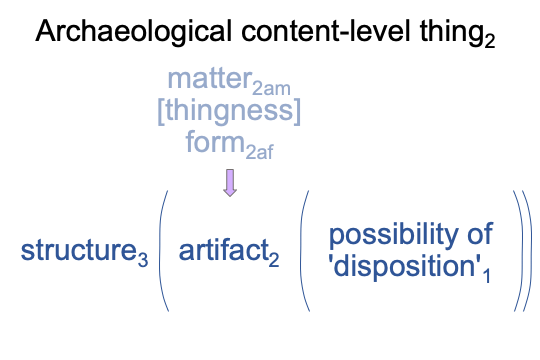
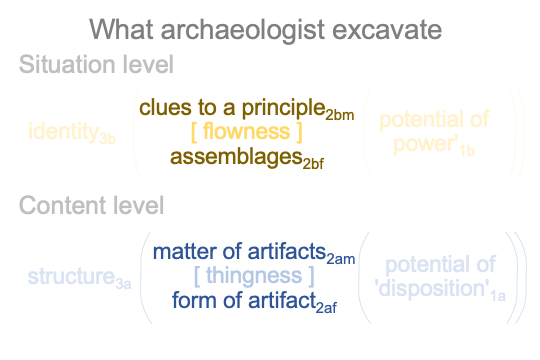
When an archaeologist meticulously excavates a site, only things (for thingness) and clues (for flowness) are unearthed.
Here is a diagram.
0052 Does this suggest that Tabaczek’s philosophical exposition of classical and contemporary thought on Aristotle’s hylomporphe and Hodder’s proposal on the nature of entanglement offer pathways to express the character of Peirce’s category of secondness in so far as it is integrated into thirdness and firstness?
0053 In other words, the archaeologist finds artifacts2a. In terms of actuality2a, the researcher will need to investigate matter2am and form2af. Then, other clues allow the investigator to propose principles of unity2bm and what the assemblages embody2bf.