Category Archives: Our current Lebenswelt is not the Lebenswelt that we evolved in
Human psychology evolved under in the social milieu of constrained complexity. Currently, humans live in unconstrained complexity. What has this done to our minds? These topics are addressed in various parts of An Archaeology of the Fall, particularly in chapters 8C and 11B.
0627 Today, we no longer are who we evolved to be.
What does this imply?
We can no longer be who we evolved to be.
Our current Lebenswelt is not the Lebenswelt that we evolved in.
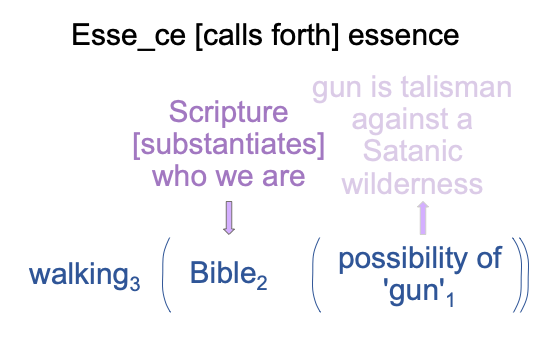
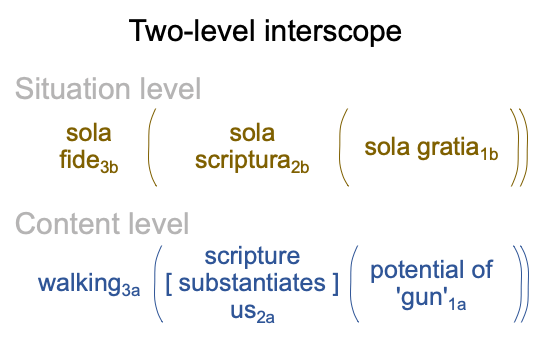
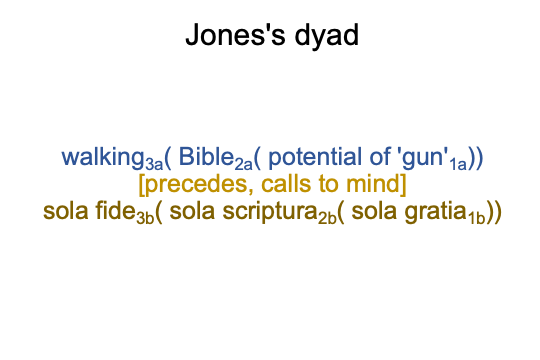
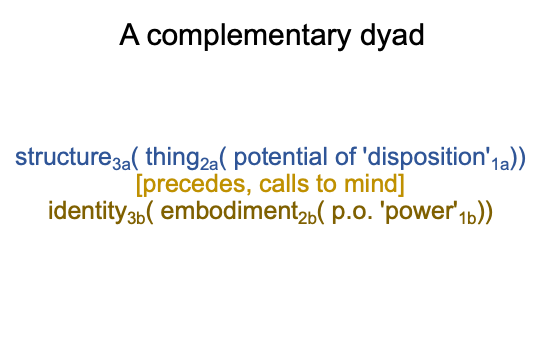
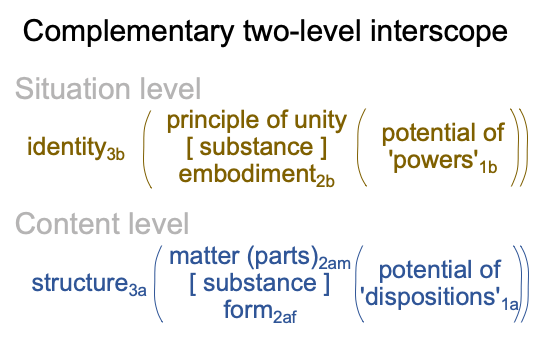
0628 Today, the general ego interscope presents a purely relational structure (a suite of triadic relations) that may be processed implicitly. This is the configuration of langue, as opposed to parole.
Here is a picture.
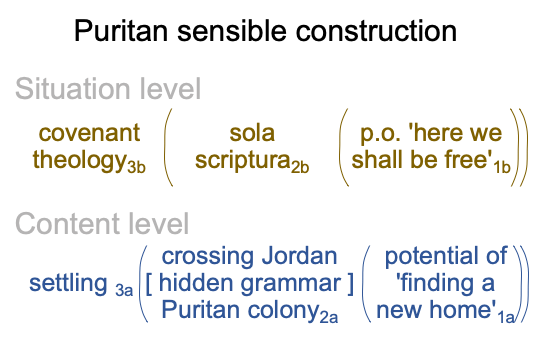
0629 Almost all of the elements of the interscope are filled with explicit abstractions.
A trace of Aristotle’s philosophy resides in the Tartu-Moscow School of Semiotics.Upwellings from deep within Slavic civilization breathe into explicit abstractions.
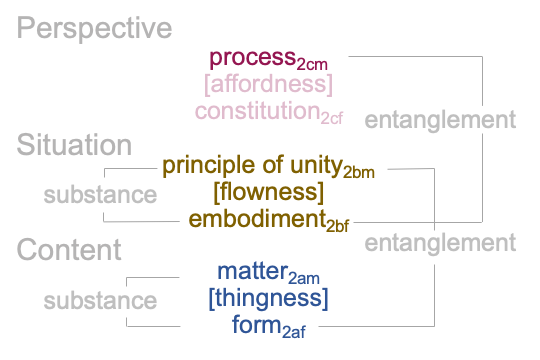
An archaeology can be seen in the structure of the content- and situation-level actualities. According to Aristotle’s hylomorphe, matter [substantiates] form. But, this Christianized pagan civilization realizes the inverse is also a thing. Form [entangles] matter.
0630 In the example, the form of a small bird entangles the matter of a young initiate.
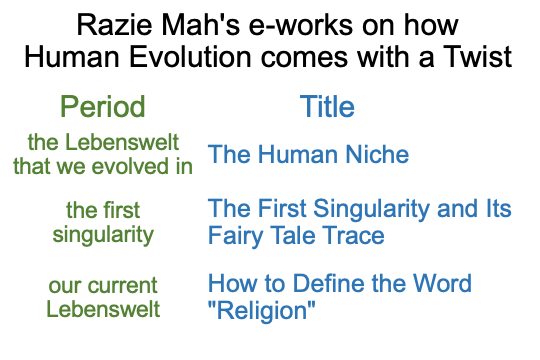
The claim coheres with the crucial claim of Razie Mah’s book on hominin evolution, The Human Niche. Our niche is the potential of triadic relations.
The lesson appears like a banner on the perspective level.
0631 This brings me to the joke about Juri Lotman’s soulful encounter with St. Methodius.
During the first ascent of the Tartu-Moscow School in the USSR, structural3b semiological3a models2c are on the scientific side of the fence. The fence demarks the academic turfs of science (Marxist theory) and superstition (Christian faith, in all its diversity).
Now, the second ascent of the Tartu-Moscow School occurs as the USSA, the maven of technology without meaning,claims the mantle of science (psychometric theory) as opposed to superstition (still Christian faith, in all its diversity).
0632 Does the second ascent of TMS forgo occupation of the science side of the fence?
Or does it straddle the fence?
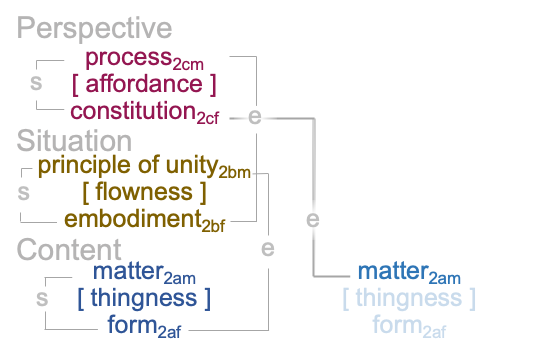
0633 It may sound uncomfortable, but take a look at the following sequence of perspective level nested forms.
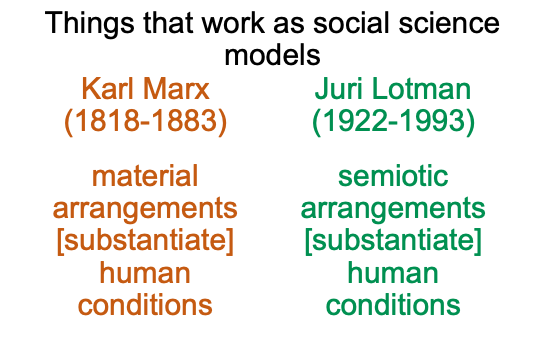
0634 In regards to the universe of signs, Lotman challenges Marx’s paradigm.
Do material arrangements [substantiate] the human condition2cf?
Lotman begs to differ.
0635 In regards to the evolution of humanity, Peircean diagrams turn out to be useful for depicting the relational beings inherent in implicit abstraction.
Consider Comments on Michael Tomasello’s Arc of Inquiry (1999-2019), by Razie Mah, available at smashwords and other e-book venues.
0636 In regards to the human as a semiotic animal, one must not forget that both exemplar and interventional signs intercalate in the perspective level of an interscope.
The specifying, exemplar and interventional signs appear in Looking at John Deely’s Book (2010) “Semiotic Animal”. This sequence of blogs appears in Razie Mah’s website in October 2023.
0637 What wonderful opportunities for the second ascendance of the TMS!
0638 But, that is not the only challenge that comes from this examination of the interview with Boris Uspenskij in the early 2010s and published in Sign Systems Studies in 2017.
I suppose that there is more than one way to denote primary, secondary and tertiary modeling systems, so why not advance one more?
0639 Here is another proposal.
Consider three tiers of interscopes, with the perspective-level of each tier displaying the following nested forms.
0640 To me, this sequence of primary, secondary and tertiary modeling systems suggest that Peirce’s diagrams may assist in knitting biosemiotics and TMS together into one overarching theoretical framework.
Three tiers of interscopes works well in the chapter on presence in Razie Mah’s How To Define The Word “Religion”. So, this might be a diagram worth mulling over.
0641 I thank the interviewer, Kaveli Kull, and Boris Uspenskij for engagements worthy of examination. I thank Ekaterina Velmezova for the translation into English.
0642 The article before me is published by Sign System Studies (volume 45(3/4), 2017, pages 230-248) by Boris Uspenskij (1937-present), one of the members of the first ascent of the Tartu-Moscow School of Semiotics, in the 1960s through the 1980s. The full title is “Semiotics and culture: The perception of time as a semiotic problem”. The paper was originally presented as a lecture held in Madrid in 2010. Plus, the paper is based on a two-part article published under the title “History and Semiotics (the perception of time as a semiotic problem)” in 1988 and 1989.
0643 The first ascent of the Tartu-Moscow School of Semiotics builds a fundament of semiology3a, structuralism3b and disciplinary languages3c that retain formal and final causations along with material and efficient causalities (called “exact methods3c“). The result is an actuality2c, a semiological structural model2c (SVi), that stands for a dyadic actuality2a where {the literary text2af (SOi) [entangles] a language2am of meaning, presence and message1a}.
0644 Here is a diagram of the fundament interscope.
0645 Exact methods3c?
Think of it3c as flying a probe2bm into a cloud of phenomena1c that cannot fully objectify the noumenon of a literary text2bf. This scholarly data-collector2bm extracts observations and measurements1c that will be evaluated (using exact methods) on the basis of signification3a(1a) and structure3b(1b).
0646 Semiological structural model2c?
According to the empirio-schematic judgment, a disciplinary language (relation, thirdness) brings a mechanical or mathematical model (what ought to be, secondness) into relation with observations and measurements of phenomena (what is, firstness).
A parallel construction follows.
A disciplinary language of exact methods3c (relation, thirdness) brings a semiological structuralist model2c (what ought to be, secondness) into relation with observations and measurements of phenomena1c within a literary text2bf (what is,firstness).
0647 Phenomena1c?
Phenomena are observable and measurable facets of a noumenon, a thing itself.
According to Kant’s slogan, a phrase that Kant may have never uttered but which is attributed to him in the same way that the entire Pentateuch is attributed to Moses, a noumenon cannot be fully objectified as its phenomena. A thing itself cannot be reduced to its observable and measurable facets.
0648 Language2bm?
Language2bm is the situation-level matter (as opposed to form) constituted by Saussure’s definition of language2aentering into a structure (or system)3b, such as a mother tongue3b, a genre3b, a style3b, an artistic community3b, a tradition3b, and other civilizational beings3b.
0649 Clearly, the semiological3a structuralist3b model2c aims to capture an Aristotelian expression of how language as matter2bm substantiates a literary text as form2bf.
Without the literary text2bf,a semiological structural model2c cannot coalesce because there is nothing to delimit free-floating, unanchored language from the phenomena that an inquirer is interested in. It is like matter without a form to substantiate. It’s useless.
0650 So, in the fundament interscope, language as matter2bm gives substance to the literary text as form2bf.
At the same time, the literary text as form2bf allows the entire situation-level hylomorphe2b to take a shapewhere language2bm may be regarded as phenomena.
0651 Say what?
Language2bm substantiates the literary form2bf and, at the same time, may be regarded as phenomena of the literary form2bf.
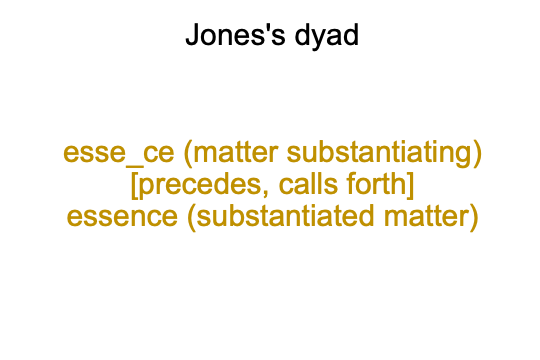
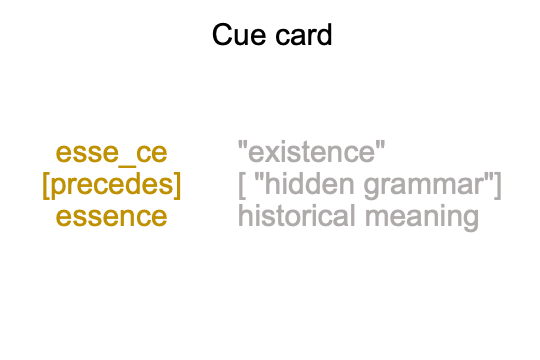
It2bm is substantiating matter2bm(esse_ce) because it virtually situates the content-level actuality2a, {langue2am[substantiates] parole2af}.
It2bm is regarded as literary phenomena by the perspective-level potential1c.
0652 The substantiated form2bf(essence) is like a noumenon and its2bf substantiating matter2bm (esse_ce) serves as its2bf observable and measurable facets (that is, its phenomena).
0732 The article concludes after the third asterisk (3).
Discussion shifts from the topic of the future to the metaphor of space.
0733 Historical consciousness discusses the future as the place that we are going.
Cosmological consciousness portrays the future as a place that we have been before.
0734 Both ways, the message1c is that the future will be a continuation of past and present.
But, what if we lived in a Lebenswelt where our hand-talk could not picture and point to these explicit abstractions?
What if we could manual-brachial gesture an arcfrom the location of the sun (or moon) towards its point of rising (past) or setting (future)?
Would these hand-talkwords testify to an implicit abstraction?
0735 What if we could not explicitly state that the normal context of space-time3c brings the dyadic actuality of {continuity in time as matter2cm [substantiates] our current Lebenswelt as form2cf} into the relation with the potential of ‘a message concerning the continuity of past, present and future’1c?
0736 Here is a picture of the interscope with that perspective-level nested form.
0737 Space is an excellent metaphor fortime.
We move through time, just as we move in space.
0738 Our motion in space is continuous, so time must be continuous as well.
Well, it must be continuous if space and motion and time are metaphors for one another.
But, one wonders.
0739 Does the perspective-level hylomorphe, {continuity in time2cm [substantiates] our current Lebenswelt2cf} apply to the Lebenswelt that we evolved in?
Does the derivative interscope explicitly manifest in the Lebenswelt that we evolved in?
0740 Can one express the explicit abstractions of history, cosmology, consciousness, continuity, and space-time in hand-talk?
What is there to image or point to?
0741 It makes me wonder. Are the foundations for these explicit abstractions somehow, built into the human thing… er… being?
Matter and form?
After all, “ego loquens” means “I speak”.
But, what if our kind evolves in the milieu of hand talk?
0742 My two conclusions are obvious and open-ended.
First, Uspenskij’s work may be diagrammed using the fundament (loquens) and derivative (ego) interscopes.
Second, time is not the only semiotic problem.
0743 My thanks to Boris Uspenskij for publishing this brief, yet engaging article.
0001 If I may present my conclusion at the beginning, “I suggest the following motto: First the bauplan, then the twist.”
0002 The full title of the essay under examination is “Unpacking the Neolithic: Assessing the Relevance of the Neolithic Construct in Light of Recent Research”. The article appears in the Journal of World Prehistory (2025) in volume 38:11, pages 1-58 (https://doi.org/10.1007/s10963-025-09198-0). The author is affiliated with the Department of Anthropology, National Museum of Natural History, Smithsonian Institution in Washington D.C.
0003 The author’s argument follows the Greek tradition of (A) setting out prior propositions, (B) adding further information and assessments and (C) proposing one’s own solution.
Prior propositions (A) are covered in the section titled, “The Origin of the Term ‘Neolithic'”.
Further information (B) includes sections on neolithic emergences in southwest Asia and other regions, including China, Japan, eastern north America, Mesoamerica and the northwest America.
The author’s proposal (C) appears in a section titled, “Repackaging the Neolithic”.
0004 I examine each movement in the sequence A, C then B.
0005 In regards to the historical origin of the term, “neolithic” (A), the word appears in the 1850s in the context of prehistoric lithic technology. A distinction between old “paleolithic” and new “neolithic” tools reflects a fairly recent change in the human condition. The Paleolithic extends very far back into the evolution of the Homo genus. The Neolithic is fairly new and applies only to Homo sapiens. By “new”, I mean, say, starting less that 20,000 years ago.
0006 As it turns out, stone tools and fossilized bones are the most recoverable items from the distant past. So, the idea that our kind evolves will of course rely of this type of data. The implications are significant. If lithic technologies are like matter, then the archaeologist may speculate on forms of prehistorical human (or “hominid” or “hominin”) conditions.
0007 For example, the earliest paleolithic stone tools are labeled “Oldowan”. These tools can be made on the fly. If I strike one rock with another, I can fracture off a shard and expose a sharp edge. Of course, one must choose the right rocks for this trick. Plus, technique is important.
Later stone tools are labeled “Acheulean”. These stone tools are made ahead of time, by the same technique of hammering off shards to reveal an intended form that… somehow… is intrinsic to the original rock.
0008 So, what am I suggesting?
Is the actuality of matter and form intrinsic to rocks, and ancestral hominins learn to tamper with one real element (matter) in order to sculpt the other real element (form)?
0009 I am suggesting more than that.
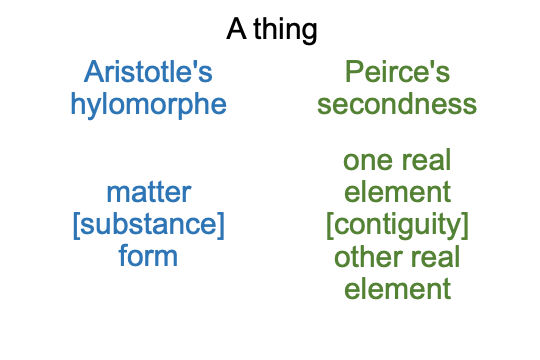
Aristotle’s hylomorphe (hylo = matter, morphe = form) is an exemplar of Peirce’s category of secondness. Secondness consists of (at least) two contiguous real elements. For paleolithic hominins, a rock (matter) could be sculpted into a stone tool (form). From the point of view of the archaeologist, the hylomorphic structure still applies. The question is, “How?”
Paleolithic stone-tool technology “sculpts” prehistorical human conditions.
0010 Of course, the word, “sculpts”, serves as an aesthetic metaphor for the contiguity between paleolithic technology as matter and hominin conditions as form.
0011 The challenge for nineteenth-century anthropology is clear. Propose a better, more scientific, or at least, less metaphysical, label for the contiguity.
With only geological strata, stone tools and fossilized bones as evidence, proposals were necessarily speculative. But, archaeologists continued digging, and by the 1850s could make the distinction between paleolithic and neolithic. Also, they figured out a reason for why the advance from Oldowan to Acheulean stone tools “sculpted” more advanced hominin conditions. Man was making himself.
0012 What do these evidential and rational developments suggest?
For a Peircean, secondness is the dyadic realm of actuality. Secondness is only one of Peirce’s three categories. The other two are thirdness (the triadic realm of normal contexts, judgments, signs, mediations and so forth) and firstness (the monadic realm of possibility).
Each of these categories manifests its own logic. Also, each higher numbered category prescinds from the adjacent lower category. Thirdness prescinds from secondness. Secondness prescinds from firstness. Prescission allows the articulation of the category-based nested form, as described in Razie Mah’ e-book, A Primer on the Category-Based Nested Form.
0013 Thirdness bring secondness into relation with firstness.
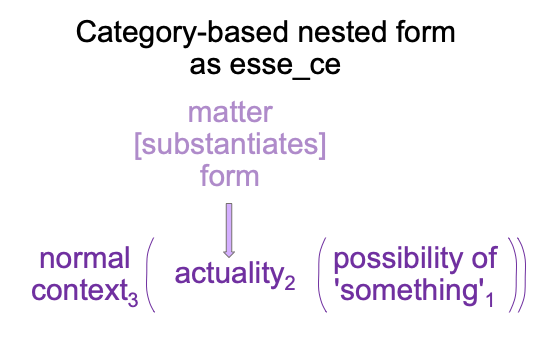
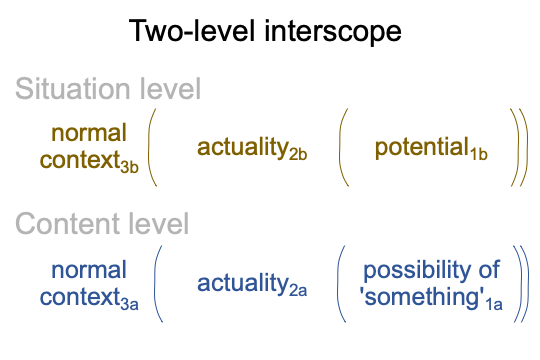
A triadic normal context3 brings a dyadic actuality2 into relation with the possibility of ‘something’1.
0014 Now I can slide the above dyad into the slot for actuality2 for the category-based nested form intimated by the title of V. Gordon Childe’s 1936 book, Man Makes Himself.
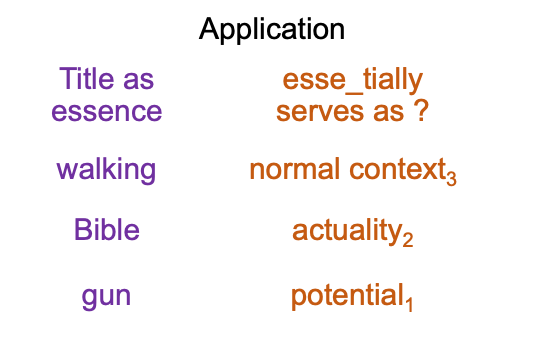
0015 The slide clarifies the contiguity, paleolithic technology constellates a substance, which I label, “technique”, that manifests an essence for the conditions of evolving hominins (that is, a substantiated form).
Consequently, the appearance of a new stone tool technology indicates a change in techniques as well as a change in the essence of the prehistoric human condition.
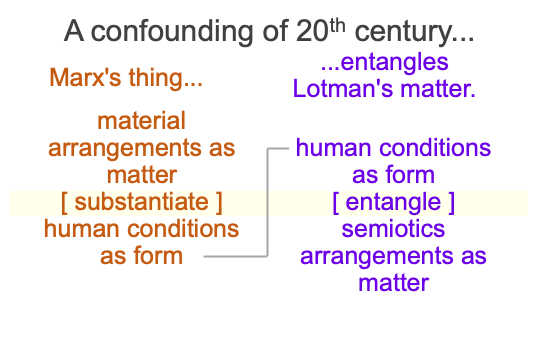
0016 According to Childe (1892-1957), the “neolithic” label encompassed more than a change in lithic technology. The prehistoric human condition gets entangled with all sorts of other matters, including sedentary communities, economies of delayed returns, various modes of storage and so forth. A long list of material arrangements gets entangled.
0017 As it turns out, once matter substantiates form, then form can entangle other matter, which is a confounding. Here, “confounding” is a technical term, precisely labeling one form originating from one matter and entangling another matter.
Historically, a confounding is an idea that belongs to Aristotle’s tradition. It is stumbled upon long after Aristotle’s campus went out of business. It is the brainchild of the Byzantine and Slavic civilizations.
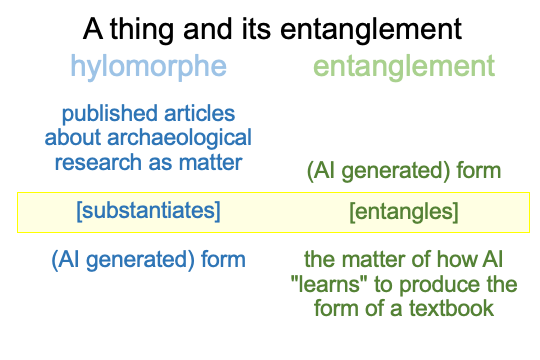
0018 Here is a picture of Childe’s confounding.
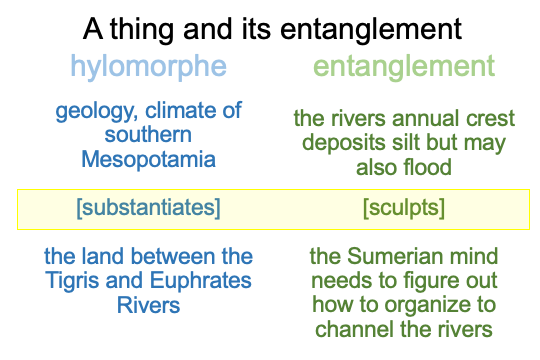
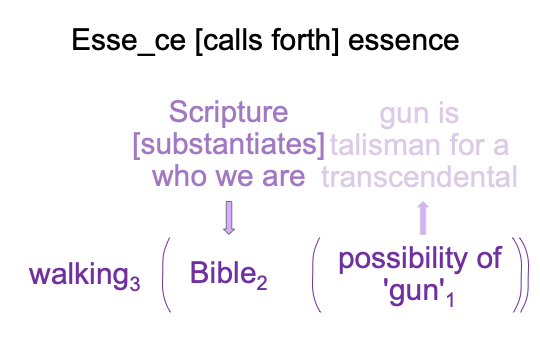
0019 The upper three lines presents the neolithic thing. Neolithic stone-tool technology [substantiates] the prehistoric human condition. The nature of the [substance] is labeled, “technique”.
The lower two lines presents the entangled matter. The [entanglement] is difficult to label, because its nature is.. well… a long list of material arrangements.
0020 A list of material arrangements appears in Table 1 of the article. Even the social components of social mechanism, magico-religious sanctions and trade can be shoved under the rug labeled, “material arrangements”.
0021 As such, the “neolithic” may serve as an adjective to a noun, “revolution”, that appeals to academics sympathetic to Marxist formulations. Yes, they are the ones who only promote academics with similar sympathies. Also, Childe was… um… a sympathizer.
The question is not about whether prehistoric folk are “communist” or “fascist”, even though these labels may apply to this or that anthropologist of the 1930s.
The question is whether the Marxist formula applies to prehistoric folk.
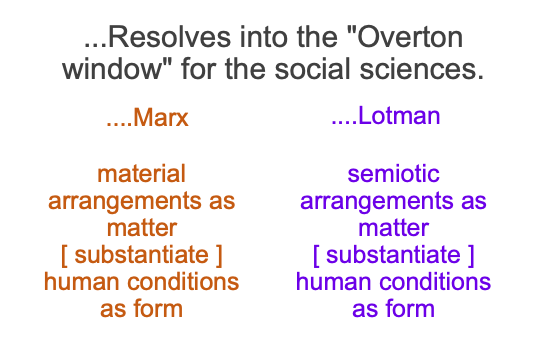
0022 The answer becomes obvious, when Childe’s confounding resolves into the following hylomorphic structure.
0023 The above figure depicts a Marxist version of Aristotle’s hylomorphe, {matter [substantiates] form}. Childe’s hylomorphe lasts for nine decades (that is, until the present day at the start of 2026). Man makes himself through a standard Marxist formulation. Soon, Soviet era archaeologists adopt the stance that the appearance of pottery is a hallmark of neolithic emergence. Pottery is a material arrangement. The emergence of the neolithic is a human condition.
0056 Okay, I will continue drinking my cocktail in the following exposition.
I regard the last two figures, along with the figures that appear in the article under examination.
0057 There is something in B that suggests two bauplans3. Early Neolithic Bauplan 1 marks the terminus of the Lebenswelt that we evolved in. Late Neolithic Bauplan 2 denotes the start of our current Lebenswelt.
0058 Bauplan 1 looks like this.
The early Neolithic bauplan3does not permit untrammeled social and labor specializations. Rather, all social circles2m (family (5), friends (5), teams (15), bands (50), and community (150)) are optimized2f in the pursuit of the final cause of ‘settling down’1. It is the same way that different organs and organ systems are optimized for ‘settling down’ into an individual.
Details of optimization will be specific to each location (because efficient causes differ), yet produce something ‘general’, that manifests in excavation sites as varied as Catal Hoyuk and Tepe Gobekli. Domestication includes the local geography, plants and animals. Domestication may even include settlements more than a day’s walk away. Domestication may include the heavens.
0059 Once rendered in this manner, the slow, seemingly reversible, spiral into the neolithic thing2 gets depicted as thin dotted horizontal lines along the axes of arrangements versus time.
0060 The late Neolithic bauplan3 permits individual social and labor specializations. Something significant has changed. The key final cause of ‘settling down’ remains relevant. However, another key final cause cannot be ignored. The optimization of the early Neolithic somehow breaks down and the late Neolithic initiates a search for order1 that continues to this day.
0061 Here is a picture of what Bauplan 2 might look like.
0062 It is as if an individual, having been formed by a bauplan 1 gestation, gets born.
What a rude awakening.
0063 What about the timeline?
If I replace the increasing boldness of the horizontal dotted lines with a slowly rising bauplan 1 slope, and if I depict the most bold horizontal dotted lines as a bauplan 2 phase transition, then I get the following graph.
0064 What does this imply?
Obviously, bauplan 1 ends in a twist, that is, bauplan 2.
I noted this slogan at the start of my examination.
0065 Less obviously, the Neolithic revolution is not in the actuality of {material arrangements [substantiating] the neolithic condition}2.
“The Neolithic Revolution” involves a transition from the Lebenswelt that we evolved in to our current Lebenswelt.
0066 Fortunately, for the author, the American Marxist academic candle is about to exhaust itself, just as the Soviet Marxist illumination did decades ago.
Yes, the crisis begins.
0067 The impending change of cognitive grounds will be at least as great as the following transition from Karl Marx (1818-1883) to Juri Lotman (1922-1993). This transition goes sigmoidal in 1989.
0068 The following hylomorphic transition is derived in Razie Mah’s blog for December 2025, titled Looking at Igor Pilshchikov and Mikhail Trunin’s Article (2016) “The Tartu-Moscow School of Semiotics”.
0069 Marx’s actuality2 is supposed to arise from the potential of scientific models1, even though the actuality2 served as doctrine, rather than a mechanical or mathematical formulation. Remember, Marx’s actuality2 conforms to the structure of Peirce’s secondness. Secondness is the realm of actuality. How easy is it to confuse this actuality with the realness of a mechanical or mathematical model? Yet, they are not the same.
0070 Lotman’s actuality2 arises from the potential of the semiosphere1, the universe of sign-relations. Semiotic arrangements are not the same as material arrangements. They are not even close.
0071 So, what am I saying?
The author senses that ‘something’ is coming and she figures out that it must concern a bauplan.
After all, bauplan is a term that is familiar to evolutionary biologists.
0072 Happily, the semiotician, Razie Mah, has already explored human evolution from the point of view of Peirce’s categories. The human bauplan is an adaptation to the niche (or the potential) of triadic relations. Plus, human evolution comes with a twist.
Here is a list of works by Razie Mah that pertain to Bauplan 1 and Bauplan 2.
0073 Surely, this is a lot to unpack. But, that is precisely what Melinda Zeder’s article calls for.
My thanks to the author for publishing this thought piece.
0001 The article before me is published by Sign System Studies (44(3) (2016) pages 368-401) by two professors, Igor Pilshchikov and Mikhail Trunin, hailing from Tallinn University in Estonia. The title is “The Tartu-Moscow School of Semiotics”. The subtitle is “A transnational perspective”.
0002 The abstract promises to situate the Tartu-Moscow School of Semiotics of the 1960s through 1980s. The article delivers more than promised.
How so?
0003 The authors sketch dynamic developments among intellectual circles within the (now former) Union of Soviet Socialist Republics.
0004 The term, “transnational”, indicates that there are nations within the former Soviet Union.
During this period in history, the governments of Estonia and Russia (along with Czechoslovakia and Poland) owe fealty to an empire with the title, “Socialist”, in its name.
So, “transnational” tells me that the article looks back from the present, into a past era, with the intent of portraying ‘something’ historical, without acknowledging that the “Union” and the “Socialist” descriptors no longer apply (at least, not in the way that they once did).
0005 “Transnational” applies to the Union of Soviet Socialist Republics (USSR, 1918-1989) as well as the upcoming… um… Eurasian convergence?
Here is a picture with three city-sites. Tartu and Moscow belong to the title. Tallinn is the location where the authors write their article. The blue is the Baltic Sea.
0006 “Transnational” steps over the boundaries depicted in black in the above figure.
Never mind the fact that the above territories reside behind, what American pundits once called, “the Iron Curtain”.
0007 Perhaps, one must appreciate an ambiguity to the term, “transnational”, given that there is another transit. This transit is in time. Or, even better, this transit is across a boundary between battles among Enlightenment gods.
Consider where the time period of 1960s to 1980s resides in the following timeline of Western civilization in the twentieth century.
Also consider the year when the article under examination is published.
Notice the boundary.
0008 The Tartu-Moscow School of Semiology constellates within one battle, as a transnational collaboration.
The TMS is remembered during another battle, which is not resolved, and so cannot be objectified as “historical”. I suppose that it can be objectified as “cultural”. Better yet, “theodramatic”.
Already, there is more to this article than meets the eye.
0348 In section eight (8), the authors discuss the third post-Soviet approach, that of Juri Lotman.
The title of Lotman’s 1990 book is The Universe of Mind.
The title is somewhat funny, since the mind associates to the normal context and a universe resides in the corresponding potential.
0349 How so?
The “universe” is not the closed totality of material arrangements.
The “universe” is the open totality of semiotic arrangements.
0350 Open to what?
Messages.
Another term for “the universe of messages1” is “the semiosphere1“.
0351 On the content level, the normal context of a TMS positivist intellect3a brings the actuality of the dyad2a, {literary text2af [entangles] language2af}, into relation with the potential of ‘(positivist) meaning’1a.
On the situation level, cultural studies3b brings the dyad2b, {cognition2bm [substantiates] social interaction2bf}, into relation with the potential of ‘(civilizational) presence’1b.
On the perspective level, mind theory3c brings the dyad2c, {semiotic arrangements2cm [substantiate] human conditions2cf}, into relation with the potential of ‘the semiosphere’1c.
0352 Lotman’s derivative interscope stands right in line with Charles Peirce’s theory of evolutionary love.
The Universe of Possibility defines the category of firstness. Firstness contains a universe of messages.
The Universe of Actualities includes semiotic arrangements and belongs to the category of secondness.
The Universe of Mind3c brings the Universe of Actualities2c into relation with the potential of the Universe of Messages1c.
0353 Mind theory3c brings the dyadic actuality of {semiotic arrangements [substantiating] human conditions}2c into relation with the ‘semiosphere’1c.
Marxist theory3c brings the dyadic actuality of {material arrangements [substantiating] human conditions}2c into relation with the potential of ‘something to do with message’1c.
0354 Surely, Juri Lotman, as an old man, does not suspect that his mind theory3c stands as an alternative to Marxist theory3c.
Marxist theory3c contextualizes the message of Soviet communism1c.
The Universe of Mind3c contextualizes the semiosphere1c.
Welcome to the Fourth Age of Understanding.
0355 The concept of the semiosphere1c is an organic development of Juri Lotman and his collaborators of the Tartu-Moscow School of Semiotics.
This explains why I claim, in point 0008, that there is more to this article than meets the eye.
This examination adds value to the authors’ article, in ways hitherto unimagined.
0356 In the following figure, the virtual nested form in the category of secondness is highlighted.
0357 The perspective-level dyad, {semiotic arrangements [substantiate] human conditions}2c virtually brings the situation-level dyad, {cognition [substantiates] cultural interaction}2b, into relation with the potential of the content-level dyad, {literary text [entangles] an aesthetic and positivist language}2a.
0358 Likewise, in the virtual nested form in the category of thirdness, mind theory3c brings cultural studies3b into relation with the possibility of the TMS positivist intellect3a.
0359 Finally, in the virtual nested form in the category of firstness, the semiosphere1c, the universe of messages1c, brings civilizational presence1b into relation with positivist meaning1a.
0360 The authors briefly discuss Lotman’s later books, which are translated into English long after his death. The authors note that these books treat issues that are rarely associated with the Tartu-Moscow School of Semiotics, even when they place its collegial collaborations in perspective.
0361 Nonetheless, some scholars wag an accusatory finger and assert, “He turned into a post-structuralist.”
0362 “Post-structuralist”?
Technical terms are so important, especially when they mean ‘something’ that common folk don’t think they mean.
There is a gap, which cannot be crossed, especially by those subject to empirio-normative domination.
Well, at least, that is what the experts on television tell me.
“Post-structuralist” is a derogatory label.
Only experts know what the label means.
0363 The authors offer a quick summary of the questions that Lotman raises in these last works. First (1), can inquirers devise a common approach to natural, social and spiritual phenomena? Second (2), how is a mind theory3c paradigmgoing to handle evolutionary (think, Lebenswelt that we evolved in) and explosive (think, our current Lebenswelt) cultural transitions. Third (3), does artistic labor serve as a workshop that builds semiotic arrangements (as matter) into the human condition (as form)?
0364 Surely, these are appropriate questions.
And, not surprisingly, the pen of Razie Mah offers literary texts that touch upon these questions. They are (1) How to Define the Word “Religion”, (2) The Human Niche and (3) An Archaeology of the Fall.
0365 The authors conclude that a global history of semiotics will tell Lotman’s tale, as well as the complicated intriguescultivating semiotic awareness beneath the watchful eyes of Soviet Socialist ideologues.
But, as far as this examiner is concerned, these modern histories may also be viewed through a lens that focuses on an illumination that harkens back to the beginning.
A light dwells deep within Slavic civilization.
0366 I wonder. Is there is an unconceived reason for why the Virgin Mary appears in Portugal, in a town bearing the name of Fatima, the daughter of the Prophet Mohammed and Khadija, and calls for the Catholic Church to consecrate her Immaculate Heart to Russia?
The visions happen in 1917, right before the Russian Revolution.
0367 In 2022, a Latin-tradition-despising pope, along with his reform-fixated Vatican-Two-promoting bishops, do precisely that. They consecrate the Immaculate Heart of Mary to Russia on March 25, 2022, at the same time when Russian (no longer Soviet!) troops enter into Ukraine. They invade in order to stop… what? Everybody in Russia apparently knows. Does anyone know in the Collective West?
0368 Perhaps not.
Is there a gap, which cannot be crossed?
Will a curtain of propaganda become transparent?
Or what?
0369 There is one more juxtaposition to make.
0370 The lower line should look familiar.
The triadic normal context of Lotman’s mind theory3a (now transcending Marxist theory3c) brings the dyadic actuality of {semiotic arrangements [substantiate] our current Lebenswelt}2a into relation with the monadic ‘semiosphere’1a,where the “semiosphere” is the potential of ‘the universe of messages’1a.
0371 The upper line is introduced in points 0355 though 0371 in Razie Mah’s e-book, Comments on Mariusz Tabaczek’s Arc of Inquiry (2019-2024) (part 1, available at smashwords and other e-book venues).
The triadic normal context of God’s Self-Actualization3c brings the dyadic actuality of {the Person who Speaks [utters] the Person who is the Word}2c into relation with the ‘Oneness of God’2c, where the “Oneness of God” is the monadic potential1c underlying God’s Self-Actualization3c.
0372 What does this juxtaposition inspire me to imagine?
Does it seem that the Speaker2c occupies the space for semiotic arrangement2cm?
Does it seem that Word2c, who creates the Lebenswelt that we evolved in (see Genesis 1-2.3) as well as our current Lebenswelt (see Genesis 2.4-10), occupies the space for the human condition2cf?
0373 Does it seem that God’s Self-Actualization3c encompasses a theoretical Universe of Mind3c?
Does it seem that the Oneness of God1c manifests the omnipresence and the omniscience of a universe of messages1c?
0374 It almost makes me wonder whether there is a post-post-truth condition.
0375 There is a story. It goes like this.
After the famous Russian philosopher, Marxist academic and scholar to be reckoned with, Juri Lotman, dies, he finds himself in a waiting room, in what looks to be an old Basilica. After a few minutes, the wooden door creaks open and he is greeted by St. Methodius, himself.
Lotman, confident of his own genius even in death, says, “Methodius, what can you tell me that I don’t already know?”
Methodius grins and says, “You’ve been working for us all along.”
0376 I thank the authors for this essay, published a decade ago, and fresh enough to support the fermentation of this examination.
0001 This essay comments on a 2017 book by biologist, Dennis Venema, and theologian, Scot McKnight. The title is Adam and the Genome: Reading Scripture after Genetic Science. The publisher is Brasos Press in Grand Rapids, Michigan.
The book consists of two equal parts. The geneticist shows that Adam and Eve cannot be a single pair who founded the human species. The theologian wrestles with how to read Genesis in light of modern archaeology.
0002 My goal is to supplement these arguments in two ways. I will re-articulate ideas about evolutionary biology using the specialized language of the category-based nested form. I will present a scientific hypothesis that re-images the Adam and Eve stories as ancient Near Eastern fairy tales.
Perhaps, at the end of these comments, I can declare, “The old historical Adam is dead. Long live the new historical Adam.”
0003 Before I begin, I attend to some housekeeping items.
‘Words that belong together’ are denoted by single quotes or italics.
Suggested readings include Primer on the Category-Based Nested Form (#1), Primer on Sensible and Social Construction (#2), and the chapter on message in How to Define the Word “Religion”. These works, by Razie Mah, are available at smashwords and other e-book venues, along with the compilation of this blog, titled, Comments on Dennis Venema and Scot McKnight’s Book (2017) Adam and the Genome.
0004 In order to see where many evangelicals are coming from, consult the September 2010 issue of Perspectives in Science and Christian Faith. This particular journal of the American Scientific Affiliation presents a snapshot of some of the difficulties posed by the early chapters of Genesis.
0005 The 2017 book, Adam and the Genome: Reading Scripture after Genetic Science, addresses one conundrum with a simple admission: Adam and Eve cannot be the progenitors of all humans, as proposed by Saint Augustine, 1600 years ago. The admission rebukes Christians striving to locate the primal couple in a genetic bottleneck event between 50 and 150 thousand years ago.
0005 Unfortunately, their solution provides little defense for Christian doctrine. Big government (il)liberals (BGilLs) claim that evolution disproves the second creation story in Genesis, just like the mercantilists, fascists and communists before them. BGiLs also insist that the Bible is the stuff of myths.
0006 Evangelical communities continue to bleed students.
Why?
Original Sin.
Christians think it describes the human condition.
BGilLs do not.
0007 Christians believe that humans are disoriented. Jesus provides orientation. Jesus is the way.
For BGilLs, the human condition is perfectible through a never-ending revolution by an administrative state. The human condition may be fulfilled by knowing one’s self. Or, is it – constructing – one’s self?
With Original Sin, we are actors in a theodrama that transcends critical theory. Indeed, critical theory may typify the corruption of Original Sin.
Without Original Sin, we are foolish players strutting on the world’s stage, full of sound and fury, signifying nothing. So why not accept the ministrations of a totalitarian government? Why not construct oneself?
0243 Certainly, Venema and McKnight lower two curtains on the historical Adam envisioned by Saint Augustine.
0244 With these comments, each curtain takes on a life of its own.
0245 The fact that descent with modification embodies the same relational structure as the message underlying the word “religion” suggests that there is more to evolutionary biology than meets the eye. The discussion ends with the “university” becoming the “ulistentome”, the “college” getting relabeled as “harangue” and the seminary turning into “hope for salvation”.
Genetics rules out Adam and Eve as the biological parents of all humanity along with Augustine’s version of Original Sin.
What about the word games that speech-alone talk allows?
0246 The fact that the stories of Adam and Eve are written in the style of (excavated) ancient Near East literature suggests that all these stories came to us through a process of descent with modification.
All written origin stories of the ancient Near East point to the trauma ofthe first singularity. They cannot see beyond this particular time-horizon.
The same goes for the Genesis stories starting with Adam and Eve. The stories of Adam and Eve mark the start of our current Lebenswelt.
0247 Here is a new image for Original Sin.
Indeed, the new version accounts for the old version.
0248 So, instead of pursuing ulistentome or harangue, seek hope for salvation.
Adam and the Genome: Reading Scripture after Genetic Science lowers the curtains on Augustine’s stage play about the nature and consequences of the Fall. Yet, the curtains come alive with the category-based nested form and the hypothesis of the first singularity.
0519 I conclude this first look at Julian Jaynes’s breakthrough masterwork, The Origin of Consciousness in the Breakdown of the Bicameral Mind, with a brief summary.
I examine the First Mariner Books edition, published in 2000, which offers the advantage of a postscript… er… “afterword”, written in 1990, fourteen years after the first edition.
The afterword does not substitute for the masterwork, even though it neatly distills the complex argument into four propositions.
0520 Here are the four propositions.
0521 This examination commences with these four propositions.
Why do I pursuit of this topic?
In my view, Mithen’s 2024 work, The Language Puzzle, exhibits the hallmarks of both subjective consciousness and bicameral mind.
0522 This examination concludes with modifications on Jaynes’s four propositions.
0523 Each of these modifications have been discussed in full.
These modifications bind together Mithen’s nyet hypothesis, pertaining to the Lebenswelt that we evolved in, and Jaynes’s historical hypothesis, pertaining to our current Lebenswelt.
These modifications demonstrate that our current Lebenswelt (items in blue) is not the same as the Lebenswelt that we evolved in (items in green).
These modifications propose how the first singularity is a major cause for this difference.
The first singularity stands between the green and the blue items.
0524 Steven Mithen publishes in 2024, almost precisely five decades after Julian Jaynes publishes in 1976. So much has happened during the past fifty years. Also, so little has happened, when it comes to developing Jaynes’s four propositions. How strange it is that Steven Mithen’s bicameral mind may have constructed a foreword to Jaynes’s masterwork, without the author consciously realizing it.
0525 This is precisely the irony that permeates Jaynes’s landmark work.