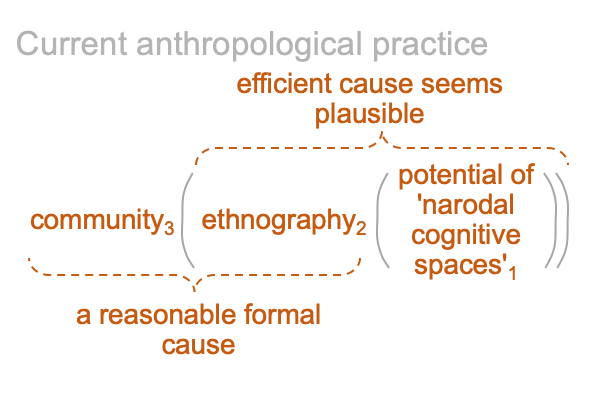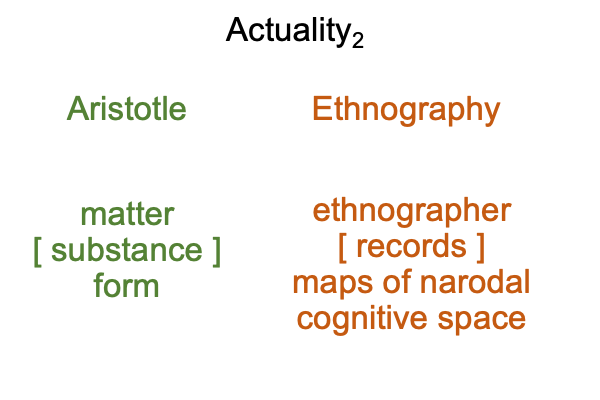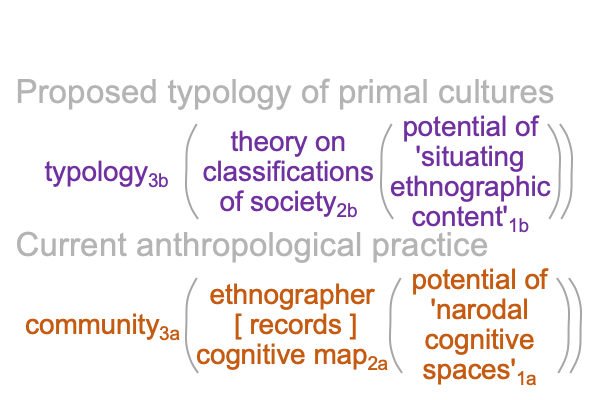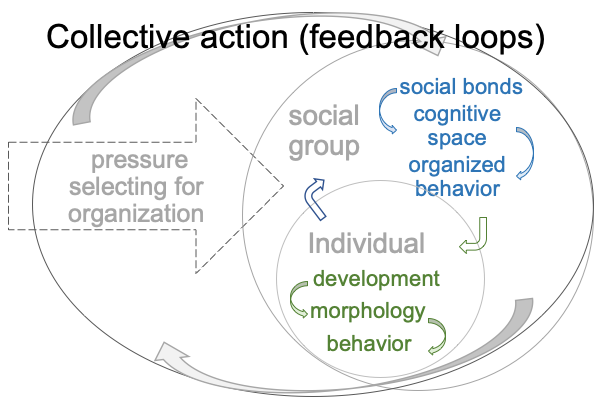
12/5/25

Looking at Igor Pilshchikov and Mikhail Trunin’s Article (2016) “The Tartu-Moscow School of Semiotics” (Part 22 of 27)

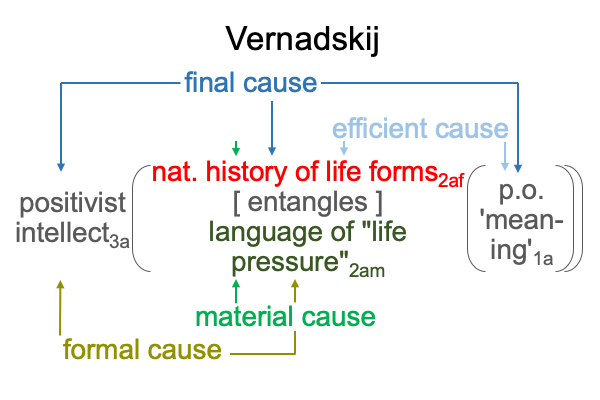
0276 Why do I mention this post-truth business?

From the 1950s until 1989, Juri Lotman (1922-1993) is a professor in a Soviet Socialist academic system.  He does not cross the line while… at the same time… tunnels a way under the line that cannot be crossed.

Of course, it is funny to describe academic tunneling, but the further that Lotman digs into a scientific explanation for human conditions, the closer Lotman gets to popping up on the other side of the Marxist line.

0277 Here is a picture of the tunnel.

0278 If structuralism is a thing, then its matter is semiology and its form is aesthetics.

Why is that?

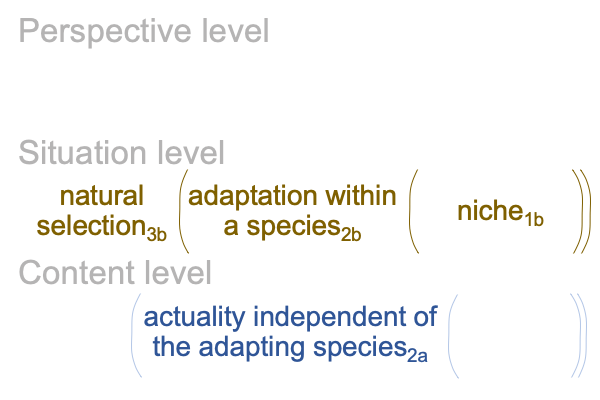
The recognition of structure… of a system… is aesthetic.  This is how humans work, in our current Lebenswelt.  We recognize structure3b and apply a label1b.  That label is validated when it gets applied over and over again to similar structures.  For example, every literary text2bf is different.  However, every literary text belongs to a genre3b.  

0279 The tunnel?

Aesthetics as form entangles cultural studies as matter.

The thing part of this confounding is the topic of sections one and two of the article (1 and 2).  At this point, reviewing the first two sections of the article under examination may prove valuable.  This examination adds value to the authors’ text.

0280 Lotman starts as a traditional literary historian, working in Moscow, the hub of a centralized empire that purports to embody Marxist theory.  Authorities are hell bent on changing material arrangements.  They anticipate changes in the human condition, according to their Marxist overlay of civilizational history itself (the model overlaying the noumenon).

0281 Lotman becomes a literary structuralist (1960s), leading the Tartu-Moscow School of Semiotics (er… Semiology) and initiating the University of Tartu Summer School.  During this time, the School produces a remarkable langue(three-level interscope) that culminates in the parole of a semiological3a structuralist3b model2c.

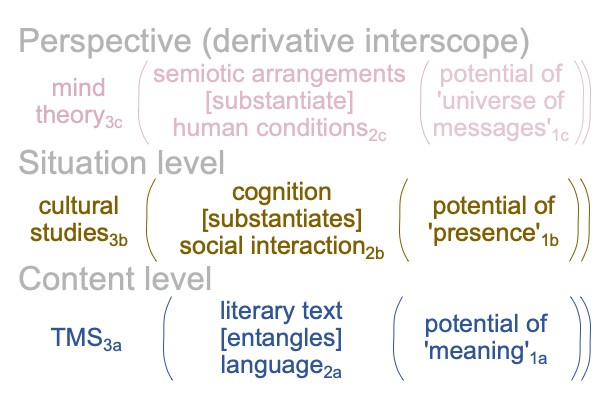
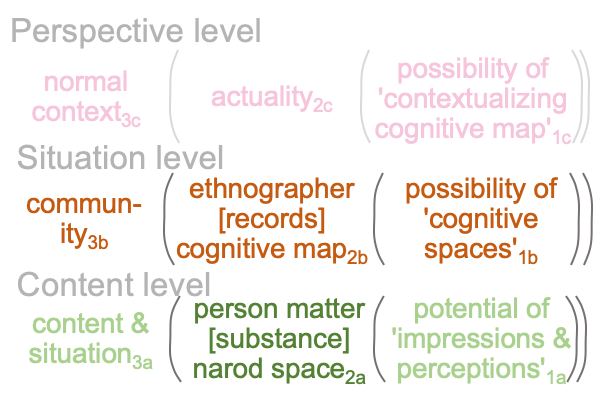
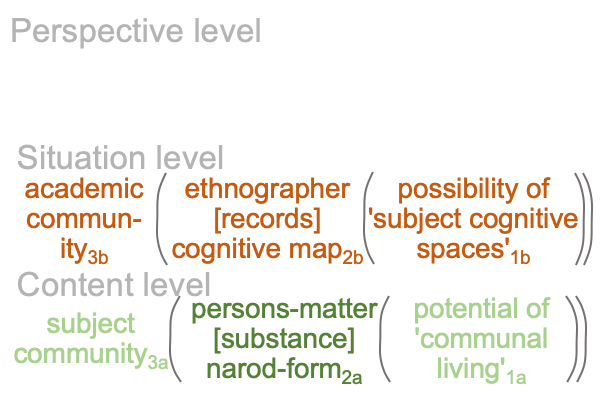
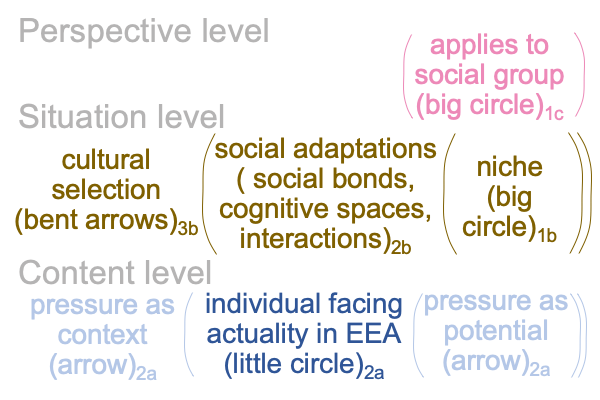
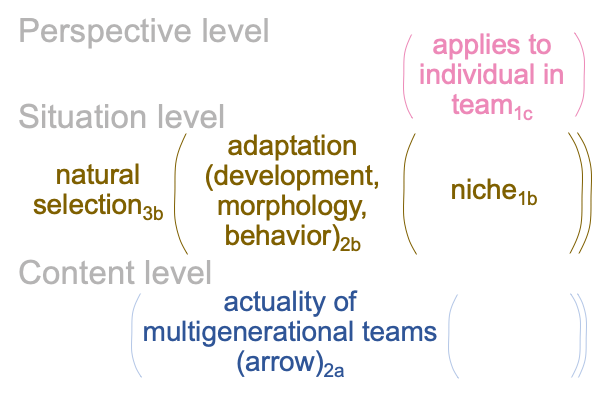
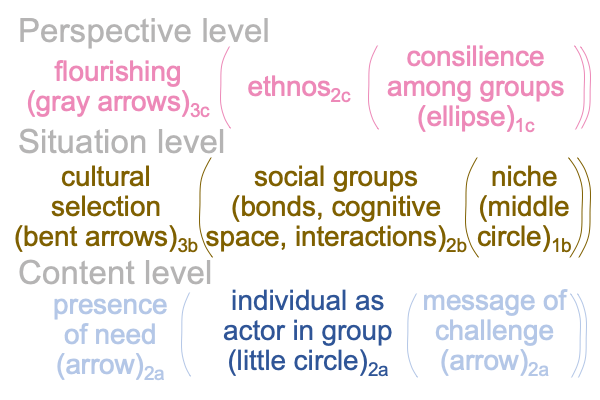
0282 The examiner has already derived the following diagram of the fundament interscope.

0283 Theoretically (A), the perspective-level actuality2c should serve as a science-friendly model that can overlay the noumenon of literature within the Slavic civilization.

But, that does not occur.

Instead, the so-called “Prague Spring”, nudges (B) the network of researchers (who are increasingly touching base with Lotman, whose voluminous correspondences currently reside at the Lotman Archives in Estonia) towards a different opportunity.

0284 What do I mean by that?

First, let me discuss the “should” (A).

Note how the three-level interscope depicted above is sustained by a Saussurean3a content-level actuality2a, arising from the potential of ‘the signifier and the signified’1a.

0285 The actuality2a itself exhibits material causation.  That means that the substance, an arbitrary relation, is real.

Of course, this makes no sense, because how can an arbitrary relation be adaptive?

Okay, that is another story.  See Razie Mah’s e-book, The First Singularity and Its Fairy Tale Trace.

0286 The normal context3a and the actuality3af involves formal causes.  Surely, if parole2af manifests as a system of differences, then langue2am must as well.

0287 Efficient causes couple actuality2a and potential1a.  The potential1a reminds me of the potential that underlies language2am on the content-level of the derivative interscope.  Meaning1a?  What is it1a?  Well, it must involve the interplay between signified and signifier1a in the human mind.

0288 Here, I can harken back to human evolutionary history, by claiming that this interplay differs between implicit and explicit abstraction.  Implicit abstraction is the sole province of hand- and hand-speech talk, belonging to the Lebenswelt that we evolved in.  Explicit abstraction is an opportunity available for speech-alone talk, belonging to our current Lebenswelt.

The actualization of langue2am and parole2af from the potential of ‘signified [&] signifier’1a serves as an example of explicit abstraction.

See Razie Mah’s e-book, A Primer on Implicit and Explicit Abstraction, available at smashwords and other e-book venues. 

0289 Doesn’t this claim sound like a huge research project?

0290 Efficient causes work in alignment with final causation.  

Consider the following category-based nested form: A mechanical decoding and encoding process3a brings the actuality of {neural networks corresponding to three-level interscopes (langue2am) substantiating vocal utterances (parole2af)} into relation with the potential of positive and negative feedback loops1a.

0291 Compare the efficient causalities involved in the actuality2a, {neural network2am [substantiates] vocal utterance2af}, emerging from and situating the potential1a of the final causalities inherent in the following two statements.

The signifier1a associates to parole2afthe spoken word.

The signified1a goes with langue2am, which turns out to be a purely relational structure, such as a three-level interscope.

0292 On the semiological or content level, langue2am is like an impression2am that substantiates a parole2af, a spoken word2af.  Consequently, the fundament interscope is founded in the same way that a person generates a written text.  One must take a pen and inscribe the spoken word2af.  So, the semiological level goes with what I think2am and what I say2af er… write2af.

0293 On the structural or situation level, inscription2af has the potential of following (and thus revealing) the laws of a semiological system1b (or “genre3b“).  Language2bm [substantiates] a literary text2bf (a new signifier, one worth showing to others).  So, the structural level recapitulates what I say2af as a literary text2bf.

0294 The words in my literary text2b carry the potential to be regarded as phenomena of the text as a noumenon1c.  This potential1c introduces the unfolded empirio-schematic judgment as the perspective level of the fundament interscope.

0295 Overall, this is what took place and would have continued uninterrupted (A), if it were not for the so-called “Prague spring” (B).

12/4/25

Looking at Igor Pilshchikov and Mikhail Trunin’s Article (2016) “The Tartu-Moscow School of Semiotics” (Part 23 of 27)

0296 The so-called “Prague spring” (B) occurs in the middle of the first iteration of the TMS.

1968 runs into a disturbance, a black swan event, and…

0297 …the path changes, from a movement that would have mimicked triumphalist science to something far more confounding.

0298 Remember, the perspective level of the fundament three-level interscope presents a model (from the empirio-schematic judgment) that should overlay the noumenon (in the Positivist’s judgment).

0299 The perspective-level actuality2c (what ought to be, Positivist’s judgment) should have proceeded to overlay the noumenon1a (what is, Positivist’s judgment), but that would produce an obvious discrepancy with the Marxist theory of the substantiation of human conditions by material arrangements.

0300 Instead (C), the perspective-level model2c enters the content level of a new derivative interscope, that will eventually constellate the claim.

Furthermore (D), the entangled matter gets confounded with the contiguities in a two level interscope that coheres to Lotman’s move to include cultural studies (described in section six (6)), in a way that does not make a claim contradicting regime sustaining Marxist models.

0301 Let me dwell on the instead (C).

The entrance follows the path of the interventional-sign relation, which is discussed in Looking at John Deely’s Book (2010) “Semiotic Animal”, appearing in Razie Mah’s blog for October, 2023.

0302 Here is a diagram.

0303 In the triadic structure of a sign-relation, a sign-vehicle (SV) stands for a sign-object (SO) in regards to a sign-interpretant (SI).

This interventional sign relation crosses from the perspective-level of the fundament interscope to the content-level of the derivative interscope.

It also passes from the empirio-schematic judgment to the Positivist’s judgment.

0304 A semiological2a structuralist2b model2c (SVi) stands for the dyad, {literary text as form2af (SOi) [entangles] language as matter2am} in regards to the TMS positivist intellect3a operating on the potential of ‘meaning’1a (SIi).

0305 In short, Lotman and his collaborators make an intuitive leap from the language of the mother-tongue, the subject matter for semiology and structuralism, to a language of meaning, presence and message that will… um… act as matterthat substantiates forms that are relevant to… hmmm… the entangled claim.

12/3/25

Looking at Igor Pilshchikov and Mikhail Trunin’s Article (2016) “The Tartu-Moscow School of Semiotics” (Part 24 of 27)

0306 Now, I proceed to the derivative interscope.

0307 The content level deals with semasiological issues.  Given the words of a literary text2af, how do we discuss2amthese words2af by way of meaning1a?

Or should I ask, “Given a signifier2af, then what is the proper signification2am?”

The literary text as semiological structuralist form2af [presents signifiers that entangle] positivist language as matter2am.

Given a positivist language as matter2am, then what corresponds to its meaning1a?

0308 Does the correspondence reflect the nature of explicit abstraction?

Does the model-regarded parole2af of the literary text2af entangle a language2am, displaying the attributes of a langue2am emerging from (and situating) the possibility of ‘positivist meaning’1a?

Given the parole2af of a literary text2afwhat does the entangled language2am corresponding to langue2am suggest by way of meaning1a?

0309 What type of confounding is this?

The single form is in red.  The originating matter is language2bm (fundament).  The entangled matter is language2am(derivative).

0310 The onamasiological question concerns whether there is a spoken parole corresponding to a particular (and perhaps, yet to be fully articulated) positivist langue.

When applied to the situation-level of the derivative interscope, the onamasiological question transforms into a cultural query, asking “Is there a presence1b to attach to the meaning1a underlying the content-level positivist langauge2am?”

0311 Say what?

Oh my.  I now proceed step by step.

0312 Step one, the literary text2af (the SOi for the semiological2a structuralist2b model2c as SVi) entangles an explicit abstraction2am consisting of a label2am emerging from (and situating) a positivist3a meaning1a.

In this entanglement, the fundament is confounded with the derivative.

0313 In step two, I compare the two content-level actualities.

In the fundament interscope, langue2am (more or less actualizing a signified1a) [substantiates] parole2af (more or less serving as a signifier1a).

In the derivative interscope, the literary text2af, that was originally substantiated by the language2bm of the mother tongue, now serves as the form2af  (perhaps, as a semiological2a structuralist2b model2c substituting for the literary text2bf) entangling an expert language2am that emerges from and situates the possibility of ‘positivist3a meaning’1a.

0314 This directly calls to mind the semasiological question, “Given a spoken word2am, then what is its meaning1a?”

In other words, what is the meaning1a (associated to signifier1a) of the explicit abstraction2am (associated to parole2af) in the derivative interscope?

0315 For the fundament, definition is regarded as implicit for the originating language2bm, specified by a text’s {langue2am [substantiates] parole2af}.

For the derivative, definition must be explicit, leading to the semasiological question.  An explicit abstraction2am (a label, parallel to parole2af) is entertained (or entangled).  However, the positivist meaning1a, which may serve as a metaphorical signifier1a for the explicit label2am resides in the domain of possibility1. An explicit abstraction2amemerges from (and situates) the potential of positivist meaning1a in the normal context of the TMS intellect3a.

0316 Step three, the derivative’s explicit abstraction2am manifests as a label2am arising (like a parole2af) from the potential of ‘positivist3a meaning’1a (serving as a metaphorical signifier1a).  The label2am (the fundament’s parole2afserves as a metaphor) emerges from a meaning1a (the fundament’s signifier1a serves as a metaphor) and its signified1acarries the potential of ‘exhibiting explicit positivist3a meaning’1a (and the fundament’s signified1a serves as a metaphor).

0317 In short, the entangled language2am seems like parole2af.

Plus, positivist meaning1a seems like a signifier1a.

The language2am of the explicit abstraction2am (the metaphorical parole2af) appears to do justice to the TMS positivist intellect3a and the potential of ‘meaning’1a (the metaphorical signifier1a).

How about a diagram of four elements of the derivative interscope?

0318 So far, step three covers the content-level elements.

0319 Once again, Saussure’s langue2am (for the fundament interscope) also serves as a metaphor for the literary text2af(for the derivative interscope).  The literary text2af (perhaps, now a semiological2a structuralist2b model2c substituting for the literary text2bf) is formally contextualized by the TMS positivist intellect3a and is alchemically enclosed in the scholar’s inquiry as a metaphorical langue1am, corresponding to the possibility of a ‘signified’1a.

Saussure’s parole2af serves as a metaphor for the language2am that is entangled by the literary text2af.  This metaphorical parole2am is both finally and efficiently related to the potential of a ‘positivist3a signifier’1a by way of definition3.

Of course, this sounds a little goofy, since an explicit abstraction2am emerges from a metaphorical signifier1a, and I am not sure what the corresponding ‘signified’1 might be.

0320 For the fundament interscope, I know that langue2am [substantiates] parole2af.

For the derivative interscope, I suspect that the literary text (semiological structuralist model)2af as metaphorical langue2am [now appears to substantiate] a language2am as a metaphorical parole2afoffering an explicit label2amallowing a positivist signifier to constellate1a.

Does that imply that the label2am (metaphorical parole2af, associated to signifier1a) precedes its meaning1a(metaphorical langue2am, associated to signified1a)?

That is a very good question.

0321 In step four, I ask, “If the explicit abstraction2am that labels a positivist meaning1a constellates the potential of ‘a signifier’1a, then what is the corresponding ‘signified1‘?”

It cannot be the literary text2af, because the literary text2af is the metaphorical langue2am that corresponds to… um… the interventional sign-object (SOi) of the structuralist3a semiological2a model2c (SVi).

If that is the case, then the corresponding signified1 may be something1b that acknowledges the presence of the entangled language2am.  Plus, it1b should show up on the situation level.

0322 Ah, I have arrived at the situation level.

If the onomasiological question concerns whether there is a spoken parole2af corresponding to a particular langue2am, then how does the question apply to a situation where the presence of a signifier1a, underlying an explicit abstraction2am, requires a corresponding situation-located signified1b?

Given the presence1b of a metaphorical signifier1a, then what technical term might label that presence1b as a signified1b?

Would such a signified1b support a referent2b as the situation-level actuality2b that virtually situates the entangled explicit abstraction2am?

0323 So maybe, the onamosiological question may be reframed by the situation-level of the derivative interscope.

Does the presence1b of a label2am associated to the entangled language2am of positivist signifiers1a in the derivative interscope serve as a signified1b that is situated by cognition2am, as a situation-level actuality2b in the normal context of cultural studies3b?

0324 Well, if that reframed question sounds plausible, then I can offer the following conclusions.

The fundament interscope operates as an empirio-schematic description of what is going on in any particular literary text.  What is going on when an author writes and a reader reads entails implicit abstraction, for the most part.  In other words, the writer conveys a text and the reader uses the same text in order to fill in the elements of a purely relational structure associated with langue.

This implicit process is the subject matter for semiology3a and structuralism3b.  These two fields of inquiry culminate ina judgment, actualized as a model2c.

The derivative interscope serves as a Positivist description of what is going on when writing and reading a particular literary text.  This description uses explicit labels2am, bearing the qualities of a metaphorical parole2af (that is, of a positivist signifier1a), that will be virtually situated by a cultural thing2b.  In short, an explicit abstraction2am (SVs) broadly stands for a cultural thing2b (SOs) in regards to cultural studies3b operating on the potential of a signified1b(virtually situating a positivist signifier1a)’ (SIs).

0325 Thus, the situation level of the derivative wrestles with onomasiological issues in a strange manner.

Given a signified1b, then what is the name of the corresponding referent2b?

Does cognition2bm, as a situation-level actuality2b in the normal context of cultural studies3b, virtually situate the presence1b of a label2am associated to the entangled language2am of positivist signifiers1a in the derivative interscope?

0326 {Cognition as matter2bm [substantiates] social and cultural interaction as form2bf} situates the presence1b of positivist3a meaning1a in the normal context of cultural studies3b.
0327 May I further transform the onomasiological question and ask, “Is the situation-level actuality of cognition2bmand social interaction2bf  the referent of an explicit abstraction2am (or label2amthat is entangled by a literary text2af?”

The answer is, “Yeah, just watch what people do after they read a particular text.”

Do actions speak louder than words?

Hmmm.

12/3/25

Looking at Igor Pilshchikov and Mikhail Trunin’s Article (2016) “The Tartu-Moscow School of Semiotics” (Part 25 of 27)

0329 The story does not stop there.

Notably, this following two-level interscope does not have a perspective level.  A perspective is required to complete a langue, a three-level interscope.

Here is a picture of what I am talking about.

0330 What fills the void of the perspective level?

Before 1989, Lotman has a ready-at-hand perspective level that satisfies any Soviet authority who may be asking.

Who is going to argue with the following?

Certainly not a poorly educated rube with a rubber stamp.

0331 What does this imply?

Those summer schools in Estonia must have been amazing.

On the one hand, international and intellectual “students” are free to play, because the perspective level is missing.  Discourse consists of sensible construction, because the missing perspective level is… um… somehow benevolent.

Benevolent?

No rubber-stamper is going to argue with the prior figure.

0332 Marxism is the ideological currency of the USSR before 1989.  The value of that currency begins to decline after 1968.  But that does not mean… you know… that one can directly deceive the ones who are charged with supervision of intellectual giants like Juri Lotman and his cohorts.

The mantra is “appease, not deceive”.

0333 At the same time, the missing perspective level is benevolent in a complete different fashion.

The gathering scholars study a civilization that converts to Christianity through the charisma of Saints Cyril and Methodius, and other saints (depending on the nation), in the 800s AD.  Cyril translates the Bible.  The Cyrillic alphabet (the raw material of the written words under investigation) is forged at this time.

0334 Most importantly, these missionaries hail from Byzantium.  They grow up on the Greek side of the formerly “Roman Empire”.  They are familiar with Aristotle.

In contrast, in the West, familiarity with Aristotle is… um… lost… then regained.  In the 600s, Boethius, who intends to translate classical Greek philosophy into Latin, croaks.  Aristotle does not get translated into Latin.  In the 1200s, the Crusaders bring Greek and Arabic texts from the Levant.  Aristotle finally gets translated and Saint Thomas Aquinas “baptizes” Aristotle’s philosophy, amidst controversy.

0335 Differences between Slavic and Western civilizations show up in subtle ways.  Hylomorphic structures occupy almost every slot for actuality in the above figures.  Westerners would put a single word into each slot.  They would not ideate the hylomorphe that expresses Peirce’s category of secondness.

0336 Appease.

Don’t deceive.

Confound.

Don’t confront.

There is a rubber-stamper who needs answers to questions like, “Comrade, does your theory reveal how material arrangements [substantiate] humans conditions2c?”

12/2/25

Looking at Igor Pilshchikov and Mikhail Trunin’s Article (2016) “The Tartu-Moscow School of Semiotics” (Part 26 of 27)

0337 Sections seven and eight (7 & 8) offer three ideations that dwell within the ambiguity depicted above.

Section seven (7) first discusses Poldmae’s theory of verse.

0338 Jaak Poldmae (1942-1979) considers poetry in the Slavic and German civilizations.  To me, it looks like his interest in metrics goes with the signifier and his interest in poetics associates to the signified.  Once these substitutions are made, the following derivative interscope is readily completed from the authors’ brief description of verse theory.

0339 While Poldmae may come unnervingly close to the old formalist habit of finding the literary devices, the above interscope is not a mere collection of mechanisms.  Verse theory is an organic whole.  Plus, the perspective-level category-based nested form looks like a clone of Marxist theory.

0340 To me, this begs the question, asking, “What happened to the content and situation levels of Marxist theory?”

Did they somehow deplete themselves?

Plus, the rubberstamper is uncharacteristically uninterested, because Poldmae asserts that poetry2c somehow corresponds to… or reveals… or depicts… the human condition2c.

Isn’t that what any Slav already appreciates?

0341 Section seven (7) next discusses the phenomenon… er… model substituting for the noumenon (?)… of intertextuality.  Intertextuality delocalizes the poet, because the poet produces a text in relation to other (prior) texts.  In a sense, a contemporary poet joins the conversation of other poets.  The contemporary poet responds to the poetics and the metrics of… what?… civilization, past and present?

0342 Uh oh, remember Saints Cyril and Methodius?

Where did they come from?

The Byzantine civilization is a fusion of Greek and Jewish civilizations, made possible by the Christianization of the Roman Empire.

0343 Unlike America, Russia is not made of new cloth.  The Slavic civilization is cut from old cloth, over and over again, in a theodrama that the American Empire simply wants to ignore.

Oh, I should say, “the USSA”?

0344 The term “intertextuality” is a beautiful Platonic term, offered by Julie Kristeva, a French linguist, that serves to cover over the perspective-level actuality of the following three-level interscope, in such a manner as to comport with the actuality2c of Marxist theory3c.

0345 To appreciate the rhizomic character of intertextuality, an inquirer may consider Razie Mah’s blog for August 2025, titled Looking at Slavoj Zizek’s Book (2024) “Christian Atheism”.

Zizek is a philosopher, not a poet, but he sounds like a poet some of the time.  He writes like a poet, even though he doesn’t know it.  Only a poet would make “Christ”, the adjective, and our human condition, the noun.  Isn’t that what the story of the Garden of Eden tells us?  We have been kicked out of the Garden because we can now challenge God Himself.  Now, outside of His Domain, we are “a-” (“without”) “-theists” (“God”).

Does Zizek suggest that Christian Atheism can stand in for… material arrangements2c?

0346 As if to confirm, Zizek concludes with a reflection on Alexandr Blok’s poem, The Twelve, written in 1918, depicting Christ as a holy ghost leading twelve Red Guards on their patrol of revolutionary Petrograd.   Of course, Soviet authorities later replaced the word, “Christ”, with “sun”, because they were too embarrassed to substitute in “material arrangements”.

0347 Zizek aside, intertextuality and verse theory both cohere to the reality of Lotman’s and Jakobson’s legacy.  Plus, they do not cross the line that Lotman’s derivative interscope tunnels under.

12/31/24

Looking at Bill Arnold’s Article (2020) “Genesis and the Challenges of the 21st Century” (Part 1 of 5)

0001 This article records a presentation at a symposium on Adam, the Fall, and the goodness of God.  The text is published in the journal, Pro Ecclesia (2020), volume 29(4), pages 387-406.  I request that the journal to unlock this issue.  After all, this lecture is not the only gem, covering a topic that is seldom broached.

0002 The author steps to the podium and posits two axioms.  One addresses the evolutionary sciences, in a minimalistic sort of way.  The other addresses biblical hermeneutics in the modern age.  Ironically, another science hides in the shadow of the second axiom.  That science is archaeology.

0003 Here is a picture of the two axioms.

0004 The science axiom poses a double difficulty.

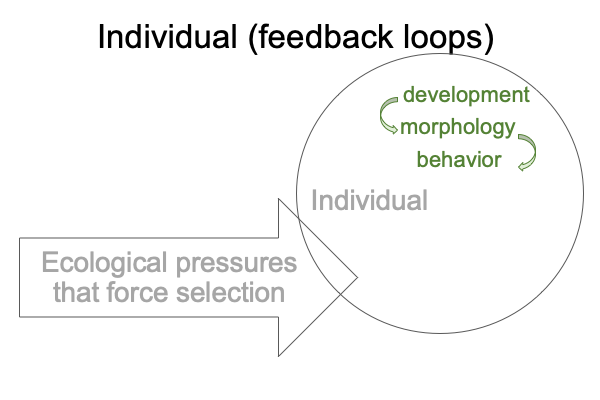
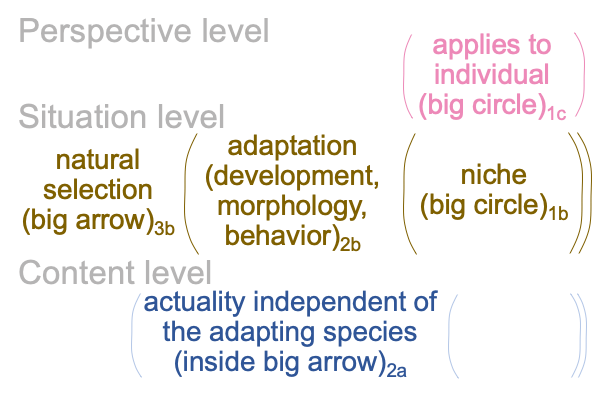
Currently, the biological sciences present all evolution as continuous developments in time, although there are moments of radical… um… “re-organization”, hence the theory of punctuated equilibrium.  When the evolutionary sciences cast their models of human evolution into the mirror of theology, the theologian sees a picture that does not quite sync with the wild change of… um… “genre” that occurs the moment after God wraps up the Creation Story, by telling humans that they should give food to the animals (Genesis 1:30).

Speaking of that, here is an application of the two axioms in action.

0005 Mirror of theology?

See Comments on Mariusz Tabaczek’s Arc of Inquiry (2019-2014), available at smashwords and other e-book venues, as well as Razie Mah’s blog for the months of April, May and June, 2024.

On the one hand, the mirror of theology embraces the noumenon.

On the other hand, the mirror of theology reflects models proposed by science.  Science is not interested in the noumenon, the thing itself.  Scientists are only interested in a noumenon’s phenomena.  Phenomena are the observable and measurable facets of a noumenon.  Scientists build models based on observations and measurements of phenomena.  If the model “works”, then scientismists want to say that the model is more real than the thing itself.  At this point, natural philosophers and theologians object and say, “No, the scientific model is not more real than the thing itself.”

0006 After an awkward pause, triumphalist scientists reply, “Well, then, how are you going to know anything about the noumenon without our models?”

“Well,” the natural philosophers say, “What about matter and form?  I can know these about the noumenon through experience of it.”

“So how are you going to do that when the noumenon is evolutionary history?  How can you grasp that though determining its matter and form?”

To which the theologian sighs and says, “Listen, whatever the noumenon is, it cannot be reduced scientific models of its phenomena.  So, I will set up a mirror that will reflect your scientific model, so you can be assured that your models are not ignored when I contemplate the metaphysical structures intrinsic to the thing itself, while keeping my mind open to revelation (including the the Bible). I will call it ‘the mirror of theology’.”

0007 To which the scientist counters, “And, we will correspondingly set up a mirror in our domain, a mirror of science.  We will look at the theological statements concerning the character of the noumenon, which really should just be replaced by our mathematical and mechanical models.  Then, we will laugh at and ridicule them.”

0008 Now, I once again present the odd coincidence pictured before as an application of the two axioms.

Do I have that correctly?

Does the scientist project his model into the mirror of theology?

Does the theologian project his metaphysical analysis into the mirror of science?

How confusing is that?

0008 It seems to me, a mere semiotician, that these two images actually reflect a single real being.  The theologian looks into the mirror of theology and sees what evolutionary scientists project, then looks at revelation and locates an appropriate correspondence.  Then, when the theologian’s correspondence is viewed by the scientist in their mirror of science, it says, “That is superstitious nonsense!”

“It”?

I thought male and female he created them.

“It” must be a first approximation.

0009 Of course, to the semiotician, the whole situation is sort of funny, because it implies that there is a body of wisdom that is independent of science, but not subject to science, because it concerns the noumenon, the thing itself.

12/30/24

Looking at Bill Arnold’s Article (2020) “Genesis and the Challenges of the 21st Century” (Part 2 of 5)

0010 Okay, so there is a off-chance that there is wisdom… or… superstitious nonsense… that is independent of science, comes from the realm of theology, appears in the mirror of science and provides a weirdly compelling impression.  After all, the start of the Developed Neolithic (projected into the mirror of theology) enhances the impressiveness of Genesis 1:30 (projected into the mirror of science).  How can it be superstitious nonsense, when the Genesis verse sounds like a sign of the corresponding evolutionary period?

0011 With this impressiveness in mind, I reiterate the following.

Currently, the biological sciences present all evolution as continuous developments in time, although there are moments of radical… um… “re-organization”, hence the theory of punctuated equilibrium.  When the evolutionary sciences cast their image of human evolution into the mirror, the theologian sees a picture that does not quite sync with the wild change of… um… “genre” that occurs the moment after God wraps up the Creation Story, by telling humans that they should give food to the animals (Genesis 1:30).

So, the question arises, “Is there a scientific proposal that would be in sync with this change in genre?

Yes, there is.  It is called the hypothesis of the first singularity.

0012 Both human evolution and chapters one through three of Genesis portray two phases.

0013 Razie Mah offers three scientific masterworks that project well in the mirror of theology.

The first work is titled, The Human Niche.  The human niche is the potential of triadic relations.  This e-book covers the Lebenswelt that we evolved in.

The second work is titled, An Archaeology of the Fall.  It dramatizes the scientific discovery of the first singularity.  But, for those who prefer not to dally in fiction, there is The First Singularity and Its Fairy Tale Trace.  In the series, “Crystallizations of the Fall”, this essay is paired with Original Sin and Original Death: Romans 5:12-19.  

The third work is titled, How To Define the Word “Religion”.  The accompanying course includes ten primers, starting with A Primer on the Category-Based Nested Form.  This course concerns our current Lebenswelt.  It introduces the category-based nested form, which encompasses three logics, corresponding to firstness, secondness and thirdness.  Thirdness brings secondness into relation with firstness.

Yes, these terms come from the philosophy of Charles Peirce.  The logic of firstness is inclusive and allows contradictions.  The logic of secondness is where the logics of contradiction and non-contradiction apply.  The logics of thirdness are exclusion, complement and alignment.

0014 In sum, human evolution comes with a twist.

That twist is mirrored in the sudden shift of genres in the first two chapter of Genesis.

12/28/24

Looking at Bill Arnold’s Article (2020) “Genesis and the Challenges of the 21st Century” (Part 3 of 5)

0015 Our current Lebenswelt starts with the Ubaid of southern Mesopotamia.

Do the stories of Adam and Eve (Genesis 2.4 on) associate to the events early in the “history” of the Ubaid?

“History”?

The term, “history”, typically refers to written documentation that serves as evidence of trends and events.

Perhaps, I can qualify stories about trends and events of times before the invention of writing in the Uruk period of southern Mesopotamia as “pre-history”.

0016 Arnold prefers the term, “mytho-history”.

0017 Yet, even here, science adds to the picture.

No one in the world would know about the mythic origin stories of the ancient Near East were it not for intrepid archaeologists of the nineteenth and twentieth centuries (who, ironically, were funded by wealthy people interested in the origins of civilization, of the Bible, of the Iliad and Odyssey, and so on).  One could say that our knowledge of these origin stories is “fragmentary”, because it is read off of fragments of cuneiform-bearing clay tablets that were fired into bricks when royal libraries burned, thousands of years before the modern age.

Some tablets date over two-thousand years before Socrates.

Indeed, the start of our current Lebenswelt is nominally set at 7824 years ago at 0 U0′ (Ubaid Zero-Prime).  The Uruk invented writing around 1800 U0′.  The Sumerian civilization officially starts around 2800 U0′.  Christ lives around 5800 U0′.  Our year is nominally 7824 U0′, but maybe astrologers who hear about the hypothesis of the first singularity can cast for an appropriate celestial inauguration marking the start of the Ubaid, the first culture to practice speech-alone talk.

0018 The list of mythic origin stories of the ancient Near East and Egypt, is not long.  Arnold goes through the trouble of naming them and identifying them with Sumerian, Akkadian and Egyptian sources.  As it turns out, both the Creation Story and the Primeval History share the same genre of this “literature of the ancient Near East”.

Here is a picture of reflections in the mirrors of science and theology.

Remember that the theologian sees what science projects into the mirror of theology and the scientist sees what theology projects into the mirror of science.

Do I have that correctly?

Does the mirror of theology stand in the domain of theology?

Does science project into the mirror of theology?

Does the mirror of science stand in the domain of science?

Does theology project into the mirror of science?

Yeah, that sounds about right.

Now, where was I?

0019 During the past two centuries, the early stories of Genesis are liberated from a literal reading.  These tales do not explicitly reveal a beginning.  Rather, they portray the beginning of some sort of revelation.  If the Creation Story and Primeval History exhibit not only the style, but some of the content, of the excavated written origin stories of the ancient Near East, then some conclude that the Genesis text derives from these even more ancient written sources.

But, that is not the case.  One cannot confidently claim that the living oral traditions that give rise to the written Genesis text in, say 5200 U0′, are derived from a literary tradition among elites that was written, say as early as 2800 U0′.  No, the style and material are so entangled, that the family oral tradition and the elite written traditions, must have been already established by the time of Ur III.  Ur III is the last flowering of the Sumerian civilization.  After that, the Sumerian language is dead.  It is no longer a living language.

Terah leaves Ur of the Chaldeans.

And Abram leaves his father, Terah, in the land that his kin lived in for so many generations.

0020 A daring exposition of the implications of these two reflections is found in chapter 13C of An Archaeology of the Fall (by Razie Mah, available at smashwords and other e-book venues).

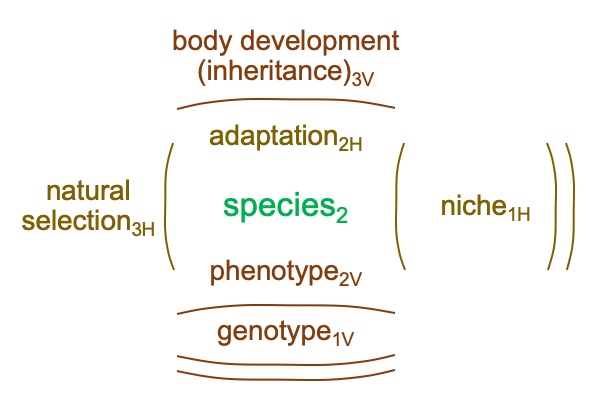
Here is another example of the strange double-reflection between the hypothesis of the first singularity and the stories of Adam and Eve.  The infilling of the Persian Gulf occurs during the Wet Neolithic.

12/27/24

Looking at Bill Arnold’s Article (2020) “Genesis and the Challenges of the 21st Century” (Part 4 of 5)

0021 One scholar proposes that the correspondences between Genesis and written origin stories of the ancient Near Eastare due to myth-making.  Myth-making produces certain literary characteristics, such as ascribing personality to nature, describing the world phenomenologically, rather than analytically, and a lack of interest in the linearity that we attribute to modern history and historiography.  Arnold adds one other literary feature to Oswalt’s list.  Arnold adds “the etiological dimension”.

0022 Etiology?

Etiology is the study of the world today in terms of what happened long ago.

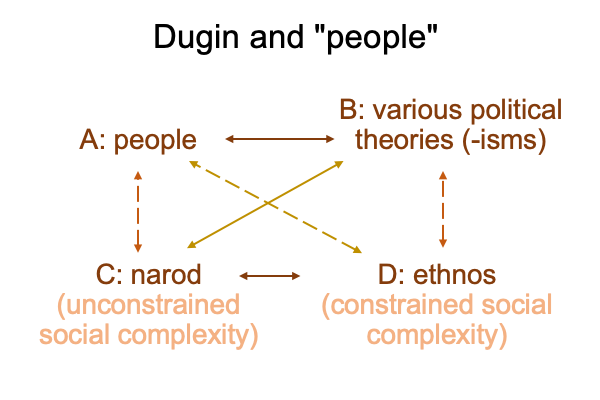
The Ubaid, the Uruk and the Sumerian Dynastic have no interest in describing the world in a fashion that is acceptable to modern historians.  Why?  There are no modern historians.  Instead, there are people who are dealing with cycles of civilization that are really spirals of unconstrained social complexity.  These folks are caught in the tourbillion and are holding on for dear life.

0023 Indeed, if history is like matter, and myth is like form, the Arnold’s “etiological dimension” is the contiguity between real events as they would be recorded by a modern historian and the mythic telling of events from long ago that explain why the world is the way it is today.

Here is a picture.

0024 Indeed, Arnold calls the etiological dimension an “ideological substance”.

0025 Now, let me apply Oswalt’s and Arnold’s myth-making hypothesis to the thing that both Genesis and the written stories of the ancient Near East have in common.

0026 What is the thing?

The esse_ce, prehistory [etiology], consists of events corresponding to the emergence of unconstrained social complexity in a speech-alone talking culture.  It just happens that the Ubaid of southern Mesopotamia is the first culture on Earth to practice speech-alone talk.  At the time, all other cultures practice hand-speech talk.  Soon, cultures adjacent to the Ubaidwill drop the hand-component of their hand-speech talk in order to imitate their civilizing brethren.  But, they will not be able to catch up in social complexity for thousands of years.

The essence, [etiology] ancient myth, consists of stories in oral, then later, written traditions.  The ideological substance that binds the matter of prehistory to the form of ancient myth, cannot be anything like the modern historian’s pretensions that history proceeds linearly.  In fact, if one looks at a recitation of events in modern times, one finds that the recitation does not grant the same insights as (even) the literature of the day, which wrestles with past, present and future.

Perhaps, that is why modern histories can be so boring.

0027 The question arises, “How do we understand this thing?”

In the 7750s, theologian William F. Albright makes an attempt.  He places the thing2 into the normal context of evolution3operating on the potential of phases of human reason1.

Here is a diagram.

0027 Albright suggests that the thing belongs to the first of three phases: (1) the proto-logical, (2) the empirical and (3) the formally logical.

0028 Of course, seventy years later, scholars chuckle, but there is a doom to this first guess.

0029 By way of formal logic, we know that there are phases of human reason.

By way of the empirical, we know that each phase supports its own actuality2, its own “thing”.

By way of the proto-logical, we all know that each phase is decreed by the gods. 

3, 2, 1 then 0?

0030 For moderns, matter is more like history.  Form is more like knowledge.  The contiguity is more like [explanation].

For those who live before the formalization of logic, matter is still like history, but flavored with the spice of fate.  Surely, fate is empirical.  Form is still like knowledge, but containing a degree of moralization that moderns are not accustomed to.  Surely, moral strength and weakness allows one to act wisely, rather than foolishly.

For those who live before the empirical phase, matter is all about fate and form is all about heroic strengths and weaknesses, along with wisdom and foolishness.

0031 That brings me to the doom of Albright’s initial guess.

If one tracks these phases back from say, the writing of the Bible (where formal logic is apparent in later writings), to the oral histories of Moses (where the law is written in a fashion that does not sound formally logical, but exhibits a certain empiricism), to the stories of Abraham and earlier, all the way to the mythic Adam and Eve (where each figure lives out a theological drama), there is one more story left.

Yes, it is the Creation Story.

0032 The Creation Story may tell of the construction of the tent of the heavens and the earth.  But, in terms of where Albright’s initial guess ends, the Creation Story is what stands before the manufacture of Adam and Eve in the Primeval History.

The Creation Story stands at 0, the null.

0033 Albright imagines that civilizational development is the same as human evolution.

It is not.

So, his guess is doomed.

Doomed to flower into another guess.

12/26/24

Looking at Bill Arnold’s Article (2020) “Genesis and the Challenges of the 21st Century” (Part 5 of 5)

0034 Yes, Razie Mah covers what postmodern scientists should project into the mirror of theology.

Our current Lebenswelt (German for “living world”) is not the same as the Lebenswelt that we evolved in.

The discontinuity is called “the first singularity”.

0035 The discontinuity entails a change in the way humans talk.

The hypothesis is technically described in The First Singularity and Its Fairy Tale Trace.

The scientific discovery is dramatically portrayed in An Archaeology of the Fall.

Both texts are available at smashwords and other e-book venues.

0036 The hypothesis, along with the hypotheses proposed in The Human Niche and How To Define the Word “Religion”,pose significant challenges to the way that human evolution is currently conceptualized.  See Comments on Michael Tomasello’s Arc of Inquiry (1999-2019), as well as Razie Mah’s blog for January through March 2024.

0037 Arnold drills down into the ideological substance of etiology.  With the hypothesis of the first singularity, the theologian’s focus on etiology bifurcates precisely along the fault-line between two genres.

Shall theology project this nested form into the mirror in the domain in science?

0038 The first step in Albright’s development scenario corresponds to the stories of Adam and Eve through the Table of Nations (following the stories of Noah’s flood).  Here, Albright’s intuition hits the mark.  This step corresponds to a phase of human reason, that may be correctly labeled, “proto-logical”.

Not surprisingly, the “proto-logical” label also applies to all the literature of the ancient Near East that is listed by Arnold.

Indeed, the label, “proto-empirical”, also applies.

Imagine passage from a world that thinks in hand-speech talk to a world that thinks in speech-alone talk.  The former allows a diversity of implicit abstractions.  The latter does not, because explicit abstraction gums up the works of implicit abstraction.  In the proto-empirical phase, explicit abstraction starts to establish a life of its own.

0039 Arnold adds that the next etiological phase corresponds to the stories of Abraham.  The founding of the people of Israel touches base with Albright’s “empirical” phase.  The Biblical text changes in clarity and focus when passing from the mythohistories of Noah to the tales of Abraham.  Terah does not move from his long-established home city lightly.  He moves for empirical reasons.  Yes, it is history, but it is rendered as myth.

0040 So, the Primeval History, along with other written origin stories of the ancient Near East, may be gathered under the catchment of “mytho-history”.  This term has the same semiotic structure as “proto-logical” and “proto-empirical”.  Yes, it is logical, but it is before formal logic.  Yes, it is empirical, but it is before the empirical takes on a life of its own.

0041 Arnold notes that Albright sees how the term, “adamah”, changes from “humanity” to “a personal name”, in the course Genesis 2.4 through 4.

He sees the change as significant and unsettling.

But, he does not have a vision where the stories of Adam and Eve are located in the tourbillion of increasing unconstrained social complexity manifesting in the Ubaid of southern Mesopotamia.

0042 Barth smiles at this unsettlement.  For this theologian, as soon as Adam is with us, so is Christ.

In the construction of the temple of the heavens and the earth, God creates humans in His image in the Lebenswelt that we evolved in.

In the manufacture of Adam’s body and the inspiration of Adam’s breath, God creates humans in our current Lebenswelt.

0043 Thus, the discontinuity of the first singularity that appears in the mirror of theology, located in the domain of theology, is reflected back in the mirror of science, located in the domain of science, as the discontinuity between Genesis 2:3 and Genesis 2:4.

I wonder.

Can I imagine that there is only one mirror?

0044 A twenty-first century reading of Genesis challenges evolutionary scientists.

Genesis joins all the written origin stories of the ancient Near East, in proclaiming what evolutionary scientists ignore,humans are created by the gods in recent prehistory.  Indeed, a causal observation of the archaeological data demands the proposal of a hypothesis like the first singularity, if only the separate two million years of evolution within constrained social complexity from the 7800 years of theodramatic madness within unconstrained social complexity.

But, there is more, see Razie Mah’s blog on October 1, 2022, for a research project for all of Eurasia.

0045 The stories of Adam and Eve precisely capture the theodramatic character and the absolutely crazy turns of events that typify our current Lebenswelt.  One does not know whether to laugh or to cry.  Father, forgive us, for we know not what we do.

Meanwhile, the Creation Story intimates a deep prehistory, confounding the construction of the temple of the heavens and the earth with a counter-intuitive sequence of events that weirdly coincides with a phenomenological vision of the Earth’s evolutionary “progression”.  

0046 A twenty-first century reading of Genesis challenges theologians interested in the noumenon of humans, in our current Lebenswelt.

If the hypothesis of the first singularity becomes more and more plausible, so does a second doctrine of original sin,where the deficits of Augustine’s first attempt are amended, yielding a doctrine that applies to the post-truth condition. See Razie Mah’s blog for January 2, 2024 for a call to action.  Also see Razie Mah’s blog for July through October 2024.  These blogs will be assembled (for user convenience) as a three-part commentary, Original Sin and the Post-Truth Condition (available at smashwords and other e-book venues).