10/3/25

The Evolution of Talk: A Note on How to Proceed (Part 1 of 1)

EOT 0001 The evolution of talk is not the same as the evolution of language.

Language evolves in the milieu of hand-talk.

So, what is the story?

0002 A course on the topic of human evolution is already on the market.

See Razie Mah’s, A Course on the Human Niche, consisting of the masterwork, plus four commentaries.

The Human Niche

Comments on Clive Gamble, John Gowlett and Robin Dunbar’s Book (2014) Thinking Big

Comments on Derek Bickerton’s Book (2014) More Than Nature Needs

Comments on Robert Berwick and Noam Chomsky’s Book (2016) Why Only Us?

Comments on Steven Mithen’s Book (1996) The Prehistory of Mind.

0003 The works are available for purchase at various e-book venues.  In order to conduct the course, purchase the e-book to read on a tablet (or as a PDF to print).  The class is not didactic.  It is Socratic.  The style is read and discuss.  The text is broken into points.  Each point can be discussed.  So, a leisurely class may open the text, read out loud and ask what the point suggests.

0004 The masterwork came out in 2018 and is still highly relevant to inquiry into the Lebenswelt that we evolved in.

How so?

The human niche is the potential of triadic relations.

No other course on human evolution poses this ground-breaking hypothesis.

0005 Nonetheless, six years later, Razie Mah adds to the first course with a second, consisting in two sequences of blogs.  This blog-inclusive (as well as e-book exclusive) course serves as a supplement to the master course, especially in regards to the evolution of talk.

0006 The first sequence is collated and rounded out in a compilation, titled, Comments on Michael Tomasello’s Arc of Inquiry (1999-2019), making the blogs and the compilation ideal for a guided- and home-schooling course.

Michael Tomasello worked at the Max Planck Institute for Evolutionary Anthropology for twenty years.  He wrote a series of books on the evolution of human cognition, communication, thinking, morality and so on.  In short, his books cover the evolution of the stuff of talk.

0007 Here is a list of the five commentaries in this first sequence.

One: Looking at Michael Tomasello’s Book (1999) “The Cultural Origins of Human Cognition”

(January 18-31, 2024, 12 blogs, 0-82 points)

Two: Looking at Michael Tomasello’s Book (2008) “Origins of Human Communication”

(January 17-4, 2024, 12 blogs, 83-186 points)

Three: Looking at Michael Thomasello’s Book (2014) “A Natural History of Human Thinking”

(February 29-5, 2024, 22 blogs, 187-388 points, completes Part 1 of Comments, see below)

Four: Looking at Michael Tomasello’s Book (2016) “A Natural History of Human Morality”

(March 26-1, 2024, 22 blogs, 389-600 points)

Five: Comments on Michael Tomasello’s Book (2019) “Becoming Human”

(points 601-793 are in Comments on Michael Tomasello’s Arc of Inquiry (1999-2019) Part 2, by Razie Mah, available at smashwords and other e-book venues)

0008 Yes, to complete the course, one needs to purchase Part 2.

How sneaky is that?

So, that is the meaning of “blog-inclusive and e-book exclusive”.

0009 The second sequence is collated in the compilation, titled, Synaesthesia and The Bicameral Mind in Human Evolution.   This compilation packages two commentaries on human evolution and sets the scene for a study of the first singularity.

This list continues the previous numbering.

Six: Looking at Steven Mithen’s Book (2024) “The Language Puzzle”

(September 29-4, 2025, 23 blogs, 0-235 points)

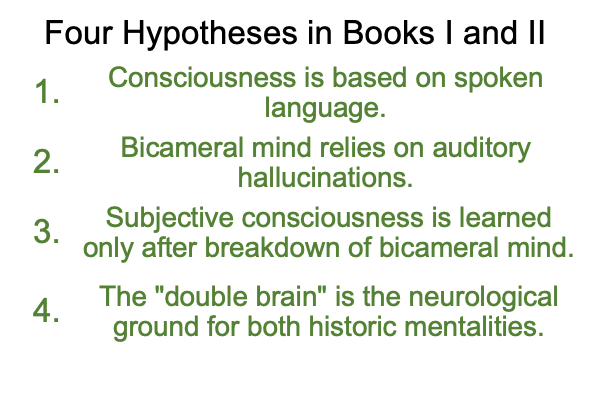
Seven: A First Look at Julian Jaynes’s Book (1976) “The Origin of Consciousness in the Breakdown of the Bicameral Mind”.

(October 31-8, 2025, 21 blogs, 235-525 points)

0010 Overall, this hybrid online-onsale course on the evolution of talk, by Razie Mah, are available for sampling (on the blog) and may be purchased at any e-book venue.

Comments on Michael Tomasello’s Arc of Inquiry (1999-2019), Parts 1 and 2 contains 753 points.

Synaesthesia and the Bicameral Mind in Human Evolution contains 525 points.

0011 Total: 1278 points, 21 hours at 1 minute per point.

Perhaps, this online course lasts around 4 to 5 weeks.

Enjoy this sample and consider purchasing other Razie Mah’s online courses, especially the one on the human niche.

09/30/25

Looking at Steven Mithen’s Book (2024) “The Language Puzzle” (Part 1 of 23)

0001 The full title of the book before me is The Language Puzzle: Piecing Together The Six-Million-Year Story Of How Words Evolved (2024, Basic Books, New York).  Dr. Mithen is a Professor of Early Prehistory at the University of Reading.  He has published before.  More on that later.

The book works on the metaphor of a jigsaw puzzle.  Fourteen chapters present the pieces.  The introduction and conclusion stage and arrange them.

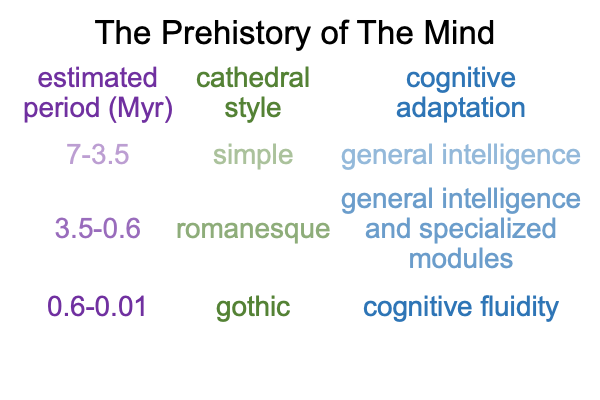
0002 This current metaphor is very different than a glorious historical metaphor used in a book published almost three decades earlier.  The Prehistory of The Mind (1996) offers the historical development of the architecture of cathedrals in Europe as a lens for considering cognitive evolution.  The metaphor works well because the nave associates to general intelligence and side chapels associate to specialized mental modules.

0003 From the genetic divergence from chimpanzees to the start of bipedalism, the simple nave of general intelligenceadapts to cognitive challenges.

From the appearance of bipedalism to the domestication of fire, specialized modules are added to general intelligence, but the two do not integrate.  Indeed, both specialized modules and general intelligence are supported by their own, thick, walls.  The metaphor is the Romanesque cathedral.

From the domestication of fire until the first singularity (think, “the potentiation of civilization”), general intelligence integrates with specialized modules, presumably due to talk becoming fully linguistic.  Language becomes the walls, supported by flying buttresses of automatic decoding.   The metaphor is the Gothic cathedral.

0004 Here is a picture.

0005 The metaphor is so wonderful that Razie Mah publishes the e-book, Comments on Steven Mithen’s Book (1996) The Prehistory of The Mind as one of the readers that accompanies the masterwork, The Human Niche, in the series A Course On The Human Niche (available at smashwords and other e-book venues).

0006 Mithen’s approach is also echoed in the work of another evolutionary anthropologist, Michael Tomasello, working at the Max Planck Institute in Leipzig, Germany, as discussed in Comments on Michael Tomasello’s Arc of Inquiry (1999-2019) (by Razie Mah, also see blogs for January through March, 2024).

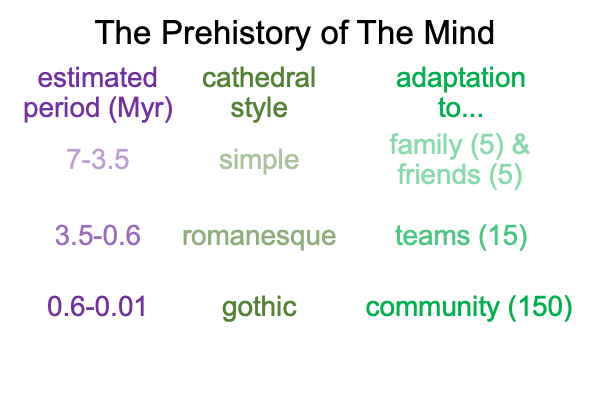
0007 Mithen’s approach is also reflected in another review that belongs to the series, A Course On The Human Niche.  The title is Comments on Clive Gamble, John Gowlett and Robin Dunbar’s Book (2014) Thinking Big.  In this review, social circles turn out to be very important in hominin evolution.  Mammalian brain size roughly correlates to group size.  So, the larger the hominin brain grows, the larger the group.

Not surprisingly, Mithen’s metaphor indicates the social circle under the most intense selection pressure, irrespective of group size.

0008 What does this imply?

Obviously, group size is not the crucial factor in hominin evolution.

Whatever is increasing hominin brain size is.

0006 To me, it is not surprising that Mithen has not encountered Razie Mah’s review of his 1996 work, even though it is one of the few more-than-surface reflections on The Prehistory of The Mind available.

Perhaps, the same will go for this blog, which will take Mithen’s metaphor of a jigsaw puzzle quite literally. 

09/18/25

Looking at Steven Mithen’s Book (2024) “The Language Puzzle” (Part 11 of 23)

0097 The earliest stone tools show us that, once a team becomes both successful and long-lived, the disjuncture between the two selection pressures remains.  Once a new team habit settles in, individuals adapt to the habit over generations, rather than the habit adapting to the individuals.

One clue to the validity of this conclusion is found in the stability of stone tools.  

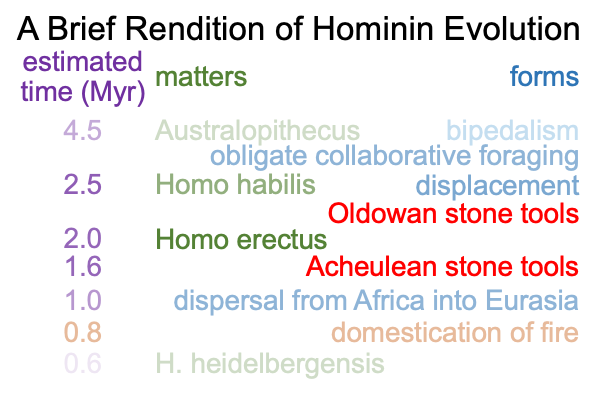
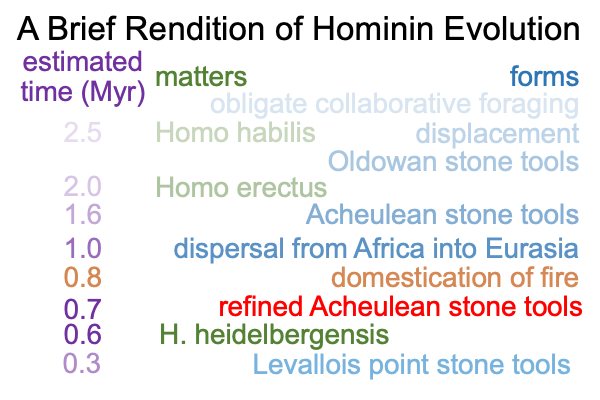
Here is a timeline.

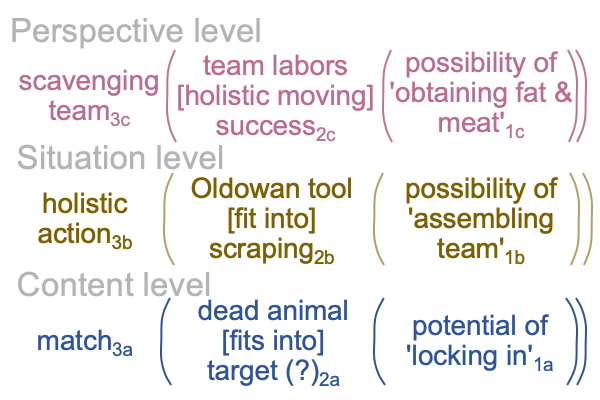
0098 Oldowan stone tools are made the same way for almost a million years.  To me, this suggests that the perspective level of the following interscope does not change, because the team activity persists over generations.  Improvements in the Oldowan team activity are not as crucial as discovering another lucrative team activity.  The Oldowan team is one.  We do not know how many others there are.

0099 But, what about the individuals that participate in the Oldowan team activity?  Are they subject to natural selection for abilities to assess which stones to choose for rapid construction and whether a carcass is worth scavenging?

Yes, the content and situation levels of the above interscope show features where natural selection can operate.  Obviously, there are many specialized cognitive abilities that can be rewarded, through natural selection, over many generations.  Indeed, while the Oldowan stone-tool “kit” remains stable, a new species of human evolves, complete with substantially larger brains.

0100 After Homo erectus appears in the fossil record in Africa, a few more hundred thousand years pass before the team changes.  Mithen describes Oldowan and Acheulean stone tools in detail, but does not elaborate on how they were used.

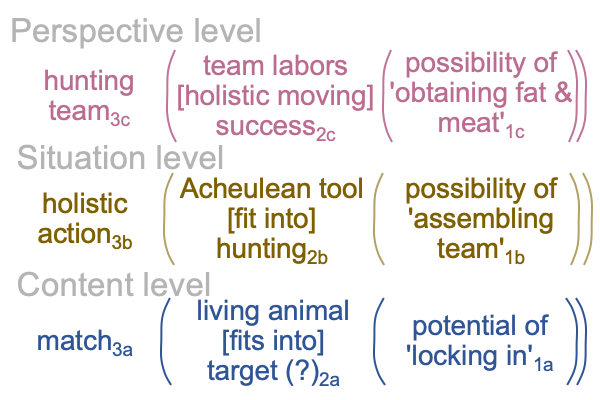
0101 Oldowan stone tools are utilitarian and made on the spot.  Opportunistic scavenging seems to be the likely definition of success2c.

Acheulean stone tools are more sophisticated and are made ahead of time.  Perhaps, this implies new ways to extract food.  Homo erectus hunt some sort of creature that can be taken down with what appears to be a fairly large stone tooth.  This is not the only possibility, but it is the one that appears in the following figure.

0102 Perhaps, the Acheulean stone-tool kit is used by more than one team.

It is difficult to know, without time travel.

If we moderns could time travel, I suspect that we would be amazed at the variety of extractive technologies that Homo erectus masters prior to the domestication of fire.  Homo erectus migrates out of Africa and into Eurasia around a million years ago.  Then, along with the domestication of fire, more refined Acheulean stone tools appear.  New stone tools imply that new teams are constellating, this time with hunting definitely in mind.

0103 Here is the ongoing timeline of hominin evolution.

09/11/25

How The Voice Gets Added to Hand-Talk In Human Evolution, Part A1 (Part 17 of 23)

0154 What a banner!

0155 The evolutionary anthropologist, Steven Mithen, publishes a book in 2024 with the full title, The Language Puzzle: Piecing Together The Six-Million Year Story Of How Words Evolve (BasicBooks: New York).  The book purports to describe the evolution of “language”.  But, what is “language”?  Is language the sole province of speech?  Of course not, deaf communities practice so-called “sign-language”.  I call this practice, “fully linguistic hand-talk”.

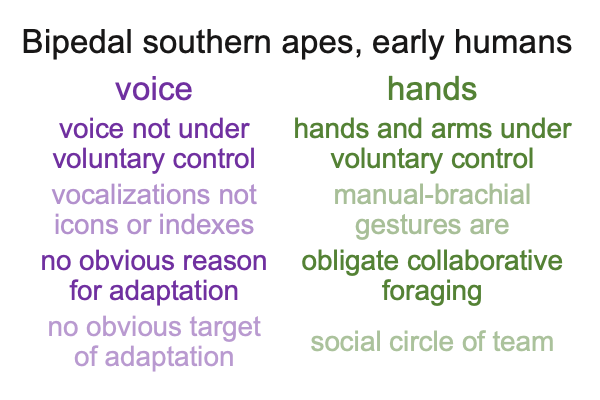
0156 Despite the reality that language can be performed in two modalities, manual-brachial gesture and voice, Mithen rules out the gestural origins of language.  Consequently, he faces the challenge of portraying the vocal origins of language.

0157 The problem?

Consider the following comparison.

0158 Two features are integral to language.

The first is displacement.  “Displacement” means that “the referent of the word does not have to be present”.

The second is symbolic operations. Symbols are sign-relations whose sign-objects are based on habit, convention, law and so forth.  Within any symbolic order, a symbol must be sufficiently different from any other symbol as to be readily recognized.  A finite set of symbols constitutes a symbolic order.  Symbolic operations constellate within a symbolic order.  One name for such symbolic operations is “grammar”.

0159 Archaeological evidence for bipedalism predates 3.5 Myr (million of years ago).  At this time, vocalizations are not only involuntary, but they tell everyone that a referent is present. It is the opposite of displacement.  Vocalizations denote placements.

Of course, that means that involuntary calls may be labeled indexes, in so far as the call indicates a presence.  That means that involuntary calls are indexes.

But, an involuntary call cannot be called a linguistic sign-relation whose sign object is determined by pointing, contiguity, cause and effect and so forth.  And, that is an index, too.

0161 Okay, that may be confusing.

Vocal calls are indexes in the same way that an emergency alarm is an index.  The alarm cannot tell me much more than “an emergency is happening”.  That is not displacement.

Manual-brachial gestures can point to something, even when that something is not present (like the location of the sunrise).  Manual-brachial word gestures allow displacement.

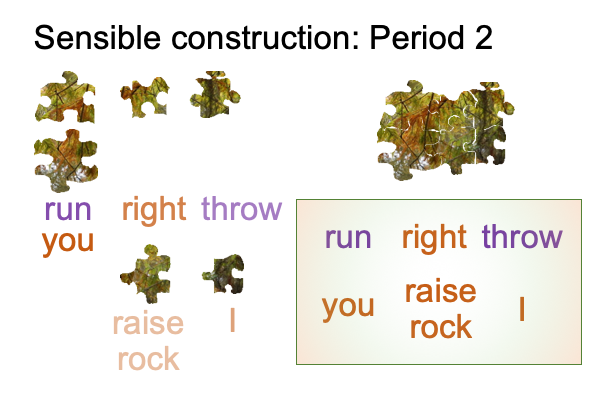
0162 In regards to symbolic operations, consider taking the metaphor, a word is like a piece in a jigsaw puzzle,literally.  Then, say, 1.7 million years before present time, while I am digging tubers with my team, not far from the forest’s edge, a vulture lands in a nearby tree and one of us notices that… uh oh… there is a jaguar in that tree.  The vulture sees the jaguar.  The jaguar eyes the little hominins.  We know why the vulture decides to land.  The vulture wants to see what happens.

Everyone gathers what tubers they have into leaf-baskets.  The elder of the team signs the following gestures to me and I reply.

0163 Elder signs [point-YOU][image-RUN][point-RIGHT][image-THROW].

Then in reply, I say, [point-ME][raise ROCK].

0164 Each iconic and indexal gesture-word has already been honed through usage to be sufficiently different from any other word-gesture (in our team-oriented lexicon) as to be instantly recognized.  So, the imagery and the indications snap together into one Gestalt, shared by both elder and myself.

Of course, Mithen discusses displacement and grammar, but not in this manner.  He proposes that displacement for the vocal channel involves synaesthesia, that is, cross-modal sensing.  But, how would this apply to the problems faced by teams, while extracting food under dangerous conditions (which Michael Tomasello labels “collaborative obligatory foraging”)?

0165 So, what is the key point?

Mithen claims to be solving a six-million year old process. But, his metaphor of the jigsaw puzzle, when taken literally, takes us through the period that stretches from the start of bipedalism to the domestication of fire.  This corresponds to Michael Tomasello’s “period two”.

Indeed, Mithen is not aware that his choice of metaphors undermines his claim against the gestural origin of language.

0166 Is that sort of funny?

In what way?

Technically, before the domestication of fire, hand-talk is protolinguistic.  Each team has its own protolanguage.  Plus, this protolanguage is not fully linguistic because it does not permit grammatically correct counter-intuitive statements, such as:

[imageTREE][point to EYES][roll EYEs back and forth]

0167 Oh, yes.  Our kind evolves in a surveillance society.  And we are on the menu.

The trees have eyes and are watching.

09/4/25

Looking at Steven Mithen’s Book (2024) “The Language Puzzle” (Part 23 of 23)

0229 So, what is The Language Puzzle about, in an implicit sort of way?

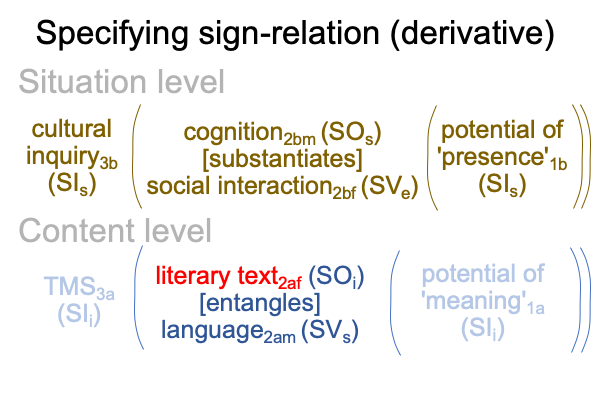
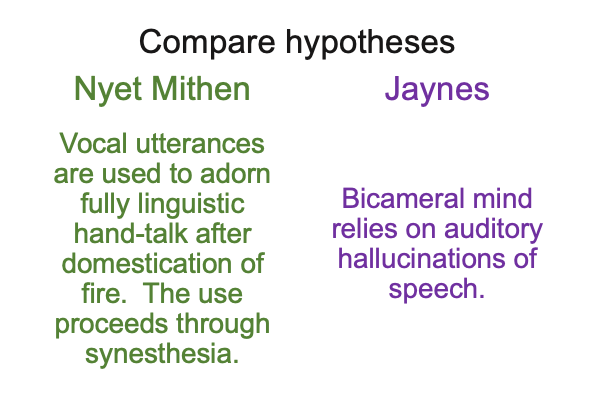
It is about how speech gets added to hand talk after the domestication of fire.

The irony of the work is found in Mithen’s explicit denial of the gestural origins of language, while…

… at the same time, the author provides a solution to a question that he cannot even pose.

0230 Examinations don’t get better than this.

This examination adds value to Mithen’s work in a surprising fashion.

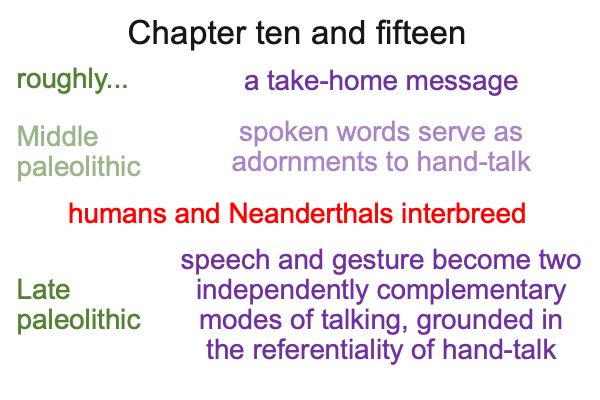
0231 This examination suggests that a tremendous amount of theoretical reformulation needs to be done.  In particular, the following juxtaposition of events is suggestive.

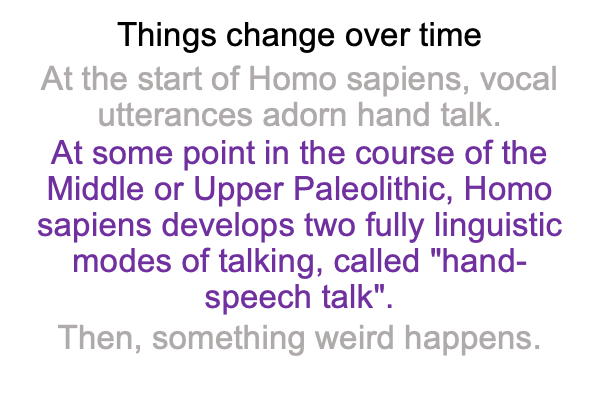
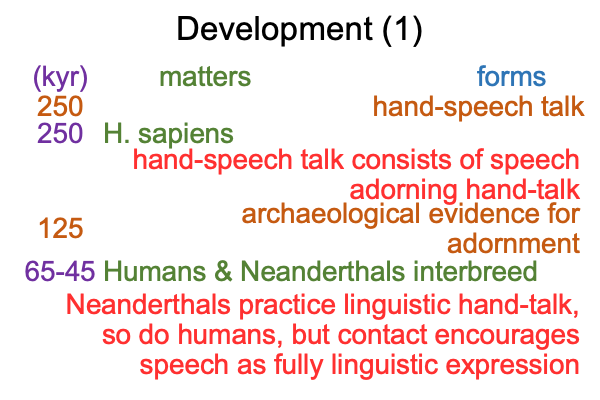
0232 I ask, “Does Homo sapien’s encounter, love affair, then divorce from the Neanderthals create a condition where speech becomes more and more independent as a mode of talking?  Does speech become capable of operating linguistically, independent of hand talk, yet remain integrated into the natural-sign references of hand-talk?”

0233 Take a look at the artifact of the lion-man, pictured in figure 3 on page 28 of Mithen’s text.

Maybe, we can ask him.

Do you think that he has something to say to us?

Surely, he cannot perform hand-talk.

So, the lion-man must speak for itself.

0233 Yes, it’s like synaesthesia gone wild.

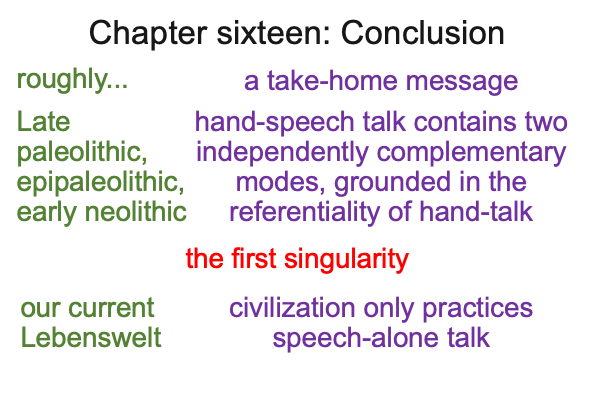
0234 But, “wild” is not even close to this last implication, which tells me that our current Lebenswelt is not the Lebenswelt that we evolved in.

What about the item in red?

See Razie Mah’s e-books, The First Singularity and It’s Fairy Tale Trace (for a technical proposal) and An Archaeology of the Fall (for a dramatic rendering), available at smashwords and other e-book venues.

0235 With that said, I thank Steven Mithen for publishing a book that can be fruitfully read both explicitly and implicitly.

Also, the story does not end here, because this examination plays a prominent role in the next commentary, Looking at Julian Jaynes’s Book (1976) “The Origin of Consciousness in The Breakdown of the Bicameral Mind”.

08/25/25

Looking at Slavoj Zizek’s Book (2024) “Christian Atheism” (Part 6 of 33)

0066 Before I step further into chapter one, I must take a guess as to where Hegel’s term, “synthesis” resides.

In one way, “synthesis” resides in the normal context3.  In another way, it resides in the potential1, along with ‘truth’1.  Since, the [substance] of [wealth and power]2 emerges from (and situates) its potential1, then there must be something more than ‘honesty’1 in ‘truth’1,  ‘Truth’1 must be accompanied with ‘something substantial’, that is, ‘synthesis’1.

Here is the resulting nested form.

0067 Chapter one opens with a question, “Who cannot handle the truth?”

May I point to those with capital and organizational excess, as well as to those with social influence and institutional excess?

Oh, those excesses.  It seems as if the former pulls the contiguity upwards by reifying [wealth] and the latter drags the contiguity downwards by reifying [power].

0068 Zizek, for his part, associates “truth” with a normative picture of a state of accord.  Accord of what?  Accumulation and order?  Thesis and antithesis?  As such, truth1… and its synthesis1… develops within a particular historical reality2… that is… a particular civilizational moment2.

0069 Does Lacan’s term, jouissance, associate to the potential of ‘truth and synthesis’1?

It may well do so.  For Christians, the [substance] that is contiguous with Father and Son is historically contingent. Why?  One God has only one opportunity to actually enter the flow of the eternal present.  If God enters the flow of the eternal present multiple times, then each time He produces a new dyad, a new historically contingent “timestamp”, if you will.  Each timestamp is a divine mediation.

0070 It is not that timestamps do not abound in Christian… er… Jewish revelation.  There is Adam (corresponding to the start of the Ubaid archaeological period), Noah (touching base with the Uruk), and Abraham (pointing to the end of the Sumerian civilization), followed by Moses and King David.  Then, the exile to Babylon, followed by a return. Construction on the Second Temple begins.  During this time, the five books of Moses come together like never before. Yet, no one imagines that the Pentateuch would one day be labeled, “the Old Testament”.

0071 All these timestamps constitute a thesis, and Jesus marks the antithesis.  

Now, even though the substance (that is, the contiguity) of Father and Sonwill change, depending on the winds of the Holy Spirit3, the potential of ‘truth and synthesis’1 becomes more and more apparent.  The synthesis1 includes the potential of one God1.  The potential of one God1 reminds me of Zizek’s use of the term, “parallax”.  From one location, I see the Father as matter and thesis.  I see the Son as form and antithesis.  But, from another location, the Speaker is matter and the Word is form.  Thesis and antithesis depends on where I stand.

Here, the terms, “thesis” and “antithesis” are bound, into a thing2, by a substance.  That substance includes [begat] and [dies with].  Father and Son are two real elements that, in theory, are distinct and separable, just like the real elements of matter and form are theoretically distinct and separable.  But, they cannot be separated without losing sight of the thing itself2.

0072 When we lose track of the thing itself2, we cannot understand.

Where have the normal context3 and potential1 gone?

0073 Zizek mentions an “irreducible oscillation”.  Here, the oscillation is among matter [and] form2, particle [and] wave2, Father [and] Son2, capital [and] social2, accumulation [and] the exercise of order2.  The oscillation is irreducible because that is the nature of Peirce’s category of secondness.  Secondness consists of two contiguous real elements. One real element cannot be reduced to the other real element.  Secondness follows the logics of contradiction and noncontradiction.

What is disturbing about secondness?

What is contradictory2 and what is not contradictory2 will change with the normal context3 and potential1.  

0074 What does this disturbance imply?

Zizek’s parallax belongs to the realm of potential1.  “Parallax” labels the optics of a monadic unity that underlies a quizzical dyadic actuality2 that changes with its normal context3.

08/15/25

Looking at Slavoj Zizek’s Book (2024) “Christian Atheism” (Part 14 of 33)

0151 So, why is Lacan not a Buddhist?

Well, there is more to objet a2c and [petit objet a]2c than illusion.

If Buddhist enlightenment is all about transcending ontological realness, then the adept who attains enlightenment should just wither away from lack of jouissance.  If that happens, then all the insight that the adept has acquired (like capital!) cannot pour (like [wealth and power]) into exercises that train other adepts within Buddhist institutions (like social!).

0152 Zizek points out that Buddhism’s own mandate acknowledges that overcoming illusion is not all there is.

What is the Buddhist mandate for the adept who achieves enlightenment?

The adept must remain in order to guide others.

Here is a picture.

0153 From my brief foray into the topic of the Lebenswelt that we evolved in, I know what an evolutionary anthropologist would label this [petit objet a]2c.  The label is “altruism”.

[Altruism] is [wealth and power].

Yes, [altruism] is the contiguity within the actuality2c of the Buddhist mandate.

But, these labels are explicit abstractions that belong to our current Lebenswelt.

0154 So, let me review.

There is a difference between an thing encountered and a thing understood.

0155 The first step in going from encounter to understanding is to regard the thing as an example of Peirce’s category of secondness.  So, when I encounter some good clay, I recognize that it is suitable for making a pot.  Both the clay and the pot constitute – what Lacan calls – an objet a.  The [substance] is petit objet a.  Petit objet a says, “Hey, this it the hylomorphe… er… ‘thing’… that you are looking for.”

0156 The second step on the path to understanding is to conjure a normal context3a and potential1a for the actuality2a.  Here, my understanding depends on my familiarity with the potter’s wheel.

08/14/25

Looking at Slavoj Zizek’s Book (2024) “Christian Atheism” (Part 15 of 33)

0157  If all I wanted to do is acquire a clay pot by exercising my social and technical know-how, then the story would end with content-level understanding.

But, in the prior examples, it does not.  Here is a picture of a virtual nested form in the category of secondness.  A perspective-level actuality2c virtually brings a situation-level actuality2b into relation with the potential of a content-level actuality2a.

0158 If I ask the clay, “What do you get out of this?”

The answer comes back, “Nothing.”

And weirdly, it is the nothing inside the clay where people brew their tea.

Does that sound like “a pair of lacks”?

0159 Now, when I shift from a piece of clay on the content level, to an adept training in the Buddhist tradition, can I say that the adept is a piece of clay?

Does the adept empty himself or herself in order to gain happiness?

0160 The adept, like the clay, creates a hollow in which the objet a of the day can brew, releasing its aromatic [petit objet a], which tells the untrained mind, “This is the reality that you should buy into.”

This will make you happy.

A beautiful, high quality, clay pot is on sale today, at reduced price!

0161 But, what about the one my grandmother gave to me?

Destroy it. Replace it. Then, brew your tea with improved satisfaction.

The adept can see through the disturbance, contain the disturbance, release the disturbance.

It is as simple and as elegant as brewing a pot of tea.

Zen style.

0162 In sipping an illusion down to its dregs, the adept feels happiness.  This is the happiness of the {acquisition of enlightenment [wealth and power] release from the illusions that people are buying}2c.  [Wealth and power] is not what we think it is.  The contiguity between acquisition and the exercise of order is dangerous.  So, why not simply let the suffering go?

“Oh wait!”, the Master intones, “Remember your form.”

0163 Surely, the greatest manifestation of [wealth and power] is what evolutionary anthropologists call [altruism].  Who can afford to give with no expectation of return?  No one can.  The adept begs for his food and for alms, so others can give and expect no thing in return.  Giving to a Buddhist monk is a moment of enlightenment.

0164 Zizek is correct in that Buddhism does not really grasp how jouissance1x, objet a2x, [petit objet a]2x and the big Other3x are radically intersubjective… or should I say?… “suprasubjective”.  They are inscribed, so to say.  But, they are not inscribed like pen on paper.  They are inscribed like the contiguity between pen and paper. {Pen [inscribe] paper}2is the actuality2 that requires understanding.  The inscription itself only requires recitation.

0165 With that, allow me to inscribe an observation.

Buddhism seems to put the evils of Soviet and Chinese Communism into the basket labeled “suffering”.

But, what about “evil”?

Are show trials evil?

Here is the observation as a virtual nested form in the category of secondness.

0166 On the content level, the normal context of a Stalinist state3a brings the dyadic actuality of {policy failures [need for blame] show trials}2a into relation with the possibility of ‘continuing current operations’1a.

On the situation level, the normal context of broadcasting3b brings the dyadic actuality of {accusation [constitutes] theatrical drama}2b or {illusion [transaction] hollow satisfaction}2b into relation with the possibility of ‘mollifying dissatisfaction with current operations’1b.

On the perspective level, the normal context of the Relativist One3c, the one who stands outside of all other jurisdictions, brings the dyadic actuality of {the projection of guilt as a judicial acquisition of “righteousness” [wealth and power] the social ordering of all when the accused confesses guilt}2c into relation with the potential of  ‘a synthetic truth’1c, which claims that current operations are both necessary and inevitable and well… do we feel the jouissance1c?

0167 Oh, it all must make sense, since, if current operations fail, then we enter the night of the world.

Nobody wants that.

08/9/25

Looking at Slavoj Zizek’s Book (2024) “Christian Atheism” (Part 19 of 33)

0205 What does Zizek do?

He investigates the contiguity between a noumenon [and] its phenomena, as if it might be a feature and not a bug.

He gives examples of Bell’s theorem.  He talks about anxiety, when it comes to relying only on phenomena.  What about the noumenon, the thing itself?  Oh, I can take the model, framed within the disciplinary languages of quantum mechanics, and account for the data, the observable and measurable features of the phenomena of really tiny things.  But, I have to take a lot of measurements, because these things are really small.  Plus, I cannot predict the behavior of any single small particle, because they are all identical as far as the measurement apparatus is concerned.

In a fashion, scientists transcend the ontological thing itself.

Scientist prefer to replace the noumenon with what the noumenon must be, according to their models.   Then, the model (standing in the place of the noumenon) [can be objectified as] its phenomena.

0206 Zizek considers space.

Zizek ponders time.

But, these excursions only bring the author to admit that space and time may well be located on the content-level, along with what it is3a and the potential of ‘the thing itself’1a.

You know, that is location with the “Please disregard…” sign.

Zizek writes something like this.  Science?  How crazy is science?  Science pushes symbolizing the real with formulas that don’t make sense to the point where we substitute our own encounters with the thing itself with what we imagine that our symbol-laden formulas are telling us what the noumenon must be.

0207 I suspect that is why Zizek is paid the big bucks.

He says it so much better than me.

Lacan was also paid well.  This fact pissed off competing psychoanalysts.  Lacan did not regard their urinations when he coined the French term, “achoses“.  Achoses gets transliterated into no-things.

For, example, a superposition of states/waves2a is an achose.

Decades later, Zizek nicely ties the ribbon by noting that the “a” of achose is the a of objet a, which I have already encountered as the actuality2x that emerges from (and situates) jouissance1x, as the potential of ‘truth and synthesis’1x.

Or, is it the possibility of ‘a synthetic truth’1x?

0208 How about the following?

What if data1c are syntheses1c of the truth1c of measurements2b?

Then I can use a Lacanian… um… a Peircean re-articulation of a Lacanian schema… to boldly rip the banner of “Please disregard…” from the imaginary noumenon level and reveal the fully exposed achose2a, as what the model says that the thing itself must be.  Oh… what?… a particle composed of superimposed waves2a?… that is not it2a, is it2c?

0209 Here is a picture of the three-level interscope.

0210 Well, it2a may not be the noumenon1a, but it2a is objectified by um… its phenomena1b.

On the content or imaginary or noumenon level, the normal context of what it is3a brings the thing that the model says it is2a (that is, an achose2a) into relation with the possibility of ‘the thing itself’1a.   Or, should I say, “the possibility that it2a can be the thing itself1a, which it2a obviously is not, because it2a is what scientists say it2a must be”?

On the situation or real or phenomenon level, the normal context of a measurement apparatus3a brings the actuality of the dyad2b, {the collapse of states/waves [yields] a measurement}2b, into relation with the possibility of ‘phenomena from what is of the Positivist’s judgment’1b.

On the perspective or symbolic or model level, the empirio-schematic judgment more or less unfolds.  The disciplinary language of quantum mechanics3c brings the actuality of the dyad2c{acquired data [fits into] mechanical or mathematical model}2c, into relation with the possibility of ‘data’1c, which is obviously a mask for jouissance1cdesignated as the potential of ‘a synthetic truth’1c.

0211 After all, doesn’t “data2c” manifest synthetic truth1c?

And, doesn’t “data2c” (as matter) fit into a mathematical or mechanical model2c (as form)?

And, just like Jesus sees Satan fall from the heavens, like a lightning bolt, does not the symbolic cast its own image down to the imaginary?

Lacan follows a sacred vision to its obscene essence.

Metaphysics is not allowed.The achose is the discharge of radical materialism2c into the hollow2a between what it is3a and the potential that it is1a.

08/9/25

Looking at Slavoj Zizek’s Book (2024) “Christian Atheism” (Part 20 of 33)

0212 Once the perspective, the symbolic, and the model2c constellates, then BOOM!

In a flash of… um… illuminatingling… discharge, the believers speak in the tongues of disciplinary languages.

Here is the previous diagram at the moment when the tension between the perspective and content levels cracks down.

The form of a mathematical or mechanical model2c instantiates the achose2a representation of the thing itself2a.

0213 The transmigration of the symbolic into the imaginary is what every ambitious scientist dreams of. 

Ferdinand de Saussure’s model of language as two arbitrarily related systems of differences shocks the discipline of linguistics, then begins to seep into the content-level of psychology, sociology, anthropology and various humanities.

Albert Einstein’s model of relativity shocks the science of physics, then permeates into the content levels of a diversity of disciplines unrelated to physics, as if what it is3a and the possibilities of ‘the thing itself’1a have changed.

0214 It happens in all sorts of sciences.  The model transmigrates into the slot for the noumenon, constituting an imaginary noumenon that can be objectified as its phenomena.  Here, the term, “imaginary”, does not comport with common use.  “Imaginary” is technically a Lacanian label for a psychological being.

Here, the psychological being is the content-level of the above interscope.

The achose corresponds to the content-level actuality2a.

0215 “Imaginary” overlays the level containing the noumenon.

The other two overlays are “real” and “symbolic”.

If I add Peirce to the mix, “imaginary” associates to the category of firstness, “real” to secondness, and “symbolic” to thirdness.  The symbolic virtually brings the real into relation with the possibilities of the imaginary.

The following figure compares the content-level that is disregarded by Copenhagen orthodoxy and the content-level that is electrified by scientists who triumphantly place their model2c into the slot for the noumenon2a

0216 I immediately notice that the actuality2a in the content-level disregarded by Copenhagen orthodoxy is already tracing upwards towards a quantum mechanical model2c.  It is only a matter of opportunity for the normal context of what it is3a and the potential of ‘the thing itself’1a to feel the impact of a symbolic discharge.

0217 What does this imply?

Does this imply that Lacan’s theoretical configuration of one particular level in an interscope fractally scales to the entire interscope?

Say what?

0218 Here is a picture containing both Lacan’s and Hegel’s terminology.  It applies to all levels, but most boldly to the perspective level (and Zizek’s configuration).

0219 Now, consider the thunderstruck three-level interscope, where triumphalist science has covered the noumenon2aover with its model, so that the model (in the slot for noumenon) [can be objectified as] its phenomena.

What if the model2c and model2a correspond to an objet a writ large?

With that question in mind, consider the following figure.

Red denotes the objet a writ large.