0308 The stereotypes of race are “black” and “white”.
The stereotypes of sex are “victim” and “aggressor”.
The stereotypes of gender are “legion” and “straight”.
0309 One stereotype cannot be labeled.
Why?
It is not a stereotype at all. It is as real as the people with money and power3c, who can make influence3a and impact3a in order to sell a product1a and an agenda1a. These are the hidden ones, who hire the psychologists and sociologists, to survey the people… or rather, their internet usage… in order to know how their interventions2c shape attitudes2af and appear relevant2af.
Surely, they3c are looking for opportunities1c.
0310 These hidden ones are as real as Reverend Dimmesdale and Hester Prynne in Nathaniel Hawthorne’s The Scarlet Letter. They matter.
0311 They finance the types that come in “stereo”, as if there are two speakers, but one musical composition in the air.
Shall I play a game with metaphors?
Two speakers (Q and R) mirror one another.
The first speaker3b (Q) constructs critical theory2bf and occupies a position of academic renown, complete with a title such as Distinguished So-and-So Chair of the Institute for the Investigation of Whatever Stereotype Needs to Be Promoted. This expertise3b virtually situates making influence3a.
The second speaker3b (R) sets the warp and woof of critical theory. Warp and woof? Let’s not get into the looming machinations in which the actions of academic employment are affirmed. These are the speakers3b who, by their very presence in academic institutions, constitute a system of surveillance as formidable as any… well… “clerical” apparatus. This expertise3b makes an impact3a.
0312 Here is the diagram for the identity3b and structure3a of critical theory as nemesis of what it means to be an American (Q). This is the sensible construction of the first speaker3b.
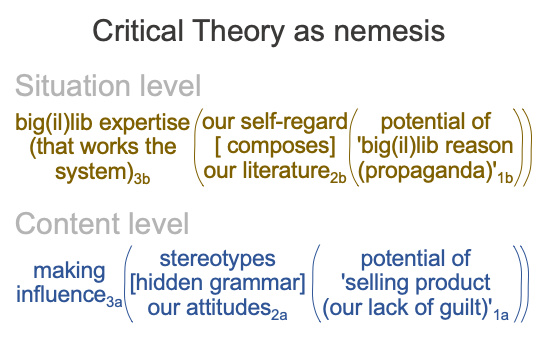
0313 To me, this big noumenon corresponds to experts3b that propose valuations2b that engender opportunities1c for the Relativist One3c, as discussed in a separate three-part e-book by Razie Mah, titled Original Sin and the Post-Truth Condition,
This examiner suggests that the literature2bf of critical theory is a novel genre of American fiction.
Jones’s application of existence (the content level) and essence (the situation level) tells me that making influence3a is like walking3a, the actuality of {stereotypes [hidden grammar] our attitudes}2a is like {the Bible [unifies] us}2a, and the potential of ‘guiltlessly selling product’1a is like the potential of ‘whatever carrying a gun intends to defend against’1a.
0314 Imagine carrying a metaphysical gun1a that would shoot Cupid before he could wound you with one of his self-annihilating arrows of desire1a.
This would be the same metaphysical gun1a that may be used against a critical theorist2b.
0315 But, what about the people who are peirced1b by the arrows of critical theories2bf and then fall in love with the promulgated stereotypes2am, whose hidden grammar makes the critical fictional forms so relevant2af (R)?
It is as if they are trapped in the mirror of nemesis.
0316 Here is a picture of the sensible construction of the second speaker3b (R).
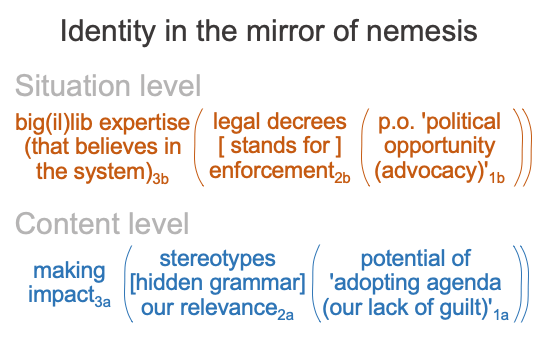
0317 It is as if the believers3b are like guns1a.
They3b are tools that the ones who work the system3b use to promulgate their self-promoting2bm literature2bf.
Believers3b spout the literature2bf of the ones with self-regard2am as if they are legal decrees2bm, demanding sovereign enforcement2bf. These legal decrees2bm pretend that stereotypical fictional matter2am is relevant2af enough to make an impact3a arising from the potential of ‘their adopted agenda’1a.
0318 Believers vicariously share the working experts’ lack of guilt1a.
They don’t need to carry guns1a.
They carry a political agenda1a.
That agenda1a makes an impact3a because operators3c in the hidden perspective level are flush with money and power2c and looking for opportunities1c.
0319 The two diagrams portrayed above constitute America’s contemporary wilderness.
0320 The student should read chapters 50, 51, 52 and 53.