
0321 Welcome to the matrix.
Welcome to a simulated reality constituted by agents that work the system (Q) and minions that believe in the system (R).
The system is always changing, yet always the same, because it lives by cancellation of their opposition. The system replaces a suspect person’s identity3b with a stereotype2am that opposes the adopted agenda1a. The stereotype-tagged guilty one2af deserves social cancellation1a (the gun1a of critical theory).
0322 Jones tells the story of a person who… well… had an old-style American identity.
In the big noumenon, identity3b virtually situates structure3a.
In the big noumenon of the nemesis of the American Identity (Q), big(il)lib expertise works the system3b and virtually situates manufacturing influence3a.
In the big noumenon of those self-identifying within the mirror of nemesis (R), big(il)lib expertise believes in the system3b and virtually situates making an impact3a.
0323 For example, self-regarding racial theorists2bm (Q) compose literature2bf that isolates stereotypes2af that – through an unspoken contiguity called “hidden grammar” – substantiate attitudes2af within the normal context of making influence3a and the potential of ‘selling a narrative (that veils the guilt of interventionalists on the perspective level)’1a.
0324 Oh, did I say “narrative”?
I meant to say, “product”.
0325 For example, educational committees2bm (R) distill what needs to be enforced2bf from the fictions of critical theory2bf. These experts3b advocate policies2b in light of what they perceive are political opportunities1b. In this way, the propaganda1b underlying the literature2bf of higher-level authorities2bm manifests as stereotypes2af that are regarded as relevant2bf in the normal context of making an impact3a operating on the potential of ‘the adopted agenda’1a.
0326 Allow me to compare critical theory (Q) and the mirroring identity of the big(il)lib believer (R).
Here is a comparison that starts with the situation-level normal context.
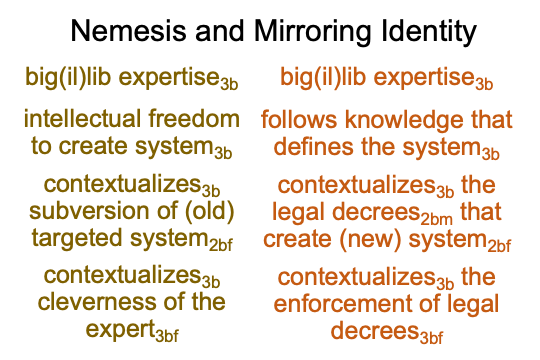
0327 On the side of nemesis (Q), the normal context of big(il)lib expertise3b has the intellectual freedom to “work” the system. Unrestrained intellectual liberty3b subverts the (old) targeted system (say, the institutional structures3a of the American Identity of the 1900s), using apparently clever tactics (typical of the manipulation of words in propaganda1b).
On the side of the mirroring identity (R), the normal context of big(il)lib expertise3b internalizes the knowledge created by cutting-edge critical theorists3b. Even though both nemesis and mirror are regarded as experts, there is a matter-of-fact distinction. For example, when a language professor teaches a course informed by the critical theories of Foucault3b, she contextualizes the French theorist’s proclamations as if they are legal decrees2bm, carrying the weight of authority2bm. The students know that the professor will use the opportunities afforded by classwork1b to enforce2bf that authority2bm.
0328 The comparison continues in the following figure.
0329 Here is a reminder. “Big(il)lib” is short for big government (il)liberalism. The bigger the government gets, the more illiberal the self-declared “liberal” will act.
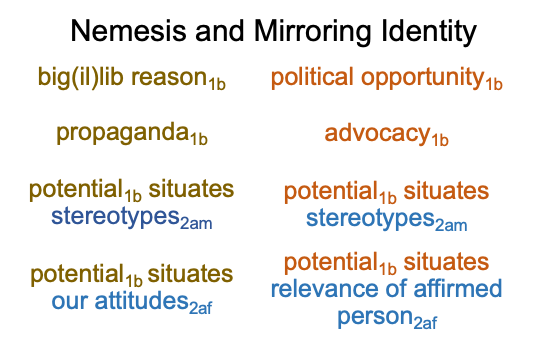
0330 Potential on the situation level1b situates the entire content-level nested form, particularly the actuality2a.
0331 On the nemesis side (Q), the technical language of big(il)lib reason1b yields propaganda1b which situates the stereotypes2am that guide our attitudes2af by way of a hidden grammar. [Hidden grammar] is the contiguity between the matter of stereotypes2am and the form of our attitudes2af.
On the side of the mirroring identity (R), the action-oriented language of political opportunity1b yields advocacy (calls to action)1b that situate stereotypes as matter2am and proclaims the importance of the attitudes that stereotypes call for2af.
0332 The comparison is completed in the following figure.
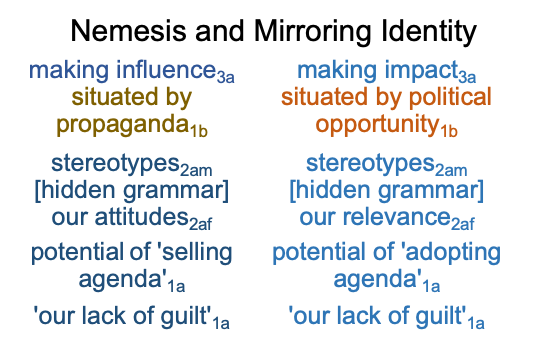
0333 On the nemesis side (Q), making influence3a is situated by the potential of propaganda1b.
On the mirror side (R), making an impact3a is situated by the potential of political opportunity1b.
Anyone tagged with one of the old American identities is outside this system. Indeed, the two sides function to sap the resources of those outside their fiction.
0334 On the nemesis side (Q), liberated theorists3b write the theoretical thought-pieces2bf that govern the stereotypes2am that “speak to” our attitudes2af.
On the mirror side (R), educated believers3b derive the laws inherent in those thought pieces2bf in order to enforce2bf the realness (not fictionality) of the stereotypes2am, thereby making them palpably real2af or “relevant2af“.
Is that not what good fiction is supposed to do?
0335 Finally, both the nemesis of American Identity and those who mirror the nemesis manifest the potential of having no guilt1a, just like the Satan, at the opening of John Milton’s Paradise Lost. And, for Americans, that potential is precisely what carrying a gun aims to mitigate.
0336 The student should read the epilogue.