0278 At the end of the previous section, Santner mentions a possible alternative source of biopower, one that both exploits and supplants citizenregular. One source is… um… public debt. Can I think of another?
If not, then public debt will do.
0279 Citizenregular goes with the content level of the society tier.
Citizenregular is an institution whose organizational objectives may yield biopower for citizenMarat.
At the same time, the regular citizen’s spirit of rational expectations, industriousness and sanity points to the organization tier in its entirety, but most especially, its content level.
The content level of the organization tier houses its own interscope of management, production and services.
Corporations strive to minimize debt. Debt reduces surplus value.
In contrast, the party strives to increase debt, knowing that it increases the authority of citizenMarat over citizenregular.
But, what type of debt am I talking about? How is debt related to fetish?
0280 Disavowal is at the heart of a fetish.
The theory of the sublime body of the king contains a fetish.
The kingly values that inform the king’s mortal body are fetishes. The king carries himself in a certain – regal – manner. He wears a crown. His clothing is adorned with furs. These displays disavow the necessity that the king must ruthlessly deal with bandits, marauders, stupid peasants and sly priests.
0281 All the regalia of the sovereign office are pieces of the Real, saying, “Here is your king.”
The little objects say, “This is how you (the subject) will recognize the potential for order.”
0282 These petit objets a also disavow the anarchic potential of royalty.
The sovereign may be nothing like Christ the King. The sovereign may mercilessly eliminate contenders for the throne. He may steal. He may use his authority to access both spiritual and carnal pleasures.
The actual flesh of the mortal body of the king may not subscribe to its inscription by royal regalia.
0283 To me, the term “flesh” fits into all three categories of the late medieval and early modern nested form.
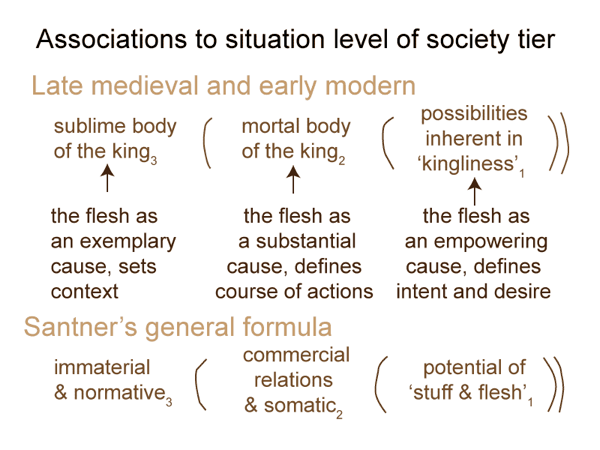
0284 The flesh is exemplary3, substantial2 and empowering1.
The word “flesh” is normative, somatic and entangling.
0285 Humans are creatures, but their environment (biologically speaking) is not an Umwelt, but a Lebenswelt.
In the animal world, the exemplar is maintained by eliminating the unfit. The somatic is maintained as status, not glory. Finally, empowerment assumes that the animal survives on whatever is at hand.
0286 How on earth did these get transubstantiated into a category-based relation that describes our thrown-ness?
0287 Let me say that an answer is assumed in Santner’s inquiries.
0288 To me, this assumption fits into Santner’s general formula.
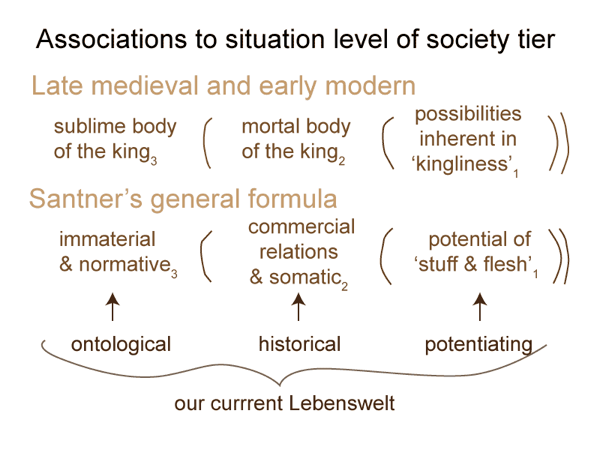
0289 Our ancestors evolved the milieu of culture. However, our current Lebenswelt is not the Lebenswelt that we evolved in.
0290 Santner sees, in the sublime body of the king, an incarnation and representation of the historical and ontological vulnerabilities of the subjects. The king’s glorious body puts the subjects’ expectations of kingliness into context. The king’s mortal body situates the subject’s expectations for protection and social stability. The subject is indebted to the king for this.
0291 Here is how this looks:
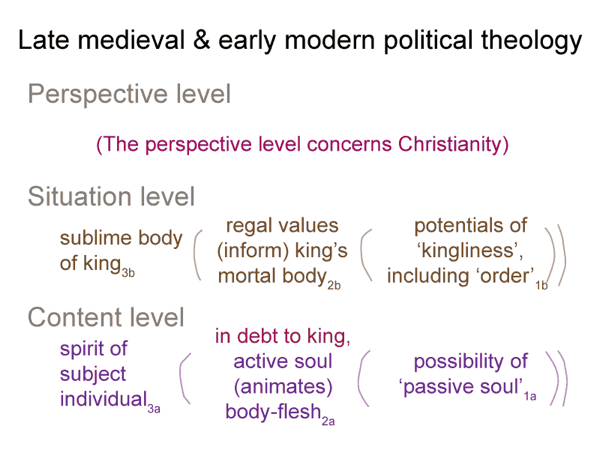
0292 Is the political theology of the dual-body of the king a fetish?
0293 If so, then the fetish situates the one who holds it. The fetish puts the holder into debt.
The fetish applies to the situation-level. The debt is felt on the content-level.
0294 Does this arrangement parallel the commodity fetish in the organization tier?
0295 The situation level contains the commodity fetish.
0296 The commodity fetish consists of this: The perceived value of a commodity does not consider how the commodity came to be. It disavows the labor value provided by the content level of the organization tier.
In fact, a corporation may conceal the integration of all the costs of production so that such knowledge does not interfere with the perceived value of the commodity.
0297 Perceived value increases the price above the integrated costs because it fixates on what the commodity means for me, rather than its constituent labor value.
Indeed, the price reflects the way that the commodity glorifies me.
Price increases with glory.
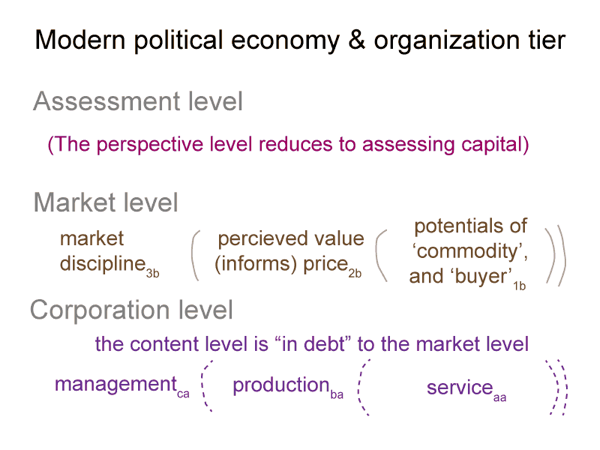
0298 This precisely correlates to Santner’s intuition that the subject is “in debt” to the king.
For the organization tier, management, production and service are in “debt” to the commodity fetish.
The corporationaB is “in debt” to an illusion of perceived value [informs] price2bB.
0299 What about this technical term: petit objet a?
0300 Slavoj Zizek is both master thinker and brainy celebrity. In many ways, he and Santner take a similar tack. Both present their literary works as material subject to psychoanalytic reading. In other words, the reader is expected tointerpret their texts within the Freudian (and by extension, the Lacanian) tradition.