Looking at Ian Hodder’s Book (2024) “Entangled.” (Part 22 of 22)
0285 What do I mean by “not enough”?
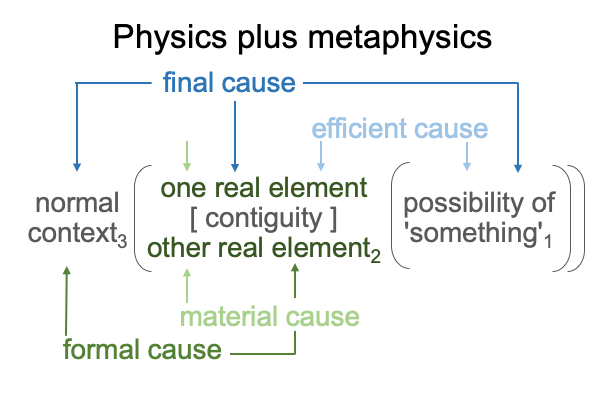
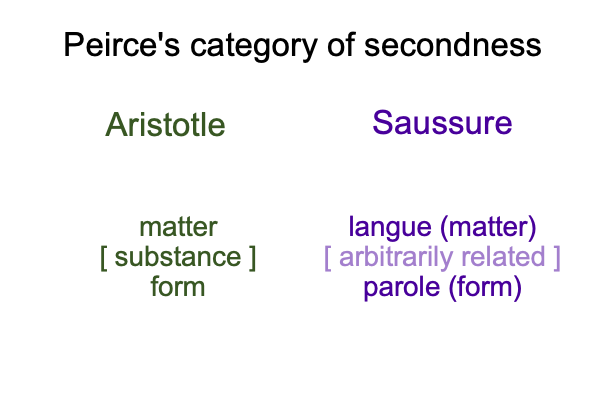
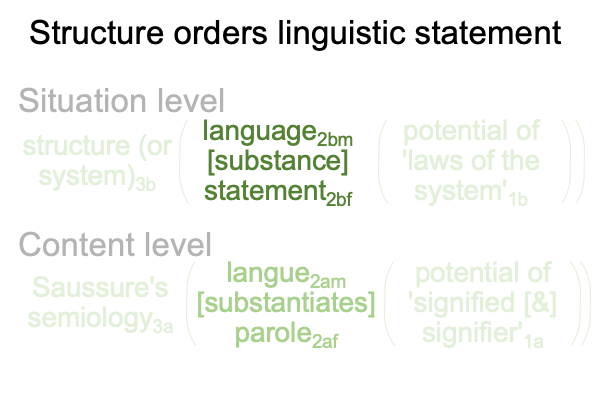
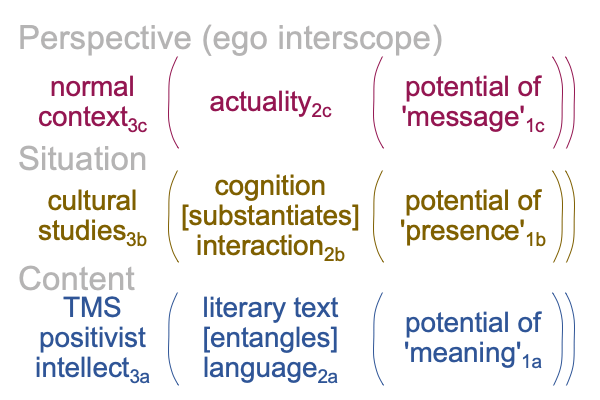
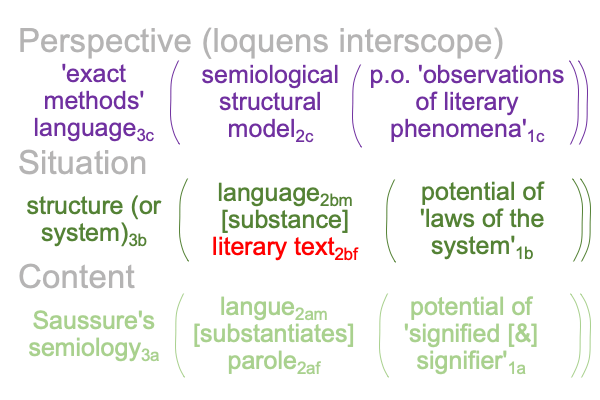
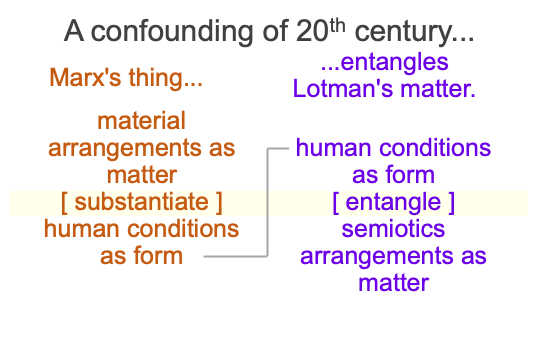
0286 From this examination, I have demonstrated that Hodder’s sociological and anthropological appreciation of “entanglement” mirrors, so to speak, a philosophical definition of a confounding. Using Aristotelian terminology, a confounding occurs when the form of a thing entangles other (non-originating) matter. Form is contiguous with two matters, one originating and one entangled. The two contiguities are “substantiation” and “entanglement”.
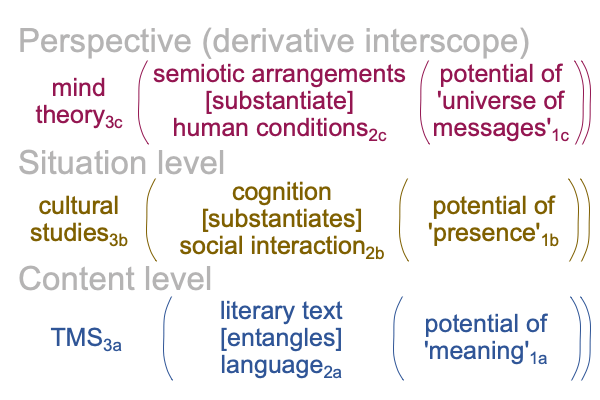
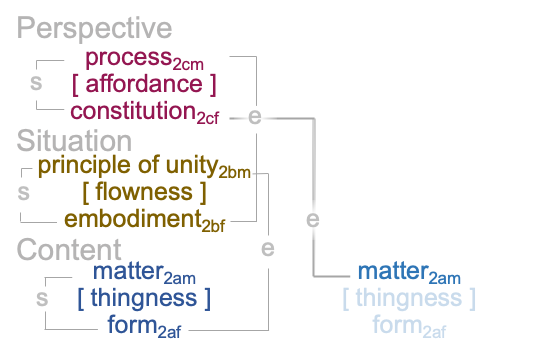
0287 This applies to content-level and situation-level hylomorphes. In the following figure, entanglement connects form on one level with matter on the adjacent higher level. This connection also occurs in the sign-relations isolated by scholastics of the Latin Age.
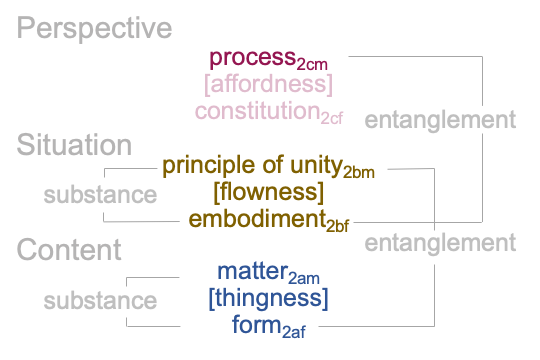
0288 Clearly, this expression of entanglement theory stands outside the Hegel-Marx Overton window.
This expression stands outside of the range of ideation among modern anthropologists in 2026.
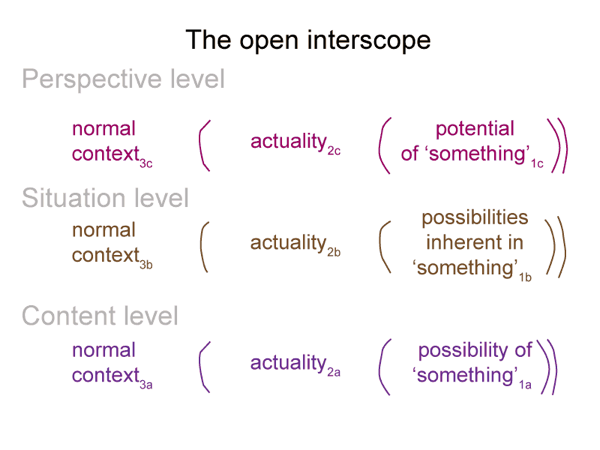
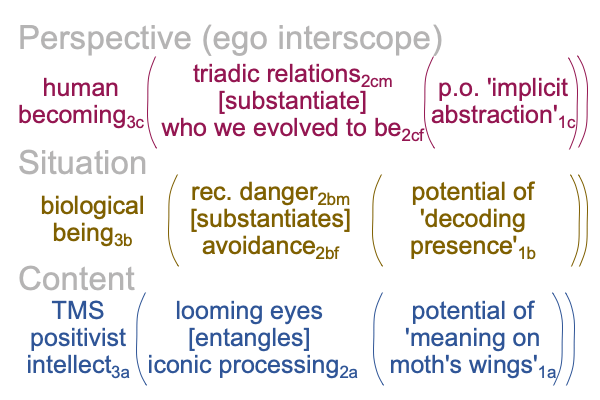
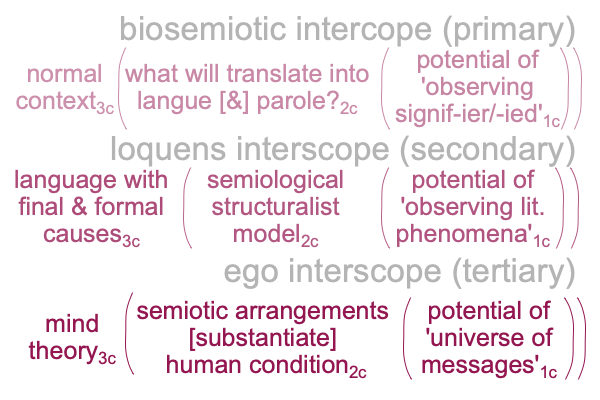
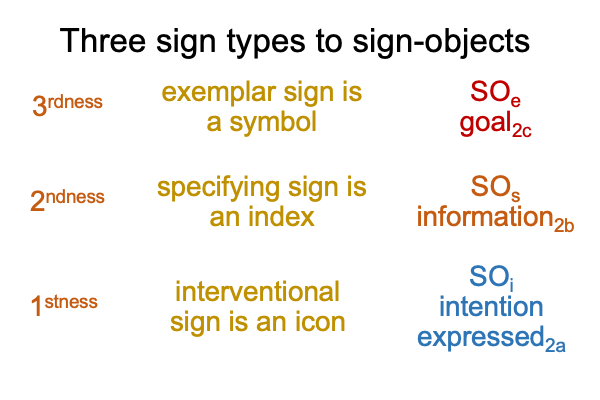
0289 The story is even more complicated. The three-level interscope fully contains two sign-relations, the specifying and the exemplar, familiar to Latin Age scholastics. Even that is not enough.
There is one more confounding that resolves into a sign-relation. The interventional sign connects the perspective-level of one interscope with the content-level of another. What is constituted2cf in one interscope stands for matter3am in another interscope. The discovery of the interventional sign-relation completes a line of thought that started during medieval times.
0290 The Hegel-Marx approaches that the author discusses in chapters 10 and 11 (C10 and C11) need to be adjusted in order to account for phenomena regarded as observable and measurable facets of a noumenon characterized by substances, confoundings and sign-relations.
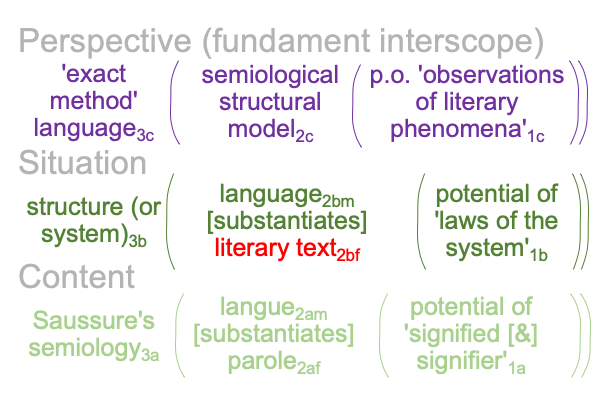
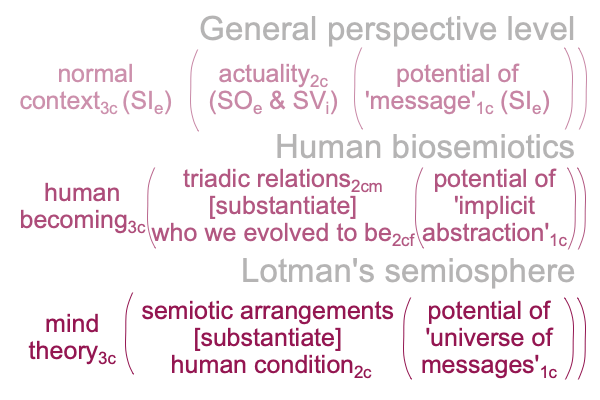
0291 The story of the emergence of Lotman’s thing is told in Razie Mah’s blog for December 2025, titled Looking at Igor Pilshchikov and Michael Trunin’s Article (2016) “The Tartu Moscow School of Semiotics” as well as follow-up examinations appearing in January through March of 2026.
0292 Juri Lotman (1922-1993) is a Soviet era academic with expertise in the arts of the Slavic civilization. He and a collaborator, Boris Uspenskij (1937-present), find that Marxist vocabulary is inadequate to discuss the phenomena of Slavic historical art production. So, they adopt semiology and structuralism in order to build models of artistic and literary productions. The models allow them to discuss Slavic art-works according to modern, scientific sensibilities.
0293 In sum, for Juri Lotman and Boris Uspenskij, Marx’s thing entangles the matter of semiotics.
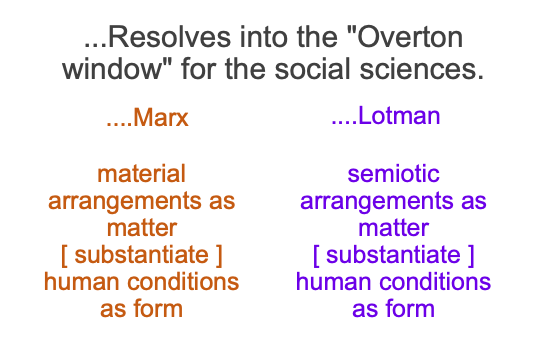
0294 The confounding resolves in… what appears to me… to be the new Overton window for the social sciences for the twenty-first century.
0295 I wrap up with three noteworthy conclusions.
0296 First, Hodder’s anthropological theory of entanglement associates with Marx’s thing. Razie Mah’s hypothesis that the human niche is the potential of triadic relations associates with Lotman’s thing.
Second, despite occupying different poles of the twenty-first century Overton window, Hodder’s sociological theory of entanglement and the philosophical definition of “entanglement” as a component of a “confounding” do not exclude one another. They either complement or align.
Third, excavations at Catal Hoyuk permit the suggestion that cultural emissaries from the Ubaid of southern Mesopotamia influence a change in things2a, embodiments2bf and processes2cm associated with Level VII (starting around 6600 B.C.). This suggestion is consistent with the hypothesis of the first singularity proposed by Razie Mah.
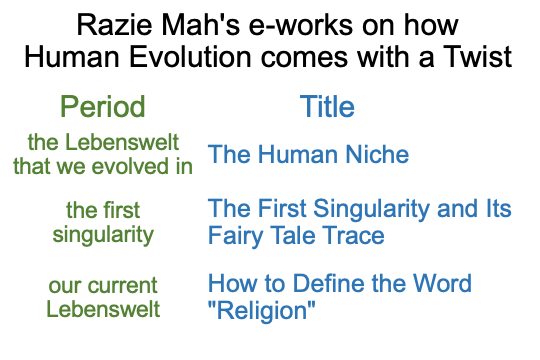
0297 Here is a summary of Razie Mah’s e-works on human evolution.
0298 My thanks to Dr. Ian Hodder for this book, as well his many collaborators. I hope that this examination adds value to his inquiries.