Looking at Dr. D. Basak’s Book (2025) “Sumerian Mythology…” (Part 12 of 20)
0139 Okay, make that now.
What other conceptual apparatus congeals when Neptune is in Aries and then blobs out in the same zodiac sign, one orbit of Neptune later?
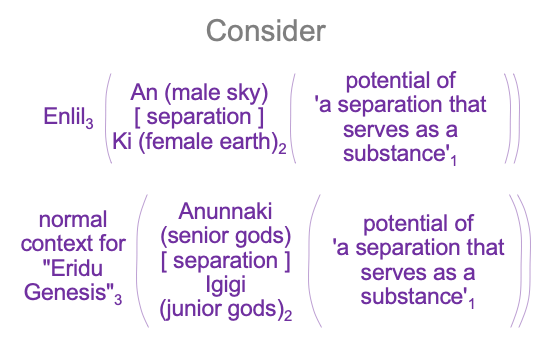
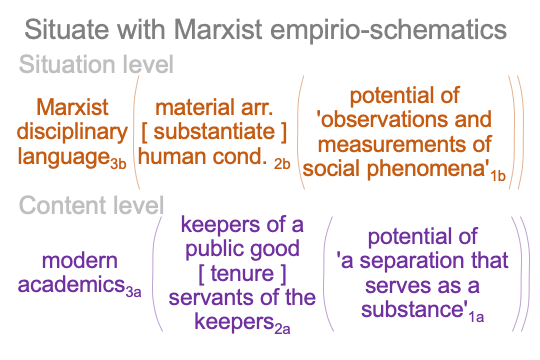
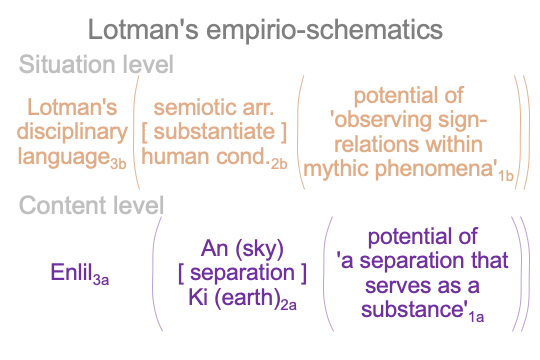
0140 Here is a picture of Marx’s thing.
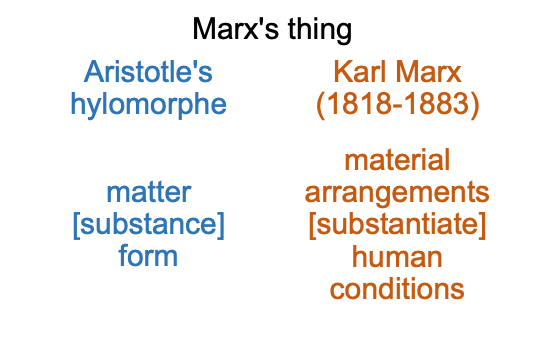
0141 Marx’s thing is not a mathematical or mechanical model. It is a variation of Aristotle’s hylomorphe, which is an exemplar of Peirce’s category of secondness. Secondness is the realm of actuality. The realm of actuality is subject to the logics of contradiction and non-contradiction. The realm of actuality is what science is all about.
Remember that the mechanical philosophers are writing in Europe around 1600s, near a peak of Neptune’s cycle that passes through Aries in 1533-1548 and then in 1697-1706. This Neptunian cycle concerns literalism. Literal references [substantiate] spoken words. I call this hylomorphe, “Martin Luther’s thing”.
0142 A sea change starts with the Reformation (1533-1548) proclaiming that literal interpretation of the Bible (translated into the person’s vernacular) is to be preferred to the Catholic’s literal, allegorical, moral and anagogical approaches.
The sea change overflows the dikes by the time Neptune enters Aries again. Pierre Bayle (1647-1706) publishes Dictionnaire Historique et Critique (1697) with copious and often secret messaging footnotes. John Harris (1667-1719) publishes Lexicon Technicum, the first with all the accoutrements of a modern encyclopedia. The modern dictionary is a tribute to Luther’s thing. If literalism is real, then aren’t dictionaries necessary?
What is more literal than a dictionary?
At the height of this sea change, mechanical philosophers (around 1600) design the empirio-schematic judgment. This judgment is a triadic relation. A literalist disciplinary language (relation, thirdness) brings mathematical and mechanical models (what ought to be, secondness) into relation with observations and measurements of phenomena (what is, firstness). Dictionaries and encyclopedia are demanded by disciplinary languages.
0143 Baruch Spinoza (1632-1677) is the precursor to what comes together during the next Neptune in Aries (1697-1706). If literalism is real, if literal references [substantiate] our spoken words, then we can be rational in ways that people have never really been rational before. Gottfried Leibniz (1646-1716) proposes a systematic rationalism, which rises to the formulation of the Positivist’s judgment, which contains the empirio-schematic judgment as what ought to be.
0144 What is the Positivist’s judgment?
A positivist intellect (relation, thirdness) brings the empirio-schematic judgment (what ought to be, secondness) into relation with phenomena (what is, firstness).
When Neptune is in Aries between 1697 and 1706, the relationship between faith and reason is a topic of intense interest. Scientific reason as a manifestation of literalism (as opposed to religious reasoning) arises from the sea of uncertainty and sets the stage for further developments. The western Enlightenment is going to be the high-point of the coming cycle (1697 to 1861). I call this Neptune-in-Aries cycle, “Spinoza’s thing”.
0145 Here is a picture.
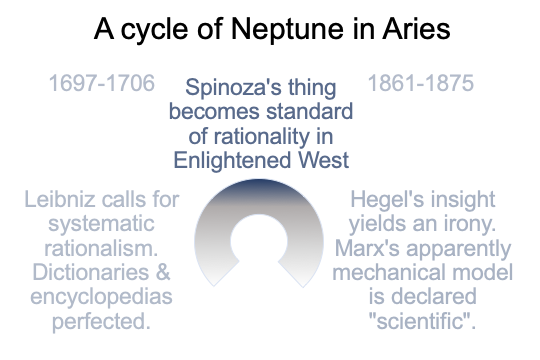
0146 Both Immanuel Kant (1724-1804) and Georg Wilhelm Friedrich Hegel (1770-1831) write between the emergence and submergence. In a way, they represent how Spinoza’s thing, actualized by Leibniz during Neptune’s passage through Aries, reaches its peak as well as its point of manifesting the contradictions that will lead to its submergence.
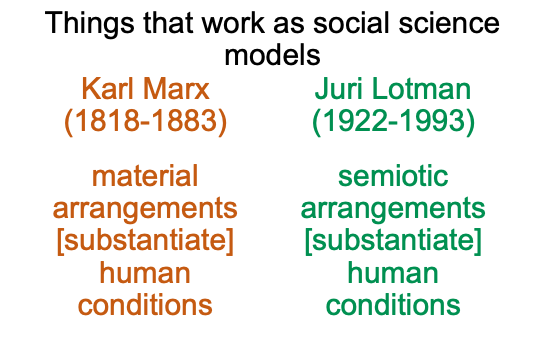
In the descent, Karl Marx (1818-1883) proposes a dyadic structure that substitutes for a mathematical and mechanical model. In other words, Marx claims that his dyadic model is scientific. At the start of the next passage of Neptune through Aries, the Paris Commune proclaims Marx’s thing as the scientific model that must be taken literally by their international movement. This international movement captures the imagination… er… “empirical interest”… of the burgeoning social sciences.
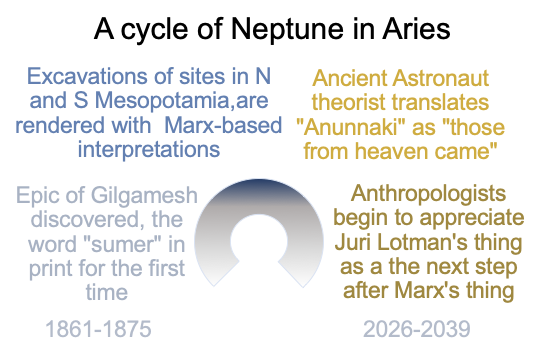
0147 Here is a picture of the next cycle for Neptune in Aries, which comes to its submergence at the current moment (1861-2026).
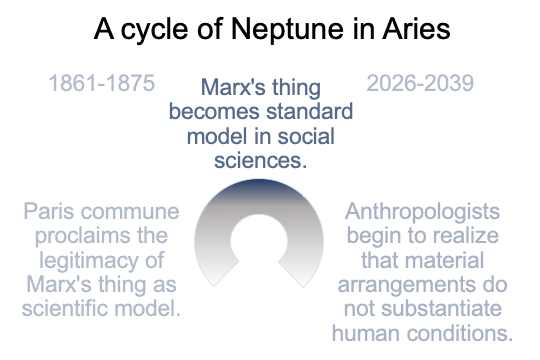
0147 For this cycle, one may ask, “Is Marx’s thing really a scientific model? Or is Marx somehow gaming the Positivist’s and the empirio-schematic judgment?”
0148 The answer begins with the question, “What is a judgment?”
A judgment contains three elements, relation, what ought to be, and what is. When each element is assigned a unique Peircean category, then the judgment becomes actionable. Actionable judgments unfold into category-based nested forms on the basis of the categorical assignments.
0149 What are the Positivist’s and empirio-schematic judgments?
The Positivist’s judgment consists of a positivist intellect (relation, thirdness) bringing an empirio-schematic judgment (what ought to be, secondness) into relation with the dyad, {a noumenon [cannot be fully objectified as] its phenomena} (what is, firstness).
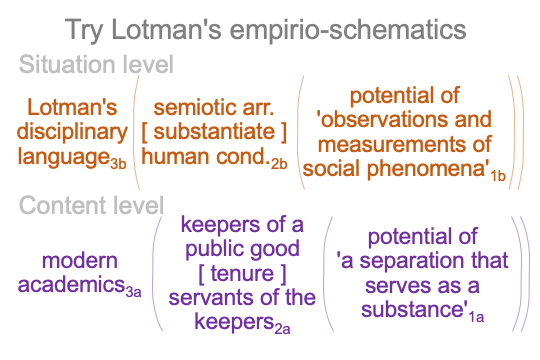
The empirio-schematic judgment, in turn, consists of a disciplinary language (relation, thirdness) bringing a mathematical or mechanical model (what ought to be, secondness) into relation with observations and measurements of phenomena (what is, firstness).
0150 Here is the trick.
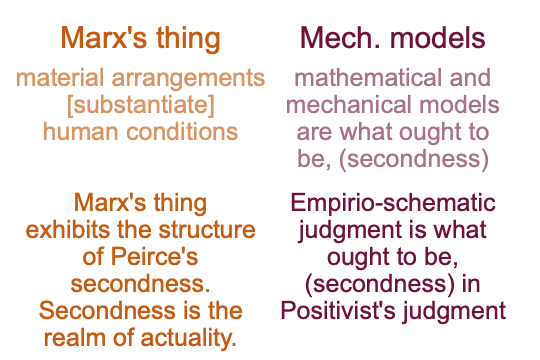
Marx’s thing has the structure of Peirce’s secondness. Secondness consists of two contiguous real elements. The real elements are material arrangements and human conditions. Secondness is the realm of actuality.
Mathematical and mechanical models belong to what ought to be in the empirio-schematic judgment. And, what ought to be is assigned to the category of secondness. Observations and measurements belong to the category of firstness. Disciplinary language belongs to the category of thirdness. These assignments place mathematical and mechanical models into the realm of actuality.
Also, the empirio-schematic judgment belongs to what ought to be and is assigned to the category of secondness in the Positivist’s judgment.
0151 So, why would a dyad that belongs to secondness not effortlessly glide into a slot that is twice imbued with that category?
0152 Who is so fixated on the natural sciences as to notice that Marx’s thing is not exactly a mathematical or mechanical model?
Only natural scientists would notice. Those that do are shunned by social scientists.
0153 Meanwhile, social scientists bend over forward in order to apply rigorous statistical criteria and analysis to their materials and methods sections, as if statistical manipulations are equivalent to mechanics and mathematics.
Precisely how does an inquirer demonstrate that the Marxist thing (as a scientific model) does not work because there is a flaw in its mathematical or mechanical formulations?
Indeed, phenomena are observed and measured selectively in order to support the appearance of mathematical or mechanical certainty characteristic of the physical sciences.
0154 Even more disheartening, statistical models constructed on selective observations and measurements of phenomena are crucial for the publications that administrators count, as if each publication is a data point that goes into a model of “academic productivity”.
0155 No wonder young professional archaeologists are exhausted.
It is Marx’s thing all the way down.