Looking at Peter Burfeind’s Book (2014) “Gnostic America” (Part 1 of 26)
0001 Peter Burfeind wrote Gnostic America: A Reading of Contemporary American Culture according to Christianity’s Oldest Heresy (Pax Domini Press, 2014).
This book is composed of four parts. The first part covers the fundamentals of Gnosticism as a Christian heresy. The second and third parts explore cultural manifestations. The fourth part applies these fundamentals and explorations to contemporary American Neo-Evangelical Christian churches.
0002 Burfeind argues that two Gnostic movements contend for sovereign power, progressives and Neo-Evangelical Christians.
To me, big government (il)liberals (BG(il)Ls) beat these Christians to the punch. The federal government has established a religion. It is not Christian. BG(il)Ls run Gnostic bureaucracies where authorities deny that they are religious at all. BG(il)Ls are the self-anointed angels (or more accurately, daemons) of a New Age dawning in America.
Christians who self-describe themselves as “spiritual, but not religious” accommodate BGL’s increasing sovereign power and aggression.
0003 Burfeind is not alone in this awareness. Over 60 years ago, Eric Voegelin expressed similar ideas in his short but significant book, The New Science of Politics.
This raises a question. What is the meaning, the presence and the message underlying the word “Gnosticism”?
With this question in mind, I turn my attention to Burfeind’s text.
Students should read chapter 1 of Burfeind’s text before proceeding.
0004 From Burfeind’s introduction, I know that Gnosticism is a very old heresy.
How old?
From chapter 1, I suspect that Gnosticism predated Christianity. Indeed, the death and the resurrection of Jesusrebuked Gnostic intuition. Why would Jesus retain the evil material shell of His body?
Jesus highlights all the ways that the Mosaic tradition offended Gnostic sensibilities. Both Christians and Jews are enamored of the material world. Gnostics, not so much.
0005 The Judeo-Christians believe in one God. So do the Gnostics. But, the one God of the Judeo-Christians is not the same as the Gnostic Source. The Source is a Monad, a complex singularity capable of putting everything into perspective. The Monad is the source of meaning.
0006 The Monad plays a key role in the Gnostic origin myth. The myth begins with the Source, beyond spoken language and in eternal time. From the Monad, male and female pairs emanated, each according to its aeon. The totality of the aeons is called the “pleroma”.
For the last era, our own, the female of the pair acted without her male consort. He was missing in action, so to speak. Sophia became pregnant with Yaltabaoth, half lion and half snake. She thought to herself, “This is not me.” So she took action, ripping the monster from her womb and hiding him in a cloud.
0007 Born yet aborted, living in a fog, Yaltabaoth decided to build his own world. He decided to create. What else was this demiurge supposed to do? He constructed his own world, which is our universe. He assigned archons (powers and governors) to rule his cosmos.
He was proud of his accomplishments.
Here I make an admission, there is more than one way to spell Yaltabaoth. That exercise is left to the reader.
Okay, back to the story.
0008 What else does this builder god do?
He manufactures our physical bodies. He steals a spark from the Monad (a soul) and pulls it into his world. As the soul descends, Yaltabaoth adds matter. At birth, each person is a spark wrapped in a mortal cloak. The spark is not material. The body is material. The two will war with one another.
0009 Therefore, Sophia pities us and offers this myth. The Self has a mission: Return to the Source. Sophia offers secret knowledge, gnosis, opening a path out of Yaltabaoth’s apparently all-encompassing cloud.
In fact, this myth, which joins cosmic and personal origins, contains a secret. It describes a location where you can find your Self.
0010 Clearly, this origin myth provides meaning. This meaning coincides with the model of social construction in Razie Mah’s How to Define the Word “Religion”. This model is further detailed in A Primer on the Category-Based Nested Form and A Primer on Sensible and Social Construction.
0011 The model is an interscope, a nested form of category-based nested forms. The interscope offers nine slots. Features in the above myth associate with different slots.
Here is the open interscope, before any associations.
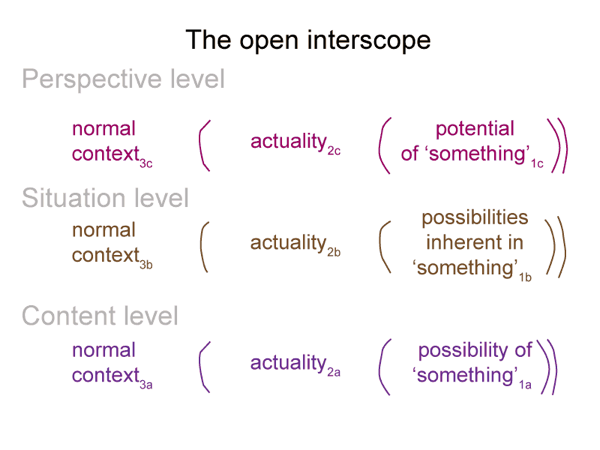
0012 My intent is to associate elements of the Gnostic origin myth with slots in the interscope of social construction.
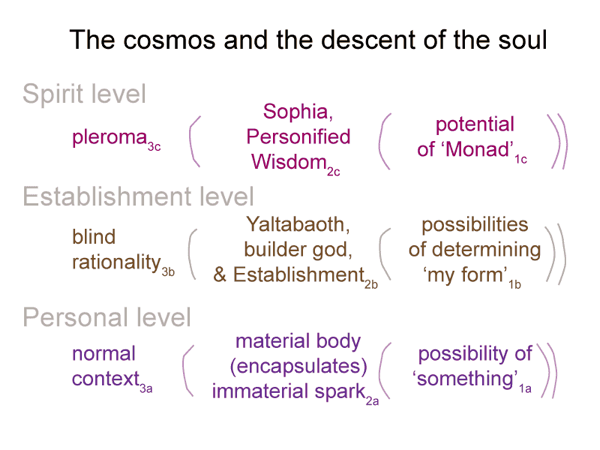
0013 My first association concerns the Monad. The Source has the potential to put the situation into perspective, so it goes into slot 1c. The pleroma automatically becomes the normal context of the perspective level (slot 3c). The pleroma3c brings the possibilities inherent in the Monad1c into relation with the actuality of Sophia2c.
0014 So what is the secret about Sophia?
Sophia is Personified Wisdom. It is not much of a secret. After all, philosophy is rooted in love (philos) and Wisdom (sophia).
0015 If Sophia2c is the mother of the builder god, Yaltabaoth, then I should put the builder god into slot 2b. Yaltabaoth2b situates our universe within the normal context of blind rationality (slot 3b).
Or should I say, “mindless rationality”?
The builder god lives in a cloud, isolated, without awareness of even his own mother. Sure, he snatches sparks from the Monad. He does this blindly. Who knows what spark goes into what body? Yaltabaoth operates in a fog. His archons are like bureaucrats, always following their rulebooks. His social norms? They constitute the Establishment.
The Establishment is the social arm of Yaltabaoth’s evil material world of blind chance and mindless necessity. For teenage Gnostics, that includes all parents. For big-government Gnostics, this includes everything associated with the American Founding.
0016 So, why does the builder god need a spark from the Source in order to animate the human body?
Yaltabaoth is so clueless. He does not realize that the spark comes from the Monad. It is just another thing at his disposal. Obviously, there is no better way to animate humans. He snatches an unwitting soul from its contemplation of Sophia and uses it to bring breath to a breathless body. Inspire. Hold it. Expire. I can feel it.
0017 Here, let me put my associations into the open interscope.