SaH0047 The following essay, originally written in 2016, comments on a book by a Lutheran Pastor about heretical influences in contemporary American society. The author is Peter Burfeind. The title of the work is Gnostic America: A Reading of Contemporary American Culture according to Christianity’s Oldest Heresy (Pax Domini Press, 2014). Please have this book at hand for the full story.
These comments are not a close reading. They situate Burfeind’s text with category-based models. These models were proposed and developed in How to Define the Word “Religion”, plus Primers 1 through 10. They were refined in the Course on Implicit and Explicit Abstraction. They portray relational and logical structures.
Also, my discussion presumes the first singularity. Gnosticism was cultivated in an early ancient civilization. As such, I expect its origin myth to be a fairy tale about the first singularity. The first singularity is discussed in the Crystallizations of the Fall series plus An Archaeology of the Fall, available at www.smashwords.com and other e-book venues.
In short, these comments apply a suite of postmodern scholastic hypotheses to Burfeind’s excellent text. They are different from, yet complementary to, Burfeind’s passionate argument.
SaH0048 This exposition constitutes a strand in the Razie Mah’s online course: Semiotics and History.
The various strands are listed in Razie Mah’s blog for February 3, 2026
‘Words that belong together’ are denoted by single quotes or italics.
SaH 0017 The authors quest for a sphere of understanding. They seek the egg, so to speak, impregnated by Juri Lotman’s genius. In the interviews in chapter 2.1, Lotman is spent, although still alive. He is old. The interviewer is a youth, a personification of the metaphysical love-child born after Slavic civilization reveals herself to Lotman’s circumspection.
0018 The miracle of Lotman’s arrival in Estonia is, weirdly, recounted in the last interview (2.14) with psychologist and cultural theorist, Jaan Valsiner. As it turns out, Valsiner’s step-father was instrumental in getting Juri Lotman to Estonia after the Second World War.
0019 Jaan Valsiner demonstrates that the Tartu-Moscow’s sphere of influence is diffuse. His testimony is seconded by Paul Cobley (2.13), Terrence Deacon (2.12), Jesper Hoffmeyer (2.11) and Stuart Kauffman (2.10).
0020 The sphere becomes less diffuse in interviews with Roland Posner (2.9), Gunther Kress (2.8) and Wilfred Noth (2.7).
Notably, Noth conducts a discourse on the crucial potential of truth, as opposed to the potential of will. Indeed, the contrast between truth and will turns out to be integral to my examination of a 2017 article on Russian identity.
0021 Finally, the sphere becomes tangible with interviews with American anthropologist, Myrdene Anderson (2.6), who researched indigenous people in Sweden, Italian semiotician Paolo Fabbri (2.5), who railed against the wooly thinking that passes for “models” in contemporary humanities, and the Italian know-it-all Umberto Eco, who noted the importance of iconicity in semiotic humanity.
What?
“Semiotic humanity”?
What about semiology?
0022 Contemporary academic discourse is currently conducted with expert-coined spoken words, but these utterancescannot picture or point to their referents. Academics swim in a pool of differences… er… two arbitrarily related pools of differences. No one can tell where he or she flotates.
Flotates?
This is what happens when spoken words are placeholders in two arbitrarily related systems of differences.
0023 Finally, the interviews engage a still-living member of the original Tartu-Moscow School of Semiotics, Boris Uspenskij (2.2). This interview gets a full examination in the course on Semiotics and History. Uspenskij stands within the sphere that the authors aspire to understand.
0024 So, what does Razie Mah’s contribution under the banner ofSemiotics and History offer?
0025 For the diffuse sphere, these examinations will present a historical narrative of ideas in the style of diagrams of purely relational structures. In short, Peirce-inspired diagrams offer a new way to narrate intellectual history.
0026 For the almost tangible sphere, these examinations practice a method of association, followed by a discussion of the implications. The articles provide material to fill in the empty slots of relational structures. When associations are made, implications become apparent.
0027 For the sphere itself, one unexpected insight is that, as the first ascendant of the Tartu-Moscow School of Semiotics struggles to fulfill the political mandate of the USSR (to make all fields of inquiry “scientific”), the researchers excavate the recently-buried remains of the civilization that is their subject of inquiry.
Imagine a scientific investigation of Russian language, history and literature, as a archaeological excavation into the being of Slavic civilization.
0028 Is that the same “she” that… um… you know… captured the attention of Juri Lotman?
How confounding.
0029 The next blog offers an introduction to Semiotics and History: The Tartu-Moscow School of Semiotics.
SaH 0030 This course is a fully on-line study that appears in Razie Mah’s blog.
The course should be conducted (ideally) by a mature reader along with one novice or more, (less ideally) by two novices in collaboration and (perhaps, heroically) by a novice reader working alone.
0031 The field of home-schooling is exploding (a term associated with Juri Lotman) in America, but a wary public wants to taste the products, before committing to purchase. This online course is the first of many, I suppose, but the import for this particular exposition is obvious when considering current events.
0031 Estonia is awkwardly situated (along with the other Baltic states) between the Slavic civilization of Russia (to the east), and the Swedish, German and Polish civilizations (to the west). Estonia was part of the USSR, during the cold war; part of the West, during the American Empire’s unipolar moment; and now is about to be nudged into a Eurasian convergence, as predicted by political theologian, Alexander Dugin.
A nudge is both a danger and an opportunity, especially for the University of Tartu, with its department of semiotics, and for the University of Moscow, with its unique constellation of intellects.
0032 One of the questions asked in almost every interview in Kull’s and Velmezova’s book goes like this, “What needs to be researched by semioticians? Or, what topics of inquiry need exploration by newly certified semioticians?”
This course offer a number of suggestions, several in connection with a stunning post-scholastic discovery that may be attributed to the first ascent of the Tartu-Moscow School of Semiotics.
Discovery?
Look and see.
The original articles are available online.
0033 Here is the list of examinations.
Go to the month in Razie Mah’s blog and scroll down.
0034 (1.) Looking at Igor Pilshchikov and Mikhail Trunin’s Article (2016) “The Tartu-Moscow School of Semiotics” (December 2025, 27 blogs, points 1-376)
0035 (2.) Looking at Ekaterina Velmesova and Kalevi Kull’s Article (2017) “Boris Uspenskij…” (January 31-10, 2026, 19 blogs, points 377-641)
0036 (3.) Looking at Boris Uspenskij’s Article (2017) “Semiotics and Culture” (January 9-2, 2026, 8 blogs, points 642-743)
0037 (4.) Looking at Mihhail Lotman’s Article (2017) “History as Geography” (late February 2026, 8 blogs, points 744-840)
0038 (5.) Looking at Mikhail Trunin’s Article (2017) “Semiosphere and history” (late March 2026, 8 blogs, points 841-952)
0039 (6.) Looking at Peeter Torop’s Article (2017) “Semiotics as Cultural History” (early February 2026, 11 blogs, points 953-1104)
0040 In a little over 1000 steps, the home- or guided-schooler can find out where the Tartu-Moscow School as been (in its first ascent) and where it may be going (in its second).
SaH0001 Razie Mah offers three foundational courses that cover human evolution.
These are:
The Human Niche
(also see the four accompanying commentaries as well as the three-part Comments on Michael Tomasello’s Arc of Inquiry (1999-2019))
An Archaeology of the Fall
(also see the three part Instructor’s Guide, as well as The First Singularity and Its Fairy Tale Trace and Original Sin and Original Death: Romans 5:12-19)
How To Define the Word “Religion”
(also see the ten primers, starting with A Primer on the Category-Based Nested Form and A Primer on Sensible and Social Construction)
These courses are on sale by various electronic booksellers.
The texts are designed to be read and discussed in a seminar setting.
0002 For inquirers. educators and students would who like to try their hands at Razie Mah’s approach, Semiotics and History offers a path. This is one course consisting of many strands. Like a fiber in a rope, each strand strengthens the entire conceptual apparatus. With few execptions, each course completely appears in the blog. Some strands will have an electronic e-book component. So, don’t be afraid to make a purchase. You will find that the costs of Mah’s electronic works are reasonable.
In the following list, the date corresponds to the cover page of each strand. A strand typically covers a month.
0003 The following list extends into the future, because more strands will be added over time.
Feb 6,5, 2026
Looking at Kalevi Kull and Ekaterina Velmezova’s Book (2025) “Sphere of Understanding” (Part 1 and 2 of 3)
Feb 4, 2026
Semiotics and History: The Tartu-Moscow School of Semiotics (Part 3 of 3)
May 30. 2026
Semiotics and History: Baroque Scholasticism
May 7, 2026
Semiotics and History: Baroque Scholasticism and Early Modernism
June 30, 2026
Semiotics and History: Early Modernism
July 31, 2026 Semiotics and History: Gnosticism in Modern America
I reviewed Steven Mithen’s book, The Language Puzzle: Piecing Together The Six-Million-Year Story Of How Words Evolved (2024, Basic Books, New York). See Razie Mah’s blog for September 2025. The examination concludes on point 0235.
During the examination, I recall a book that Julian Jaynes publishes in 1976.
I wonder, “Why does Mithen’s book remind me of Jaynes?”
I now have a copy of The Origin of Consciousness in the Breakdown of the Bicameral Mind (First Mariner edition (2000), New York, New York) before me.
This explains why I start the current examination on point 0236.
0237 Julian Jaynes (1920-1997 AD) earned master and doctoral degrees in psychology at Yale University. He lectured in psychology at Princeton from 1966 to 1990. In 1990, he writes a postscript that appears in the Mariner edition.
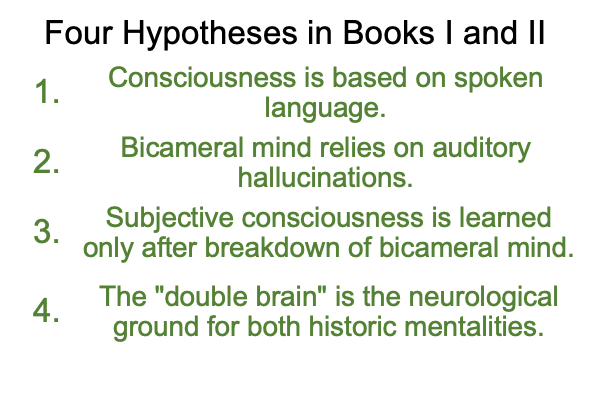
This afterward lists the four hypotheses in Books I and II. Plus, the postscript expands on Part III, by discussing the psychological transition from the bicameral mind to subjective consciousness at the end of the Bronze Age in the Near East.
0238 Here is the list.
0239 So, why does Mithen’s book remind me of Jaynes’s work?
My review of The Language Puzzle led me to conclude that Mithen’s explicit rejection of a gestural origin of languageprevents him from realizing that his information implicitly supports the very position that um… he rejects.
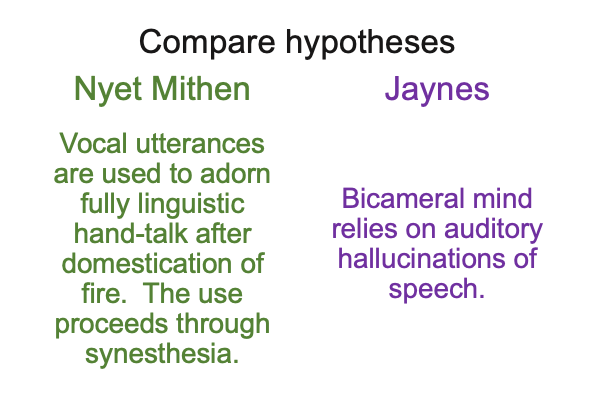
Yes, if I ignore his declaration against a gestural origin to language, then I can start to recognize that speech is added to fully linguistic hand-talk after the domestication of fire, when the community becomes a social circle under pressure from natural selection.
0240 That reminds me of a curious pun that seems to have import in the year 2025AD.
The Russian word for “no” is “nyet”.
To the American ear, “nyet” sounds like “not yet”. And, that means, “Yes, but not now.”
So, when Mithen says, “nyet”, to the gestural origins of language, his English speaking bicameral mind hears, “not yet”. So, Mithen unwittingly drops clues to his nyet hypothesis within his own subjectively conscious argument. These hints offer a weird twist to Looking at Steven Mithen’s Book (2024) The Language Puzzle. It is as if Mithen’s own bicameral mind offers – what I will call – “a nyet hypothesis”.
0241 Now, consider the first two hypothesis (A and B) in Jaynes’s Books I and II.
First (A), subjective consciousness relies on spoken language. Mithen consciously proposes that spoken words are built over millions of years through synaesthesia, cross modal “leakage” of sensations, from visual things and events to auditory vocalizations.
0242 Of course, this proposal comes across as sketchy. Why would early hominins, such as the australopithecines and the early species in the Homo genus (3.5 to 0.6Myr – millions of years ago) do this? And how? The voice is most likely not under voluntary control. Involuntary calls rule the day.
But, the vocal tract changes over time. Most likely, the voice is on the verge of coming under voluntary control by the time that Homo heidelbergensis appears in the fossil record (perhaps, over 600kyr – thousands of years ago).
On top of that, Homo heidelbergensis shows up during the period when hominins domesticate fire (800-400kyr). So, Mithen consciously and cautiously suggests that the synaesthesia business really takes off around that time.
0243 The nyet hypothesis?
Well, of course, proto-linguistic hand talk has plenty of time to evolve without cross-modal leakage during the early period (3.5 to 0.6Myr) and even has a couple of hundred-thousand years to become fully linguistic after hominins start to play with fire (0.8 to 0.6My).
So, synaesthesia would not make a jump from things themselves to vocal utterances, but from manual-brachial word-gestures to vocal utterances.
Suddenly, synaesthesia no longer seems implausible.
0244 Second (B), compare Mithen’s nyet hypothesis with Jaynes’s proposal of the bicameral mind.
To me, the idea that manual-brachial word-gestures provide stimuli allowing synaesthetic crossover from visual to auditory sensations seems like “auditory hallucinations”.
0245 My goal in this first examination is to develop this impression.
0001 The full title of the book before me is The Language Puzzle: Piecing Together The Six-Million-Year Story Of How Words Evolved (2024, Basic Books, New York). Dr. Mithen is a Professor of Early Prehistory at the University of Reading. He has published before. More on that later.
The book works on the metaphor of a jigsaw puzzle. Fourteen chapters present the pieces. The introduction and conclusion stage and arrange them.
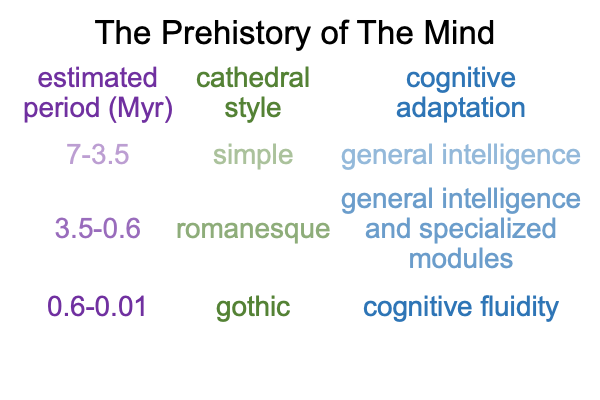
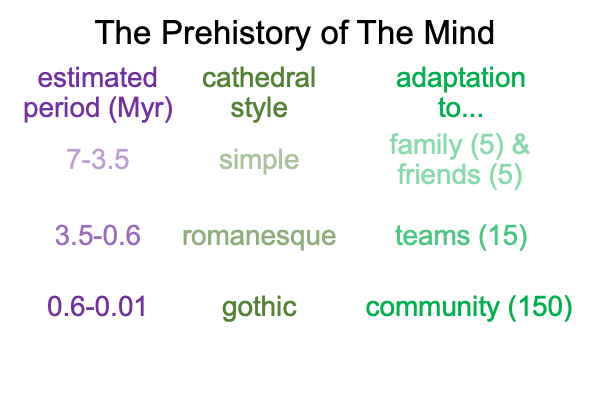
0002 This current metaphor is very different than a glorious historical metaphor used in a book published almost three decades earlier. The Prehistory of The Mind (1996) offers the historical development of the architecture of cathedrals in Europe as a lens for considering cognitive evolution. The metaphor works well because the nave associates to general intelligence and side chapels associate to specialized mental modules.
0003 From the genetic divergence from chimpanzees to the start of bipedalism, the simple nave of general intelligenceadapts to cognitive challenges.
From the appearance of bipedalism to the domestication of fire, specialized modules are added to general intelligence, but the two do not integrate. Indeed, both specialized modules and general intelligence are supported by their own, thick, walls. The metaphor is the Romanesque cathedral.
From the domestication of fire until the first singularity (think, “the potentiation of civilization”), general intelligence integrates with specialized modules, presumably due to talk becoming fully linguistic. Language becomes the walls, supported by flying buttresses of automatic decoding. The metaphor is the Gothic cathedral.
0004 Here is a picture.
0005 The metaphor is so wonderful that Razie Mah publishes the e-book, Comments on Steven Mithen’s Book (1996) The Prehistory of The Mind as one of the readers that accompanies the masterwork, The Human Niche, in the series A Course On The Human Niche (available at smashwords and other e-book venues).
0006 Mithen’s approach is also echoed in the work of another evolutionary anthropologist, Michael Tomasello, working at the Max Planck Institute in Leipzig, Germany, as discussed in Comments on Michael Tomasello’s Arc of Inquiry (1999-2019) (by Razie Mah, also see blogs for January through March, 2024).
0007 Mithen’s approach is also reflected in another review that belongs to the series, A Course On The Human Niche. The title is Comments on Clive Gamble, John Gowlett and Robin Dunbar’s Book (2014) Thinking Big. In this review, social circles turn out to be very important in hominin evolution. Mammalian brain size roughly correlates to group size. So, the larger the hominin brain grows, the larger the group.
Not surprisingly, Mithen’s metaphor indicates the social circle under the most intense selection pressure, irrespective of group size.
0008 What does this imply?
Obviously, group size is not the crucial factor in hominin evolution.
Whatever is increasing hominin brain size is.
0006 To me, it is not surprising that Mithen has not encountered Razie Mah’s review of his 1996 work, even though it is one of the few more-than-surface reflections on The Prehistory of The Mind available.
Perhaps, the same will go for this blog, which will take Mithen’s metaphor of a jigsaw puzzle quite literally.
0229 So, what is The Language Puzzle about, in an implicit sort of way?
It is about how speech gets added to hand talk after the domestication of fire.
The irony of the work is found in Mithen’s explicit denial of the gestural origins of language, while…
… at the same time, the author provides a solution to a question that he cannot even pose.
0230 Examinations don’t get better than this.
This examination adds value to Mithen’s work in a surprising fashion.
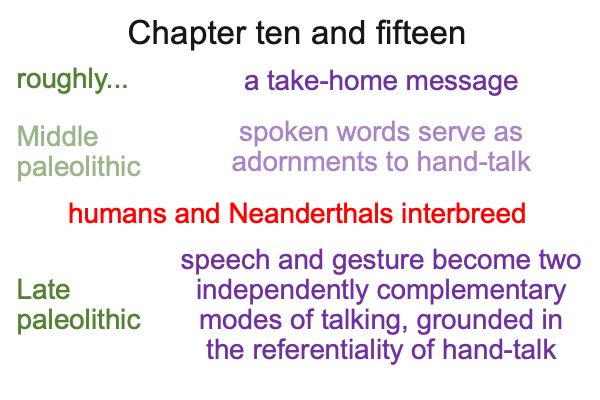
0231 This examination suggests that a tremendous amount of theoretical reformulation needs to be done. In particular, the following juxtaposition of events is suggestive.
0232 I ask, “Does Homo sapien’s encounter, love affair, then divorce from the Neanderthals create a condition where speech becomes more and more independent as a mode of talking? Does speech become capable of operating linguistically, independent of hand talk, yet remain integrated into the natural-sign references of hand-talk?”
0233 Take a look at the artifact of the lion-man, pictured in figure 3 on page 28 of Mithen’s text.
Maybe, we can ask him.
Do you think that he has something to say to us?
Surely, he cannot perform hand-talk.
So, the lion-man must speak for itself.
0233 Yes,it’s like synaesthesia gone wild.
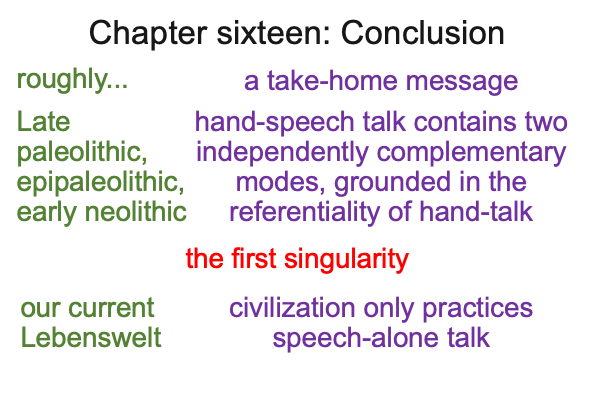
0234 But, “wild” is not even close to this last implication, which tells me that our current Lebenswelt is not the Lebenswelt that we evolved in.
What about the item in red?
See Razie Mah’s e-books, The First Singularity and It’s Fairy Tale Trace (for a technical proposal) and An Archaeology of the Fall (for a dramatic rendering), available at smashwords and other e-book venues.
0235 With that said, I thank Steven Mithen for publishing a book that can be fruitfully read both explicitly and implicitly.
Also, the story does not end here, because this examination plays a prominent role in the next commentary, Looking at Julian Jaynes’s Book (1976) “The Origin of Consciousness in The Breakdown of the Bicameral Mind”.
1053 The text before me is chapter six of Pathways (see point 831 for book details, pages 101 through 136). The author is one of the editors of Pathways.
1054 To me, the abstract introduces evolution writ large.
The abstract suggests that the interventional sign-relation precedes semiotic agency, as far as evolution writ large goes. Evolution writ large includes the evolution of the inanimate universe along with the evolution of life.
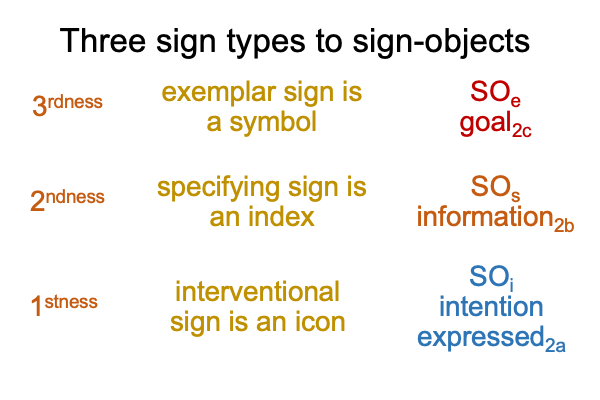
1055 Before life, inanimate objects manifest only as meanings-in-themselves. An evolving macroscopic thing may be labeled an “eventity”, which seems like a real initiating (semiotic) event2a (SVs) or an action that could be goal-directed2c (SVi).
Surely, some eventities rely on lower-level entities. But, what about agency and subagency?
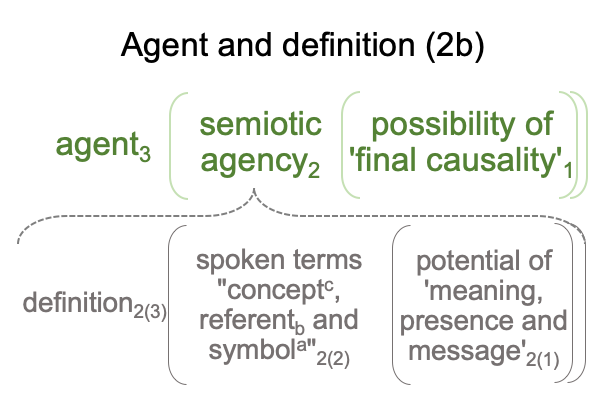
With non-human life, hierarchies of sub-agents3 operate within each living agent3 (or “holobiont”).
With human life, persons3, who are holobionts in terms of anatomy and physiology, operate as subagents within… what?… social circles?
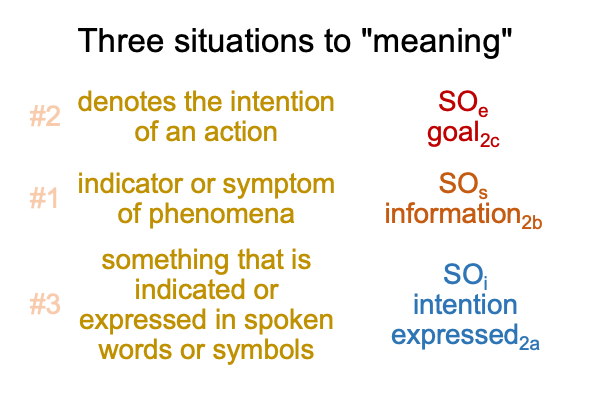
1056 The introduction (section 6.1) starts with an observation. The term, “meaning” is typically used in three situations.
Here is the list along with associated sign-elements.
1057 This coincidence is remarkable. At the very start of the introduction, the author offers situational instances of “meaning” that correlate to the three sign-objects intrinsic to a three-level interscope.
The author then writes that he is interested in the first two types (the ones associated with semiotic agency) but not so much the third type (the one associated with the interventional sign relation), because this one is already well-developed in linguistic semiotics.
1058 But, there is another coincidence to note.
Recall that Peirce’s typology of natural signs is based on the categorical qualities of the sign-object.
The icon is a sign-relation whose sign-object is based on the qualities of firstness, including images, pictures, unities, wholes. The logic of firstness is inclusive and allows contradictions. A sign-vehicle stands for its sign-object on the basis of similarity or imagery.
The index is a sign-relation whose sign object is based on the qualities of secondness, including contact, contiguity, pointing, influence, cause and effect and so on. The logic of secondness includes the law of noncontradiction. A sign-vehicle stands for its sign-object on the basis of indication and pointing.
The symbol is a sign-relation whose sign-object is based on the qualities of thirdness, including normal context, mediation, judgment, habit, tradition and so on. The logics of thirdness are exclusion, complement and alignment. A sign-vehicle stands for its sign-object on the basis of convention.
1059 Since all sign-objects belong to secondness, I can assign Peirce’s typologies on the basis of the category of the level in a three-level interscope. Icon goes with the level of content. Index associates the situation level. Symbolmatches the perspective level.
1060 Here is a list of associations.
1061 I ask, “How well do the two coincidences correspond?
1062 I start with thirdness, an exemplar sign is a symbol whose sign-object, SOe, denotes a goal2c on the perspective level. The sign-object has the qualities of both acquired habit and innate disposition. So, the assignment of symbolworks.
1063 For secondness, a specifying sign is an index whose sign-object, SOs, denotes a symptom2b on the situation level. I suppose that corresponds to information2b. A symptom2b virtually situates its phenomenon2a in the same way that information3b virtually situates an initiating (semiotic) event2a. The sign-object holds the qualities of indication and pointing. So, the assignment of index works.
1064 For firstness, an interventional sign is an icon whose sign object, SOi, denotes something that is indicated or expressed in spoken words or symbols2a on the content level. Does that correspond to intention expressed2a(SOi)? Or, better yet, does that correspond to an image of intention expressed2a (SOi) that is contiguous with a real initiating event2a (SVs) in the dyadic content-level actuality2a?
Is the third situation for “meaning” animage that is indicated or expressed in spoken words and symbols.
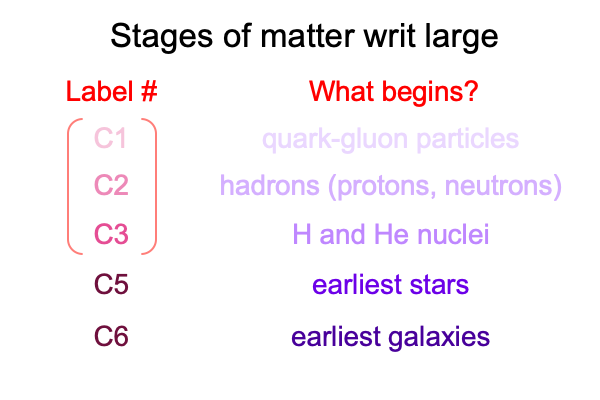
1137 The material that I cover in my portrayal of C1 and C2 using Frege’s triangle goes with section 6.3, titled “Potential Meanings During the Abiotic Period of the Evolution of the Universe”.
Here is a picture.
C4 (is missing because it) covers the genesis of atoms with masses greater than helium. Technically, C4 follows C5, as written above. Why? Atoms with masses greater than helium are produced by nuclear fusion in stars. The story bifurcates from the cosmic sequence to the substance sequence. The substance sequence starts with atoms with masses greater than helium and proceeds through the emergence of life.
1138 The Frege triangles for C1 and C2 are easy compared to what follows in section 6.4 (“Evolution of Meanings in Biological Systems”) and 6.5 (“The Evolution of Meanings in Human Societies and the Relationship between Hierarchies of Substance (that is, biology) and Semantics (that is, within our current Lebenswelt)”).
Nevertheless, my exercises demonstrate the utility of Frege’s triangle in the extension of the biosemiotic interscope into all aspects of postmodern inquiry, including into abiotic noumena, the domains of physics and chemistry.
1139 There are many threads to follow in this demonstration.
The first thread is obvious. Can this be done for all noumena listed in Table 6.2?
The answer is yes. Once one starts a spiral, other spirals follow, and they diverge, and they coalesce, and who knows what else.
1140 The starting point of the author’s cosmos chain (C1) is obviously the Big Bang.
But, one can say that other starting points can be imagined, hence theories of the multiverse. The multiverse consists of many universes, each with different energy, space, natural laws and constants. Physicists can simulate these many “universes”. Hollywood movie makers can fashion plotlines from the conceptc. It is all very theatrical, including the name for the start of our own universe, “the first singularity”.
1141 The starting point of the author’s substantial chain (S1) is atoms, made in stellar furnaces because (up to the atomic configuration of iron) fusing atoms releases a tremendous amount of energy, enough to keep a star from falling in on itself from gravity.
Anyone who has cracked a chemistry textbook knows that there is no “first singularity” to be found in this discipline. One can imagine that each element in the periodic table constitutes its own singularity. Spirals diverge and coalesce in the most fantastic ways, so there is no telling which molecules are the precursors to life and which are not.
1142 This is where Frege’s terms complement Peirce’s.
Frege’s terms serve as spoken labels. Labels are used for symbolic operations. Symbolic operations undergird grammar (that is, language). So, Frege’s terms point to the somewhat disturbing intimation that speech-alone talk (or a theoretical equivalent) is intercalated into semiotic agency and, by way of bridging, to significance that is outside of semiotic agency (that is, the interventional sign-relation).
Here is a picture.
1143 Peirce’s terms also serve as spoken labels. These labels apply to the contiguities between real elements in the actualities of all interscopes. These labels apply to something like [substance], in a contiguity between something like matter and something like form. To a greater or lesser extent, all dyads in Peirce’s secondness pay tribute to Aristotle’s hylomorphe as an exemplar.
1144 The biosemiotic interscope reifies into the biosemiotic noumenal overlay, including both semiotic agency and the interventional sign-relation.
This chapter presents an impossible challenge. Spirals (or hierarchies) go back to the first singularity, thirteen billion years ago. Each spiral brings the inquirer to a new level. Some spirals write small, others write large, but they all begin … for us … with a clot. A pen touches paper, then moves to portray a diagram, a purely relational structure, portraying what all living things have in common.
1145 This examination recites all that has gone before.
This examination is a refutation to those who think that modern science knows enough to weave these spirals into a vision of our universe, as well as of us, the images of the one who speaks the universe into being.
1146 I say, “Diagram spirals!”
Perhaps, the author agrees and anticipates that Frege’s triangles will reveal a hierarchy… or is it?… a spirality that portrays meanings and their evolution.
1147 The text before me is chapter eighteen of Pathways (see point 831 for book details, pages 379-400). The full chapter title is “Anchors of Meaning: The Intertwining of Signs, Abduction and Cognitive Niches”. This chapter opens Part IV of Pathways. The title of Part IV is “Meanings in Humans and Beyond”.
1148 The author belongs to the Philosophy Section of the Department of Humanities at the University of Pavia, Italy. He has a scientific affiliation as well, being a member of the Computational Philosophical Laboratory.
1149 The abstract tells a story that mirrors this examination (so far). Biosemiotics is not only semiotic agency. Biosemiotics encompasses semiotic agency and the interventional sign relation. The two are bridged through the contiguities of [conceptc] and [symbola].
Human brains thrive on semiosis. The brain generates a series of signs (specifying and exemplar) that latch onto an apparently external sign-relation (interventional) with the two contiguities of [conceptc] and [symbola].
1150 Or, should I use the word, “anchors”?
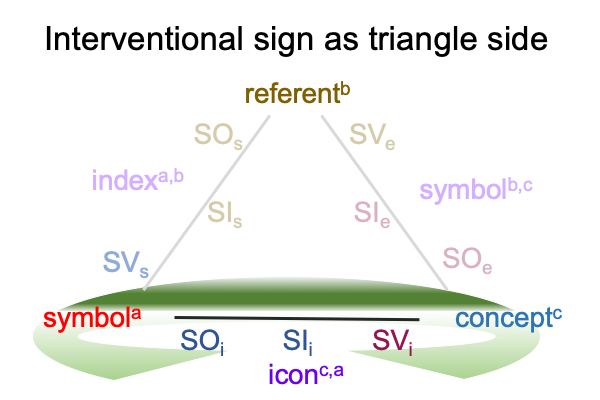
Here is the picture of the [conceptc] and the [symbola] as corners that anchor Frege’s triangle.
[Conceptc] is the contiguity within the perspective-level actuality2c of a goal2c.
A banner wraps around the interventional sign-relation.
[Symbola] is the contiguity within the content-level actuality2a of a real initiating (semiotic) event2a.
1151 In section 18.1 (“Humans as Ecological Engineers and Chance Selectors”), the real initiating (semiotic) event2aencompasses innately anticipated systems of differences. For, example, the infant expects to interact with persons. Each person has his or her own face. It’s like a system of differences (Saussure’s view) or a symbolic order (Peirce’s approach).
The family is one of the smallest social circles of the Lebenswelt that we evolved in. Since roles are re-enacted generation after generation within this social circle, one might think that the each person2a images an appropriate role2c. This happens at first…
…and one sees it when an infant gets separated from its mother.
That tyke is not taking any chances.
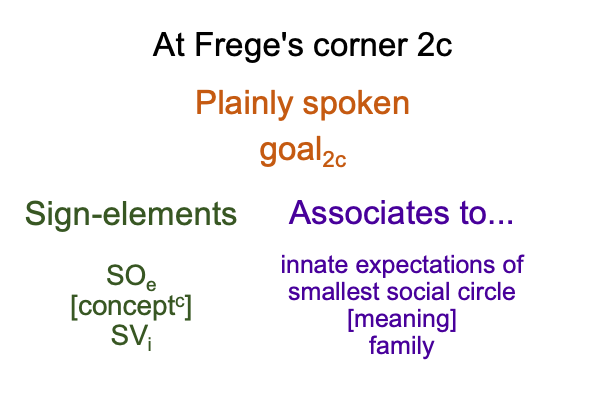
1152 The child is born with innate expectations of the smallest social circle (SOe) [and that means] family (SVi).
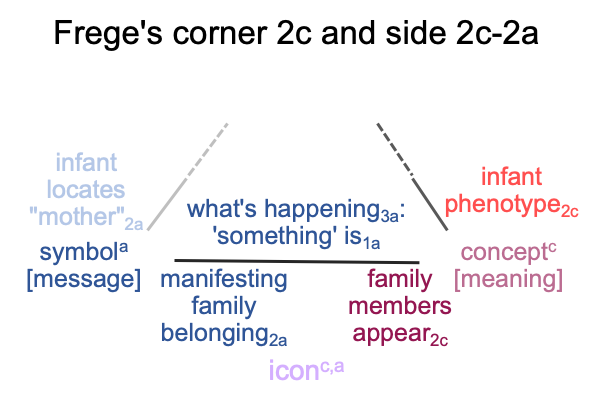
Does this look like Frege’s corner 2c?
1153 If so, then the interventional sign-relation, which stands outside every agent in the family, yet is the reality in which each agent participates, follows.
Family members2c (SVi) stand for their particular social roles2a (SOi) in regards to (a normal context like) what is happening3a operating on (a possibility like) the potential of ‘something’ happening1a (SIi).
1154 Here is a diagram of the interventional sign-relation for a newborn.
1155 Is this cultural-niche construction?
If so, then who or what is constructing this niche? Or does the niche construct itself because it exploits an opportunitythat arises from the independent actuality of sign-relations? Just like a bat exploits acoustics to echo-locate, humans exploit sign-relations to abduct who mommy must be.
Sign-relations are immaterial beings that entangle the material. The materiality of the family members2c (SVi) signify the manifestation of ‘home’2a (the immaterial manifestation of family belonging, SOi) in regards to the normal context of the birth of an infant3a operating on the potential of ‘a successful birth’1a(SIi).