0249 Chapters 11, 12 and 13 are devoted to debunking an agenda, called “the ancient astronaut theory”, proposed by various hucksters starting in the 1950s. This theory is multifaceted, since there is more than one proponent. Basak’s book says that the theory sweeps into public popularity because of the uncertainty following the second battle among the Enlightenment gods, the hot war among fraternal ideologies (1938-1945 AD) and leading into the third battle among the Enlightenment gods, the cold war among materialist ideologies (1945-1989).
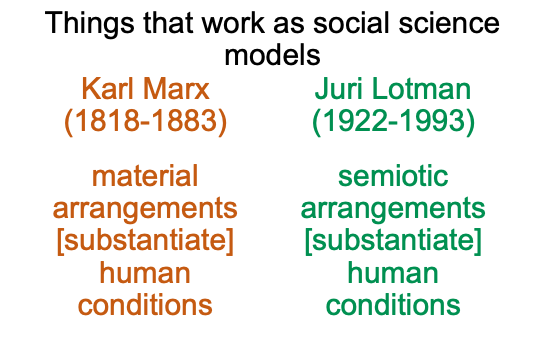
0250 Against this interpretation, which explains this social phenomenon in terms of a model where material arrangements after the Second World War and the start of the Cold War [substantiate] conditions ripe for scam-ideas about ancient civilizations, I place a Lotmanist suggestion that the social popularity of the ancient astronaut theories is accounted for by the inadequacies of Marxist-interpretations of archaeological research into the Neolithic period.
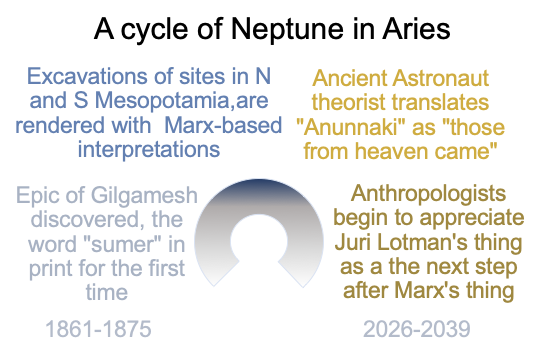
0251 Here is a picture of the framework of the latest cycle of Neptune in Aries.
Highly successful excavations by Western archaeologists offer the promise of coming to terms with the rise of ancient civilizations, based on Marxists formulations.
The Marxist thing does not quite do the job, so alternate theories are proposed by hucksters anticipating an explanatory breakthrough. Basak’s exercise in debunking the very entertaining alternatives only replays the Marxist thing. Basak relies on the Marxist thing to debunk the alternatives that arose from the lack of explanatory power of the model that material arrangements [substantiate] human conditions.
Now, anthropologists are starting to realize that all those people who entertained the now-debunked “ancient astronaut theory” were not as stupid as the Marxist thing presumes.
0251 Once again, Razie Mah’s four part blog, Looking at Melinda A. Zeder’s Article (2025) “Unpacking the Neolithic”, offers insights. The results of anthropological research into the so-called “Neolithic” does not… indeed, cannot… account for another trend hidden within the data. That trend is towards unconstrained social complexity. Basak’s AI program (my speculation, of course) trains only on results and discussions produced by researchers interested in looking for the material arrangements that substantiate neolithic conditions. They cannot account for a change in semiotic practices. They cannot account for what Razie Mah’s hypothesis of the first singularity suggests.
0252 Therefore, why not postulate ancient astronauts?
Surely, ancient monumental constructions, such as pyramids, stone circles, and tracks of figures that can only be seen from the sky indicate ways that civilizing humans communicate with these alien beings.
0253 If this is not a cry for a semiotic accounting for the emergence of unconstrained social complexity, I don’t know what is.
0254 Chapter 14 offers a standard summary of the achievements of ancient Sumeria.
0255 Chapter 15 returns to the topic of the Sumerian creation myths. Once again, the text re-iterates established points. On one hand, the Marxist thing can provide an explanation that cannot be challenged because… well… it is supposedly just like a mathematical or mechanical natural science model. On the other hand, the Marxist thing cannot account for the emergence of unconstrained social complexity in southern Mesopotamia.
Lotman’s thing can.
0256 Here is a picture.
0257 Although this pair of options may appear stunningly simplistic, the ancient astronaut theory shows that stunningly simplistic can work. It can offer an off-ramp to the current academic highway of a publication-based arms race, where young professional archaeologists struggle to pass through the substance called “tenure” only to realize that they have merely passed from antithesis to thesis (see points 0124-0128).
0258 Beck et al.’s manifesto, “Changing the Landscape of Archaeological Publishing” (Current Anthropology 67(1) (2026), https://doi.org/10.1086/739789), is well worth contemplating as a marker for the end of one Neptune in Aries spiral and the beginning of another.
0002 In 2012, the European Science Foundation convened an exploratory workshop, titled, “The Neolithic of Arabia: New Paradigms and Future Perspectives”. The schema is available online.
In the section on the main objectives of the workshop, the organizers (Dr. Remy Crassard and Dr. Phillipp Drechsler) note that the fragmentary characteristics of scientific knowledge to date favors the persistence and acceptance of current theories and precludes the development of new paradigms, along with comprehensive and coherent approaches to the Neolithic.
0003 This “favoring” and “precluding” is intrinsic to a recent essay in the journal, Prehistory, which is examined in Razie Mah’s blogs on January 1, 2026, titled Looking at Melinda Zeder’s Article (2025) “Repackaging the Neolithic”.
0004 While the workshop organizers do not call for a novel global vision, they do call for a synthetic approach that encourages the integration of diverse research on the topic.
0005 This open letter calls for more comprehensive research into the link between the early Holocene infilling of the Arabian Gulf and the emergence of two spheres of interaction for the Ubaid (southern Mesopotamia and the western Gulf littoral). The addendum provides an introduction.
0006 How comprehensive?
0007 Consider the questions raised by Razie Mah in the e-book, The First Singularity and Its Fairy Tale Trace.
0008 First, does the forced migration induced by the early Holocene marine transgression explain the ‘Ubaid phenomenon, where this culture may be considered to be the first to practice speech-alone talk?
0009 Second, does speech-alone talk spread from the Ubaid, along established paths of down-the-line trading, to the rest of Eurasia? Why do all hand-speech talking cultures adopt speech-alone talk after coming into contact with a speech-alone talking culture? Are there archaeological markers indicating that, not only has contact occurred, but the transition is underway. Artifacts that might demand labels, like copper, certain types of pottery (such as the white pottery of the Archaic Hassuna), changing habits of lithic-tool knapping, might serve as markers.
0010 Third, what are the semiotic natures of hand-talk, hand-speech talk and speech-alone talk? Does hand- and hand-speech talk constrain social complexity? Does speech-alone talk potentiate unconstrained social complexity?
0011 These questions can be bundled into one grand question, which, ironically, is what the workshop specifically forbade.
Is our current Lebenswelt the same as the Lebenswelt that we evolved in?
Are we who we evolved to be?
0012 I hope this call is heard by all people of good will. The time has come to set aside the swords and pick up where European Science Foundation’s exploratory workshop left off.
0010 Earnestly yours,
The Desk of Razie Mah
September 2-15, 2026
0011 Addendum: Looking at Richard Cuttler’s Article (2013) “Considering Marine Transgression as a Mechanism for Enforced Migration and the Littoral Gulf ‘Ubaid Phenomenon” in Razie Mah’s blog, September 1, 2026
0001 The citation for this article is: Cuttler, R. (2013). Considering marine transgression as a mechanism for enforced migration and the littoral Gulf ʿUbaid phenomenon. Arabian Archaeology and Epigraphy, 24(1), 37–43.
I obtained my copy from Wiley online. Thank you.
0002 In the early 2010s, Dr. Richard Cuttler smells a very interesting intellectual aroma, but is unable to sense where the trail leads. What is the link between the infilling of the Persian Gulf and the appearance of the Ubaid culture of southern Mesopotamia?
0003 The titular “consider” is one way of saying, “Imagine the possibility.”
If the marine transgression into the Arabian… or is it Persian?.. Gulf enforces a migration of the people who originally settled the fresh water marshes of the Ur Shatt (that’s “Ur Schatt” for Germans) waterway, then does that account for the Ubaid appearing in both Mesopotamia and on the shoreline of central Arabia?
0004 Why would an archaeologist consider such an if-then scenario?
During the glacial period, the Euphrates and Tigris Rivers flowed together into a waterway, the Ur-Shatt, that fed a corridor of lakes and marshes (now underwater “basins”) into the sea. Such a concourse would be a favorable place for Epipaleolithic enthnoses to settle, taking advantage of diverse natural resources.
0005 Little did they realize that the Ur-Shatt waterway, a veritable oasis during the glacial period, would slowly be covered with around 70 meters of sea-water. By “slowly”, I mean thousands of years. At the same time, the rise in sea-level has a horizontal dimension. After filling the basins, sea-water spreads into a shallow geological bowl.
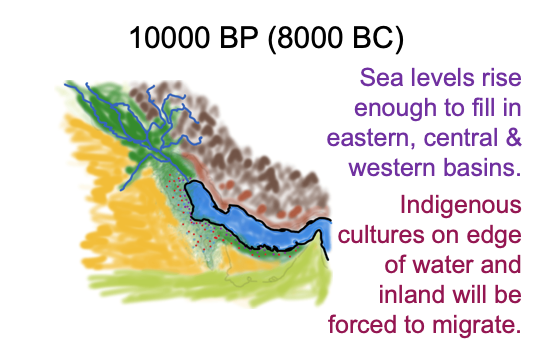
0006 Here is a picture of the scenario once the low-lying basins are full.
The indigenous settlements are represented by red and purple dots.
The sea-rise will force these people to migrate.
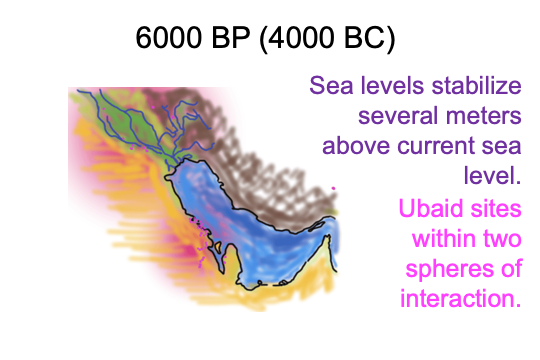
0007 Here is a picture once the Gulf is filled to the brim (as far as the sea-rise would go, which is several meters above the present sea-level).
The Ubaid settlements are represented by magenta dots. Plus, the background color has taken on a magenta hue, denoting two spheres of interaction, the central Arabian Gulf and southern Mesopotamia. This is my rendition of Figure 1 of the article.
0008 How does anyone know that there are two spheres of Ubaid settlements?
Originally, the term, “Ubaid”, labels a type of pottery found in excavations throughout southern Mesopotamia. Why did archaeologists not also look at the central Arabian Gulf region?
The author is perhaps too embarrassed to say that late-nineteenth and early-twentieth century archaeologists focused on this region because… well… that is where the Garden of Eden is supposed to be. That is where Noah’s flood took place. That is where Judah was taken into exile in ancient times. So, of course, Protestant Christians are going to pay for exorbitant excavations in order to reveal… you know… something about justification by faith alone, scripture alone, and grace alone.
0009 Okay, I am just guessing on that one.
0010 Then, in 1968, G. Burkholder discovers Ubaid pottery in the western Gulf littoral.
0011 What a surprise.
The Ubaid is the lowest level excavated in southern Mesopotamia, which means that it has the deepest time horizon. Now, the Ubaid shows up near Bahrain. Doesn’t that smell like a great research project? To an archaeologist, it sure smells good… but, how does one follow the scent when the trail goes under the waters of the Gulf?
Professor Richard Cuttler, who I am sure has some good stories to tell, seeks funding for seismic reflection maps of the Gulf’s underwater landscape, in order to obtain better placed sediment cores of the sea-floor. He wants to investigate, but he does not know that there is another component to the puzzle. Also, big funding is hard to come by.
0012 If the project is funded, what will he find?
Among other points, the sediment cores would provide pollen-based clues to the changing climate of the time.
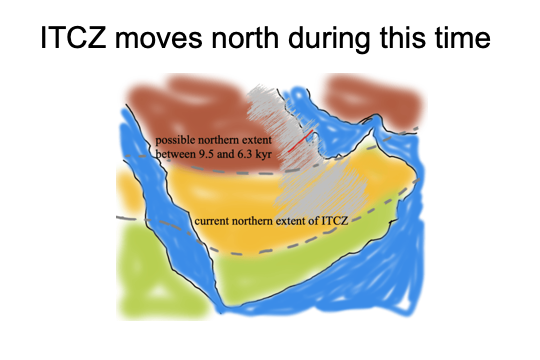
0013 At the start of the current interglacial, the Inter-Tropical Conversion Zone (ITCZ) shifts north, then back, then north again, in a most fickle manner. For the time under consideration, the ITCZ moves north, but not as far north as the gulf-to-be.
Here is a picture.
0014 The two dotted gray lines indicate the furthest extend of the ITCZ currently, and between 9.5 and 6.3 thousands of years ago (kyr). South of the line, the monsoons deliver plenty of rain water. North of the line, the westerlies lose all their water before arriving in Arabia.
0015 Curiously, all the Ubaid sites develop north of the early Holocene ITCZ line, suggesting that water was not a crucial issue. That makes no sense. Southern Mesopotamia obviously has lots of fresh water because of the Euphrates and Tigris and other rivers. What provides water to the pre-Ubaid sites in the central western Gulf?
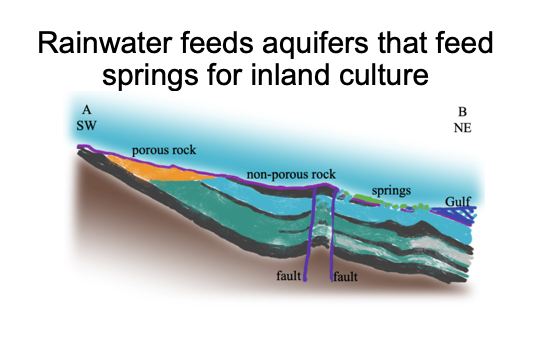
0016 Take a look again at the above figure. The gray brushstrokes and the red line denote a massive aquifer that is tilted. It is high in the west and low in the east. The Dammam label is a concatenation of the saying, “That’s a damn aquifer, ma’am.” Am I kidding? This aquifer relies on a huge tilted fault-riddled plate of non-porous rock supporting porous layers that allow rain water, falling south of the northernmost ITCZ line, to flow underground and come to surface in springs that stand outside the low-lying basins.
0017 Here is my version of the article’s Figure 2.
Note how water flows downhill in the Dammam aquifer then comes up in springs further inland from the sea-water filled basins.
0018 Why is this so important for this examination?
This examiner wants to show that… in the land surrounding the freshwater marshes and salt-water depths of the basins at 10,000 BP… there are two cultures: a Mesolithic culture that lives right along the water and uses fresh and salt water resources and a Neolithic culture that exploits the water from Dammum-fed springs to engage in rudimentary agriculture and stockbreeding.
0019 The question is, “Why would I want to establish two disparate cultures in the same region?”
Wouldn’t that just complicate the story of an enforced migration?
0020 Here, I review.
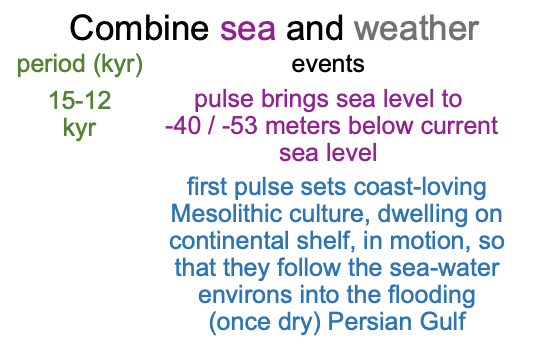
0021 First, the sea level starts to rise, if there is not a paleolithic culture already on the fresh-lakes of the Ur-Shatt waterway, then a Mesolithic culture displaced from living on the continental shelf could enter into the environs. Such a culture would simply follow the water into the eastern, central and western basins, since they already know how to exploit fresh-water and marine resources.
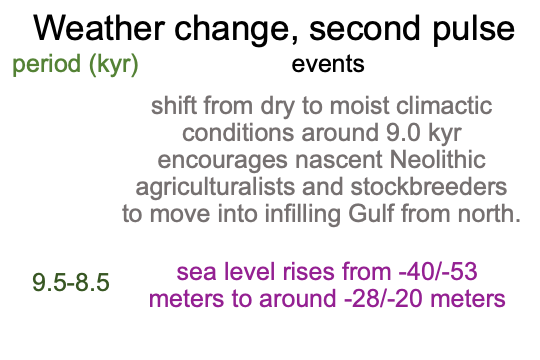
0022 Second, there is a shift from dry to wet climactic conditions, as the intertropical convergence zone (ITCZ) shifts north. Does it shift north enough to provide water directly to lands around the infilling Gulf? The author establishes that even if it does not, the ITCZ shifts north enough to feed the Dammum aquifer which would provide fresh water to a Neolithic agricultural and stockbreeding culture that migrates in from the north and settles in the dry-lands just beyond the marshes.
0023 Then the sea-level rises more, overfilling the basins and entering into the flat-bowl terrain of the surrounding landscape. Now, both the Mesolithic and Neolithic culture are forced to migrate in response to the rising seas.
0024 Here is where I introduce an idea that Dr. Cuttler did not think of and may have never heard about until this moment.
The economies of the Mesolithic and the Neolithic culture are different. They do not depend on the same resources. Practical reason predicts that these cultures should mingle with one another and eventually become one.
However, each culture practices its own hand-speech talking language. That means that they have a serious impediment to talking with one another. Both practice a dual-mode style of language. How are they going to get around that?
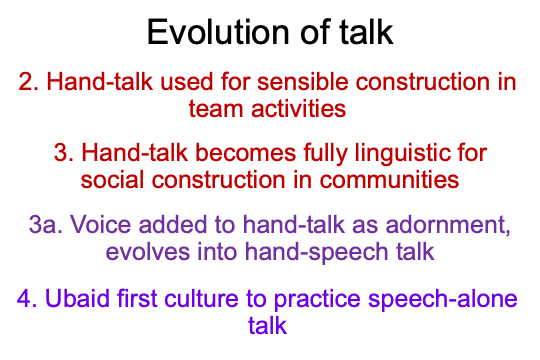
0025 Let me step back and say that the evolution of talk is not the same as the evolution of language. Almost every book available on human evolution discusses the evolution of language as a facet of hominin communication. Only Razie Mah’s books discuss the evolution of talk as a semiotic adaptation.
0026 Here is a brief overview.
0027 The first period ranges from the separation of the chimpanzee and human lineages (around 7 Myr) to the start of bipedalism (around 3.5 Myr). The hominin lineage communicates in two small and one larger social circles. The small social circles are family (5) and friends (5). The larger social circle is the band (50).
0028 The second period ranges from the start of bipedalism to the domestication of fire (around 0.6 Myr). Michael Tomasello says that this period is dominated by “obligatory collaborative foraging”. That means that the social circle under the most intense selection pressure is the team (15). Hominins forage in teams. Pre-linguistic hand-talk is an adaptation to team work. Pre-linguistic hand-talk relies on sensible construction. Sensible construction relies on content and situation.
0029 The third period ranges from the domestication of fire to the first singularity (around 9kyr). The social circle under the most intense selection pressure is the community (150), the team of teams. This period is dominated by, what Razie Mah calls, “obligatory social-circle harmonizing”. Hand-talk becomes fully linguistic as an adaptation to the semiotic dynamics of social construction. Social construction involves content, situation and perspective.
0030 Prior to the evolution of Homo sapiens, the voice comes under voluntary neural control for singing. Why sing? There are two social circles larger than the community, the seasonally gathering mega-band (500) and the occasionally gathering tribe (1500). Their episodic gatherings require rapid synchronization. The voice was recruited to do precisely this. Singing identifies each participant within these larger social circles as belonging to the group. Plus, singing synchronizes all participants to the tasks at hand.
Sexual selection does the rest.
0031 With the evolution of Homo sapiens, the voice is systematically adapted for use as an adornment to hand-talk. In liminal lighting, communal hand-talk is difficult to instantly recognize. The voice is added as an adornment. Sound-word adorns gestural-word. The semiotics of the union remains grounded in hand-talk. However, the semiotic qualities of the sound-word (speech) are unique. So, cultural evolution produces two independent channels of talk, hand and speech talk, that are highly socially regulated.
In short, the transition from the voice as an adornment to hand-talk to fully elaborated hand-speech talk occurs over hundreds of thousands of years during the Paleolithic. My guess is that archaeological evidence of adornment parallels the development of this cultural adaptation.
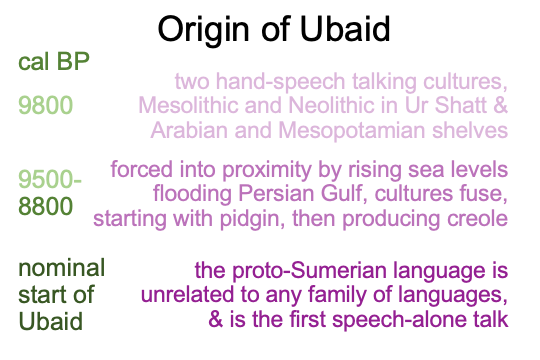
0032 The fourth period begins when two hand-speech talking cultures, one Mesolithic and one Neolithic, are forced into the same migration. These cultures have different economies, so they do not fight over resources. Rather, they trade and get along. They intermarry. They engage in interactions familiar to anthropology. They start with a pidgin. Then, later generations establish a creole. That creole is the proto-Sumerian language. Sumerian is unrelated to any large family of languages.
0033 Plus, that creole is the first speech-alone talk on Earth.
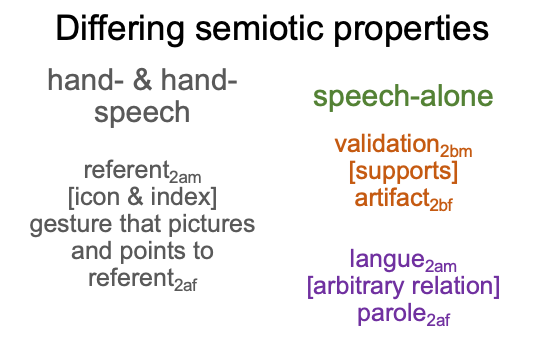
The semiotic properties of hand- (and hand-speech) talk and speech-alone talk are significantly different. The following figure presents dyads (characteristic of the Charles Peirce’s category of secondness) that may be read as Aristotle’s dyad of {matter [substance] form}.
0034 Hand- (and hand-speech) talk requires only one hylomorphe. A referent as matter substantiates, by way of icon and index, a manual-brachial word-gesture as form. The fact that word-gestures become routinized, and thereby instantly recognized, does not detract from this semiotic grounding. The referent precedes the hand-talk word.
0035 Speech-alone talk requires two hylomorphes, one on the content and one on the situation level. In terms of content, Ferdinand de Saussure (1859-1913) defined spoken language as “two arbitrarily related” systems of differences. What I think is arbitrarily related to what I say. So, where does the referent come in?
The referent comes on the situation-level, because each content-level word-utterance2af must be validated2bm(as situation-level matter) by the form of an artifact2bf. The spoken word precedes its referent.
0036 While this explanation sounds like gibberish to any newcomer to the field of semiotics, including many anthropologists and archaeologists in 2026, there is clearly method to the madness.
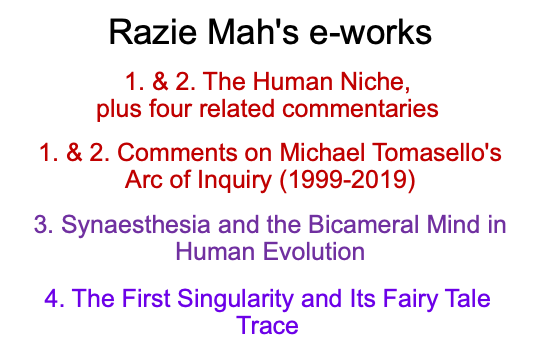
0037 Here is a list of Razie Mah’s e-works that are pertinent to this topic.
0038 The bottom line?
Hand- and hand-speech talk constrain social complexity.
Speech-alone talk facilitates unconstrained social complexity.
0039 This is precisely the theory that Dr. Cuttler needs in order to bring his research proposals to the next level.
0040 The origin of the Ubaid is the first step in a huge research project that is intrinsic to The First Singularity and Its Fairy Tale Trace.
0041 Cuttler’s analysis concerns the material arrangements that set in motion a dramatic shift in semiotic reality.
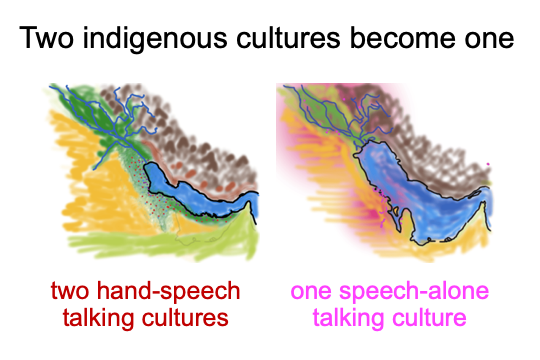
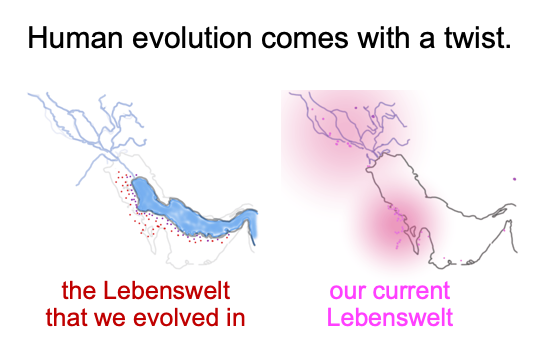
0042 Our current Lebenswelt is not the same as the Lebenswelt that we evolved in.
The image on the left represents two hand-speech talking cultures that belong to the Lebenswelt that we evolved in.
The image on the right represents one speech-alone talking culture that initiates our current Lebenswelt.
0043 I suspect that the Ubaid narod knows that they are different. They are surrounded by ethnoses that are poor and disorganized, in comparison to the wealth and the power that comes from (even a little) labor and social specialization.
The Ubaid does not know why it is special, it only knows that the surrounding hand-speech talking cultures talk with their hands. The hand-speech talking culture cannot help but notice the inverse. The Ubaid emissaries do not talk with their hands. However, they have the best dried fish. Plus, they want to give us their pottery, but it seems that they expect something in return.
Soon enough, the Ubaid strains at maintaining communality, or whatever it was that they had before their creation. Meanwhile, their way of talking encourages them to create artifacts that validate their spoken words, condemning them to further social complexity.
0044 It is hard to imagine what it was like, when every youth is ready to move past the tired artifacts that validate their grand-parent’s words.
Or, maybe it is not hard to imagine.
0045 Nor is it hard to imagine Abdullah Hassan Masry’s 1974 “sphere of interaction” hypothesis. Each Ubaid site belongs to a sphere of interaction, where it takes on its own “specialties”, its own gods, and its own ways of accommodating its labor and social specializations.
Doesn’t that sound like the contemporary term, “multipolar world”?
0046 Here is a picture.
0047 What is the second research project demanded by the hypothesis of the first singularity?
From the spheres pictured above, speech-alone talk spreads to the four corners of the world.
Imagine the research project needed to establish whether that claim is plausible!
0048 Dr. Richard Cuttler, the door is open. Follow your nose. Thank you for publishing your considerations.
Here is another online course on the same subject matter. All parts appear in Razie Mah’s blogs. Click on the month, then scroll downwards.
0012 These are sample courses. So, one may pick and choose points and reviews as one pleases.
Plus, there are lots of pictures. Pictures can be interesting and informative.
How so?
For the most part, the pictures are diagrams of purely relational structures.
0013 What am I selling?
Three online courses that cover the topic of human evolution. All are offered by Razie Mah. All are available at smashwords and other e-book venues. Merely purchase the e-books, print the pdf or read on a tablet. Each point can be discussed. The texts are designed to read and discuss.
A Course on the Human Niche contains the masterwork, plus four commentaries. This course introduces the Lebenswelt that we evolved in.
A Course on An Archaeology of the Fall, contains the masterwork, plus outside reading (Paul’s letter to the Romans and Sura 5). An instructor’s guide is available. This course pertains to the hypothesis of the first singularity.
A Course in How To Define the Word “Religion” contains the masterwork, plus 10 primers. This course concerns our current Lebenswelt, which is not the same as the Lebenswelt that we evolved in. A “how-to” instruction appears in Razie Mah’s blog in December 2022.
0014 With that said, here is the second online course on this topic.
One: Looking at William Lane Craig’s Book (2021) “In Quest of the Historical Adam”
(September 31-1, 2022, 21 blogs, 120 points)
Two: Looking at John Walton’s Book (2015) “The Lost World of Adam and Eve”
(August 30-1, 2022, 22 blogs, 192 points)
Three: Looking at Andrew Kulokovsky’s Overview (2005) “The Bible and Hermeneutics”
(May 27-16, 2022, 10 blogs, 85 points)
Four: Looking at Carol Hill’s Article (2021) “Original Sin with Respect to Science”
(February 25-7, 2022, 15 blogs, 72 points)
Five: Looking at Roy Clouser’s Article (2021) “… Support of Carol Hill’s Reading…”
(March 8-1, 2022, 6 blogs, 34 points)
Six: Looking at Mark S. Smith’s Book (2019) “The Genesis of Good and Evil”
(January 31-13, 2022, 16 blogs, 100 points)
0015 Total: 90 blogs, 603 points, 10 hours at 1 minute per point.
Maybe, this online course lasts around 2 weeks.
Enjoy this sample and consider purchasing Razie Mah’s online courses.
0001 Loren Haarsma is an old man, a physics professor and a Christian. As a fellow of the American Science Affiliation, he has lectured on the intersection of science and faith. He is a scholarly voice in the Biologos network.
The full title of his book is When Did Sin Begin: Human Evolution and The Doctrine of Original Sin (2021, Baker Academic, Grand Rapids, MI).
If one goes to the resources page for the Biologos.org website, then selects the topic, “Bible”, and the subtopic, “Adam and Eve”, one will find an extensive collection of essays on the concerns in Haarsma’s title: timing, evolution and original sin.
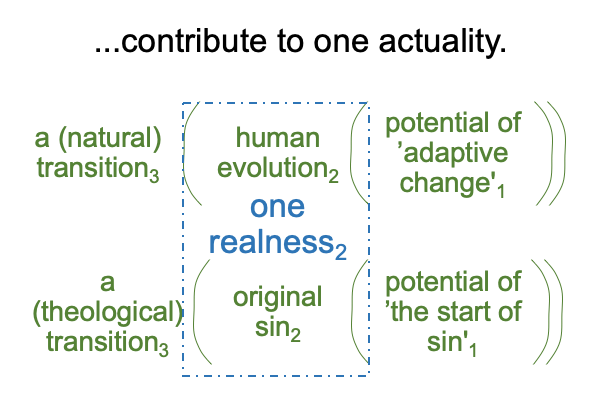
0002 How do these concerns fit into a category-based nested form?
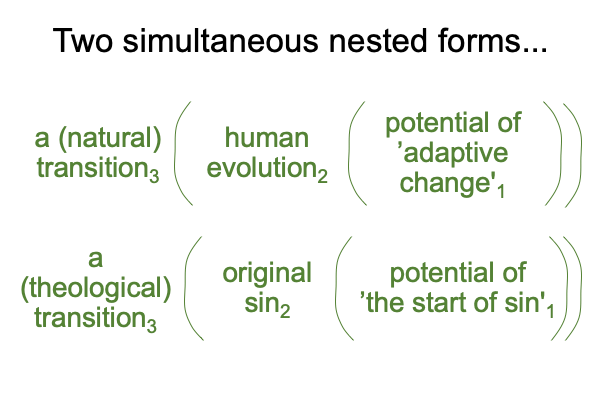
Timing calls forth a normal context3. The question, “when?”, implies an event. Here, the event is a transition. For evolution, the transition is a topic of natural inquiry. For original sin, the transition is a topic for theologians.
Human evolution and original sin belong to the realm of actuality2.
The only item not mentioned is potential1. Here, the question mark applies. For human evolution2, the potential must be adaptive change1. For original sin2, the potential is the start of sin in our current Lebenswelt1.
0003 To me, these concerns yield two category-based nested forms.
Here is a picture, following the recipe in A Primer on the Category-Based Nested Form.
Figure 01
0004 These two normal contexts exclude one another.
0005 The upper normal context3 associates to evolutionary science. The focus of attention is on natural history and genetics.
Typically, an adaptive change produces speciation. However, in human evolution, an adaptive change may be cultural. Human evolution is both biological and cultural. Since natural history and genetics do not adequately describe culture, they may not be enough to scientifically describe human evolution. Indeed, no natural science convincingly addresses cultural change.
0006 The lower normal context3 associates to theological science. The focus of attention is on special and general revelation.
Special revelation includes Genesis 1-11. Genesis 1-11 divides into two parts. In the Primeval History (chapter 2:4-11), Adam is brought to life as the first human, even though um… in the Creation Story (chapter 1-2.3), humans are already intended, created and blessed, in the framework of six days of creation.
General revelation includes Greek philosophy, among other traditions. Greek philosophy is useful for resolving contradictions. For example, some theologians resolve the contradiction inherent in the two parts of Genesis 1-11 by claiming that Adam (in Genesis 2.4-4) is the male and female “them” that God intended, created and blessed (in Genesis 1).
Say what?
In the Creation Story, God creates them, male and female. So, Adam must have had some sort of divided consciousness, one operating in his mind and the other working in his ribs.
Just kidding.
0007 Greek philosophy’s usefulness is not limited to resolving contradictions, no matter how silly the resolution may be. Greek philosophy may also be used in situations where contradictions cannot be resolved. Such a situation occurs here. Human evolution2 and original sin2 belong to a single actuality. They both pertain to one realness2.
Here is a picture.
Figure 02
0008 Two (apparently independent) category-based nested forms intersect in the realm of actuality2. The two constituting actualities cannot escape the one realness, because they constitute the one realness. Certain contradictions are accidental. Certain contradictions are essential. Greek philosophy is useful for separating the accidental from the essential. A set of essential contradictions is called “a mystery”.
0001 William Lane Craig publishes a work of erudition, titled, In Quest of the Historical Adam: A Biblical and Scientific Exploration (Wm. B. Eerdman’s Publishing, Grand Rapids, MI, ISBN 978-0-8028-79911-0). The bibliography contains over 250 references.
Part One discusses what is at stake.
Part Two covers the Biblical “data” concerning Adam and runs 210 pages.
Part Three covers scientific evidence about the start of humanity (broadly defined) and runs 117 pages.
0002 Overall, the first two-thirds of the book discusses the importance of the historical Adam and explores what types of stories are contained in Genesis 2.4-11. Then, the final one-third addresses the question, “If humanity descends from a single couple, then where would we locate that couple in the scientific story of human evolution?”
0003 Clearly, this professor would have been assisted by glancing at the masterworks in the Razie Mah series, The Human Niche, An Archaeology of the Fall and How To Define the Word “Religion”, available at smashwords and other electronic book venues.
0004 Why?
Every sentence in this book is well composed and carefully reasoned. But, Craig’s quest ends at a location that is anything but. He writes (more or less), “Adam may be plausibly identified as a member of Homo heidelbergensis, living 750,000 years ago.”
The quest ends where the book should have started.
Then, the title could have been, “What if Adam and Eve are really the first humans?”
What if, indeed.
0006 Craig’s argument presumes, all along, that Adam and Eve are the first humans.
In this examination, I do not neglect the opposing question, “What if they are not?”
0112 This is the last blog concerning this particular book. I post this blog first, because WordPress places the latest blog closest to the top for each month. Chronologically, the first blog in a series appears last on the month’s list and the last blog eventually appears first. There is a certain logic to this, which I appreciate and adjust my posts accordingly. My goal is to limit my examinations to one-month duration.
0113 I summarize.
0114 First, Part Three of Craig’s book associates to Genesis 1:26, the intention of man. The time frame corresponds to the period after the domestication of fire and before the speciation of anatomically modern humans. Our religious sensibilities evolve during this period, as discussed in the e-masterwork, The Human Niche.
0115 Second, Part Two of Craig’s book attempts to define Genesis 2:4-11 as mytho-history. The attempt turns Craig’s definition into an inquiry concerning the first singularity. The first singularity associates to the start of the Ubaid culture of southern Mesopotamia. The hypothesis of the first singularity explains why our current Lebenswelt is not the same as the Lebenswelt that we evolved in. The consequences of the first singularity are captured by the stories of Adam and Eve. This is a theme in the e-masterwork, An Archaeology of the Fall, by Razie Mah, available at smashwords and other e-book venues.
0116 Third, Part One of Craig’s book sets a path to a category-based nested form, defining3 the stories of Adam and Eve2as emerging from (and situating) Jewish covenantal history (meaning1), the ancient Near East and Genesis 1-11 (presence1), and the notion that Adam originates humanity’s tragic flaw (message1). The categorical structure of definition is introduced in the e-masterwork, How to Define the Word “Religion”.
0117 Fourth, Part One presents ten family resemblances characterizing the term, “myth”. These family resemblances associate to all the elements in a three-tier interscope. The interscope is a relational structure, presented in the e-work, A Primer on Sensible and Social Construction.
0118 Fifth, Part Two fills in the interscope of myth with the ten family resemblances, leading to an understanding that Genesis 2:4-11 and the origin stories of the ancient Near East pertain to the same prehistoric events and processes, occurring during the Ubaid, the Uruk and the Sumerian Dynastic archaeological periods.
0119 Sixth, Part Three fails to capitalize on the fact that both the Genesis Primeval History and the origin stories of the ancient Near East portray a recent creation of humanity. This failure follows a lacuna in the modern discipline of Anthropology, which does not envision that our current Lebenswelt is not the Lebenswelt that we evolved in.
Why does modern Anthropology not register the first singularity?
Modern Anthropology self-identifies as science. Modern Anthropology belongs to the waning Age of Ideas.
The hypothesis of the first singularity belongs to the dawning Age of Triadic Relations. Peirce’s philosophy opens a new, semiotic consciousness. That consciousness calls for a postmodern Anthropology radically different from what modern intellectuals call “postmodern”.
0120 My thanks to William Lane Craig, for demonstrating the beauty of good English prose, even while missing the mark in his quest for the historical Adam.
0001 In this series of blogs, I examine John H. Walton’s book, The Lost World of Adam and Eve: Genesis 2-3 and the Human Origins Debate, published in 2015 by Intervarsity Press. John Walton is a Professor of the Old Testament and has published other commentaries.
0002 I examine this book from the point of views of (A) natural philosophy and (B) the hypothesis of the first singularity.
0003 From the first point of view (A), what Walton calls, “archetypal”, may also be construed as “noumenal”, as opposed to “phenomenal”. According to Comments on Jacques Maritain’s Book (1935) Natural Philosophy, modern science construes each thing as a noumenon and its phenomena. A noumenon is the thing itself. Phenomena are its observable and measurable facets. Science models phenomena. Science cannot address the noumenon, the thing itself.
0004 So, how we recognize noumena, things themselves?
Noumena are the subject of philosophical inquiry. Aristotle’s hylomorphe is the first step in philosophical inquiry. We perceive the thing itself, directly, as a dyadic relation containing two contiguous real elements. Aristotle calls the two real elements, matter and form.
What about the contiguity?
The contiguity will be placed in brackets.
I will use another one of Aristotle’s terms for the contiguity. The term has been the subject of a lot of wooly thinking. So, the choice is rich, in more ways than one.
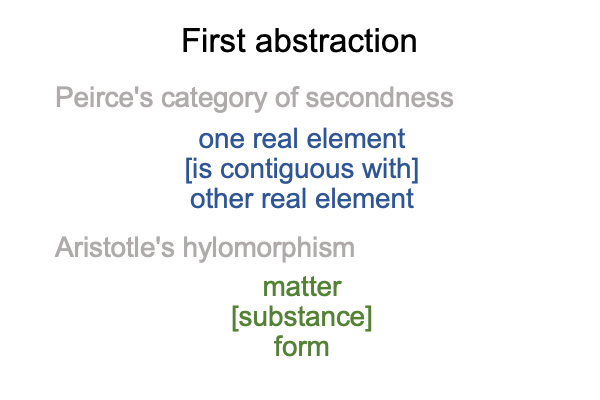
0005 According to Charles Peirce, the category of secondness, the realm of actuality, consists in two contiguous real elements.
According to Aristotle, the hylomorphe is (basically) matter [substantiates] form. The verb, “substantiates”, is the same as the noun, “substance”.
Here is a picture.
Figure 01
0006 Human recognition of hylomorphes is immediate and intuitively natural.
Why?
We evolved to recognize noumena, things themselves.
This is how the ancient world thinks. Greek philosophers ask, “Why are there things instead of nothing?” The answer ends up with Aristotle’s proposal. The hylomorphe is the portal to natural philosophy. Natural philosophy considers things in themselves.
0007 Today, science-lovers fixate on phenomena, such as the observable and measurable aspects of a thing, called “original sin”. Then, they they build models for how Adam could be the direct cause of this thing.
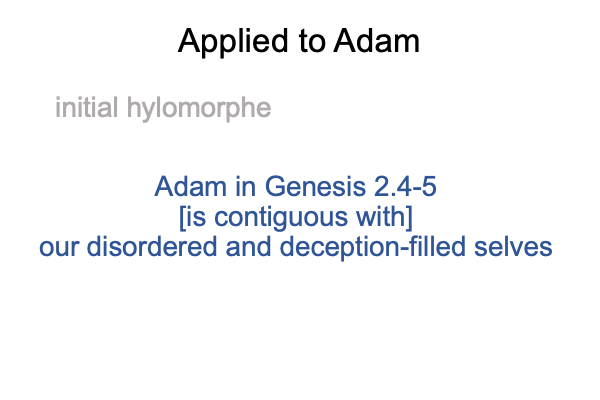
In contrast, Walton argues that the civilizations of the ancient Near East look at this issue from the noumenal side. Adam is contiguous with what is wrong with the world. Paul wrestles with this hylomorphe in his famous letters to the Corinthians and the Romans.
Figure 02
0008 From the second point of view (B), Walton’s propositions appear more and more like a noumenon whose phenomena yield a novel scientific hypothesis. This novel hypothesis is formally proposed in the masterwork, An Archaeology of the Fall, available at smashwords and other e-book venues.
In 2015, John Walton and his collaborator, N.T. Wright, are not aware of this novelty. The hypothesis of the first singularity changes everything.
0009 In the conclusion, Walton states that his book demonstrates that Genesis 1 is concerned with God’s ordering of a grand sacred space with the goal of coming into relation with us. Genesis 2.4 starts with God planting humans within a sacred space, within the grand sacred space, only to find that we bite. We bite into the fruit of the tree of the knowledge of good and evil. Isn’t that smart?
0010 We deceive ourselves.
We introduce chaos into God’s order.
Oh, I meant to say, it is Adam’s fault.
0011 Weirdly, this sounds a lot like all the other origin stories of the ancient Near East, especially the ones recovered by archaeologists from royal libraries that burnt to the ground thousands of years ago. Cuneiform clay tablets fire into brick. The bricks retain their integrity even when buried by detritus. Then, they are excavated by modern archaeologists. Then, archaeologists miraculously find a way to read the script.
0012 Walton has the advantage of these archaeological discoveries. Walton has the advantage of new scholarship on Paul and the Jewish civilization during the Second Temple Period. Yet, he writes in the twilight of the Age of Ideas.
0013 This examination brings his propositions into the dawning Age of Triadic Relations.
Walton sets forth 21 propositions.To these, I attend.
Humans can be viewed as a distinct creation and a special creation of Ged, even if there is continuity, as far as genetics and natural history are concerned.
0188 However, there is a twist in human evolution.
The twist does not alter our genetic make-up.
The twist does not involve any phenotypic alteration.
The twist involves an immaterial change in cultural evolution.
The semiotics of speech-alone and hand-speech talk are radically different.
0189 Our current Lebenswelt is not the same as the Lebenswelt that we evolved in.
0190 John Walton writes, in 2015, without knowing about Razie Mah’s three masterworks. All are available as smashwords and other e-book venues.
The Human Niche covers the Lebenswelt that we evolved in.
An Archaeology of the Fall dramatically renders the first singularity.
How to Define The Word “Religion” confronts the nature of our current Lebenswelt.
0191 Every proposition in The Lost World of Adam and Eve is touched upon by these three scientific works.
Walton’s excellent book is published in the twilight of the Age of Ideas.
All the material that he covers asks to be re-articulated, in order to move into the dawning Age of Triadic Relations.
0192 My thanks to John Walton (and collaborator, N.T. Wright) for their engaging effort. The science has changed. It is time to put pen to paper, again.
0001 The overview under consideration appears in 2005 in the Journal of Creation (volume 19(3), pages 14-20).
The article is attractive because it considers affirmations and denials that appear in The Chicago Statement on Biblical Inerrancy, published in 1978 in J. Evangelical Theological Society (volume 21(4), pages 289-296).
0002 The author of the article, Andrew S. Kulikovsky, earned a Bachelors of Applied Science (in Computer and Information Science) from the University of South Australia, then a Masters of Arts in Biblical Studies and Theology from Louisiana Baptist University. His Master’s thesis was on biblical theology of creation. At the time that his overview was published, he worked for his law degree at Deakin University, Melbourne Australia.
Single quotes and italics are used to group words together.
0003 Kulikovsky starts his brief overview, titled “The Bible and hermeneutics”, with the doctrine of biblical inerrancy.
0004 But, before entering that first section, I must wonder, “What is ‘hermeneutics’?”
In dictionaries, the term signifies the formal process by which an interpreter derives the author’s intended meaning.
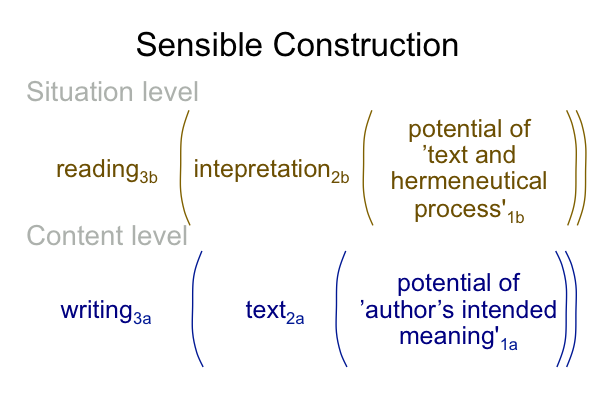
0005 In terms of the category-based nested form, there are two actualities in hermeneutics. One actuality virtually situates the other.
The text itself2a emerges from (and situates) the potential of the author’s intended meaning1a in the normal context of writing3a. An interpretation2b virtually situates that text.
An interpretation2b emerges from and situates the potential of the text and a hermeneutical process1b in the normal context of proper reading3b.
0006 The following relational structure is called a two-level interscope. Two-level interscopes are typical for sensible construction, according to A Primer on Sensible and Social Construction.
Figure 01
0007 The text2a in question is the Bible, particularly Genesis 1-2.3, the Creation Story, and Genesis 2.4-11, the Primeval History.
0008 I now move to the section on biblical inerrancy.
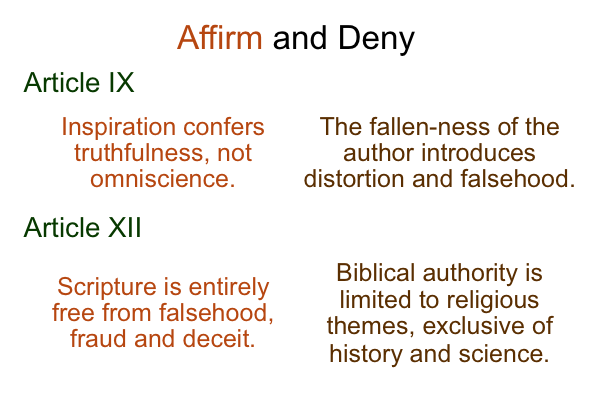
Kulikovsky recounts articles nine and twelve of the Chicago Statement of Biblical Inerrancy. The following table does not report the complete affirmations and denials. These are in the overview. However, I hope they are close enough.
Here is a table.
Figure 02
0009 Even though these statements mention the contrast between hermeneutics and scientific narrative, the focus is on the contrast between true and false (Article XII) and honesty and deception (Article IX).
The Evangelical Theological Society affirms that Genesis is true. Plus, Genesis is not deceptive.
The denials reject what others may affirm. One aspect of the denial in Article XII is particularly worthy of repetition. No scientific hypothesis about earth history may properly be used to overturn the teaching of Scripture on creation and the flood.
In order to frame the denial in the most nuanced manner possible, I say, “If the content of a denial is affirmed, then that affirmation may negate the original affirmation. For this reason, the denial is really an affirmation that must be rejected, because it can be carried too far.”
0010 Of course, the affirmations and the denials of the Evangelical Theological Society proclaim that Biblical exegesis comes first, and stands before, purported scientific challenges. But, their very structure calls to mind a semiotic construction called the “Greimas Square”, which I won’t further capitalize, unless in a title. The greimas square is the topic of the next blog.