05/30/26

Semiotics and History: Baroque Scholasticism

SaH0001 Are there independent courses of study completely contained within Razie Mah’s blog?

Yes, besides the main courses that are announced at Razie Mah’s website, other online courses may be found.

Semiotics and History offers various courses.  The courses are like threads.  Each strand integrates with other strands, so the conceptual apparatus starts to work like a rope, giving the student a tool to climb through history.  

Here is the reading list for this strand.

Looking at Daniel Novotny’s Book (2013) “Ens Rationis from Suarez to Caramuel” (points 0001-0265, appearing in May, 2026)

Looking at Daniel Novotny’s Essay (2017) “Izquierdo on Universals” points (0266-0365 appearing in June 2026)

The dates pass backwards because WordPress places latest post first, for each month.

So, click on the month, then scroll downwards

0002 Other notes.  

Words and phrases that belong together may be placed in italics for easier reading.

Prerequisites include A Primer on the Category-Based Nested Form and A Primer on Sensible and Social Construction,by Razie Mah.  These are available at smashwords and other e-book venues.

A list of other strands may be found on the Semiotics as History Post at Razie Mah’s website, dated April 1, 2026.

05/29/26

Looking at Daniel Novotny’s Book (2013) “Ens Rationis from Suarez to Caramuel”(Part 1 of 19)

0003 The following 2016 essay comments on a recent book on baroque scholasticism by Daniel Novotny, a Professor of Philosophy at the University of South Bohemia in the Czech Republic.  The title of the work is Ens rationis from Suarez to CaramuelA Study in the Scholasticism of the Baroque Era (Fordham University, 2013).  

0003 This commentary is not a close reading.  Rather, it is a curious association of postmodern and semiotic diagramsto Novotny’s writing.  These models come from Razie Mah’s foundational works, including How to Define the Word “Religion” as well as An Archaeology of the Fall.

I regard Novotny’s work as both insightful and prophetic.  By “insightful”, I mean seeing through the highly nuanced Latin text in order to grasp the core.  He plainly condenses each nuanced argument into one or two sentences.  By ‘prophetic’, I mean that he quests for truth.  In chapter 9, paragraph 3, Novotny admits that his initial aim was to show that, even today, Baroque scholastic culture could produce philosophical illumination.

As the following comments will show, he is on target, but not in the way he expected.

0004 Why consider baroque scholasticism?

John Deely (1942-2017 AD) writes the first postmodern survey of the history of philosophy, from the ancient Greeks to the 21st.  His book is entitled, Four Ages of Understanding (2001, University of Toronto Press).

0005 Deely locates Baroque scholasticism (1600 to 1680 AD) at the start of the Age of Ideas and the end of the Latin Age.  He focuses on this time – right around the promulgation of the Peace of Westphalia (1648 AD) – as paradigmatic.  Two figures stand out.

0006 In France, Rene Descartes (1596-1650) wrestles with the philosophical implications of the new mechanical philosophy.  Note, the word “philosophy” appears twice.  On one had, philosophy trends to modernism and postmodernism.  On the other hand, philosophy spawns science.

0007 In Spain, John Poinsot  (1589-1644) arrives at the definition of a sign.  A sign is a triadic relation.  The relation was classified as ‘a being of reason’ (ens rationis) by Suarez, the first philosopher covered by Novotny.  Almost 300 years after Francisco Suarez ,(1548-1617) the sign as a triadic relation is independently discovered by Charles Sanders Peirce.  Peirce marks a new turning.  He is the first philosopher of the upcoming Age of Semiotics.

0008 Both John Deely and Daniel Novotny seek to understand the critical juncture where the Latin Age gave way to our current Age of Ideas. 

The origin of the Age of Ideas is wrapped in modern mythology.  Descartes is lionized.  Poinsot is ignored.  The Age of Ideas reigns in the shining castles of modern universities.  To me, state-supported multiversities look like palaces. Mechanical philosophy is taught to some.  Analytic philosophy is taught to others.  Propaganda and technique covers the rest.

Outside the palaces of big government (il)liberalism lays a moat of resentment, filled with materialistic philosophies, political theologies and television.  Even further away, the forgotten remnants of the Latin Age slowly convert an apparently dead civilization into a living soil.  For centuries, moderns were warned about going into the dark forest of scholasticism.

Yet, that is where John Deely and Daniel Novotny wander.

0009 A crucial difference arises between Deely and Novotny.  Deely has Peirce’s definition of the sign to guide him.  He has a lantern.  Novotny does not have the advantage of a postmodern source of light.  Novotny only has his own intuition.

John Kronen, of the University of St. Thomas, captures Novotny’s lack of an illuminated path in his review, writing, “If one agrees with Aristotle that opposites are treated in the same science (e.g. medicine treats both health and sickness) … then one should agree that metaphysics (the study of being) ought to study nonbeing”.

Indeed, Novotny bravely says, “OK, I will look into this nonbeing stuff.  I will go into the dark forest of scholasticism and see what happens.”

0010 From these labors, he comes up with the insights and the prophecy that I place before you.

0011 What about this nonbeing stuff?

During the Latin Age, the term “beings of reason” appears in various scholastic discussions.  In 1597 AD, the Spanish Jesuit Francisco Suarez writes the first comprehensive treatment on the topic (Chapter 9:Paragraph 1).  This marks the start of Baroque scholasticism (Chapter 1: Sections A-D).

0012 Why are ‘beings of reason’ needed?

Suarez proposes three reasons (Chapter 3: Section C: Point 3).  These are distilled by Novotny into claim SN8:

Beings of reason are needed (1) to know nonbeing, (2) to know things comparatively and (3) to explain why humans can think of self-contradictory beings.

Over the previous centuries of inquiry in Aristotle’s tradition, schoolmen routinely use the term “beings of reason” on three occasions.  These occasions suggest reasons for inquiring into the nature of the term.  They are (1) negations, (2) privations and (3) relations.  Self-contradictions (4) are also implicated.

So, at the beginning, Suarez asks: What is the ontological status of the term ‘beings of reason’?

0013 Now, let me turn to my own methods.

What do I have that makes my comments more than a curiosity?

Just as Deely holds the lantern of Peirce’s semiotics, I hold the flashlight of the category-based nested form.  You can be the judge of the power of this source of illumination.

Please note the prerequisites at point 0003.

Here is the category-based nested form in a nutshell:

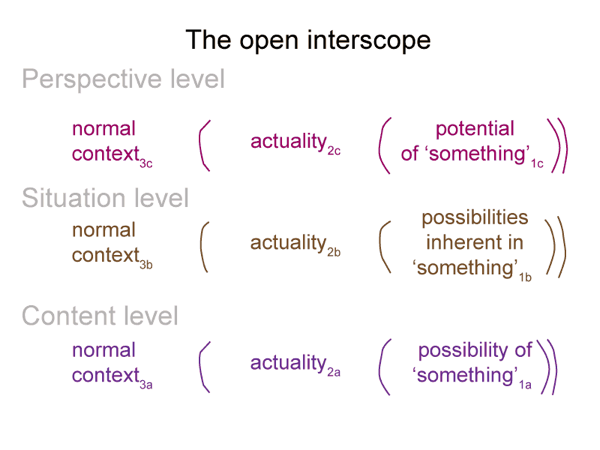
0014 The nested form is depicted as follows:

normal context3( actuality2( possibility or potential of something1))

The numerical subscripts denote Peirce’s categories.  The parentheses denote precission.

This depiction breaks down into four statements:

Actuality2 emerges from the possibility of something1.

Actuality2 situates the potential of something1.

A normal context3 contextualizes actuality2(something1).A normal context3 brings actuality2 into relation with the possibilities inherent in something1.

05/8/26

Looking at Daniel Novotny’s Book (2013) “Ens Rationis from Suarez to Caramuel”(Part 19 of 19)

0249 Second, what is the structure of this ‘being of reason’?

0250 Let me start with an example.

My example will be the words “being of reason”2a.

This example belongs to our current Lebenswelt, since both ‘being’ and ‘reason’ are explicit abstractions.  The terms are juxtaposed in a way that violates the laws of non-contradiction.  ‘A being’ is an actuality whose existence cannot be denied.  It is a fact.  ‘Reason’ is the determination of a ratio.  This determination is a second, contradicting actuality.

0251 Why does the juxtaposition entail a contradiction?

A being is one element.  A ratio compares two elements.  What is the other element that ‘a being’ is compared to?  It must be something regarding the manner of being because it is weighed against being.  But, it does not exist in the manner of being.

0252 OK, maybe I can accept that there is a contradiction between two actualities.

What are the two actualities?

The first is being2 (‘what is encountered’).  The second is the determination of a ratio2.

A single actuality contains these two contradicting actualities.  It does so by serving as the terminus for the ratio.

0253 At this point, to me, the intrinsic unity becomes apparent.  The beingin_reason2a is what the encountered being ought to be.

In this case, the encountered being2a is an extrinsic, linguistically formulated, self-contradiction.  The being of reason2abecomes a single, unified nonbeing composed of two actualities: the word “being”, pointing to existence or what is, and the determination of a ratio or reason, pointing to the constellation of what ought to be.  The unification must be a nonbeing because the logic of non-contradiction cannot reduce it to its component actualities.

0254 This suggests that nonbeings resist the logic of non-contradiction.  Yet, beingsin_reason are actual when they occupy the slot designated for secondness in the category-based nested form.

0255 This also suggests that the two component actualities belong to nested forms.  In other words, each of the actualities comes with a normal context and possibilities.

0256 What could these nested forms be?

I figure that the normal context3 for being as what is there2 might be realness3.  Perhaps, it3 is existence3.  The underlying possibility1 is a basis for realness1.   Realness3 brings ‘being (what is)2’ into relation with a potential basis for realness1.

I suppose that the normal context3 for the determination of a ratio2 is rationality3.  The underlying possibility1 is a basis for the ratio1.  So, rationality3 brings ‘the determination of a ratio2’ into relation with a potential basis for the ratio1.

0257 The two nested forms intersect in the realm of actuality, as follows:

0258 Curiously, this intersection reflects all the elements in judgment2c.  Judgment2c belongs to the formal intellect2c. Judgment2c virtually contextualizes the reckoning by the efficient intellect2b.

0259 Judgment2c is a relation between ‘what it is’ and ‘what it ought to be’.  The formal intellect virtually designs the normal contexts of the intersection and sets the parameters for the potentials.

0260 For Baroque scholastics, the basis of rationality was captured in the logic of non-contradiction.  This is why the beingin reason2a could not exist, even though it could be regarded in the manner of being.  The basis of realness was existence.  Facts went with existence.  Fiction did not.

0261 The interscope for ‘being of reason’ in Baroque scholasticism ended up looking like this:

0262 To me, this interscope marks the beginning and the end of the Age of Ideas.

The Age of Ideas emphasizes the axis of true versus false, throwing the axis of true versus deception into shadow.  Baroque scholasticism faded from view, along with fictions like beingsin_reason.

On the one hand, once the elevation of one axis and the occlusion of the other axis became ingrained as habit, then modern philosophy and science follows.

On the other hand, modern literature explores the negations, privations, relations and self-contradictions in which Baroque scholasticism sleeps.

0263 Modernism is a world with a fixed perspective.  Actuality is every thing.  Actuality is all there is.  For example, modernism elevates human dispositions.  It occludes human conscience.  Thus, the term “sin”, which coincides with the intersection of human action and thought, follows the same trajectory as “beings of reason”.

0264 Modernism is a world of deception.  Surely, facts may paint a false picture.  Facts depend on one’s fictions.  Indeed, facts will support ‘the current intersection of existence and rationality’ until the moment when deception turns realness into deprivation and negates rationality with its own distorted valuations.

Will we then return to beings of reason as explanations for negation, privation, relation and self-contradiction?  Or will we return to beingsin_reason in order to locate the intrinsic unity between fact and fiction?

0265 There is more to actuality than every thing.  Charles Peirce opens a path to postmodern scholasticism.  Deely and Novotny opened a vista into where we have been.

05/7/26

Semiotics and History – Baroque Scholasticism and Early Modernism (Part 1 of 1)

SaH0043 The Baroque scholastics of southern and central Europe live at the same time as the mechanical philosophers of northern and western Europe.  The latter give rise to the Age of Fiction, with Cervantes publishing Don Quixote in the early 1600s.  The former give rise to the Age of Ideas, with the birth of modern science.

Of course, it is not as neat as that.

Consequently, an examination of an article by Novotny serves as a capstone for Razie Mah’s online course on Baroque Scholasticism and as an introduction to an online course in Early Modernism.

Baroque Scholasticism consists of Looking at Daniel Novotny’s Book (2013) Ens Rationis from Suarez to Caramuel (and appears in Razie Mah’s blog in May, 2026).

The capstone for Baroque Scholasticism and the introduction to …and Early Modernism consists of Looking at Daniel Novotny’s Article (2017) Izquierdo on Universals

Baroque Scholasticism and Early Modernism consist of a review of Eric Santner’s Book (2016) The Weight of All Flesh.

SaH0044 Both are strands in the course: Semiotics and History.

See Razie Mah’s blog for February 3, 2026.

05/7/26

Looking at Daniel Novotny’s Essay (2017) Izquierdo on Universals (Part 1 of 6)

0267 What are universals? Why are they important? 

In the Spring 2017 issue of the American Catholic Philosophical Quarterly (vol. 91(2) pages 227-249), Daniel Novotny examines Disputation 17 of the Baroque scholastic treatise, The Lighthouse of the Sciences (1659).  The title of Novotny’s article is Sebastian Izquierdo on Universals: A Way Beyond Realism and Nominalism.  These comments intend to demonstrate the postmodern relevance of this work using the category-based nested form.

0268 Oh, back to the starting questions.

Some things are similar to one another.  Universals grow out of this impression.  Various things can share in certain universals, to the exclusion of other things.  In this very brief paper, Daniel Novotny reviews and summarizes the theory of universals proposed by the Spanish Baroque scholastic, Sebastian Izquierdo, SJ (1600-1681 AD).

Izquierdo’s life overlaps with the northern European authors who mark the dawn of the Age of Ideas, including Thomas Hobbes (1588-1679) and Rene Descartes (1596-1650).  His life also overlaps with theorists marking the twilight of the Latin Age, including Francisco Suarexz (1548-1617) and John Poinsot (1589-1644).  Our current age is born at this time.  This is the moment to which we must return in order to come to terms with our era.

0269 Daniel Novotny is not unfamiliar with the Baroque philosophers.  I commented on his full-length book, Ens Rationis: From Suarez to Caramuel, published in 2013.  Novotny’s exposition is so clear that constructing (inevitably messy) category-based nested forms came easy.

My comments wove a story into his presentation, starting with the dichotomy of fact versus fiction and ending with an intimation of postmodern social construction.  This narrative adds value by connecting Baroque scholasticism and our present, postmodern, world.

0270 As for the article under examination, Novotny begins with a caveat.  Baroque philosophy and theology is a complex tapestry, filled with commentary and references.  One can easily get lost in this forest of questions and answers.  Typically, an entire text must be examined in order to configure an author’s opinion, if distinct from all others.  Since such effort is very difficult and time consuming, Novotny limits this publication to a careful examination of Disputation 17 of Izquierdo’s major philosophical work, The Lighthouse of the Sciences.

Disputation 17 presents Izquierdo’s theory of universals.

0271 The table of contents for The Lighthouse of the Sciences is organized in a novel way, portending substantial differences from traditional doctrines and methods.  In Disputation 17, Izquierdo considers three questions.  To me, these questions sound postmodern.

Q1. What are universals?

Q2. Are some universals independent of the intellect?

Q3. If universals are intellect dependent, what is their nature?

0272 To the first question, Izquierdo offers four meanings:

0273 Let me supply an example from Eric Santner’s (2016) book, The Weight of All Flesh

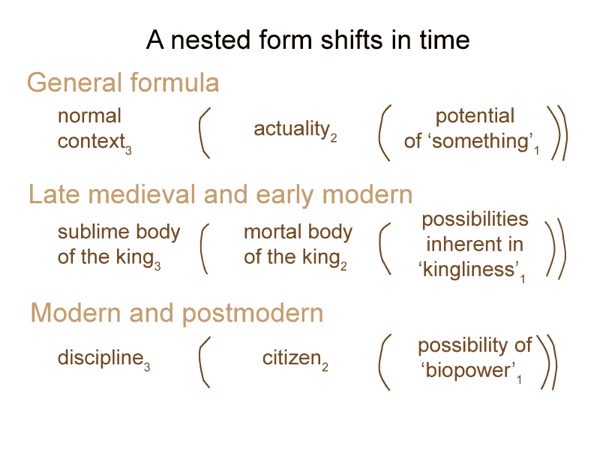
0274 During late medieval and early modern times, political theologians proposed that the king had two bodies.  One was mortal.  The other was glorious.

When a king died, his mortal body was quickly buried.  An effigy (representing the king’s glorious body) was manufactured and placed on the throne until the coronation of a new king.  Then, the effigy was buried in a separate funeral.

0275 The glorious body of the king is a universal with four meanings.

0276 The last meaning is particularly twisted.  The universal, in its proper sense, cannot be a particular.  Yet, here is a particular effigy that becomes a symbol of the king’s glorious body.

According to C. S. Peirce, a symbol is a sign based on tradition, convention, law, consensus and so on.  Here, a political and theological consensus connects a sign-object (the king’s glorious body) to a sign-vehicle (an effigy of the deceased king).

0277 In Peirce’s semiotic terminology, the scholastic term “objective concept” portrays the union of a sign-vehicle and sign-object.  The term “objective precision” reflects the operation of a sign-interpretant.

0278 In the terminology of the nested form, “objective concept” belongs to secondness, the realm of actuality.  “Objective precision” belongs thirdness and firstness, the realms of normal context and possibility, respectively.  An objective concept is a mind-dependent being.  Objective precision is a formal act of the intellect.

0279 For example, in Shakespeare’s Hamlet, a murderous uncle gains the throne and becomes king (objective concept).  Unfortunately, the ghost of Hamlet’s father (the glorious body of the deceased king) appears, calling Hamlet to reject his uncle’s claims (through objective precision).  Hamlet’s uncle has no nobility.  Therefore, his uncle is not king (and does not have a glorious body, since the glorious body of Hamlet’s father haunts the world).

0280 This dramatic call to judgment may be depicted as a relation between what is and what ought to be.  Indeed, I define the actuality of judgment as this triadic relation.

0281 Here is a diagram.

05/1/26

Looking at Daniel Novotny’s Essay (2017) Izquierdo on Universals (Part 6 of 6)

0350 Next, the fourth proposition (P4) comes up for consideration.

0351 What is the disposition of the universal to each of Aristotle’s definitions?

According to the working model, both definitions are in play in the primal triad.  They are not independent.  How can this be?  This model supports further philosophical inquiry.

0352 Propositions P2 and P3 pertain to the interscope of the individual in community.

0353 P3 points to the fact that the normal context for judgment2c is reason3c.

0354 P2 suggests that what is and what ought to be may not be labeled.  Instead, phantasms and impressions substitute for these intersubjective unities.  The resulting judgment is called an intrinsic abstraction.  This is the type of judgmentrendered in the Lebenswelt that we evolved in.

0355 The Christian sacrament of the Eucharist serves as an example.

What is appears as a piece of bread2a.  What ought to be is the phantasm of the body of Christ2b.  Thomas Aquinas discovered the relation, twelve hundred years after the commissioning of the Last Supper.  Transubstantiation2c (as the universal, relation) brings the appearance of bread2a->2c (as the universal, what is) into relation with the body of Christ2b->2c (as the universal, what ought to be).

0356 What is emerges from the potency of the material and physical.  What ought to be emerges from the potency of the formal and logical.  What brings these into relation is a mystical operation emerging from the potency of human understanding.

0357 Of course, I will never hear the word “transubstantiation” on television in this era of big government (il)liberalism.

Instead, I will see a commercial for a Czech beer, starting with the image of an amber bottle, glistening with condensate.  Music starts.  The word “you” appears as a hand grasps the bottle.  “Can”, another hand pops the cap.  “Be”, one hand lifts the bottle.  “The King”, the hand pours the beer.  “Of Bohemia”, the cascading brew fills an image of a throne.

The music swells as the honey-colored throne morphs into a glistening glass of beer.

The voice-over intones, “You can be the King of Bohemia.”

0358 Has the glorious body of the king transubstantiated into a commodity, a regal libation?

0359 I raise my glass to Ceske Budejovice in the Czech Republic, the home of the University of South Bohemia.

0360 Daniel Novotny lists the consequences of Baroque Scholastic Sebastian Izquierdo’s Disputation 17 in The Lighthouse of the Sciences.  He concludes with an impression: Izquierdo is close to modern empiricism.

0361 Izquierdo rejects the extra-mental features of universals and avoids the projection of universals into the realm of the mundane.  He avoids nominalism by insisting on objective concepts.

0362 Novotny suggests that Izquierdo’s rejection of Aristotle’s act-potency distinction draws him into the same errors that plague contemporary metaphysics and philosophy of mathematics.  The middle way between nominalism and Platonism must be grounded in the metaphysical structure of reality.  But, Izquierdo cannot lock onto that relational structure.

0363 Charles S. Peirce gave me a gift.

0364 His three categories point to the ground that Izquierdo intimated.  Izquierdo’s third way may have failed, but with the category-based nested form, I can look across the turbulent seas of the Age of Ideas and say, “I see what you mean.”

0365 The Lighthouse of the Sciences still beacons.

02/6/26

Looking at Kalevi Kull and Ekaterina Velmezova’s Book (2025) “Sphere of Understanding” (Part 1 of 3)

SaH 0001 The full title of the book before me is Sphere of Understanding: Tartu Dialogues with Semioticians.  The book is volume 23 of the series, Semiotics, Communication and Cognition, edited by Paul Cobley and Kalevi Kull, published in 2025, by Walter de Gruyter GmbH, Berlin/Boston.  

Kalevi Kull is a biologist who joined the Department of Semiotics at the University of Tartu in 1997.  Ekaterina Velmezova is a linguist and historian who graduated from Moscow State University.  Each, in their own way, represents the two poles of the Tartu-Moscow School of Semiotics.

0002 The question is: Does this book mark the end of the first ascent or the beginning of the second ascent for the Tartu Moscow School of Semiotics.

0003 After the introductory chapter, extolling the virtues of dialogue, the authors offer a brief history of semiotics in Estonia.  The arrival of Juri Lotman, a scholar of Slavic literature, initiates a transnational collaboration within the old USSR.  The summer school at Tartu University proves seductive.  Here is a place where scholars in Slavic literature are free to play.

0004 So, one aspect of the sphere that the authors desire to understand is a historical conception, sired from the intellectual loins of Juri Lotman, that has taken a life of its own.  The only question is: Who is she?

0005 Kalevi Kull wrestles with emergence in biological systems.  What about this semiotically inclined child of history?

0006 Ekaterina Velmezova performs translation into English, as well as, I imagine, editing in Russian.  After all, these are times when Estonians may want to hedge their bets.

0007 Who knows?

Can the Tartu-Moscow School of Semiotics be born again?

The interviews provide clues.  They are gems framed in their historical moments.

0008 So how do I, a crypto semiotician, respond?

0009 First, I look at back issues of the journal that Juri Lotman founded, Sign System Studies, and find a special issue in 2017 bearing the title: Semiotics and History.

Second, I review several of the articles, plus one from 2016, in order to produce my contribution to the book’s dialogue.

Third, I package the results into an online independent mini-course, the first in a series titled, “Semiotics and History”, by Razie Mah, starting in December, 2025.

0010 The editors of the journal, Sign System Studies, have permission to scrape the blogs of this mini-course for a special on-line issue, as well as permission translate the blogs into other languages.  After all, time is cruel.  If the blog goes off-line, then the editors will retain a response that addresses what the authors seek.

0011 What do the authors seek?

0012 First, they seek a “sphere”.  Shall I add… “of influence”?  Or, shall I be satisfied with “of understanding”.

The interviewers ask semioticians questions.  After the year, 2008, these queries include how the semiotician came into contact or awareness of the (first ascent of) the Tartu-Moscow School of Semiotics (1960s-1980s).  The authors want to appreciate the school’s sphere of influence.

0013 Second, they seek understanding.

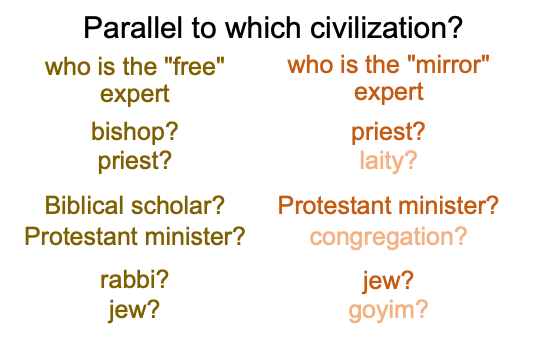
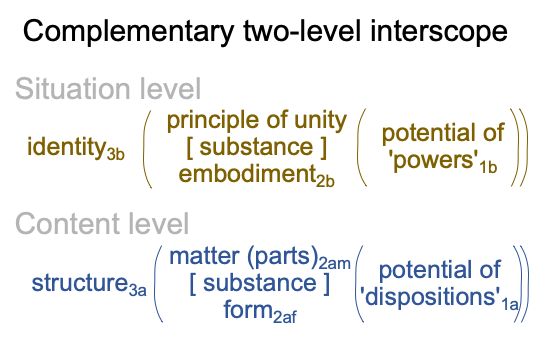
Here is where the discrepancy between Saussure and Peirce comes in.  Today, practitioners of both traditions are called, “semioticians”.   But, Saussure called his path of inquiry, “semiology”.  And structuralism?  Structuralism virtually situates semiology.  Structuralism is semiology as matter substantiating aesthetics as form.

0014 So, what am I doing?

I follow the path of Peirce, into the labyrinth of triadic relations, and attempt to identify the normal contexts (thirdness) and potentials (firstness) of the actualities (secondness) of semiology and structuralism.

0015 What do I find?

I find that “she” is Slavic civilization, herself.

0016 My examination of articles in the 2017 special issue of Sign System Studies, titled “Semiotics and History”, pays tribute to the authors’ search, embodied in the title, and provides a way to understand the Tartu-Moscow School’s sphere of influence, for both the first iteration in the old USSR and its second iteration in the upcoming Eurasian convergence.

02/5/26

Looking at Kalevi Kull and Ekaterina Velmezova’s Book (2025) “Sphere of Understanding” (Part 2 of 3)

SaH 0017 The authors quest for a sphere of understanding.  They seek the egg, so to speak, impregnated by Juri Lotman’s genius.  In the interviews in chapter 2.1, Lotman is spent, although still alive.  He is old.  The interviewer is a youth, a personification of the metaphysical love-child born after Slavic civilization reveals herself to Lotman’s circumspection.

0018 The miracle of Lotman’s arrival in Estonia is, weirdly, recounted in the last interview (2.14) with psychologist and cultural theorist, Jaan Valsiner.  As it turns out, Valsiner’s step-father was instrumental in getting Juri Lotman to Estonia after the Second World War.

0019 Jaan Valsiner demonstrates that the Tartu-Moscow’s sphere of influence is diffuse.  His testimony is seconded by Paul Cobley (2.13), Terrence Deacon (2.12), Jesper Hoffmeyer (2.11) and Stuart Kauffman (2.10).

0020 The sphere becomes less diffuse in interviews with Roland Posner (2.9), Gunther Kress (2.8) and Wilfred Noth (2.7).

Notably, Noth conducts a discourse on the crucial potential of truth, as opposed to the potential of will.  Indeed, the contrast between truth and will turns out to be integral to my examination of a 2017 article on Russian identity.

0021 Finally, the sphere becomes tangible with interviews with American anthropologist, Myrdene Anderson (2.6), who researched indigenous people in Sweden, Italian semiotician Paolo Fabbri (2.5), who railed against the wooly thinking that passes for “models” in contemporary humanities, and the Italian know-it-all Umberto Eco, who noted the importance of iconicity in semiotic humanity.

What?

“Semiotic humanity”?

What about semiology?

0022 Contemporary academic discourse is currently conducted with expert-coined spoken words, but these utterancescannot picture or point to their referents.  Academics swim in a pool of differences… er… two arbitrarily related pools of differences.  No one can tell where he or she flotates.

Flotates?

This is what happens when spoken words are placeholders in two arbitrarily related systems of differences.

0023 Finally, the interviews engage a still-living member of the original Tartu-Moscow School of Semiotics, Boris Uspenskij (2.2).  This interview gets a full examination in the course on Semiotics and History.  Uspenskij stands within the sphere that the authors aspire to understand.

0024 So, what does Razie Mah’s contribution under the banner of Semiotics and History offer?

0025 For the diffuse sphere, these examinations will present a historical narrative of ideas in the style of diagrams of purely relational structures.  In short, Peirce-inspired diagrams offer a new way to narrate intellectual history.

0026 For the almost tangible sphere, these examinations practice a method of association, followed by a discussion of the implications.  The articles provide material to fill in the empty slots of relational structures.  When associations are made, implications become apparent.

0027 For the sphere itself, one unexpected insight is that, as the first ascendant of the Tartu-Moscow School of Semiotics struggles to fulfill the political mandate of the USSR (to make all fields of inquiry “scientific”), the researchers excavate the recently-buried remains of the civilization that is their subject of inquiry.

Imagine a scientific investigation of Russian language, history and literature, as a archaeological excavation into the being of Slavic civilization.

0028 Is that the same “she” that… um… you know… captured the attention of Juri Lotman?

How confounding.

0029 The next blog offers an introduction to Semiotics and History: The Tartu-Moscow School of Semiotics.

02/3/26

A Course on Semiotics and History: A List of Online Contributions

SaH0001 Razie Mah offers three foundational courses that cover human evolution.

These are:

The Human Niche

(also see the four accompanying commentaries as well as the three-part Comments on Michael Tomasello’s Arc of Inquiry (1999-2019))

An Archaeology of the Fall

(also see the three part Instructor’s Guide, as well as The First Singularity and Its Fairy Tale Trace and Original Sin and Original Death: Romans 5:12-19)

How To Define the Word “Religion”

(also see the ten primers, starting with A Primer on the Category-Based Nested Form and A Primer on Sensible and Social Construction)

These courses are on sale by various electronic booksellers.

The texts are designed to be read and discussed in a seminar setting.

0002 For inquirers. educators and students would who like to try their hands at Razie Mah’s approach, Semiotics and History offers a path.  This is one course consisting of many strands.  Like a fiber in a rope, each strand strengthens the entire conceptual apparatus.  With few execptions, each course completely appears in the blog.  Some strands will have an electronic e-book component.  So, don’t be afraid to make a purchase.  You will find that the costs of Mah’s electronic works are reasonable.

In the following list, the date corresponds to the cover page of each strand.  A strand typically covers a month.

0003 The following list extends into the future, because more strands will be added over time.

Feb 6,5, 2026

Looking at Kalevi Kull and Ekaterina Velmezova’s Book (2025) “Sphere of Understanding” (Part 1 and 2 of 3)

Feb 4, 2026

Semiotics and History: The Tartu-Moscow School of Semiotics (Part 3 of 3)

May 30. 2026

Semiotics and History: Baroque Scholasticism

May 7, 2026

Semiotics and History: Baroque Scholasticism and Early Modernism

June 30, 2026

Semiotics and History: Early Modernism

July 31, 2026 Semiotics and History: Gnosticism in Modern America

12/31/25

Looking at Igor Pilshchikov and Mikhail Trunin’s Article (2016) “The Tartu-Moscow School of Semiotics” (Part 1 of 27)

0001 The article before me is published by Sign System Studies (44(3) (2016) pages 368-401) by two professors, Igor Pilshchikov and Mikhail Trunin, hailing from Tallinn University in Estonia.  The title is “The Tartu-Moscow School of Semiotics”. The subtitle is “A transnational perspective”.

0002 The abstract promises to situate the Tartu-Moscow School of Semiotics of the 1960s through 1980s.  The article delivers more than promised.

How so?

0003 The authors sketch dynamic developments among intellectual circles within the (now former) Union of Soviet Socialist Republics.

0004 The term, “transnational”, indicates that there are nations within the former Soviet Union.

During this period in history, the governments of Estonia and Russia (along with Czechoslovakia and Poland) owe fealty to an empire with the title, “Socialist”, in its name.

So, “transnational” tells me that the article looks back from the present, into a past era, with the intent of portraying ‘something’ historical, without acknowledging that the “Union” and the “Socialist” descriptors no longer apply (at least, not in the way that they once did).

0005 “Transnational” applies to the Union of Soviet Socialist Republics (USSR, 1918-1989) as well as the upcoming… um… Eurasian convergence?

Here is a picture with three city-sites.  Tartu and Moscow belong to the title.  Tallinn is the location where the authors write their article.  The blue is the Baltic Sea.

0006 “Transnational” steps over the boundaries depicted in black in the above figure.

Never mind the fact that the above territories reside behind, what American pundits once called, “the Iron Curtain”.

0007 Perhaps, one must appreciate an ambiguity to the term, “transnational”, given that there is another transit.  This transit is in time.  Or, even better, this transit is across a boundary between battles among Enlightenment gods.

Consider where the time period of 1960s to 1980s resides in the following timeline of Western civilization in the twentieth century.

Also consider the year when the article under examination is published.

Notice the boundary.

0008 The Tartu-Moscow School of Semiology constellates within one battle, as a transnational collaboration.

The TMS is remembered during another battle, which is not resolved, and so cannot be objectified as “historical”.  I suppose that it can be objectified as “cultural”.  Better yet, “theodramatic”.

Already, there is more to this article than meets the eye.