SaH0045 This strand of Semiotics and History considers the rise of capitalism in early modernism in terms of changes of political theology.
Oh, I meant to say “mercantilism”.
Okay, how about a label for whatever Shakespeare’s Merchant of Venice and income taxes in twenty-first century Americahave in common?
Also, I should have also said, “political economy”, instead of “political theology”.
Be that as it may, please enjoy the following commentary on Eric Santner’s challenging book.
This strand starts with of Looking at Daniel Novotny’s Article (2016) Izquierdo and Universals (and appears in Razie Mah’s blog in May 7-1, 2026, for orientation, see Razie Mah’s blog for May 7, 2026).
As well as Looking atEric Santner’s Book (2016) The Weight of All Flesh (appearing in Razie Mah’s Blog in June, 2026, go to month and scroll down).
SaH0046 For a full list of strands in the course on Semiotics and History, see Razie Mah’s blog for February 3, 2026.
0001 The following 2017 essay comments on a recent book by a Professor of Literature about the subject matter of the political economy. Eric Santner tries to figure out its immaterial measure.
Why do I say immaterial measure?
Consider the complete title: The Weight of All Flesh: On the Subject Matter of Political Economy.
Weight is a measure of something material. However, weight itself is not material.
Similarly, matter ought to be material. But, subject matter is not.
Also, the economy processes materials. Politics does not.
Will literalism do under these circumstances?
Once the flesh has weight, then it is no longer simply what it is.
Once matter is taken to be a subject, then it is no longer merely what it is.
Once the economy is taken to be political, then it is no longer only what it is.
0002 To me, the category-based nested form applies.
The actualities of flesh, matter and economics exist by themselves. But, humans evolved to consider more than what is at hand. We are designed to put actuality into a nested form.
So, these actualities exist, for us, in the normal contexts of weight, subject and politics. These are not the only normal contexts. They are the contexts raised by the author.
The contextualization of actuality raises another question.
What potentiates the weight of flesh, subject matter and political economy?
You may already know the answer. I do not. Consequently, I turn to this text to see what I may discover. This will be a fairly close reading, so have Santner’s book at hand.
‘Words that belong together’ are denoted by single quotes or italics.
0003 Eric Santner wrote The Weight of All Flesh: On the Subject-Matter of Political Economy (Oxford University Press, 2016). The main body of the book consists in a preface and two lectures. The two lectures constitute chapters 1 and 2. These chapters are broken into parts.
Santner’s presentations are works of art, composing the 2014 Tanner Lectures on Human Values at the University of California, Berkeley.
0004 The front piece is an introduction by Kevis Goodman. The end piece is a suite of comments by Bonnie Honig, Peter E. Gordon and Hent de Vries, followed by a reply by Eric Santner.
The responses are very challenging. How does one reply to something that sounds like free association?
Unfortunately, the front and end pieces will not be covered in these comments. However, the end piece may be used as an exercise in the methodology that composes these comments.
0005 Why is this interesting?
My interest is obvious once one looks at How To Define the Word “Religion” plus the first ten associated primers.
The tenth primer ends before the majesty of sovereign power. Primers 8, 9 and 10 tell of the difficulty of seeing beyond these mountains. Anyone who argues about politics can stir up an avalanche.
What does Primer 8 tell me?
Infrasovereign religions grasp for sovereign power in order to impose their organizational objectives on those outside their organization.
What about Primer 9?
Socrates had to drink hemlock. Why did he have to do that?
Primer 10?
Rene Girard proposes that a scapegoat mechanism is apparent in all civilizations. Plus, the mechanism comes into play when power structures try to preserve themselves.
Overall, politics and religion map a dangerous landscape. Eric Santner walks where angels fear to tread.
0006 Primers 8, 9 and 10 explore the presence underlying the word “religion”.
Institutions occupy the content level of the society tier. They contextualize the organization tier. These institutions harbor organizational objects, objectsorganization, that call the individual into organization. These objectsorg are virtually situated by sovereign acts, laws and decrees.
0007 Eric Santner reads literature. He observes art. He sees that something changed in the West over the past few centuries.
What is this something?
It is completely missed by the current social and political sciences. However, it appears in Western paintings, poems, novels, plays, and other artistic works. This is the stuff that Eric Santner studies.
0008 Subject matter. What is it?
“Matter” is stuff. “Subject” is something that ends up objectified.
Okay, now what?
Does subject matter signal the objectification of matter?
Or does subject matter signify the objectification of something that matters?
0009 At the end of the Latin Age and the beginning of the Age of Ideas, around the 1600s AD, the subject matter of political theology was the king’s two bodies. One body was mortal. The other was sublime.
The object of the king’s glorious body supplemented the subject of the king’s mortal body. Santner labels the process spectral (glorious body) materiality (mortal body).
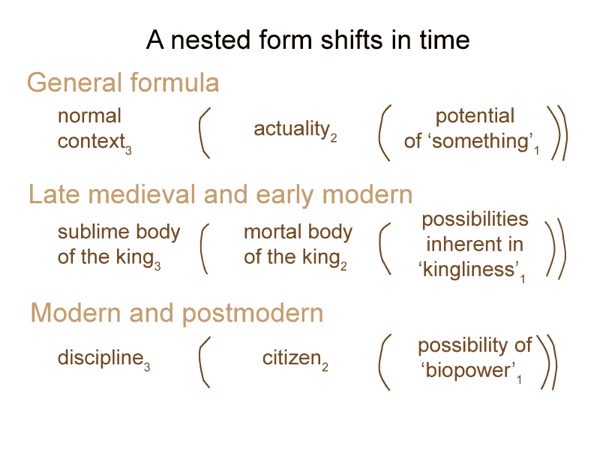
0010 To me, the glorious body is the normal context for the actuality of the king’s mortal body.
The nested form looks like this:
Sublime body3( mortal body2( potential of kingly being1))
0011 Does this express the character of the subject matter?
The mortal body is matter. The sublime body is the normal context that objectifies the mortal body. Thus, the king’s mortal body becomes a subject for political theology. The something that underlies the mortal body, giving its flesh weight, is the quality of being king.
0012 Moving to the present day, the matter of political theory falls to the people, rather than the king. The subject gets dispersed from one king to many citizens. The glorious body translates into what Michel Foucault calls “discipline”. The qualities that weight the mortal body of the king turn into “biopower”.
To me, modern political theory translates into the following nested form:
Discipline3( citizen2( possibilities inherent in biopower1))
0013 The two nested forms are shown below:
Normal context3 and possibility1 surcharge actuality2.
0014 The mortal body of the king is more than it otherwise would be in any other context. Its actuality possesses a surplus of immanence because it now has potential.
Similarly, one citizen may heroically rise above others as an expression of the biopower released by discipline. Other citizens are weighed and measured in the exercise of biopower.
0015 The pressure cooker of the royal person expanded to the business of the citizen. Medieval and early modern political theology gave way to modern political economy.
0016 Take a look at a painting. Jacques Louis David painted the extraordinary Death of Marat, during the French Revolution.
Compare this image to a wax effigy of a dead medieval king, or some other memorial, placed on the throne during official mourning.
0017 Jean-Paul Marat, the citizen, dies in his tub. David paints the death scene.
The king’s mortal body is buried. An icon of his sublime body is placed on the throne.
Clearly, David paints the equivalent to the sublime body of the citizen, Marat.
0018 One could say that this represents a loss of enchantment. After all, Marat, the revolutionary, hardly behaved royally.
This lack of royalty aligns with the emptiness above Marat, the corpse. The upper half of David’s painting is empty. If Marat had been royalty, the upper register would be full of angels and saints welcoming the glorious king.
What happened to the angels and saints?
0019 Heck, not even Marat’s fellow citizens are in the upper frame, registering the emotions of shock, grief, and, perhaps, relief. Critics have called the nondescript space above the dead Marat oppressive, abstract and unmotivated, characteristic of a representational deadlock.
0020 Perhaps, the cunning and ambitious artist was saying, “Do not let this be you.”, while painting, “This fellow was a citizen hero.”
Santner does not tell why Marat got knifed in his enclosed bathtub, filled with medicinal waters. Marat was a radical agitator. He named his newspaper, “The People’s Friend”. He was murdered by a woman who had come to him, claiming news from one of the districts of France.
During her trial, she testified that she killed one man in order to save one hundred thousand. She was found guilty. Her head was chopped off with a guillotine.
0021 Jacques-Louis David was charged with organizing Marat’s funeral. Surely, Marat was a martyr for the Revolution. Yet, despite the acclamation, no other figure appears in the painting.
0022 Why?
The reason is simple.
No sane person (whether angel, saint or fellow citizen) wanted to be associated with this crazy person, who was typical of the Jacobins, the party that celebrated the Cult of Reason and the Cult of the Supreme Being.
0023 David’s painting is both a warning and a paean.
0024 To Santner, the empty upper register of the painting associates to the impossibility of transcendence in the modern age. Business is busy-ness.
In the preceding section, Santner dwells on the word “doxologies”.
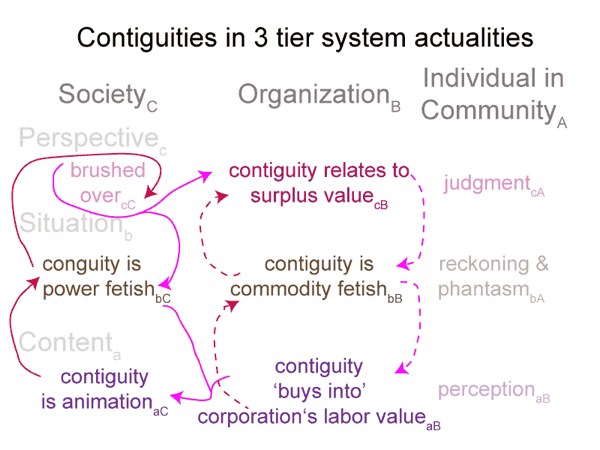
0548 There are two doxologies flowing upwards in the following figure.
This pair of doxologies is glory and money.
One is societal. The other is organizational.
0548 Santner coins the word, paradoxology, for exploring this double flow.
The subject matter of the political economy is a paradoxology.
0549 There are two movements flowing downwards in the preceding figure.
The pair of condensates are busy-ness and identity / purpose.
One is societal. The other is organizational.
One is enforced through sovereign laws and decrees. The other is inculcated through broadcast advertising.
0550 Santner recounts a debate about how to interpret Kafka’s writings.
Walter Benjamin and Gershom Scholem expressed different views of the theological tracks of Kafka’s stories.
0551 Scholem argued that Kafka’s work shines like a revelation. But, it’s a tricky revealing. It does not lead the reader to God, but to some originating nothingness.
0552 Benjamin countered that Kafka’s work has a message: The gate to justice is study. But the question is: What to study? The Torah has been brushed over by modern inquiry. Students have lost the Holy Writ.
0553 Scholem replied: No, those who study have not lost the Scriptures. They have lost the ability to decipher them.
0554 Does this conversation fit into the previous figure?
A suprasovereign religion was brushed over by the time that Marx projected the transcendent (a political theology) onto the immanent (the machinations of the organization tier).
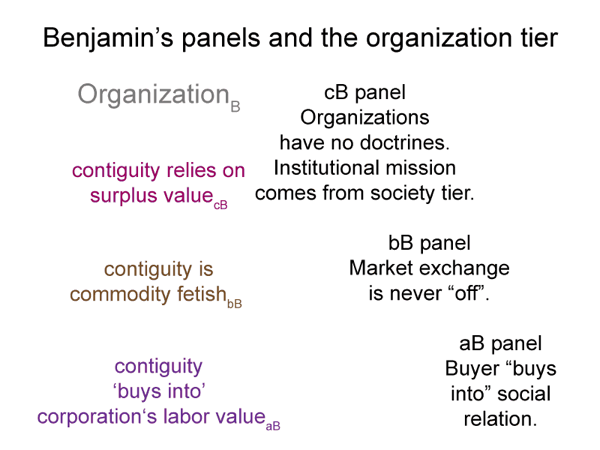
0555 Santner concludes with Walter Benjamin’s tripartite image of capitalism.
In one panel, capitalism is a purely cultic religion. It has no doctrine. It has no dogma. Adam Smith’s theories of the self-regulation of markets are exemplar. What is the invisible hand? It is dogma? Or is a way to describe events that cannot be reduced to cause and effect?
In the next panel, capitalism is always “on”. It never takes a holiday. Santner associates this to the doxologies of everyday life. Work is always waiting. Duties are never completed.
In the final panel, capitalism creates guilt, not atonement. In other words, it creates more debt, more burdens and more work.
Does the sovereignty of debt become sovereign debt?
Not necessarily, but it happens often enough. After all, who pays for the political entrepreneurs? Who pays for the busy-ness of citizensMarat?
0556 Does each of Benjamin’s panels describe a level of the organization tier as understood from the communist perspective?
How curious.
0557 Certainly, capitalism is a religion worthy of contempt.
Too bad it is a projection of Marxist ideology.
Walter Benjamin’s career as literary critic expanded the cognitive space opened by the Marxist religion.
This is the nature of religions.
0558 Marxist ideology projects a plausible theology onto something in the organization tier that everyone encounters.
0559 Marx selected one of the best encounters.
In every purchase, I, the buyer, encounter a corporation that I do not belong to.
Is this alienating, or what?
0560 My money goes up from the product (content) through the price (situation) and becomes surplus value(perspective).
A quality of the product comes down, from the brand name (perspective) through the abstract material guaranteed by the brand name (situation) to the aspects of my identity congruent with this abstract material (content).
0561 Following this pattern, I only purchase bread from The Staff of Life Bakery.
It is my paradoxology.
My devotion increases the glory of the bakery. The bakery provides me with a mission, “Eat the bread of life.”
My money keeps the bakery in business. The brand name makes my mouth water.
0562 When Adam Smith attempted to describe this process, he saw an invisible hand, guaranteeing high quality products for low price. There was no dogma. There were no doctrines. There was only rational self-interest.
0563 When Karl Marx passed judgment on this process, he reified the theological dogmas of mercantilism. Everywhere that Marx looked in the organization tier, he found religious expression.
If he were to start his own religion, then what better way than to project the theology of mercantilism onto the operations of the organization tier and then declare it evil?
Indeed, the organization tier becomes evil when viewed as an unholy ascent of money and a devilish descent of brand names.
0564 Thus, the paradoxology of Marxism becomes clear.
A doxology of communist powerrises through the society tier in response to a projected evil doxology, called “capitalism”, arising in the organization tier.
0565 The organizational objectives of Marxism become inevitable once its projections are assumed and never questioned.
0566 To me, this conclusion makes the works of Eric Santner and Giorgio Agamben fascinating to behold. Here is the subject matter of political economy.