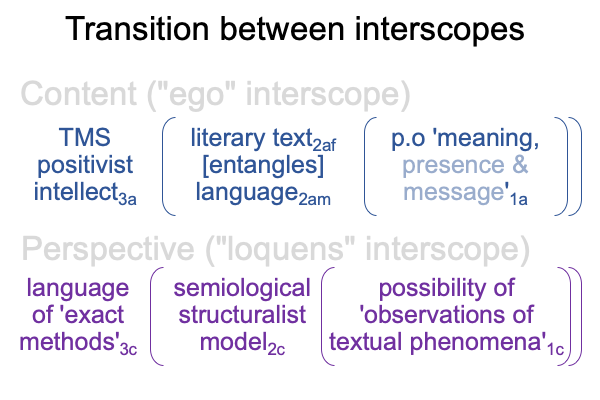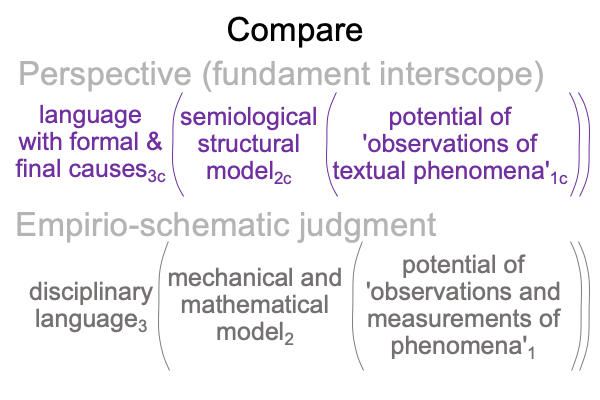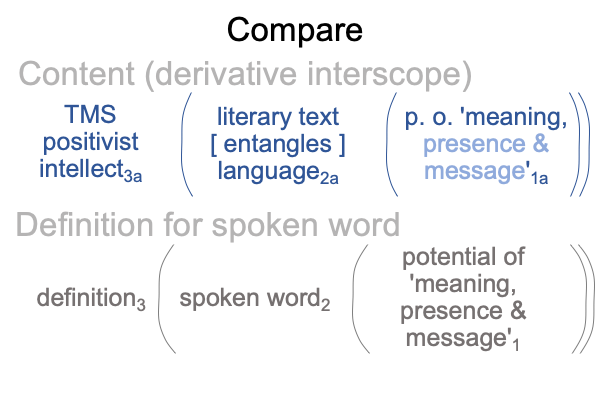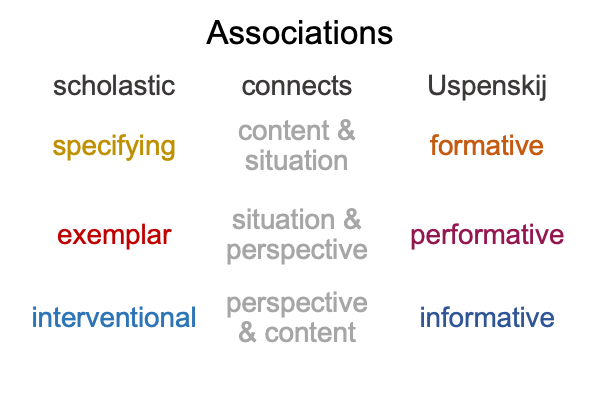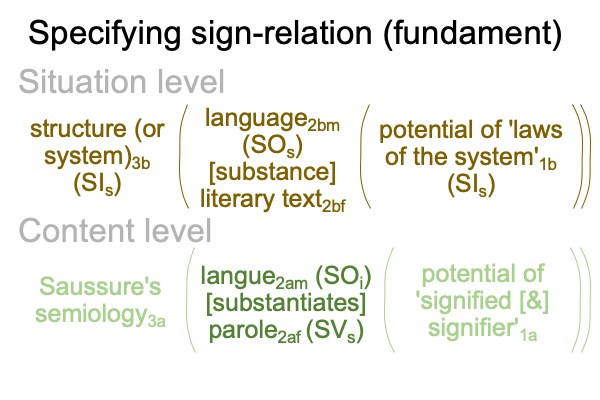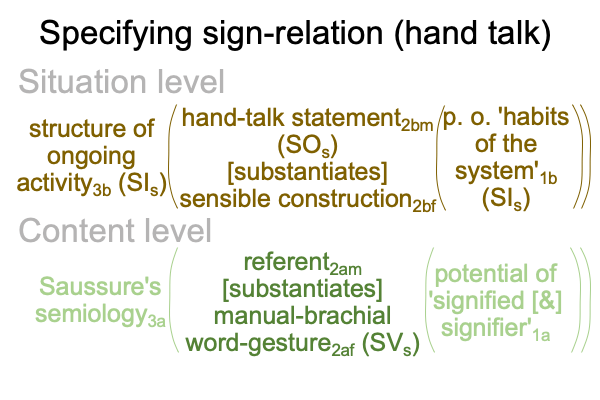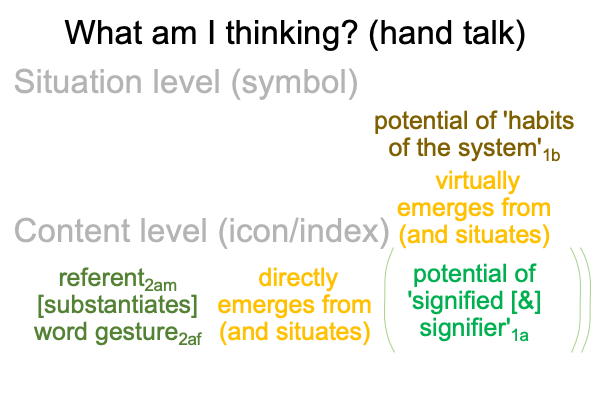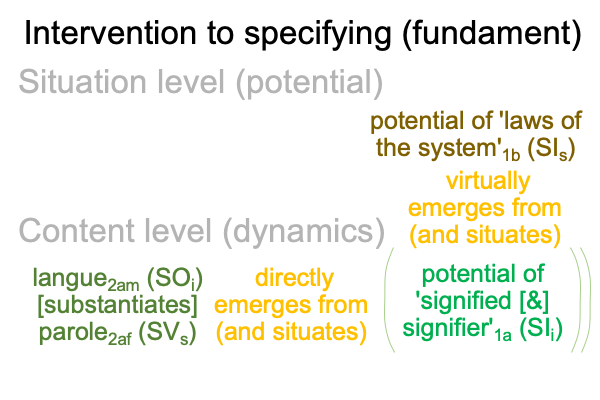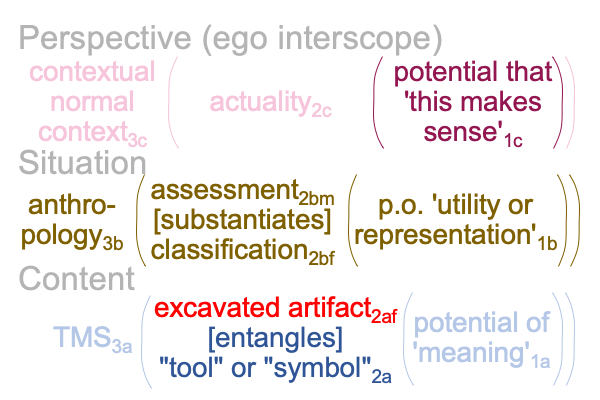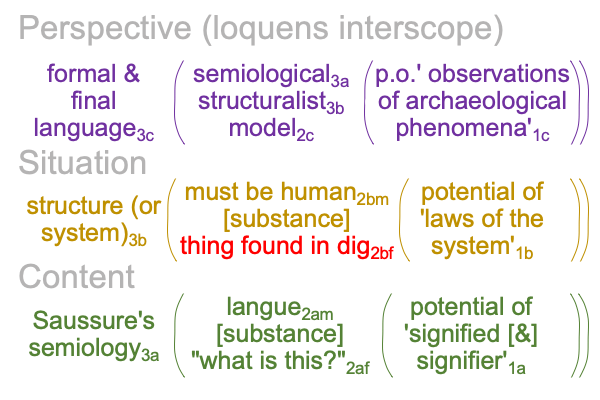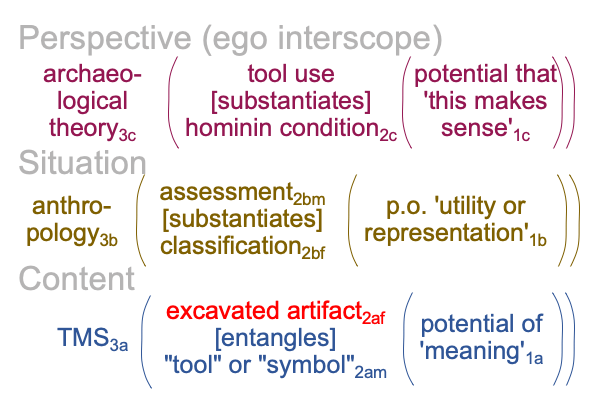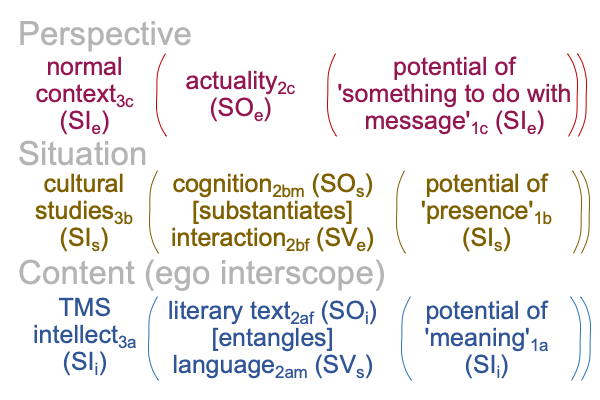
0062 In the second section, the author offers a Thomistic account of original justice.
Aquinas starts with the fundamental states of human existence.
Here are my associations.
0063 A state of innocence associates to original justice.
“Justice”?
Yeah, I heard that word used, before. I also heard it misused. After all, any spoken word is simply a placeholder in a system of differences. Shift the system of differences and the word adjusts. If I put the word, “justice”, as the focus (A) of a Greimas square, what do I get?
Perhaps, the following will do.
0064 The focal word (A) is “justice”.
Injustice (B) contrasts with justice (A).
Well-governed (C) speaks against (contradicts) injustice (B) and complements justice (A).
Here, I may add that well-governed includes self-governed.
Ungovernable (D) contrasts with well-governed (C), speaks against justice (A) and complements injustice (B).
0065 How curious.
That seems to work well.
Now, let me turn the nouns into adjectives to further illuminate a distinction hidden within the horizontal dimension.
0066 With this figure in mind, I consider what the author says about Aquinas’s teaching concerning the relation of both (1) prelapsarian adamah to God and (2) of parts within the hominin. As to (1), the highest in the innocent person is subject to God. As to (2), the hominin exhibits a certain rectification of order in interior disposition. The inferior powers of the soul (and body) are subject to the superior.
0067 A well-governed body (C) complements a just soul (A).
0068 While many imagine that Aquinas discusses an idealized philosopher, whose, if I remember correctly, members are supposed to be subject to logical reason, when one starts to grasp that Aquinas’s teaching applies to people, who would scare the wits out of any civilized person, yet would welcome that civilized person as one of their own (and if not that, eat him), then we are looking at, as Graeber and Wengrow put it, “the dawn of everything”.
Or “the dawn of everything that moderns never imagined possible”.
0069 The noble savage is noble because he is innocent?
Does Aquinas’s teaching, applied to the Lebenswelt that we evolved in, predict darwinian social and sexual selection favoring those who are just within their social circles and those who can govern their bodies in ways that modern athletes of all sports would admire?
It is as if each person contains his own society, with diverse factions (parts and appetites and tendencies) that need to be governed (that is, made whole). The challenge requires both material and immaterial (that is, relational) training. The relational entangles the material. The material entangles the relational.
0070 The lesson applies to more than the body and soul of each individual.
It applies to the social circles as well. Social circles work in harmony.
If they don’t, then natural selection works its scythe.
Hominins adapt to survive in Aquinas’s state of innocence.
0071 For physical anthropologists, a familiar instance of a whole bringing its parts into being through proper governanceis the Oldowan stone tool.
The Oldowan stone tool is made on the spot by hitting one stone against another in a specific manner, causing the target stone to fracture. After a series of blows, the target stone expresses a sharp, jagged edge, making the stone tool like a giant tooth, capable of stripping muscle off bone and cracking long bones in order to expose the marrow fat.
0072 What is going on?
The whole stone on the left has within it, parts that are removed when struck, with good aim, by another rock. The result is the Oldowan stone tool on the right.
If I go back to Aquinas’s Greimas square and replace “soul” with “aim” and “body” with “stone”, then I obtain another way to appreciate the implications of Aquinas’s formulation.
0073 Without a doubt, Aquinas idealizes the prelapsarian adamah, because he works from the Biblical text, written in Latin, not in the common vernacular. He also examines philosophical texts, translated from Arabic to Latin. He “baptizes” Aristotle and other ancient Greek philosophers. So, the prelapsarian Adam seems like an incredible person, just like the philosophers of old.
0074 Aquinas lives two centuries before the Europeans “discover” the Americas, populated by peoples who were exposed to speech-alone talking civilizations, but were not quite ready to surrender their happy-go-lucky hand-speech talking ways. These hand-speech talking folk appear radically naive to the Europeans. Some might say that the descriptor, “original innocence”, applies to the North American Plains Indians. They have no idea that Eurasian civilizations are three-thousand years older than the earliest American civilizations.
Late-medieval Europeans are shocked by reports of life in the Americas. Indeed, early modern Europeans are dismayed after some of these hand-speech talking Americans learn European languages and say, “Y’all are the most miserable creatures that I can imagine.”
0075 Once this connection is made, everything changes.
Aquinas’s exploration into the nature of the prelapsarian adamah does not apply to some sort of philosopher king. It applies to a noble savage. Even weirder, it applies to noble savages who could not express the qualifier, “noble”, using hand-talk. No, these savages embody everything that makes humans noble. But, they have no gesture-word corresponding to the speech-alone term, “noble”.
What is there to picture and point to?
0076 The conceptual shift is jarring, accounting for John Paul II’s use of Aquinas as a soapbox on which to stand while proclaiming “biblical teachings” from passages of Genesis that must be regarded as prelapsarian. The Genesis passages point to a Lebenswelt on the other side of the first singularity, to a time when we are who we evolved to be.
John Paul II suspects, but does not articulate, that the soap-box on which he stands contains a pot of conceptual gold.
0077 How can that stone, lying next to the partially eaten remains of… a dead wildebeest… say, “I am the target stone that contains, within me, the sharp edges that will provide the toothiness you need to scrape dried meat from ligaments and crack long bones to get the marrow fat.”?
Even the stones cry out.
Grace inflows nature.
The hominin knows, at a glance, that this stone will do. After a few sharp blows, the Oldowan tool is in hand, ready for work. Other members of the team stand by, also holding little stones, watching for any sight of a curious predator. Yet, potentially disruptive predators know that these hominins can injure from a distance. There is nothing quite as unforgiving as a well-thrown stone.
0078 Yes, grace is everywhere. It flows through the scene, where a team of hominins scavenge from the corpse of a wildebeest, in the open, on the savannah, which is a dangerous place to linger. No one works alone. Everyone belongs to the team. Without grace, the lucky find would be worthless.
0079 Thomas Aquinas has no knowledge in regards to the scientific construct of evolutionary theory.
He has no idea about the impending “discovery” of a new continent, standing to the west, between Europe and India. He has no idea that this new continent is filled with people that start trending towards civilization around 3000 U0′, rather than 0 U0′.
He has no information about ancient civilizations that lasted hundreds, even thousands of years, in the Near East, only to leave dusty hills containing royal libraries of cuneiform clay tablets, fired into bricks.
0080 What does Aquinas know?
The Genesis stories of Adam and Eve offer clues.
Aquinas portrays Adam and Eve as individuals, in the state of original justice. Original justice manifests as a rectitude of order among the parts of the sovereign person, who is ultimately wholly grounded in the rectitude of an order towards God.
This seems like a metaphor for royalty to me.
There is no rebelliousness within the kingdom.
The passions among the parts (the people) do not conflict with the soul’s (the king’s) dominion.
Indeed, the reasoned judgment of the soul (the king) cultivates and trains the expression of passions (among the people) in order for the person (the kingdom) to survive and flourish.
0081 How does the double (personal and political) vision of Aquinas key into the Lebenswelt that we evolved in?
0082 In Comments on Clive Gamble, John Gowlett and Robin Dunbar’s Book (2014) Thinking Big (by Razie Mah, available at smashwords and other e-book venues), the authors of the reviewed book make great hay over Robin Dunbar’s formula correlating mammalian brain size to group size. The hominin brain to body mass ratio increases significantly in the millions of years from the southern apes to Homo sapiens. So does group size. Hominins start as bands (50) and end up with communities (150), with higher resonances, all the way to tribe (1500).
The idea of group size resonances occurring at factors of three plays a role in their argument. However, the authors of the reviewed book do not realize that the evolution of talk might occur within one social circle (the team), then later expand to the entire group (the community) when circumstances change. Hand talk is locked within the team for over a million years, until the domestication of fire offers a platform for talking itself: gossip after a fire-cooked meal.
Well, hand talk covers more than gossip. Over time, hand-talk becomes fully linguistic, allowing the proclamation of grammatically correct yet counter-intuitive statements, such as “the raven gathers pebbles from the creek”. In hand talk, the statement is grammatically correct. But, it does not make much sense, because ravens don’t swim.
0083 Here is a picture of the various social circles in operation in the Lebenswelt that we evolved in.
0084 Each social circle exhibits its own relational logic. Each social circle is a site for natural selection of individuals suitable for that social circle. This includes diverse teams. Over generations, each long-lasting successful exercise of obligate collaborative foraging selects for adaptations, including neural and muscular, that make the team activity more productive and more fun. For example, the physics of rock fragmentation becomes intuitively natural, for some, eventually leading to the invention of a new stone tool technology, the Acheulean stone tool, that is made ahead of time and carried along in the team activity.
0085 Team activity?
Hominins figure out all sorts of ways to obtain food that does not conflict with the interests of other creatures.
For example, bury a lot of overripe fruit, then wait a few weeks. The hole is now full of delicious edible bugs. The creativity of our ancestors must have been incredible. Their range of culinary traditions may put our own to shame. Each successful team selects for its own adaptations, both anatomical and physiological, making its exercise of obligatory collaborative foraging more… um… “natural”. No wonder the size of the hominin neocortex expands over time, along with group size. It’s like a giant menu of what and how to eat.
As well as what and how to avoid being eaten.
0086 Is this where Aquinas comes into the picture?
Aquinas’s double vision is both personal and political. The prelapsarian adamah is both a kingdom of parts and a sovereign over a kingdom. Plus, this sovereign answers to the order of God.
Consider each social circle to be an individual writ large. Consider the individual hominin as a social circle writ small. Each social circle has its own nature and grace. Each person has his or her own nature and grace.
0087 Does Aquinas know that the term, “Adam”, in Genesis, is a pun, meaning both “humanity” (adamah) and “an individual’s name” (Adam)?
Certainly, his political-personal approach calls to mind a harmony of the social circles, where higher social circles operate as sovereign, and lower social circles operate as the kingdom of parts. Plus, the higher social circles are always aware of an order higher than their own.
0088 Now comes the kicker.
A perfect or complete justness within the souls of the social circles associate to a more perfect or complete governance of the bodies of the social circles, so that the whole and the parts are (relatively speaking) immortal. Surely, the people who compose the social circles are mortal. But, the bodies of the social circles are not mortal. So, adamah is immortal, even though Adam is not. Yet, adamah is Adam and Adam is adamah.
0089 To me, the immortal harmony of the social circles, selected through cultural (for each expression of a social circle) and natural (for individuals with aptitudes for being productive and having fun within social circles) selection, corresponds to the tree of life, in the garden of Eden. The mortality of the person resides within the immortality of the tree of life. We (hominins) are the roots. We are the fruits of the tree of life. Plus, the tree of life grows in a garden ordained by God.
Culture and hominins co-evolve.
0090 Yes, this evolution-informed vision is different than an immortal Adam, as some sort of philosopher king, ruling over all the parts of his body, while remaining ordered to the rectitude of God.
Certainly, it sounds different and more research is needed.
But, my goal is only to establish a principle that is intimated by John Paul II’s theology of the body.
The ethos of the gift is a phenotypic expression of our species, because the trait is an adaptation to the gift, as a triadic relation.
0091 Once one starts to fill in the cognitive blanks about human origins that have been opened during the past eight centuries…. as soon as one tries to translate what Aquinas says about the prelapsarian Adam into the evolution of adamah, humanity, in the double framework of the souls and the bodies of mortal beings participating in the souls and bodies of intergenerational beings,composed of diverse and nested (not so much hierarchical) social circles that promote the survival and flourishing of its participants… does one begin to appreciate the intellectual daring of John Paul II’s proclamation of a blessed, holistic and Christian theology of the body.
0092 At this point, I examine the fourth section, covering John Paul II’s integration of original innocence and the ethos of the gift.
To start, take a pencil and strike out the word, “perfect”, and replace it with the word, “complete”.
Why do I do this?
I know a few perfectionists, and they are not completionists. Completion means fulfillment of an intention. An oak tree is the fulfillment of the intention of an acorn. The oak tree completes the acorn.
0093 Aquinas mentions three states of humans. The following figure shows how the terms associate to biblical teachings, the hypothesis first singularity, and to Alexander Dugin’s political theology.
0094 Well, maybe the above figure overstates the importance of the hypothesis of the first singularity and Alexander Dugin’s political theology. I mean, look at the three items for glory. There is no way that they are equivalent.
I am sure that Pope John Paul II, looking down from his heavenly perch, chuckles at the folly.
0095 John Paul II refers to humans before original sin as living in a state of innocence and receiving the gift of grace. Current Christian philosophy and theology have yet to grasp the implications. What is the nature of the Lebenswelt that we evolved in?
Aquinas’s account of original justice seems a little too academic. The state of innocence involves a complete ordering of the lower parts of man by that which is highest in him. The rule of the soul over the body may be simultaneously labeled “self-mastery” and “interior freedom”.
0096 Too academic?
Doesn’t Aquinas’s account follow the rules of the Greimas square?
0097 Well, yes.
Nevertheless, Aquinas’s explicit abstractions defy the experiences of modern civilized folk… until… “man” is replaced the the term, “adamah”. “Humanity” adapts to social circles, each of which offers opportunities to exploit and dangers to overcome. The harmony among these social circles corresponds to the higher parts ordering the lower parts, allowing all social circles to flourish and adapt.
In short, adamah is the human writ large, just as Adam is adamah writ small.
0098 In our current Lebenswelt of unconstrained social complexity, social circles translate into institutions and organizations. See A Primer on How Institutions Think, by Razie Mah, available at smashwords and other e-book venues.
0099 Self-mastery is required to participate in each social circle. Plus, social circles celebrate interior freedom. No one forces a person to join one team or another, even though an evolutionary anthropologist may call teamwork, “obligatory collaborative foraging”. Social circles celebrate the responsibility to make a choice as to which team to participate in.
I call the distinction between freedom and responsibility a “co-opposition”.
Responsibility3 serves as a normal context for the possibility of freedom1.
Freedom3 serves as a normal context for the potential of responsibility1.
The integration of the person and social circles ranges from the male-female bond that founds each family (5) to the elders who arrange and negotiate occasional gatherings of communities (1500). Participation is a gift. Willingness to participate gives peace of mind. Participation generates productivity and fun.
Participation3 serves as a normal context for the possibility of purpose1.
Purpose3 serves as a normal context for the potential of participation1.
0100 Of course, Pope John Paul II does not know the hypothesis that the human niche is the potential of triadic relations.
Yet, he focuses on a relation that is undeniably relevant to natural selection. For our lineage, male-female pair-bonding is evolutionarily ancient, perhaps starting as a co-adaptation that contributes to a successful transition to bipedalism.
0101 How so?
Bipedalism evolves to facilitate transit between widely separated regions of seasonally rich resources, characteristic of the ecology of mixed forest and savannah.
0102 The problem?
The female cannot walk long distances and forage and feed her children by herself.
0103 The solution?
The male adapts to become the female’s helper.
“The marriage deal” is an evolutionary concept discussed in The First and Second Primers on the Organization Tier, as well as A Primer on the Family. The male offers protection and provisioning. The female offers fidelity. Without fidelity, the genes of the protective and provisioning male do not make it to the next generation. So, fidelity is key to “the marriage deal”.
Further adaptations, both organically and culturally, serve to increase the benefits of the marriage deal.
0104 Of course, a scientific discussion of the so-called “marriage deal” does not compare to the theological rhetoric of Pope John Paul II, where the communion of male and female in mutual self-giving is congruent with adamah’s original happiness. But, such scientific discussion suggests that the rhetoric applies to the Lebenswelt that we evolved in.
0105 Big time!
The pope’s treatment of marriage applies to every social circle. Maybe not so romantically. But, definitely so practically. Every social circle entails giving and receiving, because the triadic relation of the gift is intrinsic to its operation. The human niche is the potential of triadic relations.
0106 In Theology of the Body, Pope John Paul II proposes that original innocence entails a gift of holiness given to man and to woman, enabling them to participate in the inner life of God, through their radical giving of self to one another, in purity of heart.
He concludes that the ethos of the gift may serve as the basis for a truly adequate anthropology.
0107 To this examiner, Pope John Paul II stands on the soapbox of the theology of Thomas Aquinas. He proclaims biblical teaching.
At the same time, he points toward the prelapsarian Adam… or adamah… and subtly suggests that a truly adequate anthropology may be found in… an application of Aquinas’s metaphysics and biblical teaching to who we evolved to be.
0108 Male and female we evolved to be?
And more…
Male and female in mutual self-giving, we evolved to be.
0109 Here is a picture with another way to appreciate the relation between John Paul II’s specific application and the broad application that The Theology of the Body intimates.
This schema may be applied to all social circles.
0110 Adamah is “humanity”, when the hominin and the social circle may be distinguished but not separated. Adamah do not articulate triadic relations using explicit abstractions. Rather, adamah live them and, over generations, adapt to them. We live by implicit abstraction. Implicit abstractions are built into our souls and bodies. Adamah associates to the “image of God” of Genesis verses 1:26-31.
0111 The foundational social circles are family (5) and friends (5).
The social circle for obligatory collaborative foraging is the team (15). Here is where our lineage learns to be productive and have fun. Proto-linguistic hand talk is an adaptation to teams. Teams engage in sensible construction.
The social circle that provides safety in numbers in travel and at night is the band (50).
The social circle that brings harmony to diverse teams is the community (150). Here is where we learned to be more than productive and experience more than fun. Fully linguistic hand talk is an adaptation to community. Communities engage in social construction. Social construction is the meaning underlying the term, “religion”.
0112 The social circle that gathers bands and communities in seasonal celebrations is the mega-band (500). Here is where singing is first used for social synchronization. The gathering cannot last long, in order to avoid disease. So, rapid social synchronization is required.
Once the voice is under voluntary control due to social and sexual selection, the voice is exapted at the start of our own species, Homo sapiens, over 200,000 years ago. Humans practice hand-speech talk until the first singularity.
The social circle that calls for wisdom and offers deep witness to the signs of The One Who Hand Talks the World Itself is the tribe. The tribe is a linguistic community.
0113 Unbeknownst to Pope John Paul II, a theology of original innocence as a disposition towards interpersonal self-giving may be precisely the metaphysics needed to conceptually elucidate the dynamic harmonies within and among social circles that characterize hominin evolution.
0114 Man is not meant to be alone, as a radical individual, whose sexuality is a tool to satisfy “needs”, according to some theoretical -ismist construction.
Yet, man is alone, caught in a web of explicit abstractions promising to solve his alienation, by incorporating him into an idea, an “-ism”, concocted by some “Western Enlightenment inspired” political philosopher. If he buys into the agenda, then he may be a person, among an ideologically defined people.
Such theory may be technically correct, but it is wholly misleading. Now, -ismists are increasingly discredited.
0115 In our current Lebenswelt, we live in the state of original sin.
We are not alone in contemplating our condition.
Alexander Dugin calls for a fourth political theory.
Pope John Paul II offers a theology that complements Dugin’s vision.
Dugin offers a political theory that complements the pope’s theology.
0116 Just beyond Adam, representing our current Lebenswelt, there is adamah, prelapsarian humanity, representing the Lebenswelt that we evolved to be. Philosophical inquiry into biblical teaching may allow us to see that humans and social circles co-evolve, so man was never meant to be alone.
The people are beginning to realize that the -ismists are wrong, the narod is where we could be, and the ethnos is where we can never return to. We long to return. But, we cannot. So turn around and see what God has to offer.
0117 Perhaps, now, in a confused and exploratory fashion, we can modify our scientific interpretation of human evolutionand stand on Aquinas’s soapbox just like the the pope does, and greet the prelapsarian adamah, as who we evolved to be.
0118 My thanks to the author for publishing an article worthy of examination.
Surely, this examiner goes to places that the author never envisioned.
Such is the way of scholastic inquiry. Commentaries follow commentaries. Then, everything changes.
0001 The full title of the work before me is The Tower of Babel Moment: Lore, Language, Leibniz, and Lunacy. The author is one of the wandering stars of our current age, an era when academics award more doctorates than any job market can absorb. Professors with sharp elbows occupy the few available academic positions, leaving brilliant and successful graduates, the ones with sharp minds, to find places in heaven knows where.
Farrell finds a spot on the internet, that once verdant pasture of free expression, and establishes his own scholastic exploration outside of modern institutional constraints. In short, he founds his own school. Those who listen to his voice offer remuneration. God bless all concerned.
0002 The work before me offers speculation on the nature of the titular biblical story.
Farrell proceeds by way of a spiral staircase of observations and… may I say?.. expansive “measurements”. Measurements of what? The literature of the seventeenth century? The titans of the late Renaissance? Yes, that will do.
0003 My goal in this examination is to shoehorn Farrell’s exploration into a category-based nested form composed of category-based nested forms. The interscope is elaborated in A Primer on Sensible and Social Construction, by Razie Mah, available at smashwords and other e-book venues. Of all procrustean beds that I have at my disposal, the interscope is most accommodating.
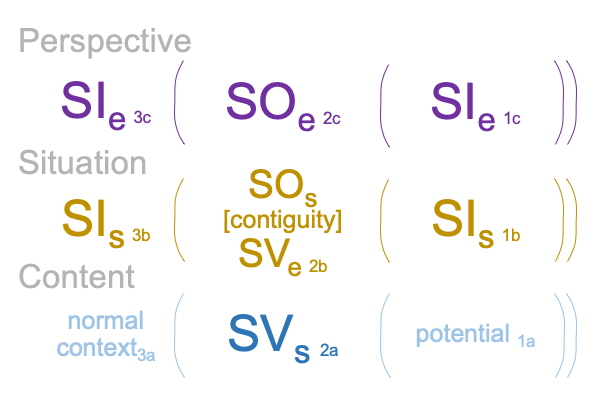
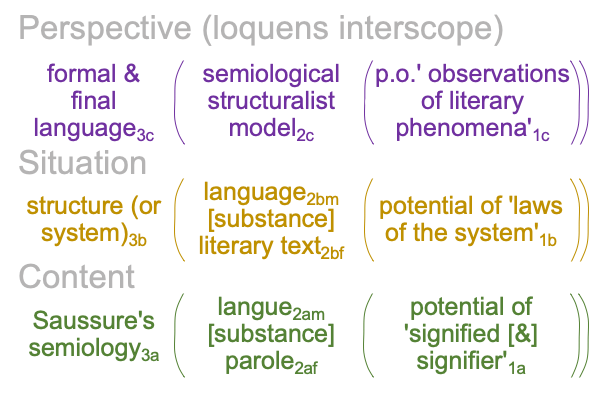
Here is a diagram of the interscope.
0004 The method is simple. First, associate features of Farrell’s argument to elements in the above matrix. Second, discuss the implications.
Each nested form consists of four statements, the most paradigmatic of which goes like this. A normal context3 brings an actuality2 into relation with the possibilities inherent in ‘something’1. The subscripts refer to the categories of Charles Peirce. Thirdness brings secondness into relation with firstness.
The nested form is fractal. An interscope is a category-based nested form composed of category-based nested forms. A two-level interscope associates with sensible construction. A three-level interscope corresponds to social construction. Note how the labels change from 1, 2 and 3 to a, b, and c.
The three-level interscope allows the visualization of virtual nested forms, composed of elements within one column. For example, the virtual nested form in the realm of actuality turns the second column into a category-based nested form,where a perspective-level actuality2c (as virtual normal context) brings a situation-level actuality2b (as virtual actuality) into relation with a content-level actuality2a (as virtual potential).
0005 Farrell opens chapter one with his personal discovery of Leonard Bernstein’s recorded lectures, titled “The Unanswered Question”. In these lectures, Bernstein discusses Noam Chomsky, who has his own unanswered questions. Chomsky, in turn, provokes Farrell to ask his own unanswered question, “How do linguists go about demonstrating linguistic universals?”
A universal may be regarded as an observable feature “measurably” appearing in all spoken languages.
0006 Phonologists find common observable features in the sounds of speech. Common sounds are attributed to the anatomy of the head and neck.
Etymologists find common observable features in closely related words in different languages. The words are similar and not identical, because they arise from isolation and drift among speaking populations, in a manner similar to biology’s slogan, “descent with modification”.
0007 The key?
Universals imply common origins. For phonologists, the universal is biological. For the linguist, the universal is… perhaps lost… in the recesses of time.
0008 A dramatic hypothesis stands against this key. A sudden change may destroy the common language of humanity. That change may be labeled, “A Tower of Babel Moment”.
0009 Years ago, Farrell proposes a wider context to this type of hypothesis. The scenario includes ancient cosmic wars and world grids. But, these are other books, and other matters, than the text at hand.
0010 So, before going on to chapter two, let me draw some associations.
On the content level, the normal context is language3a. The actuality may be called a “topology”, or a map of all spoken languages2a. The potential is that universals imply common origins1a.
The normal context of language3a brings the actuality of cross-language maps2a into relation with the potential of ‘the idea that universals imply common origins’1a.
On the situation level, the normal context is a civilizational moment3b. The actuality is the Tower of Babel (the biblical story)2b. The possibility is ‘discontinuity’1b.
The normal context of a civilizational moment3bbrings the actuality of the story in Genesis 112b into relation with the potential of a discontinuity1b that corresponds to God confounding the common language of the plains of Shinar.