0163 A quick review is in order.
0164 The literary scholars in the exploratory, transnational collaborations during the so-called “Cold War” attempt to construct paradigms for language and literature compatible with the regime-promoted association between the terms, “socialist” and “scientific”. These experts do not want their subject of study to be usurped by reductionist paradigms in the “human sciences”. They do not want literary texts to be regarded as phenomena of a sociological, a psychological or a communication-based noumenon.
0165 They do not have Peirce’s method of diagramming relations by way of category.
So, they adopt the intellectual tools-at-hand, including Saussure’s semiology and its cohort, structuralism. Structuralism is a thing, where {semiology as matter [substantiates] aesthetics as form}. The problem, of course, is that aesthetics as form entangles the Marxist thing as matter. The Marxist thing? Material arrangements as matter [substantiate] human conditions as form.
0166 But, that does not stop them.
They figure that they will have to deal with the confounding as it manifests in real time.
They are fully aware of the danger that their research aiming to satisfy the regime’s intellectual mandates may end up triggering the regime’s not-so-intellectual reactionaries.
They are heroic, in this regard.
0167 Semiotics unfolds in history.
Sign systems develop.
The timeframe has reached the 1960s through the 1980s.
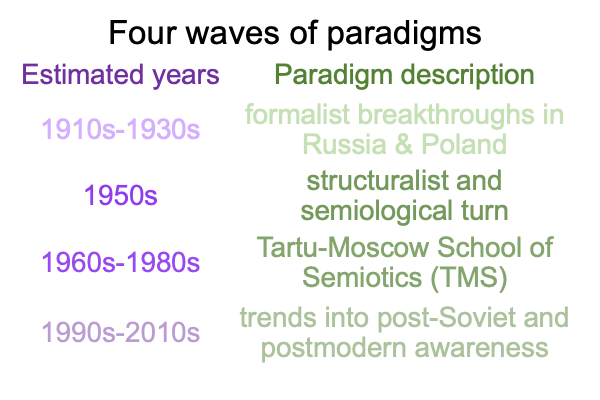
0168 The Tartu-Moscow School unwittingly constellates the fundament interscope, sensibly building from Saussure’s semiology3a to structuralism3b, then socially constructing a disciplinary language3c that supports models2c that apply to the potential of observations of textual phenomena1c.
The article under examination is devoted to this period in history.
Yet, only the transnational perspective makes it to the subtitle.
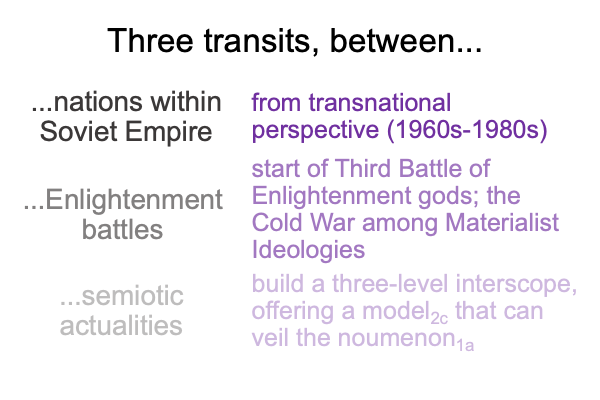
0169 At this point, I would like to go through the fundament interscope.
First, structuralism3b situates semiology3a.
Here is a picture.
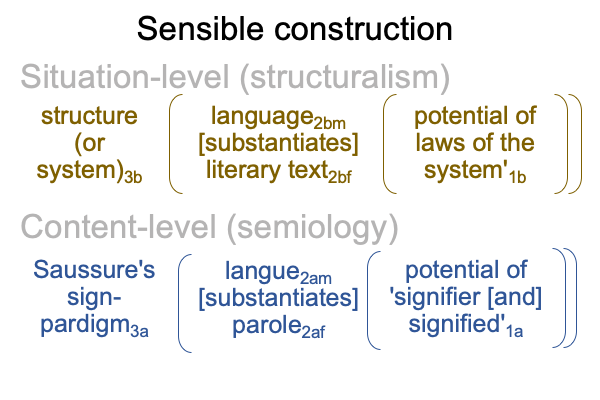
0170 On the content level, the normal context of Saussure’s sign paradigm3a brings the actuality of the hylomorphic dyad, {langue as matter2am [substantiates] parole as form2af}, into relation with the potential of ‘a signified [and] a signifier’1a.
On the situation level, the structure (or the system associated with genre, style and so forth)3b brings the actuality of a hylomorphic dyad, {language as matter2bm [substantiates] a literary text as form2bf}, into relation with the potential ‘laws of the system’1b.
0171 This is a sensible construction.
I now ask, “Does this two-level interscope comport with the slogan that structuralism as a thing is composed of semiology as matter and aesthetics as form?”
0172 The answer must be equivocal.
On one hand, the answer is “Yes, structuralism3b situates semiology3b and so I could say that semiology3a is like matter that enters into an aesthetic system3b as a form.”
On the other hand, the answer is “No. Where in modern literature does aesthetics as form manifest a structure or system3b?”
0173 Okay, maybe, the answer might not be equivocal.