0174 The history of literary structuralism, as portrayed in sections one through three (1-3) may be rendered as the embodiment of a three-level interscope.
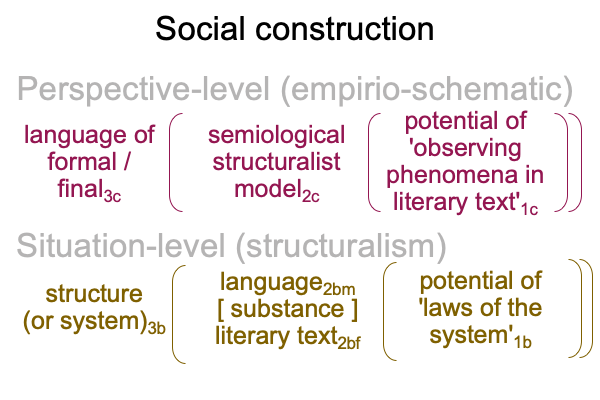
All I need to do is add a respectable level3c to put the sensible construction of structuralism3b and semiology3a into perspective3c.
By “respectable”, I mean that it looks a lot like an unfolded empirio-schematic judgment.
After all, science is what the most “socialist” of Soviet academics are looking for.
0175 Here is the resulting social construction.
0176 Well, that was easy.
A perspective level contextualizes the situation level of the fundament interscope.
The normal context of a disciplinary language (that includes formal and final causation, along with material and efficient causation)3c brings a semiological3a structuralist3b model2c into relation with the potential of ‘observing phenomena in a literary text’1c.
0177 Ironically, a complete three-level interscope corresponds to langue, according to Razie Mah’s e-book, Comments on Robert Berwick and Noam Chomsky’s Book (2016) Why Only Us? (available at smashwords and other e-book venues).
0178 Of course, this claim is not obvious.
But, the proposal addresses very important questions, asking, “Is langue a purely relational category-based structure? Do all humans share this purely relational structure? Does grammar for all spoken languages assist in filling in the empty slots for a three-level interscope? Finally, once all the slots are filled in, does that constitute a complete thought?”
0179 If the answers are affirmative, then the three-level interscope diagrammed below constitutes a complete thought,that is, a way of approaching a subject that comports with human intuition. (And, isn’t that what Aristotle’s tradition does best?)
Once again, here is a diagram of the fundament interscope.
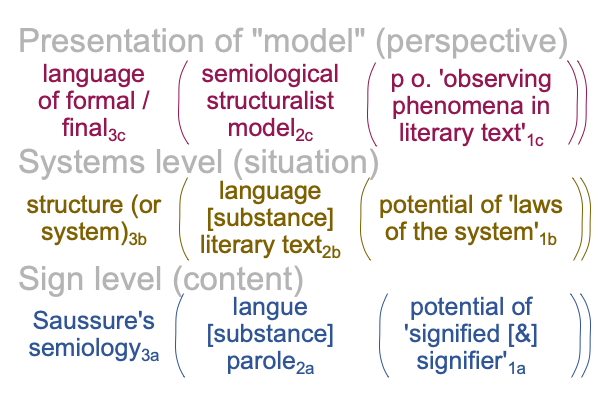
0180 Notably, the perspective level of this three-level interscope derives from the empirio-schematic judgment. The model2c cannot be rejected by the guardians of Soviet
Socialist respectability. (And, isn’t that necessary in a political system that idealizes itself as “scientific”, as opposed to “superstitious”?)
0181 The perspective level presents an actuality2c that will overlay the noumenon, the thing itself, in a category-based nested form that corresponds to the Positivist’s judgment.
0182 The Positivist’s judgment? Unfolded into a category-based nested form?
The triadic normal context of a not-religious intellect3a brings an empirio-schematic judgment2a into relation the possibility of ‘a noumenon [that cannot be objectified as] its phenomena’1(2e).
Here is a picture for the Literary Positivist.
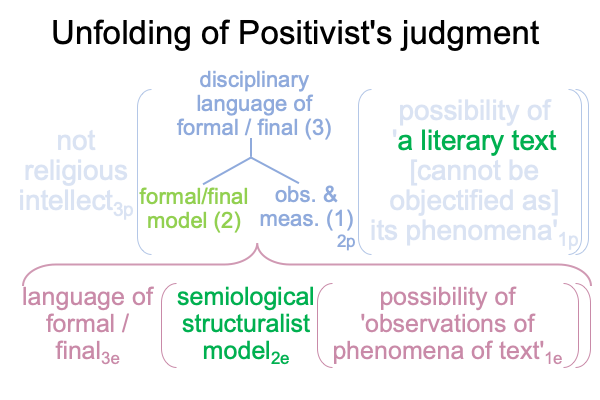
0184 The thing itself is the literary text2af.
But, as with triumphalist science, a model2c is destined to replace the literary text2af – or at least reconfigure its potential – for the content-level of an interscope that is derivative to the fundament interscope.
0185 In other words, the perspective-level of the fundament interscope grounds the content-level of the derivative interscope, on an adjacent higher level of inquiry.
Why?
0186 The empirio-schematic judgment is what ought to be (secondness) for the Positivist’s judgment.
So, substituting a hylomorphe2a into the slot for the empirio-schematic judgment2a significantly alters the Literary Positivist’s judgment.
0187 All in all, a confounding reconfigures the Literary Positivist’s judgment.
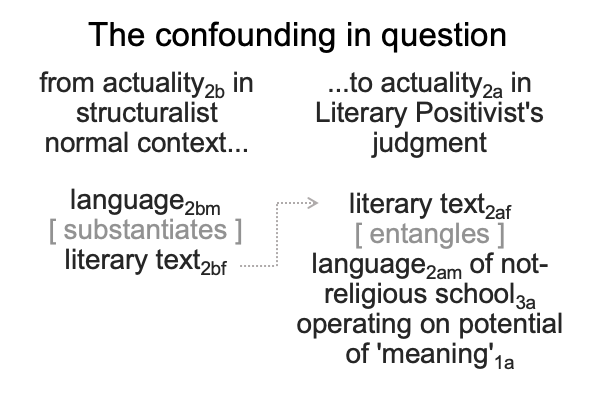
0188 To this substitution, I now attend.