0189 A virtual nested form runs down each column in a three-level interscope.
Here is the virtual nested form in secondness for the fundament, along with the hylomorphe2a that I propose should go into the actuality2a of a modified Positivist’s judgment.
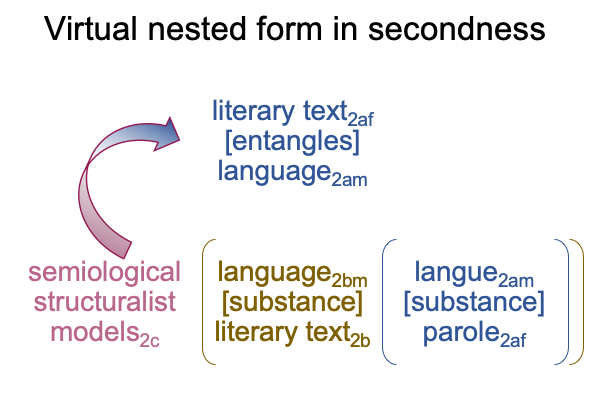
0190 The virtual normal context of a structuralist model2c brings the situation-level actuality of {language [substance] literary text}2b into relation with the potential of the content-level actuality of {langue [substance] parole}2a.
This virtual nested form supports an entanglement2a that will replace what ought to be2a (secondness) and remodel the Positivist’s judgment.
0191 Does this make sense?
A writer puts pen to paper.
In doing so langue2am (what is going on in one’s head, talking to oneself) as matter [substantiates] written words as form2af.
This act is virtually situated by {language2bm [substantiating] the literary text2bf}, arising from the potential of ‘the laws of the system’1b.
Then, the literary text2bf may be contextualized by a structuralist model2c, formulated by an expert in linguistics and literature.
0192 But, what is a structuralist model2c?
Perhaps, I can say that a structuralist model2c encourages an entanglement: {literary text as form [entangling] academic language as matter}2a.
0193 To start, the semiological structuralist model2c contextualizes the text2bf (as a situation-level form) even as it substitutes for the text2af (that is, the model2c overlays the noumenon1a).
Next, the substitution shifts the model2c overlaying its noumenon1a out of the realm of possibility1 and into the realm of actuality2, as a form2af that entangles matter2am.
0194 The above figure portrays what I am trying to convey.
0195 Notably, the empirio-schematic judgment has not disappeared. Rather, it has take a life of its own, as one might expect when material and efficient causalities are no longer truncated of related formal and final causations.
0196 What about potential1a for a remodeled Positivist’s judgment?
In the following figure, the virtual nested form in firstness for the fundament supports a content-level potential1a for the derivative.
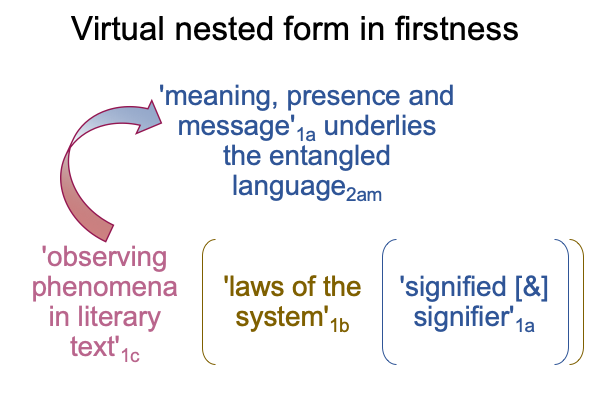
0197 The virtual normal context of ‘observing phenomena in a literary text’1c brings the actuality of ‘laws of the system’1b into relation with the potential of ‘Saussure’s formulation of signifier and signified’1a.
0198 Now, the fact that langue and parole2a (as actuality2a) belong to the normal context of Saussure’s semiology3a, means that each spoken word has “closely related placeholders” in two arbitrarily related systems of differences. The Greimas square turns out to be useful for isolating a particular word or term from nearby words and terms. But, that does not solve the concern that each instantiation2a of {a langue as matter [substantiates] a parole as form}2a sits squarely in a network of arbitrary relations3a.
The concern is mollified, to a certain extent, by the impression that the dyad, {signifier [and] signified}1a, is not arbitrary. It is intuitive and referential.
0199 Why does the human mind generate that impression?
As it turns out, according to Razie Mah’s e-book, The Human Niche, language (as defined by Saussure) evolves in the milieu of hand talk. Hand talk connects a manual-brachial word-gesture (signifier) to a pre-existing referent (signified) through Peirce’s icons and indexes. Pantomime is iconic. Pointing is indexal. After gestures that pantomime and pointare routinized, they becomes symbols. From Saussure’s linguistic point of view, language requires symbols in order to operate. Indeed, grammar consists in symbolic operations within a fixed system of differences.
0200 No one in the 1960s or the 1980s knows this.
However, the literary circles of the USSR intuitively discern the correct potentials.
The potential for ‘laws of any language’1b virtually situates the potential that the signifier pictures or points to its signified1a, even when parole2af and langue2am are explicit abstractions and the spoken word2bf cannot picture or point to its… um…
What was I saying?
0201 While {langue2am [substantiating] parole2af} directly situates the potential of ‘signifier and signified’1a, the potential of ‘laws of the system ‘1b virtually situates the same potential1a. Plus, these laws1b define the way that the inquirer observes phenomena in a literary text1c.
0202 Well, maybe the word, “define”, may be inadequate, but the term appears in a nested form that is foundational for Razie Mah’s e-book, How To Define The Word “Religion” (available at smashwords and other e-book venues).
The normal context of definition3 brings the actuality of a spoken word2 into relation with the possibilities of ‘meaning, presence and message’1.
0203 May I substitute the adjective “written” for “spoken”?
To me, this implies that the possibilities inherent in ‘observing phenomena in the literary text’1c launches the potential of ‘meanings, presences and messages that underlie the definitions of the entangled language’1a.
Consult the above figure.
0204 The virtual nested form in the category of thirdness depicts Lotman’s journey during the 1960s through the 1980s.
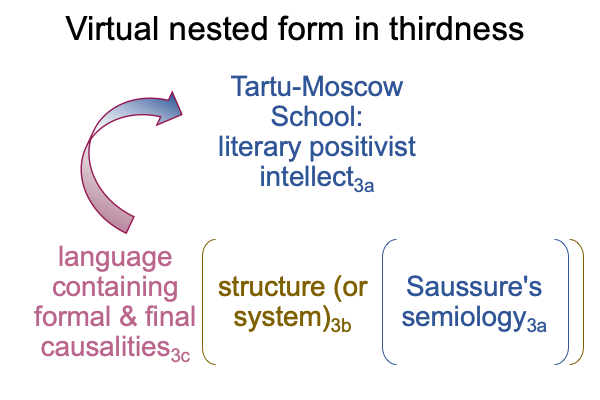
0205 Lotman’s inquiry stretches the structuralist thing, {semiology [substantiates] aesthetics}, from the content-level of the fundament interscope to the content-level of the derivative interscope.
In terms of normal contexts, a science-inspired language containing formal and final causalities3c in the fundament interscope leaps to the Tartu-Moscow School of Semiotics (in its first iteration, from the 1960s through the 1980s) as a literary positivist intellect3a.
The latter normal context3a contextualizes a radically transformed Positivist’s judgment, without challenging the de facto primacy of the original Positivist’s judgment.
0206 Indeed, the positivist intellect of the Tartu-Moscow School3abrings a novel… science-compatible… aesthetic language2am into relation with the potentials of meaning, presence and message1a.