0130 In the empirio-schematic judgment, a scientific disciplinary language (relation, thirdness) brings mechanical and mathematical models (what ought to be, secondness) into relation with observations and measurements of phenomena (what is, firstness).
The collaborators of the Tartu Moscow School, the Prague Linguistic Circle and other scholarly networks arrive at a judgment where the literary text remains the noumenon. Otherwise, the literary text becomes a phenomenon of reductionist sociological, psychological or communication-based models, posing as noumena.
0131 Here is a diagram.
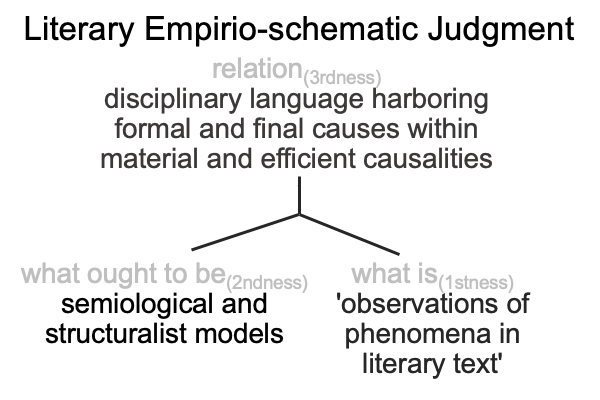
0132 For relation, the disciplinary language of linguists harbors formal and final causalities within apparent material and efficient causalities.
For what ought to be, Aristotle’s four causes are moored to the reality that each actuality is accompanied by a nested form. Also, appearances of material and efficacy are anchored to the dyadic (hylomorphic) character of actualities for both structuralism (concerning the structure of the system of differences within a given aesthetic) and semiology(concerning the dyadic relations between each langue and parole).
For what is, phenomena are observable features of a literary text. Linguists and scholars of literature make the observations, which range from which word is used for a particular passage (the purview of semiology) to how the structure of the entire literary work associates to a particular genre (the purview of structuralism).
0133 The literary scholar’s version of the empirio-schematic judgment constitutes the perspective level of the fundament interscope.
The situation level offers a nested form that conforms to the structuralist model2c.
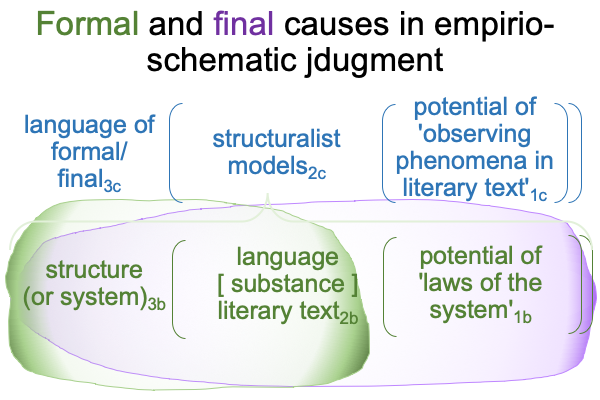
0134 The structuralist model2c puts the entire situation-level nested form into perspective, even though it2c only virtually contextualizes the actuality2b, {language2af as matter [substantiates] the literary text2bf as form}. So, it2c pays attention the situation-level actuality2b.
The situation-level normal context3b and potential1b are not under the spotlight. They are also not off-stage.
The situation-level nested form has a formal side and a final side. These are shown in colored regions in the above diagram.