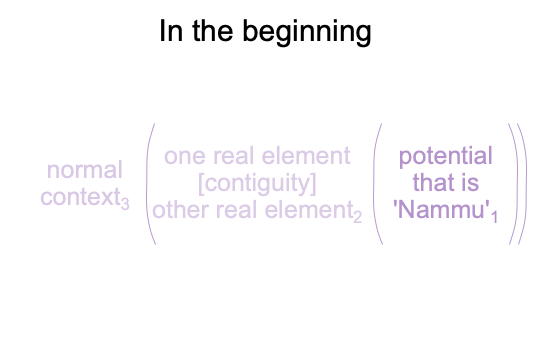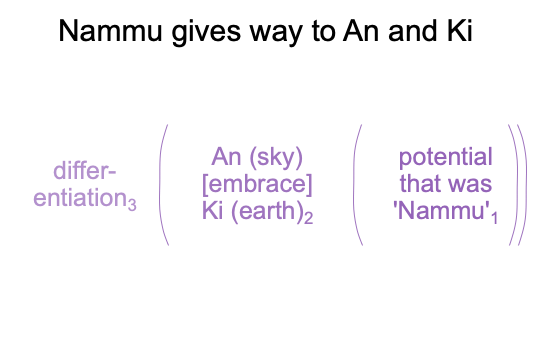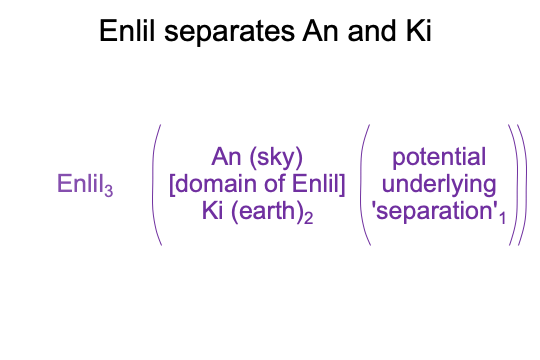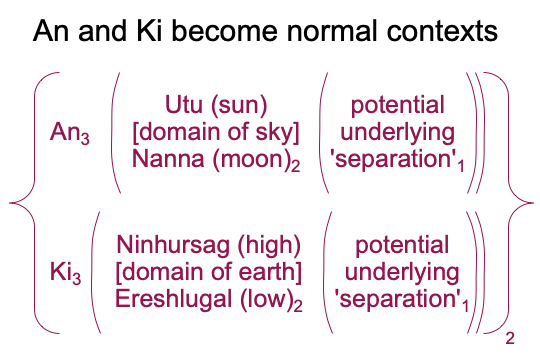
02/14/26

Looking at Peeter Torop’s Article (2017) “Semiotics of Cultural History”  (Part 5 of 11)

1013 Well, that is close enough to science that a scholar schooled in Slavic languages and literature gets.

I call the resulting interscope, “fundament”, because it takes the inquirer from the mother tongue2a through the composition of the text2b, to a model2c that is based on the nature of signs3a and on the way that any particular genre, style, fashion, and artistic expression constitutes a system3b bound by rules1b.  The fundament applies to a wide range of “languages” in so far as a specific style of artistic expression displays distinct elements, or forms2b(2a), that correspond to mental thoughts2a and linguistic matter2b.

1014 Here is a picture of the fundament interscope.

1015 Perhaps, most striking is the Aristotelian character of the fundament.  The content-level hylomorphe2a is universal.  The situation-level hylomorphe2b should be intelligible.  The perspective-level model2c is a relation that brings the intelligibility of the situation-level hylomorphe2b into relation with the universality of the content-level hylomorphe2a.

The fundament seems to be an exercise in aesthetics as much as modern science.

Juri Lotman labels it, “Russian theory”.

1016 Is it any coincidence that Russian Theory spontaneously constellates at the same time as Husserl’s and Heidegger’s phenomenology?  Both strive to assess what the noumenon must be, given the phenomena of matter and form.

1017 Phenomenology re-articulates technical achievements (such as a particular style of architecture) as social things, arriving at noumena whose phenomena engage the social sciences.

See the e-book course, Phenomenology and the Positivist Intellect, by Razie Mah, available at smashwords and other e-book venues.  Also see the three part e-work, Biosemiotics as Noumenon.

1018 Russian theory re-articulates literary achievements (as well, all the modern arts) in Slavic civilization as… um… semiological and structural judgments2c, lingering like Byzantine shadows of Aristotle in the Marxist-illuminated hallways of Moscow and Tartu Universities.

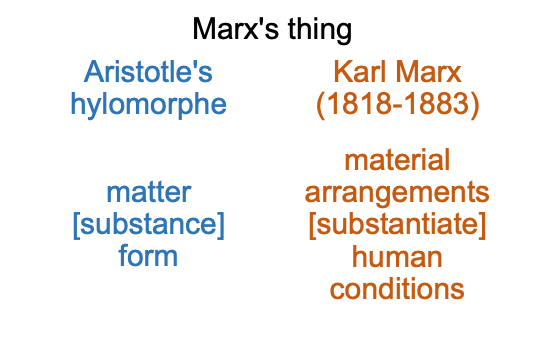
1019 Indeed, the fundament is so… um… profound that Marx’s thing gets entangled in semiotics as matter.

1020 How confounding.

The dangers of this confounding are palpable in the interview with Vyacheslav Ivanov, appearing in Kalevi Kull and Ekaterina Velmezova (eds.), Sphere of Understanding: Tartu Dialogues with Semioticians (2025, Walter de Gruyter GmbH, Berlin/Boston, pages 47-68).

1021 One can only admire Lotman’s bravado when it comes to the bureaucratic morons, who are both culturally Slavs (having an intuitive Orthodox appreciation of entanglement) and indoctrinated not be be Slavs (by the Marxist insistence that Christian superstition is scientific nonsense) and are therefore already conflicted.

Sometimes, morons can advance science by simply not resolving their conflictions.

1022 But, that is another story.

1023 Here, on page 321 of the text under examination, Torop shifts into the technical details of a literary order.  He offers a table, listing levels for intratextual and extratextual relations.  Intratextual relations concern the text itself.  Extratextual relations concerns what type of text it is.

1024 The actualities of the fundament interscope compare well with Torop’s intratextual relations.

1025 On the content level of word and meaning, Saussure’s dyadic actuality compares to subtextual and lingual meanings.  In short, an author must craft thoughts2am into words2af.

1026 On the situation level of the structure of the textual material, the dyad of {language as matter2bm [substantiates] the literary text as form2bf} compares to what Torop calls “the structure of material (dominant element or level)”.

1027 What does the term in parentheses imply?

Does “the dominant element or level” represent the normal context of structure (or sign-system)3b operating on the potential laws of the system1b?

For example, a text on history may be an epic tale, a historical analysis or a fairy tale.  Each manifests a different structure3b and lawfulness1b.

1028 On the perspective level of poetics, a semiological structuralist model2c compares to textual specificity.  To me, both actualities contain some sort of judgment.

For example, let me propose a thesis in the humanities that consists of concatenating plagiarized passages from various experts on a particular topic.  When the submission is debated by the student’s faculty committee, they may consider the fact that the passages were chosen by the student may represent a unique intellectual advancement offered by the student.  In comparison to the visual arts, the submitted text is a collage.

The problem is obvious.  A submission on say, a Slavic work of literature, cannot be labeled a “thesis” when it is really the textual equivalent to a collage.

1029 So, Torop’s label of “poetics” for the perspective level conveys a certain irony.

02/13/26

Looking at Peeter Torop’s Article (2017) “Semiotics of Cultural History”  (Part 6 of 11)

1030 When the lazy faculty members vote to award the degree on the basis of this “literary collage”, and after the funds for the college’s endowment are released by a nervous, yet protective donor, a rumor goes out that the nature of the academic thesis in languages and literature has changed.  “Literary collages” are now accepted as original academic work.

1031 Spoken words can be so slippery.

So, actions speak louder than words.

1032 Of course, in order to justify the move, one of those lazy faculty members may be induced to write a defense, in which a semiological structuralist model2c is constructed in order to portray the student’s submission as a literary text2afthat emerges from the potential of ‘the meaning of an intellectual accomplishment’1a in the normal context of… well… a positivist intellect that is more compromised than that of the Tartu-Moscow School of Semiotics3a.

1033 Here is a picture of the perspective-level of the fundament interscope and the content-level of a derivative interscope, which is not under the umbrella of Russian Theory for this example, because the entire exercise is a scam.

1034 The semiological structuralist model2c of perspective-level of the fundament interscope stands for the literary text2af on the content-level of the derivative interscope in regards to a modern intellect3a operating on the potential of ‘positivist meaning’1a.

1035 According to Peirce, a sign-vehicle (SV) stands for a sign-object (SO) in regards to a sign-interpretant (SI).  The above diagram expresses what I call “the interventional sign-relation”, as described in Looking at John Deely’s Book (2010) “Semiotic Animal”, appearing in Razie Mah’s blog in October, 2023.

In this case, the guilty faculty member’s semiological structuralist model2c of the “collage thesis2bf (SVi) stands for literary text as form2af (SOi) in regards to the academic institution’s positivist intellect3a (which is not TMS, for sure) operating on the potential of ‘an acceptable intellectual accomplishment, worthy of an advanced degree’1a (SIi).

1036 Recall that the semiological structuralist model2c brings the intelligibility of the literary text2b into relation with the universality of language2a.

So, a semiological structuralist model2c that that brings the intelligibility of a concatenation of plagiarized texts2b into relation with the universality of the language of the visual arts2a (SVi) stands for the way that {this literary text as a form2af [entangles] the language of meaning as matter2am} (SOi) in the normal context of an obviously compromised academic stance3a operating on the potential that ‘a literary study may be compared to a visual collage’1a (SIi).

1037 Enough of this.

I’m sure the reader has a good idea that this academy engages in sophistry.

Can one build a sensible interscope on an exercise of sophistry?

Well, one can try.

Here is the general sensible construction that anyone with integrity would produce.

1038 I leave it to the reader to produce the sensible construction specific to the scam.

1039 Why?

I am plunging headlong into displaying the derivative interscope, which emerges from and situates the fundament interscope.

Here is a picture.

1040 On the content level, a positivist intellect comparable to that of the Tartu-Moscow School of Semiotics, in its 1960s-1980s hey-day3a, brings the actuality of the dyad of {the fundamentally modeled literary text as form2af[entangles] a discursive and derivative language as matter2am} into the relation with the potential of ‘meaning’1a.

Here, the potential1a does not refer to subtextuality, but to “functionality”, in the broadest sense of the word.  ‘Meaning’ is not “functional” unless it satisfies the formal requirements of its design3a and the intentions of its final causality3a.

1041 On the situation level, the normal context of cultural studies concerning the reception of the work3b brings the actuality of the dyad, {cognition as matter2bm [substantiates] social interaction as form2bf}, into relation with the potential1b of ‘a presence’ that situates the matter of language2am.

1042 Returning to the scam, in the next academic year, the department of languages and literature receives many applications by students eager to explore the opportunities offered for constructing a thesis based on plagiarized material cut and pasted into a “literary collage”.

1043 The problem arises when this new style of thesis is compared to theses from other academic institutions.

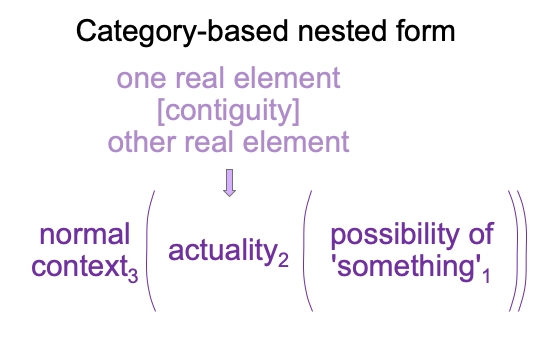
I suppose this problem figures in the general perspective-level category-based nested form in the above figure.

Perhaps, this is why the perspective level is left empty.

02/12/26

Looking at Peeter Torop’s Article (2017) “Semiotics of Cultural History”  (Part 7 of 11)

1044 The derivative interscope compares to the table on extratextual relations in Figure 1 on page 321.  The title of Figure 1 is “The construction of text”.

1045 Here is a table comparing the virtual nested form in actuality for the derivative interscope with Torop’s extratextual relations.

While the fundament interscope addresses the text itself.  The derivative interscope assesses the text in relation to other texts.  Such an assessment characterizes extratextual relations for the work.

1046 Are the correspondences sufficient to conclude that this examination’s fundament and derivative interscopes and Torop’s intratextual and extratextual relations are similar… if not identical?

If the answer is “yes”, then this examiner has a clue to the nature of the missing perspective-level actuality2c.  The perspective-level actuality2c assesses how a particular text relates to other texts, and in doing so, weighs the intelligibility of the reception of the work2b against the universality of its functional meaning2a.

1047 An affirmative answer also brings this examiner to the topic of Bakhtin’s chronotopes.

Figure 2 on page 322 of Torop’s essay presents what may be Bakhtin’s chronotopical system.

In fact, the table in Figure 2 is assembled from a short piece, “Forms of time and of the chronotope in the novel”, written around 1937-1938, along with “concluding remarks” added in 1973.  Plus, there are entries in various notebooks, scribbles on papers that were preserved, and so on, adding clarity… and weirdness… to a distinction between architectonic time (corresponding to the chronotope) and the time when the story or artwork is composed (and, presumably, the author and the author’s cultural scope are alive).

1048 For example, consider a sci-fi author completing a story about “life in the future”, the day before the world ends.  The chronotope must be life in the future.  The time when the story is composed corresponds to the day before an asteroid hits the Earth.

Oh, this is the twist.

The author belongs to a rare breed of dinosaur living 65 million years ago.

The translation occurs when an AI program trained to scan fossilized dinosaur nests suddenly recognizes patterns within the nesting material that correspond… through comparison with patterns in other… what?.. ancient Mesopotamian glyphs, allowing for some sort of translation.

1049 So, what is the title of this unbelievable literary text?

“Actuality to be determined2c“.

1050 Am I saying that Bakhtin’s chronoscope is the actuality to be determined2c?

Am I saying that the actuality to be determined2c is more than intertextual specificity?

It2c is the time envisioned in a story written the moment before the author, and the author’s cultural scope, vanish into the past.

1051 So, what is this moment in the present, where the past recedes and the future awaits the text itself?

It must be the moment when langue2am [substantiates] parole2af.

1052 Just as there is a time-piece within a radioactive atom that determines when the unstable isotope decays into another element, there is a time piece within every author and cultural scope.  That time-piece determines when the time of composition and the chronotope separate into the author and the text.

1053 An academic can study the author and the text in order to produce, using the fundament interscope, a semiologiccal2a structural2b model2c.  This model2c, when regarded as the noumenon of the text2af, may entangle key elements within the chronotopical system, as shown in the following figure.

1054 But, there is a problem.

The closer that the semiotician swerves into Bakhtin’s chronotopical system, the more and more the semiological structuralist model2c looks… well… irrelevant. 

Look at the poetics level.

Surely, a semiological structural model2c is bland and uninteresting compared to topographic, psychological and metaphysical realities.

No?

1055 Okay, there is another problem.

It is not at all obvious that my one-to-one association with each of Bakhtin’s triads corresponds to content-, situation- and perspective-level actualities.

The chronotope does not seem to match the fundament and derivative interscopes, at least not directly.

Plus, Torop loves Bakhtin as much as he does Lotman and Uspenskij.

The essay makes that obvious.

1056 On top of that, the article itself swerves from the TMS school (olive color) to Bakhtin (orange color) and back (to olive color).

Here is a picture with color-coded section headings.

1057 So, the author goes from the TMS school to Bakhtin and back again.

What does this imply?

The swerve into Bakhtin must be crucial.

02/11/26

Looking at Peeter Torop’s Article (2017) “Semiotics of Cultural History”  (Part 8 of 11)

1058 Now, about that rumor about AI discovering glyphic writing while examining fossilized dinosaur nests which were dated to 65Myr (millions of years ago), right before the asteroid impact that ended the Epoch of Weird Multicellular Animals (600-65Myr).

1059 The university involved in the incident apologized.

Apparently, over the Easter holidays, the Anthropology Department wheeled the new AI computer in use by the Archaeology Department, which had been examining photos of fossilized dinosaur nests for patterns, to take a look very early pre-cuneiform tablets.  They trained the AI to recognize cuneiform, but when they applied the program to the early tablets, the AI said that this pattern showed that an egg lies here and that pattern is a dinosaur footprint, and so on.

Frustrated, the anthropology team returned the AI computer to the archaeologists, who were surprised when the AI started reporting, around Pentecost, that the nesting material contained intentionally written glyphs that could be interpreted.

1060 It is like the Greimas square.  Train a student on the Greimas square, then every spoken word becomes a focus for the technique.  It is quite remarkable.

I suppose that applies to myself, because it seems that all I see is the TMS fundament and derivative interscopes in every semiotic paper that I examine.

1061 So, maybe I should take a step back and draw a line between the virtual nested form in secondness for the fundament interscope and Torop’s table describing Bakhtin’s chronotopical system (Figure 2).

1062 Uh-oh.

Once I do this, I gestalt the following.

If “gestalt” is a verb, that is.

Reality expands into Peirce’s category of thirdness.

Time and space spins into Peirce’s secondness.

And, phonics associates to Peirce’s firstness.

1063 Surely, this diagram looks like it matches a comparison of the fundament and Torop’s Figure 2.

However, the levels look more and more suspicious.

Do they contain category-based nested forms?

1064 Consider the perspective or “reality” level.

Does a normal context of metaphysical reality3c bring the actuality of psychological reality2c into relation with the potential of ‘topographic reality’1c?

Surely, that looks well… may I use the word, “unrealistic”?

1065 So, what if I switch reality to correspond to three nested normal contexts?

Here is a picture.

1066 Now, that looks more realistic.

Overall, the normal context of reality3 brings the actuality of space and time2 into relation with the potential of ‘tone’1.

For three levels, reality3 is a normal context operating on the possibility of ‘tone’1, where ‘tone’ is most clearly expressed in terms of music-related explicit abstractions.  The label corresponding to ‘tone’1 changes from content, to situation and on to perspective.

1067 Yes, that seems more reasonable.

Here is the resulting interscope.

1068 On the content level, the normal context of topographic reality3a brings the actuality of concrete (or specific) time and space2a into relation with the potential of ‘homophony’1a.  Homophony is like a melody.

On the situation level, the normal context of psychological reality3b brings the actuality of subjective time and space2binto relation with the potential of ‘polyphony’1b.  Polyphony is like harmony and dissonance.  A melody is situated by harmony and dissonance.

On the perspective level, the normal context of metaphysical reality3c brings the actuality of mythological time and imaginary space2c into relation with the potential of ‘heterophony’1c.  Heterophony is like the visual appearance and acoustic character of the venue in which a musical or dance performance occurs.

1069 Now I ask, “Does the above figure look like a semiological3a structuralist3b model2c?”

02/10/26

Looking at Peeter Torop’s Article (2017) “Semiotics of Cultural History”  (Part 9 of 11)

1070 Torop continues to recount the lessons that come from Bakhtin’s notes.

The next section is titled, “Semiotics of culture and chronotopicality”.

Not only does a chronotopical analysis distinguish three levels in every text, but, for literature, the three levels display narratives and performances.

Is this where semiotics enters into the picture?

1071 The author offers another table correlating levels of the text and the sphere of semiotization.

Here is a picture.

1072 The same principles apply as before.

Chronoscopy goes with Peirce’s category of thirdness.

Narrative and performance associates to secondness.

The world belongs to firstness.

1073 Similar to before, the above figure looks like a semiological3a model2c.

On the content level, a topographical homophonic normal context3a brings the actuality of story and events2a into relation with the potential of ‘an intertextual storyworld’1a.

On the situation level, a psychological polyphonic normal context3b brings the actualities of narration and performance2b into relation with the potential of ‘a multimodal, innerworld with self and others’1b.

On the perspective level, a metaphysical heterophonic normal context3c brings the actualities of verbal and pictorial descriptions2c into relation with the potential of ‘cohesive principles establishing a conceptual world’1c.

1074 Now I ask, “Do these arguments add up to a semiological3a structuralist3b model2c?”

1075 By the time that the author finishes this section, he has intimated that Bakhtin’s article and scribbles on the chronotope offers a semiological structuralist model composed of interscopes, rather than category-based nested forms.

Here are the virtual nested forms in the category of thirdness for each interscope.

02/9/26

Looking at Peeter Torop’s Article (2017) “Semiotics of Cultural History”  (Part 10 of 11)

1076 The author moves on to the topic of “cultural semiotics as semiotics of cultural history”.

I love topics like this.

They almost make my wordplay appear reasonable.

1077 According to Lotman, each generation has a language to describe yesterday.

1078 What does this imply?

Torop has a positivist language2af, historically developed within the Tartu-Moscow School of Semiotics (on its preparation for a second iteration, this examiner hopes), for translating the somewhat disordered clues left by Bakhtin into a text, consisting of tables.  Each of these tables correspond to an interscope (Peircean constructions, which the author does not have at the time, but are implicit to the tables, themselves).

There are two tables. 

The one dealing with narrative and performance associates to the semiological level of the fundament interscope.

The one dealing with space and time associates to the structural level of the fundament interscope.

These tables correspond to the literary text2bf as form for the fundament interscope.

1079 In Torop’s language, langue as matter2am consists in what Bakhtin is thinking, and wondering about, in regards to the way that literature works.  This matter2am sort of emerges from a signfied1a in the normal context of Saussure’s semiology3a.   Parole as form2af consists in the article that Bakhtin writes and the pages of notes that survive concerning the nature of the “chronotope”.  Indeed, the spoken word, “chronotope2af” situates the signifier1a that Bakhtin imagines and Torop uses to tag the article and the pages of notes.

Bakhtin’s works correspond to langue2am and parole2af in the fundament interscope.

1080 These associations allow me to apply the fundament interscope, as a semiological structuralist model2c, to Torop’s tables2bf.

1081 To me, this application is appealing.

1082 I now move on to the rest of Lotman’s observation.

Each generation, in principle, does not have a language to describe tomorrow.

1083 How does this apply?

In 2017, Torop does not have Peirce’s construction of the interscope.

The basics are presented by Razie Mah’s e-books, A Primer on the Category-Based Nested Form and A Primer on Sensible and Social Construction (available at smashwords and other e-book venues).

1084 Despite this lack, Torop successfully communicates that Bakhtin’s parole2af of the “chronotope” serves as the language2bm that substantiates two tables2bf.  The universality of the “chronotope”2af and the intelligibility of Torop’s two tables2bf are weighed when one regards them as contributing to a semiological3a structuralist3b model2c.

1085 Here is corresponding interscope.

1086 The above interscope may be compared to the interscopes postulated by this examiner as characteristic of the Tartu-Moscow School of Semiotics.

1087 But there is more.

02/7/26

Looking at Peeter Torop’s Article (2017) “Semiotics of Cultural History”  (Part 11 of 11)

1088 The final section, on cultural semiotics as semiotics of cultural history offers the trope… er… slogan… saying, “Culture is memory.”

On the fundament, the literary text2bf offers something to remember, if for no other reason than it is encoded as a text. Texts may survive to be available to the future.  Parole2af is often not so lucky.

Time is cruel

So many texts have been lost.  Precious few oral traditions remain intact.

The issue is twofold.  The text or the oral tradition needs to survive.  Also, a code for translation must be retained… or… recoverable.

This is one of the problems with the writing of ancient Mesopotamia, where there are few texts that have more than one script in a single document.

1089 Lotman spends many hours reflecting on text and code.

Some of his reflections end up in his book, Universe of the Mind.

1090 The author presents a table on Lotman and Uspenskij’s views of the temporal aspect of chronotopical analysis.

1091 Of course, the above table does not correspond to Torop’s original table2bf (fundament and derivative, Figure 1).

Perhaps, this table further develops and refines Bakhtin’s semiological structuralist model2c (Figure 2).  

However, it is hard not to imagine that the above figure translates into an interscope.

1092 Say what?

1093 The Tartu-Moscow School expresses two interscopes, the fundament culminates in the semiological structuralist model2c and the derivative rises to a yet-to-be-determined perspective-level actuality2c.

1094 Bakhtin’s notes and scribbles express two interscopes as well.  These two interscopes constitute two adjacent tiers within a model more expansive than the semiological2a structuralist2b model2c.  The construction of Torop’s article intimates that this expanse is well worth investigating.

1095 The way that Lotman’s thing includes time shows how Torop’s tables2af entangle a language2am of presence1b (as well as meaning1a).  Lotman recognizes2bm time2af as a formal requirement of the chronotope2am and forces Torop to construct his own table (Figure 4 on page 330) as a way to situate2bf that entanglement2a.

1096 Here is a juxtaposition of the virtual nested form in the category of secondness for the derivative interscope and Torop’s reconstruction of Lotman’s approach.

1097 A virtual nested form proceeds down a column in a three-level interscope.

Here are the columns in the realm of actuality2.

1098 In the general form of the derivative interscope, a perspective-level actuality2c (to be determined) brings the situation-level actuality of {cognition2bm [substantiates] social interaction2bf} into relation with the possibility of {a literary text2af [entangling] a language2am of meaning1a, presence1b and message1c}.

1099 For Torop’s table addressing Lotman (Figure 4), the perspective-level actuality2c of {semiotic arrangements2cm[substantiate] human conditions2cf} virtually brings the situation-level actuality of {Lotman’s recognition of time2bm[substantiates] Lotman’s thing with respect to time (as a three-level table)2bf} into relation with the content-level possibility that {Torop’s tables as text2af [entangle] the chronotope’s formal requirements2am of the normal context of the Tartu-Moscow School3a}.

1100 Oh yeah, that makes sense.

Cultural history manifests in the framework of the semiotics of the text, where the text is a representation of culture.

Bakhtin’s culture, that is.

Lotman’s culture, too.

1101 If Bakhtin’s insights are formalized as text by Torop’s tables, then Torop’s tables constitute a semiological structuralist model2c of Bakhtin’s insights2af and support the entanglement of a language2am that sounds very much like any language of interpretation.

What is the meaning1a, presence1b and message1c of the chronotope?

Lotman’s thing focuses on time and produces a variation of the fundament interscope.

Torop’s table of Lotman’s consideration of time produces a categorical stairway to a perspective-level actuality2c in the derivative interscope.

1102 Once again, what is Lotman’s thing?

Oh, yes, it is the archaeological recovery of an insight that is present… at least in potential… since the very origins of Slavic civilization.

In the beginning is the Word, and the Word as matter substantiates the human condition as form.

1103 Here is a picture.

Such is the resolution, of the confounding where history substantiates culture and culture entangles semiotics.

1104 My thanks to Peeter Torop, for putting pen to paper and for building the tables that demonstrate the fecundity and the surprising beauty of the first iteration of the Tartu-Moscow School of Semiotics.  May a second iteration follow.

02/6/26

Looking at Kalevi Kull and Ekaterina Velmezova’s Book (2025) “Sphere of Understanding” (Part 1 of 3)

SaH 0001 The full title of the book before me is Sphere of Understanding: Tartu Dialogues with Semioticians.  The book is volume 23 of the series, Semiotics, Communication and Cognition, edited by Paul Cobley and Kalevi Kull, published in 2025, by Walter de Gruyter GmbH, Berlin/Boston.  

Kalevi Kull is a biologist who joined the Department of Semiotics at the University of Tartu in 1997.  Ekaterina Velmezova is a linguist and historian who graduated from Moscow State University.  Each, in their own way, represents the two poles of the Tartu-Moscow School of Semiotics.

0002 The question is: Does this book mark the end of the first ascent or the beginning of the second ascent for the Tartu Moscow School of Semiotics.

0003 After the introductory chapter, extolling the virtues of dialogue, the authors offer a brief history of semiotics in Estonia.  The arrival of Juri Lotman, a scholar of Slavic literature, initiates a transnational collaboration within the old USSR.  The summer school at Tartu University proves seductive.  Here is a place where scholars in Slavic literature are free to play.

0004 So, one aspect of the sphere that the authors desire to understand is a historical conception, sired from the intellectual loins of Juri Lotman, that has taken a life of its own.  The only question is: Who is she?

0005 Kalevi Kull wrestles with emergence in biological systems.  What about this semiotically inclined child of history?

0006 Ekaterina Velmezova performs translation into English, as well as, I imagine, editing in Russian.  After all, these are times when Estonians may want to hedge their bets.

0007 Who knows?

Can the Tartu-Moscow School of Semiotics be born again?

The interviews provide clues.  They are gems framed in their historical moments.

0008 So how do I, a crypto semiotician, respond?

0009 First, I look at back issues of the journal that Juri Lotman founded, Sign System Studies, and find a special issue in 2017 bearing the title: Semiotics and History.

Second, I review several of the articles, plus one from 2016, in order to produce my contribution to the book’s dialogue.

Third, I package the results into an online independent mini-course, the first in a series titled, “Semiotics and History”, by Razie Mah, starting in December, 2025.

0010 The editors of the journal, Sign System Studies, have permission to scrape the blogs of this mini-course for a special on-line issue, as well as permission translate the blogs into other languages.  After all, time is cruel.  If the blog goes off-line, then the editors will retain a response that addresses what the authors seek.

0011 What do the authors seek?

0012 First, they seek a “sphere”.  Shall I add… “of influence”?  Or, shall I be satisfied with “of understanding”.

The interviewers ask semioticians questions.  After the year, 2008, these queries include how the semiotician came into contact or awareness of the (first ascent of) the Tartu-Moscow School of Semiotics (1960s-1980s).  The authors want to appreciate the school’s sphere of influence.

0013 Second, they seek understanding.

Here is where the discrepancy between Saussure and Peirce comes in.  Today, practitioners of both traditions are called, “semioticians”.   But, Saussure called his path of inquiry, “semiology”.  And structuralism?  Structuralism virtually situates semiology.  Structuralism is semiology as matter substantiating aesthetics as form.

0014 So, what am I doing?

I follow the path of Peirce, into the labyrinth of triadic relations, and attempt to identify the normal contexts (thirdness) and potentials (firstness) of the actualities (secondness) of semiology and structuralism.

0015 What do I find?

I find that “she” is Slavic civilization, herself.

0016 My examination of articles in the 2017 special issue of Sign System Studies, titled “Semiotics and History”, pays tribute to the authors’ search, embodied in the title, and provides a way to understand the Tartu-Moscow School’s sphere of influence, for both the first iteration in the old USSR and its second iteration in the upcoming Eurasian convergence.

02/5/26

Looking at Kalevi Kull and Ekaterina Velmezova’s Book (2025) “Sphere of Understanding” (Part 2 of 3)

SaH 0017 The authors quest for a sphere of understanding.  They seek the egg, so to speak, impregnated by Juri Lotman’s genius.  In the interviews in chapter 2.1, Lotman is spent, although still alive.  He is old.  The interviewer is a youth, a personification of the metaphysical love-child born after Slavic civilization reveals herself to Lotman’s circumspection.

0018 The miracle of Lotman’s arrival in Estonia is, weirdly, recounted in the last interview (2.14) with psychologist and cultural theorist, Jaan Valsiner.  As it turns out, Valsiner’s step-father was instrumental in getting Juri Lotman to Estonia after the Second World War.

0019 Jaan Valsiner demonstrates that the Tartu-Moscow’s sphere of influence is diffuse.  His testimony is seconded by Paul Cobley (2.13), Terrence Deacon (2.12), Jesper Hoffmeyer (2.11) and Stuart Kauffman (2.10).

0020 The sphere becomes less diffuse in interviews with Roland Posner (2.9), Gunther Kress (2.8) and Wilfred Noth (2.7).

Notably, Noth conducts a discourse on the crucial potential of truth, as opposed to the potential of will.  Indeed, the contrast between truth and will turns out to be integral to my examination of a 2017 article on Russian identity.

0021 Finally, the sphere becomes tangible with interviews with American anthropologist, Myrdene Anderson (2.6), who researched indigenous people in Sweden, Italian semiotician Paolo Fabbri (2.5), who railed against the wooly thinking that passes for “models” in contemporary humanities, and the Italian know-it-all Umberto Eco, who noted the importance of iconicity in semiotic humanity.

What?

“Semiotic humanity”?

What about semiology?

0022 Contemporary academic discourse is currently conducted with expert-coined spoken words, but these utterancescannot picture or point to their referents.  Academics swim in a pool of differences… er… two arbitrarily related pools of differences.  No one can tell where he or she flotates.

Flotates?

This is what happens when spoken words are placeholders in two arbitrarily related systems of differences.

0023 Finally, the interviews engage a still-living member of the original Tartu-Moscow School of Semiotics, Boris Uspenskij (2.2).  This interview gets a full examination in the course on Semiotics and History.  Uspenskij stands within the sphere that the authors aspire to understand.

0024 So, what does Razie Mah’s contribution under the banner of Semiotics and History offer?

0025 For the diffuse sphere, these examinations will present a historical narrative of ideas in the style of diagrams of purely relational structures.  In short, Peirce-inspired diagrams offer a new way to narrate intellectual history.

0026 For the almost tangible sphere, these examinations practice a method of association, followed by a discussion of the implications.  The articles provide material to fill in the empty slots of relational structures.  When associations are made, implications become apparent.

0027 For the sphere itself, one unexpected insight is that, as the first ascendant of the Tartu-Moscow School of Semiotics struggles to fulfill the political mandate of the USSR (to make all fields of inquiry “scientific”), the researchers excavate the recently-buried remains of the civilization that is their subject of inquiry.

Imagine a scientific investigation of Russian language, history and literature, as a archaeological excavation into the being of Slavic civilization.

0028 Is that the same “she” that… um… you know… captured the attention of Juri Lotman?

How confounding.

0029 The next blog offers an introduction to Semiotics and History: The Tartu-Moscow School of Semiotics.

02/4/26

Semiotics and History: The Tartu-Moscow School of Semiotics (Part 3 of 3)

SaH 0030 This course is a fully on-line study that appears in Razie Mah’s blog.

The course should be conducted (ideally) by a mature reader along with one novice or more, (less ideally) by two novices in collaboration and (perhaps, heroically) by a novice reader working alone.

0031 The field of home-schooling is exploding (a term associated with Juri Lotman) in America, but a wary public wants to taste the products, before committing to purchase.  This online course is the first of many, I suppose, but the import for this particular exposition is obvious when considering current events.

0031 Estonia is awkwardly situated (along with the other Baltic states) between the Slavic civilization of Russia (to the east), and the Swedish, German and Polish civilizations (to the west).  Estonia was part of the USSR, during the cold war; part of the West, during the American Empire’s unipolar moment; and now is about to be nudged into a Eurasian convergence, as predicted by political theologian, Alexander Dugin.

A nudge is both a danger and an opportunity, especially for the University of Tartu, with its department of semiotics, and for the University of Moscow, with its unique constellation of intellects.

0032 One of the questions asked in almost every interview in Kull’s and Velmezova’s book goes like this, “What needs to be researched by semioticians?  Or, what topics of inquiry need exploration by newly certified semioticians?”

This course offer a number of suggestions, several in connection with a stunning post-scholastic discovery that may be attributed to the first ascent of the Tartu-Moscow School of Semiotics.

Discovery?

Look and see.

The original articles are available online.

0033 Here is the list of examinations.

Go to the month in Razie Mah’s blog and scroll down.

0034 (1.) Looking at Igor Pilshchikov and Mikhail Trunin’s Article (2016) “The Tartu-Moscow School of Semiotics”  (December 2025, 27 blogs, points 1-376)

0035 (2.) Looking at Ekaterina Velmesova and Kalevi Kull’s Article (2017) “Boris Uspenskij…” (January 31-10, 2026, 19 blogs, points 377-641)

0036 (3.) Looking at Boris Uspenskij’s Article (2017) “Semiotics and Culture” (January 9-2, 2026, 8 blogs, points 642-743)

0037 (4.) Looking at Mihhail Lotman’s Article (2017) “History as Geography” (late February 2026, 8 blogs, points 744-840)

0038 (5.) Looking at Mikhail Trunin’s Article (2017) “Semiosphere and history” (late March 2026, 8 blogs, points 841-952)

0039 (6.) Looking at Peeter Torop’s Article (2017) “Semiotics as Cultural History” (early February 2026, 11 blogs, points 953-1104)

0040 In a little over 1000 steps, the home- or guided-schooler can find out where the Tartu-Moscow School as been (in its first ascent) and where it may be going (in its second).