06/10/22

Looking at Peter Redpath’s Essay (2000) “The Homeschool Renaissance” (Part 14 of 17)

0064 Is the much-advertised “Western Enlightenment” merely the historical rendering of a new Renaissance, in subjugation to the authority and prestige of the blossoming empirical sciences?

This is one implication of the alternate ending to Redpath’s tale.

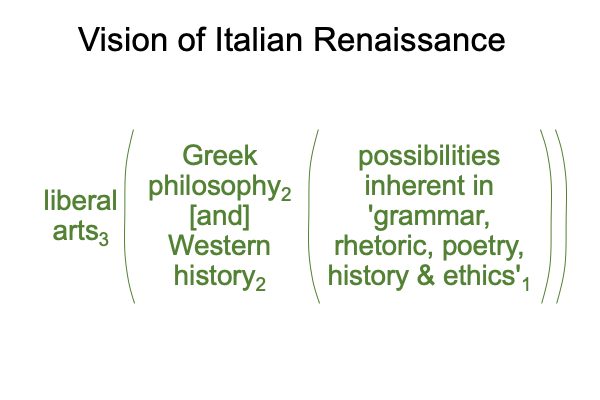
0065 Here is a picture of the Western Enlightenment.

Figure 13

0066  Do I see a small flaw that may grow into a catastrophic unraveling?

Will political slogans reverse the inevitabilities of mathematics and mechanics and render the natural and social sciencesinto servants to a new science, occulting out of the chaos of the social sciences, just as the social sciences coalesce out of the neglected noumena of the natural sciences?

0067 Redpath does not articulate this particular scenario.

Twenty years later, his actions demonstrate that he intuitively senses its theodramatic implications.

Redpath pioneers an academy promoting “uncommon” common sense.

He proposes a return to the analytic and synthetic logics of Thomas Aquinas.

06/9/22

Looking at Peter Redpath’s Essay (2000) “The Homeschool Renaissance” (Part 15 of 17)

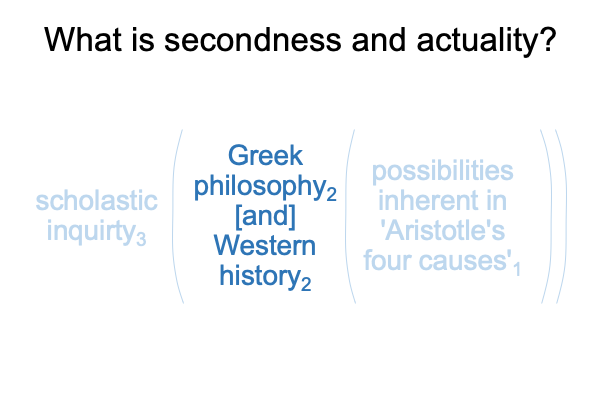
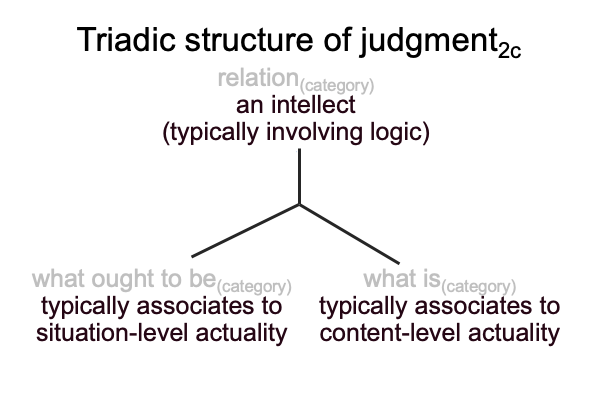
0068  Scholastic logic, Aristotelian causality, mathematical learning and abstractions are key features of what ought to befor the scholastic judgment, as shown below.

Figure 14

0069 What does that imply?

What ought to be works on principles available to sensible reason.

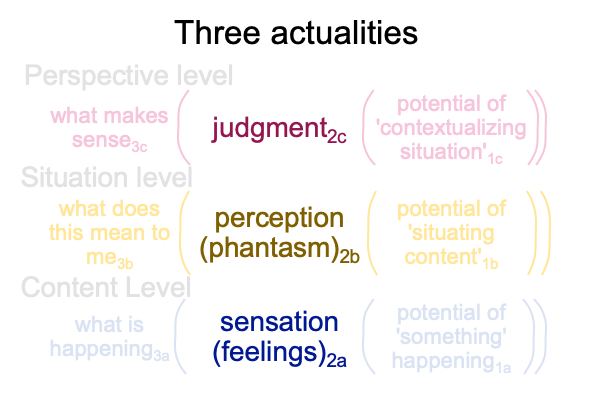
In this examination of Redpath’s essay, I phrase the implication as follows, “The world exhibits regularities in all three of Peirce’s realms: possibility (firstness), actuality (secondness) and normal context (thirdness).  Each realm manifests its own logic.  The Baroque scholastic tradition identifies the sign as a triadic relation and Peirce picks up this thread.  Peirce goes on to identify the three categories that are implicit in the arc of Thomism, from Aquinas to Poinsot.”

0070 In contrast, for Renaissance visionaries, what ought to be is a world constructed by oracular and occult beings.  Our world is composed of social constructions.  The discipline of poetic theology aims to discover those beings capable of restoring the political glory of Rome.

To this, Redpath says, “These oracular and occult beings excite our judgments.  They tingle our sensations.  They color our perceptions.  Yet, they neglect logic.”

0071 In contrast, for mechanical philosophers, what ought to be is a world that can be modeled with mathematics and mechanics.

To which I say, “Mathematics and mechanics apply to Peirce’s category of secondness, which is subject to the laws of non-contradiction.  The other categories are subject to scientific inquiry only in so far as they manifest secondness.  The logic of the empirical sciences is radically incomplete.”

06/8/22

Looking at Peter Redpath’s Essay (2000) “The Homeschool Renaissance” (Part 16 of 17)

0072 Redpath tells a tale in order to magnify Aquinas’s note of caution.  Small errors at the start of an enterprise produce significant errors at the end

Redpath’s tale concerns the Italian Renaissance, which neglects logic at its beginning, eventually falling into subjugation to the radically incomplete logic of the empirical sciences.

There is a historical sequence.  Renaissance innovators are followed by mechanical philosophers and mechanical philosophers are followed by the thinkers of the Western Enlightenment.

An alternate option, concocted here, says, “The Western Enlightenment may well be the rebirth of the Renaissance, under the conditions of its subjugation to the empirical sciences.”

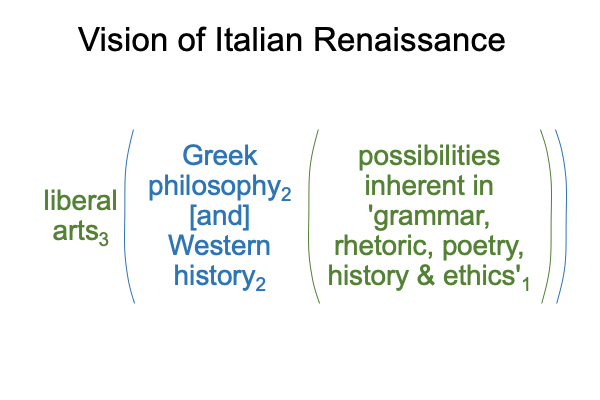
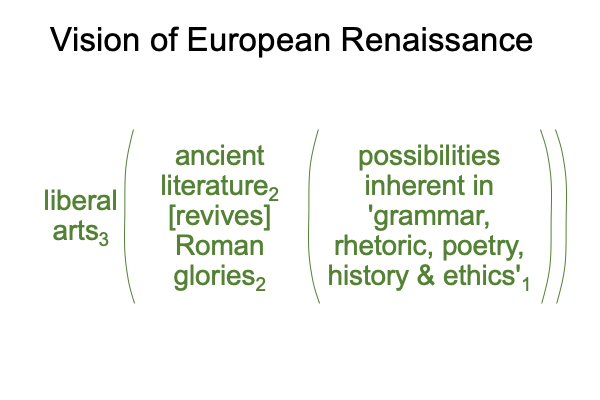
0073 Here is a diagram of what the Enlightenment judgment can be.

Figure 15

Oh, it looks the same as the Renaissance judgment.

0074 So, what does that suggest?

Does the Enlightenment, retaining the Renaissance’s neglect of logic, cover up the radically incomplete logic of the empirical sciences, so that the normal contexts of the liberal arts3 and scientific disciplinary languages3 together exclude the richness of natural reason3, available in scholastic arguments, Aristotelian causalities, mathematical learning and abstractions?

Ah, such is the Age of Ideas.

0075 Perhaps unwittingly, Redpath unveils the two contenders facing the Homeschooling Renaissance.  One disregards logic and proposes occult beings bursting with final and formal causalities.  The other channels logic into mathematics and mechanics and says that material and instrumental causalities explain all things.

No wonder Redpath calls for a return to “uncommon” common sense.

I call the alternative the Age of Triadic Relations.

06/7/22

Looking at Peter Redpath’s Essay (2000) “The Homeschool Renaissance” (Part 17 of 17)

0076  Twenty years ago, Redpath concludes that we need to learn from the mistakes of the founders of the last great Western Renaissance.  He addresses the upcoming Homeschooling Renaissance.  It must not devolve into a battle among the arts.  Rather, it must offer a restoration of ordinary sense experience as the foundation of reason.  Philosophy, as well as the literary and fine arts, will naturally follow.

Order will return to human learning.

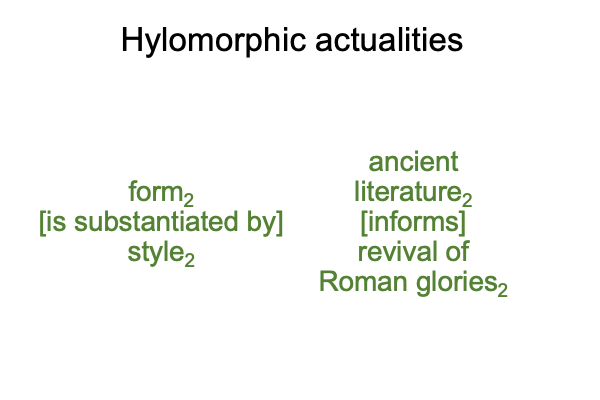
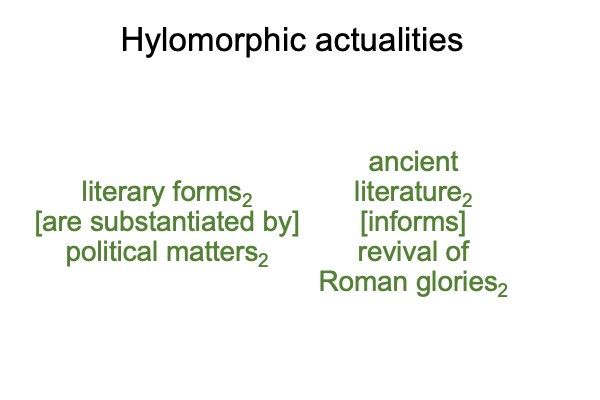
0077 To me, the prior diagrams place Redpath’s lesson and tale into a new way of looking at our current condition.  Each diagram expresses a triadic relation.  All the diagrams engage one another.

At the same time, there is a center, the interscope that is formulated by scholastics, dismissed by Renaissance humanists, and ignored by mechanical philosophers.  Redpath calls the center “scholastic psychology”.  I call this interscope, “the individual in communityA“.

0078 Here is a picture.

Figure 16

0079 Yes, here is a picture, working on principles available to sensible reason.  Sensible reason transcends secondness, the realm of actuality, where the principle of non-contradiction applies.  Sensible reason includes thirdness and firstness.  In order to understand, we must place an actuality2 into its appropriate normal context3 and potential1.

0080 Aquinas stands at the spring of a great philosophical river.  John Poinsot stands at the harbor, where this river enters the sea.  Charles Peirce plans to sail the sea.  Razie Mah is a sailor on Peirce’s ship.

0081 Twenty years ago, Redpath offers one guidance.  Watch for small flaws, for they become terrors at the end.

Today, Redpath offers another.  The enterprise begins.

0082 There is only one house open for us all.  There is only one boat navigating an ocean of deception.  Every parent knows this.  The house of God is built on revelation.  Reason, grounded in ordinary sense experience, allows us to see its designs.  The ship of God sails into both calm and storm.  Logic, grounded in triadic relations, allows us to characterize the winds.  Our creation starts with winds moving over the waters.  Our creation ends with a place that we call home.

Razie Mah offers his wares to the Big Schoolhouse.

Welcome to the Age of Triadic Relations.

12/24/21

Looking at the Book (2015) Genesis: History, Fiction or Neither? (Part 21 of 38)

0071 Gordon Wenham begins his interpretation of Gen 1-11 with the genealogies.  The genealogies seem to be minor elements, since they do directly tell stories.  However, they are significant as a genre.

Here is the virtual nested form in the realm of possibility.

genealogy1c( insights for reader1b( Biblical witness1a))

0072 To me, the principle of genealogy1c directs the reader1b to consider the possibilities inherent in a family tradition1a.  The intended audience is the witness’s family.

0073 Wenham notices two obvious patterns.

Linear genealogies connect the generations.

Segmented genealogies make claims to territories or skills.

These topics, descent, territory and skills, must be relevant to the family.

0074 Also, there are less-obvious patterns.  The number seven stands out, starting with the six days of creation and the seventh day of rest.  Tens and twenties are also favored.

Are these relevant to the family’s pedigree, territory or skills?

In a world that is constantly and unpredictably specializing, who would be sensitive to repetitions of particular numbers?

May I guess?

The numbers have mystical significance.

What specialization might concern itself with mystical significance?

0075 I go back to the metaphor of a river, flowing through time, for the consequences of the first singularity.  Gravity is a metaphor for the actualization of the potential for labor and social specialization.  Eddies and whirlpools are metaphors for long-lived spontaneous structures, such as markets, temples and thrones.  Spontaneous structures include associations of scribes, canal builders and maintainers, farmers, warriors and the like.

A family lives within one of these long-lived whirlpools.  Each generation preserves the witness of the family through routinized stories about what the ancestors witnessed.

0076 Does that fit the definition of the term, “protohistory”?

12/23/21

Looking at the Book (2015) Genesis: History, Fiction or Neither? (Part 22 of 38)

0077 After noting the character of the genealogies, Gordon Wenham examines Gen 1-11, starting with the Creation Story, Gen 1:1-2:3.

Wenham sees the Creation Story as an overture to the symphony of Gen 1-11, as well as the entire Pentateuch.

On the one hand, the Creation Story departs from other written origin stories of the ancient Near East.

On the other hand, the Creation Story coheres to the literary styles of these extra-Biblical narratives.

0078 To me, the Creation Story is the only written origin story of the ancient Near East that places humans in the Lebenswelt that we evolved in.  To the ancients, the Creation Story describes God building a tent (or temple) of creation. To moderns, the Creation Story tells a progressive tale, reminiscent of evolution.  Some associate a day to an evolutionary era.  To postmoderns, the articulated structure of the Creation Story aesthetically matches the bony structure of the evolution of our world, especially when the correspondence is viewed through the three types of natural sign: icon, index and symbol.

0079 The hypothesis of the first singularity takes the implications one step further.  Humans, created in the image of God,appear in this dramatic unfolding of a narrative that artistically corresponds, in the way of signs, to the evolutionary record.  These humans correspond to Adam, before the Fall, living in paradise. The tree of life resides in Eden.

On top of that, if, as Thomists postulate, original justice defines the state of Adam before the Fall, then original justiceshould also apply as a noumenal description of the Lebenswelt that we evolved in.  This is discussed in Comments on Daniel Houck’s Book (2020) “Aquinas, Original Sin and the Challenge of Evolution”, available at smashwords.

12/22/21

Looking at the Book (2015) Genesis: History, Fiction or Neither? (Part 23 of 38)

0080 The appearance of the Ubaid of southern Mesopotamia marks the start of the first singularity.  Development towards unconstrained social complexity begins immediately, and imperceptibly, like gravity moving water in a river.  The narratives in Gen 2.4-11:9 describe eddies and whirlpools, events in the flow of time.

0081 Wenham argues that the term, “myth”, is not appropriate.  I use the term, “fairy tales”.  Why?  Mothers tell their children fairy tales.

The Creation Story is told from father to child.  It is referenced later in the Pentateuch.  Moses codifies the seventh day as a day of rest.

In contrast, the stories of Adam and Eve are told from mother to child.  They are not put into writing until the Pentateuch is woven together into a coherent whole.  Indeed, vivid reminders of the Adam and Eve are found in the New Testament, not the Old Testament.

0082 What does this imply?

The stories of Adam and Eve belong to the genre of fairy tale.  Once routinized, fairy tales may remain stable for thousands of years.  These early stories are like ancient zircons intercalated into recent sedimentary rock.

With the hypothesis of the first singularity, inquiry turns completely around, just as in geology, where zircons offer clues to environments far earlier than the rocks in which they are embedded.  The stories of Adam and Eve offer fairy-tale clues to the start of our current Lebenswelt.

12/21/21

Looking at the Book (2015) Genesis: History, Fiction or Neither? (Part 24 of 38)

0083 Gordon Wenham asks (more or less), “Can we think of Gen 1-11 as a genealogy, adorned with narratives?”

The literature of the ancient Near East offers parallels.  The Sumerian King List directly compares to Biblical genealogies.  Other writings of the ancient Near East coincide with Biblical narratives.

0084 For example, the Sumerian Flood Story is similar to Noah’s Flood Story.  In terms of content, they refer to an identical prehistoric event.

0085 Yes, this fits Wenham’s overall label of “protohistory” for Gen 1-11.

I return to the virtual nested form in the realm of possibility, found in day 20 of this series.

protohistory1c( insights for reader1b( Biblical witness1a)

There is an advantage to Wenham’s term, “protohistory”.  It expands the field of inquiry to include all discovered written origin myths of the ancient Near East.

0086 From my point of view, the discovery of these extra-Biblical materials is nothing short of miraculous.

These writings are preserved as cuneiform inscriptions on clay tablets, fired into bricks with the immolation of a royal library, and buried in ruins for thousands of years.  Only after Western archaeologists recover tablets and clever people figure out ways to translate them, do these stories come back to life.

0087 Who knows about these tablets?

At the time when the Babylonian exile ends and the Pentateuch takes final form, no one knows about these tablets.

At the time of Christ, no one knows about these buried tablets.

The same goes for Augustine of Hippo and Thomas Aquinas.

It is as if God concealed these tablets for the modern West to discover, in the Age of Ideas, after the successful birth of science.

12/20/21

Looking at the Book (2015) Genesis: History, Fiction or Neither? (Part 25 of 38)

0088 Why do all the written origin stories of the ancient Near East depict a recent creation of humans (with the exception of the Creation Story)?

The hypothesis of the first singularity offers an explanation.  The hypothesis works as a perspective2c, that virtually brings a situation-dependent interpretation2b into relation with the contents of the Biblical text2a.

Figure 09

0089 Of course, the hypothesis is not the only perspective-level actuality2c.

Another option is God’s Word2c.

0090 With the passing of the Age of Ideas, the normal context of our current Lebenswelt3c does not rule out either actuality2c.

Does the potential of ‘genre as classification’1c, seem to favor the natural approach of the hypothesis2c over the supernatural approach of God’s Word2c?

I wonder.

Well, the name of the book that I am looking at could be titled, “Genesis: Does Genre1c Contribute to Insights1b into the Biblical Witness1a?”.

Plus, the arguments from the contributors seem to give a qualified “yes”.

0091 In other words, the concept of genre1c gives the reader insight1b into how the witness is viewing ‘something real’1a.

0092 The concept of the first singularity1c offers a hypothesis on the nature of ‘something real’1a.

At the same time, the hypothesis does not describe the event from within.

Instead, the Genesis witness1a describes the emergence and fall of Sumerian civilization, the original fruit of the first singularity2c, from God’s point of view3c.

So, the answer to the question (in 0090) remains unclear.

12/17/21

Looking at the Book (2015) Genesis: History, Fiction or Neither? (Part 26 of 38)

0093 Wenham considers an odd passage, Gen 6:1-4.  The passage sounds like fantasy or myth.  But, the placement is crucial.  The mention of the Nephilim comes right before the first announcement of the flood.

Commentators offer a wide variety of explanations.

Here is mine.

0094 If a four-hundred year cycle associates to a genre, and if the primeval history covers nine cycles, then one expects a layering of genres in the same fashion as sedimentary rock.  The Nephilim are mentioned in passing.  It is like a distinct, thin layer in sedimentary rock.

0095 Here is an analogy from modern times.

During the latter half of the nineteenth and start of the twentieth centuries, at the zenith of the Age of Ideas, textbooks in philosophy covered the Greeks, the Romans, then the Renaissance, the Western Enlightenment and Modernism.  Twelve centuries of the Latin Age are thinned down to a funny little term, “the dark ages”.  That is three cycles, one for each word.

0096 With this analogy in mind, Genesis 6:1-4 may cover a lot of history.  It has its own genre.  This genre differs from the genre of the flood.