11/2/26

Looking at Alva Noe’s Book (2023) “Entanglement”  (Part 24 of 24)

0309 I wrap up with a final note on how this examination supplements Dr. Noe’s extraordinary path.

This examination opens up a grand terrain of inquiry for scholars interested in studying how our current Lebenswelt is not the same as the Lebenswelt that we evolved in. 

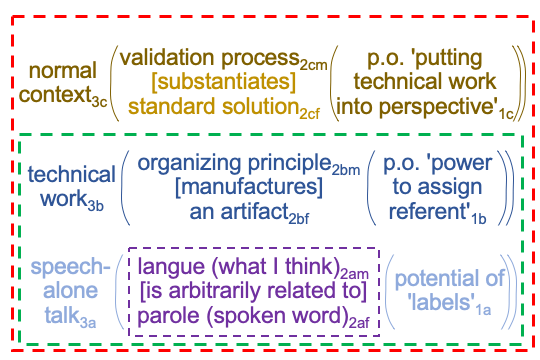
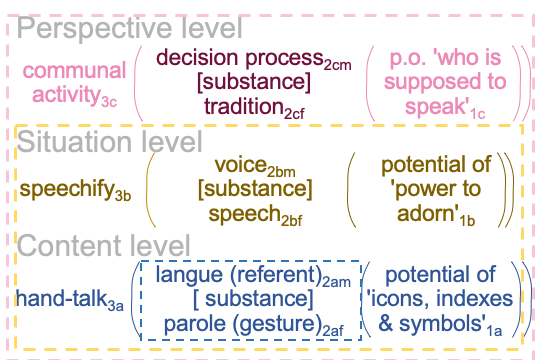
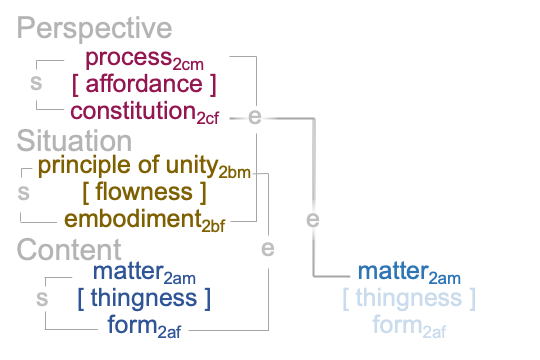
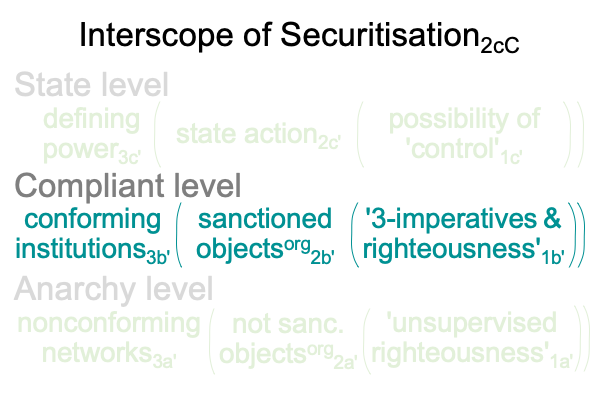
0310 The following figure shows the interscope for speech-alone talk, colored in the same manner as the interscope for the social construction of natural science, pictured above.

0311 Compare the above figure to the interscope for hand-speech talk, developed earlier.

0312 One three-level interscope goes with our current Lebenswelt.

The other three-level interscope associates to the Lebenswelt that we evolved in.

0313 The productive scholar takes out of his treasure something new and something old.  Dr. Alva Noe brings out what is new.  Art and philosophy1c potentiate  aesthetic inquiry2cm in the normal context of figuring out what makes us who we are3c.  This examination brings out what is old.  It is an insight that is as old as the stories of Adam and Eve.  Our current Lebenswelt is not the same as the Lebenswelt that we evolved in.

0300 There is no reason not to draw from premodern aesthetic inquiries2cm.  Indeed, it seems that art and philosophy1c fall into shadow at the onset of the modern Age of Ideas.  Now, Razie Mah confronts mankind with the possibility that the human niche is the potential of triadic relations.  He writes a work of art, titled, An Archaeology of the Fall.  Take the figures showing the confoundings for hand-speech talk and speech-alone talk to any art museum.  See how they direct one’s vision.

0301 There is plenty of reason to resist the replacement of the potential of ‘art and philosophy’1c with the potential to ‘observe and measure’1c.  Scientifically oriented philosophers would have me accept that what I think2am and what I say2am entangle the mathematics and the mechanics of neurobiology.  The methods and data2bf of neurobiology entangle a model2cm capable of telling what the noumenon must be2cf for me to understand what makes me who I am3c.

0302 My thanks to the author for publishing a work worthy of examination.  Thank you for presenting an opportunity to add color to a text.

10/31/26

Looking at Ian Hodder’s Book (2024) “Entangled.”  (Part 1 of 22)

0001 The full title of the Work before me is Entangled: A New Archaeology of the Relationships between Humans and Things (Second Edition).  The author is emeritus professor at Stanford University, California, and affiliated with the And Koc University in Istanbul, Turkey.  The publisher is Wiley Blackwell (Hoboken, New Jersey).  The identifier is ISBN 978 111 985 5866 (paperback).

0002 The first edition is published in 2016 and titled Studies in Human-Thing Entanglement, which is quickly followed in 2018, with Where are We Heading: The Evolution of Humans and Things (Yale University Press).  This boost is examined in Razie Mah’s blog (June 30 to 16, 2023, Looking at Ian Hodder’s Book (2023) “Where We Are Heading”).

0003 The second edition (2024) involves a significant rewrite.  The topic is the same, but the emphasis changes.  The change is captured in the title of the first chapter, “Thinking about Things Differently (from Things to Flows)”.

0004 Section 1 of chapter 1 (S1C1) starts with the question, “What is a thing?”

For me, the question is addressed in a recent article by Mariusz Tabaczek, eliciting a response by a capable semiotician, who posted a draft in the website academia.edu titled Response to Mariusz Tabaczek’s Article (2025) “Contemporary and Classical Versions of Hylomorphism”.

0005 The response relies on the definition of “entanglement” developed in Razie Mah’s blog in December, 2025, titled Looking at Igor Pilshchikov and Mikhail Trunin’s Article (2016) “The Tartu-Moscow School of Semiotics”.

0006 The term, “entanglement” stands like a mirror of the term, “substantiation”, thereby confounding the structure of Peirce’s category of secondness.

I will explain in the following points.  For further introduction, consult Razie Mah’s e-works, A Primer on the Category-Based Nested Form and A Primer on Sensible and Social Construction.

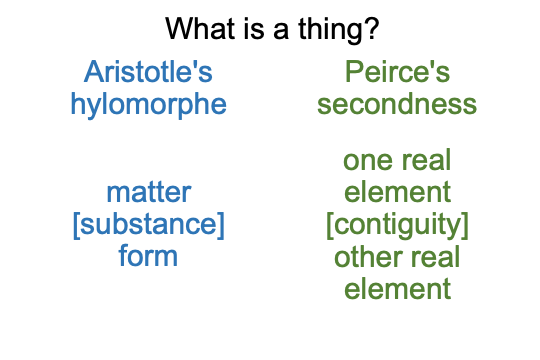
0007 What is a thing?

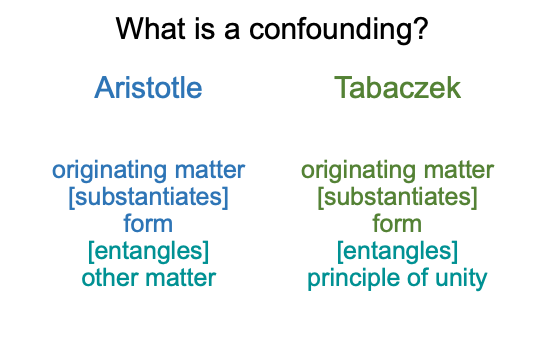
According to Aristotle, the first step in natural philosophy is to regard a thing as matter [and] form.  The brackets are there for a reason.  Aristotle’s hylomorphe (hylo = “matter”, morphe = “form”) is an exemplar of Peirce’s category of secondness.  Secondness consists of two contiguous real elements.  For Aristotle’s hylomorphe, the real elements are matter and form.  The contiguity, [and], is hardly adequate.  So, Razie Mah purloins the much-abused term, “substance”, to replace the conjunction.

0008 Here is the result.

0009 Of course, the use of the word, “substance” (a noun), as the label for the contiguity between matter and form may be regarded as controversial.  However, the act only adds a technical definition to an already discarded label.  Modern thinkers have no idea what the term originally means, so they are convinced that whatever meaning that a modern assigns must be appropriate.  “Substance” means whatever a modern says that it means.

What a message.

0010 The idea of entanglement comes up, because, once matter [substantiates] form, then the form may get entangled with other matter.  The thing remains a thing, but now other matter becomes apparent.  For Tabaczek’s review of contemporary commentaries on Aristotle’s hylomorphe, certain philosophers say that the form entangles a principle of unity.

A principle of unity becomes the entangled matter.

0011 Here is a picture.

0012 This principle of unity allows the person to regard the form as a hole…  I mean, whole… as in holistically.

One might think that a principle of unity does not constitute matter.  But, has that thinker ever framed a picture?  That frame is confounding.

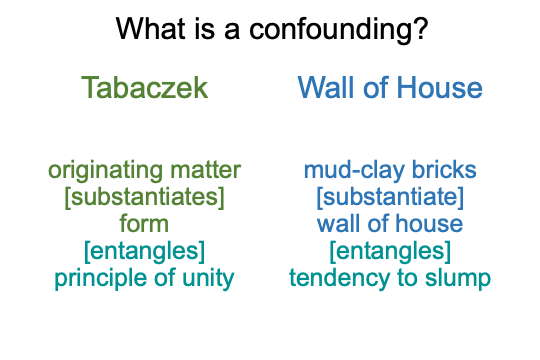
0013 Another example is found in Hodder’s research fieldwork.

Long long ago, the inhabitants of Catal Hoyuk (the anglicized version of a Turkish label) frequently plaster their walls as a solution to the undesired habits of mud-clay bricks.  They tend to slump.  Plaster helps control the loss of integrity that slumping entangles.

Here is a diagram.

0014  Happily, plastering the walls solved other issues as well.  The text explains.

10/7/26

Looking at Ian Hodder’s Book (2024) “Entangled.”  (Part 22 of 22)

0285 What do I mean by “not enough”?

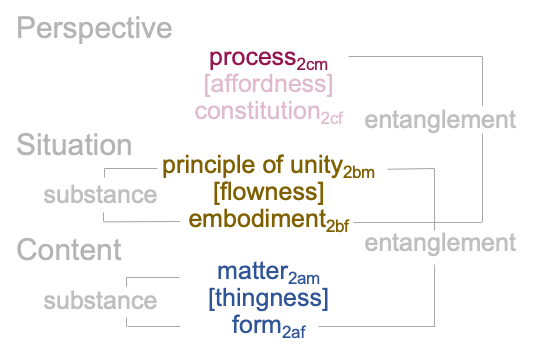
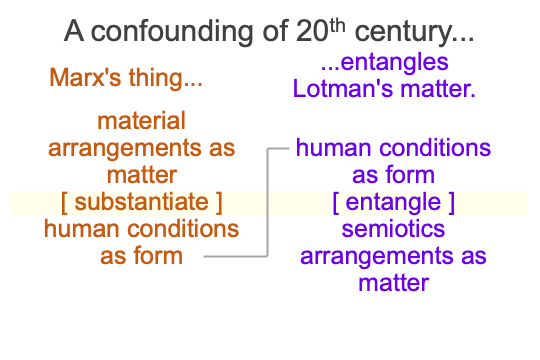
0286 From this examination, I have demonstrated that Hodder’s sociological and anthropological appreciation of “entanglement” mirrors, so to speak, a philosophical definition of a confounding.  Using Aristotelian terminology, a confounding occurs when the form of a thing entangles other (non-originating) matter.  Form is contiguous with two matters, one originating and one entangled.  The two contiguities are “substantiation” and “entanglement”.

0287 This applies to content-level and situation-level hylomorphes.  In the following figure, entanglement connects form on one level with matter on the adjacent higher level. This connection also occurs in the sign-relations isolated by scholastics of the Latin Age.

0288 Clearly, this expression of entanglement theory stands outside the Hegel-Marx Overton window.

This expression stands outside of the range of ideation among modern anthropologists in 2026.

0289 The story is even more complicated.  The three-level interscope fully contains two sign-relations, the specifying and the exemplar, familiar to Latin Age scholastics.  Even that is not enough.

There is one more confounding that resolves into a sign-relation.  The interventional sign connects the perspective-level of one interscope with the content-level of another.  What is constituted2cf in one interscope stands for matter3am in another interscope.  The discovery of the interventional sign-relation completes a line of thought that started during medieval times.

0290 The Hegel-Marx approaches that the author discusses in chapters 10 and 11 (C10 and C11) need to be adjusted in order to account for phenomena regarded as observable and measurable facets of a noumenon characterized by substances, confoundings and sign-relations.

0291 The story of the emergence of Lotman’s thing is told in Razie Mah’s blog for December 2025, titled Looking at Igor Pilshchikov and Michael Trunin’s Article (2016) “The Tartu Moscow School of Semiotics” as well as follow-up examinations appearing in January through March of 2026.

0292 Juri Lotman (1922-1993) is a Soviet era academic with expertise in the arts of the Slavic civilization.  He and a collaborator, Boris Uspenskij (1937-present), find that Marxist vocabulary is inadequate to discuss the phenomena of Slavic historical art production.  So, they adopt semiology and structuralism in order to build models of artistic and literary productions.  The models allow them to discuss Slavic art-works according to modern, scientific sensibilities.

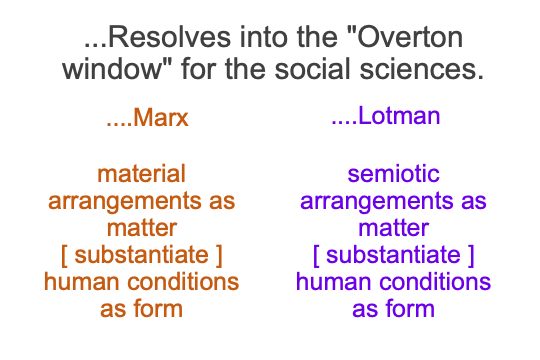
0293 In sum, for Juri Lotman and Boris Uspenskij, Marx’s thing entangles the matter of semiotics.

0294 The confounding resolves in… what appears to me… to be the new Overton window for the social sciences for the twenty-first century.

0295 I wrap up with three noteworthy conclusions.

0296 First, Hodder’s anthropological theory of entanglement associates with Marx’s thing.  Razie Mah’s hypothesis that the human niche is the potential of triadic relations associates with Lotman’s thing.

Second, despite occupying different poles of the twenty-first century Overton window, Hodder’s sociological theory of entanglement and the philosophical definition of “entanglement” as a component of a “confounding” do not exclude one another.  They either complement or align.

Third, excavations at Catal Hoyuk permit the suggestion that cultural emissaries from the Ubaid of southern Mesopotamia influence a change in things2a, embodiments2bf and processes2cm associated with Level VII (starting around 6600 B.C.).  This suggestion is consistent with the hypothesis of the first singularity proposed by Razie Mah.

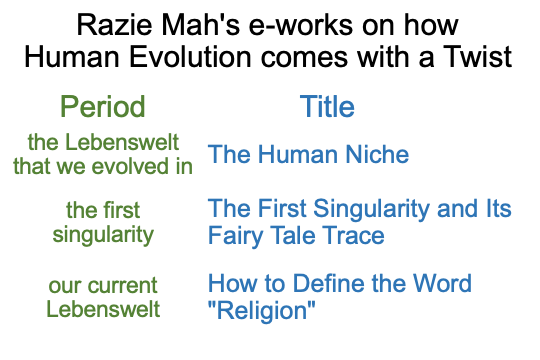
0297 Here is a summary of Razie Mah’s e-works on human evolution.

0298 My thanks to Dr. Ian Hodder for this book, as well his many collaborators.  I hope that this examination adds value to his inquiries.

03/21/26

Looking at Augustin Fuentes’s Article (2016) “The Extended Evolutionary Synthesis…” (Part 1 of 16)

0001 The full title of the article before me is “The Extended Evolutionary Synthesis, Ethnography, and the Human Niche: Toward an Integrated Anthropology”.  The work is published in Current Anthropology (volume 57, supplement 13, June 2016, pages S13-S26; DOI: 10.1086/685684).  At the time of publication, the author is a Professor at the Department of Anthropology at the University of Notre Dame, Indiana.  He has since been scooped up by Princeton.

Scooped?

Ask anyone in Human Resources what that term means.

0002 The material for this thought-piece is developed at the Center for Theological Inquiry in 2012-13, in a collaborative titled, “Inquiry on Human Nature”, and presented to a Wenner-Gren symposium in 2014.

0003 This is the time when the much-vaunted program of “niche construction” is in the Zeitgeist… er… air.  The author seeks to capitalize on this extension of the evolutionary synthesis.  The first extension, starting fifty years earlier, is from natural history into genetics, and is now called “Neodarwinism”.

And what does he want to invest that capital in?

An integrated anthropology.

0004 Integrated anthropology?

I suppose that anthropology is to integrate with evolutionary science.

This is precisely an interest of Razie Mah, as witnessed in his three masterworks: The Human Niche (2018), An Archaeology of the Fall (2012), and How To Define the Word “Religion” (2015).

0005 But, that is not the references that I really should be pointing to.

I should be indicating two primers, by Razie Mah, available at smashwords and other e-book venues.  These are A Primer on the Category-Based Nested Form and A Primer on Sensible and Social Construction.

0006 Why?

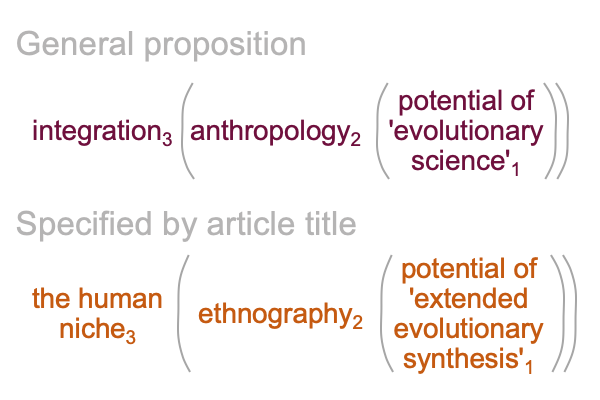
The terms in the title of the work under examination associate to elements in a category-based nested form.

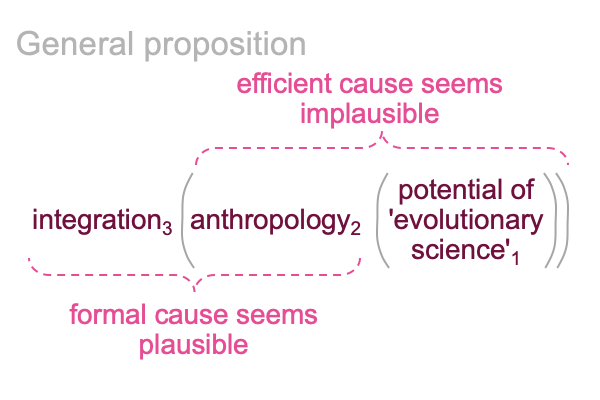
I associate “integration” to the normal context3.

I associate “anthropology” to the actuality2.

I associate “evolutionary science” to the potential1.

0007 The category-based nested form derives from the philosophy of Charles Peirce.  It consists in four statements.  The fourth is paradigmatic.  A triadic normal context3 brings a dyadic actuality2 into relation with the monadic possibility of ‘something’1.  The subscripts correspond to Peirce’s three categories.

0008 Here is a picture of my associations, along with how each element gets specified by the title of this article.

0009 What do these associations imply?

The human niche3 is the “integration3” of an “integrated anthropology”.

As such, the human niche3 should contextualize ethnography2 (as a specific application of anthropology2).

0010 The formal causation in these statements seems reasonable.

But, does the efficient causation seem plausible?

Does anthropology2 emerge from the potential of evolutionary science1?

Can ethnography2 situate the potential of ‘niche construction (as a case-study for an extended evolutionary synthesis)’1?

0011 The following figure distills the author’s challenge.

03/4/26

Looking at Augustin Fuentes’s Article (2016) “The Extended Evolutionary Synthesis…” (Part 16 of 16)

0163 Consequently, a pattern of domestication and entanglement is an appropriate darwinian model for the adaptations involved in discipline of ethnography.

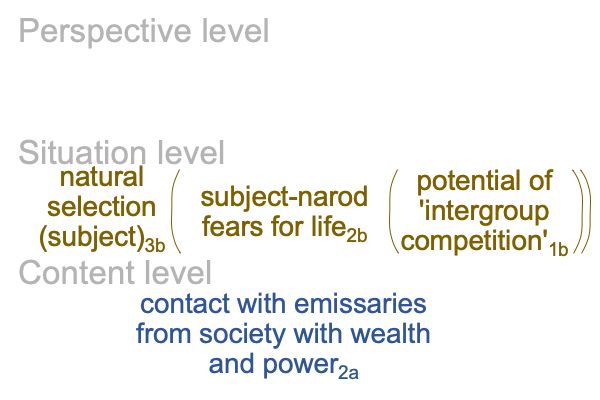
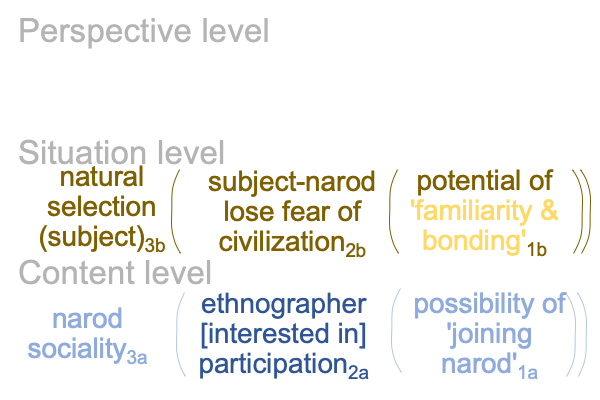
0164 On one hand, the ethnographer is an emissary from a society with wealth and power and serves as an actuality independent of the adapting narod-folk2a.

The potential of intergroup competition1b says that fear should be the appropriate adaptation2b, in the course of natural and cultural selection3b.

0165 But this does not happen.  Instead, the narod-folk3b,1b adapt by losing their fear of the ethnographer’s society2b.  This is the nature of domestication.

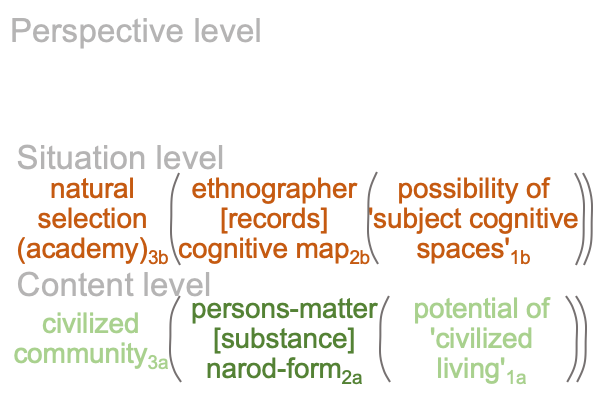
0166 On the other hand, the narod-folk2a are the actuality independent of the adapting species for anthropologists within Western academies3b who are trained by (and train) ethnographers on the methods of mapping the cognitive spaces of narod-folk1b.  The very act of mapping the cognitive spaces of a narod (whether historically given or spontaneously generated) exhibits the anthropology of substantiation and entanglement.

0167 I conclude by returning to the snarky comment at point 119 and apologizing.

Yeah, semioticians have teeth.

0168 The author notes, in the final paragraph, that the human niche is a basal framework that enables the inquirer to include the salient features, forces and processes at multiple levels of… um… organization.  Surely, that description fits the idea of using the purely relational structure of the category-based nested form as a tool for inquiry.  All that this examiner has done is transpose elements from the author’s argument into the empty slots of a category-based nested form.

This suggests that category-based nested forms satisfy Bourdieu’s enigmatic phrase, of “structured structures predisposed to function as structuring structures”.  Category-based nested forms are purely relational (triadic) structures that gather material through the intuitive use of association, followed by an exploration of the implications.

0169 My thanks go to the author of this article, who undoubtedly has published more academic literature since this work from 2016, without the value that this examination adds.  Perhaps, this 2026 review may add to a re-illustration of the envisioned integrated anthropology.

04/6/23

Looking at Karatzogianni and Robinson’s Article (2017) “Schizorevolutions Versus Microfascisms” (Part 1 of 4)

0001 Last month, the Razie Mah blog presented the end of Comments on David Graeber and David Wengrow’s Book (2021) “The Dawn of Everything” (available at smashwords and other e-book venues).  The blog is titled Looking at Graeber and Wengrow’s Chapter (2021) “The State Has No Origins”.

The question arises, “Does the weird confounded diagram developed in this commentary have relevance to other inquiries covering the human condition in our current Lebenswelt?”

0002 This blog offers an answer, by way of example.

Three years before the conjunction of Saturn and Jupiter in the constellation of Aquarius, Athina Karatzogianni and Andrew Robinson publish an article in the Journal of International Political Theory (2017, Vol. 13(3) 282-295).   The British scholars are experts in communication and sociology.  Thier article investigates the role of anarchy… er, “anarchy”… in state securitization.

0003 The weird and confounded diagram that appears in the commentary on Graeber and Wengrow’s book looks like this.

Figure 01

The goal of this blog is to briefly review Karatzogianni and Robinson’s article and to demonstrate that a derivation of this figure maps onto the topic.

0004 What is this article about?

The full title is Schizorevolutions versus Microfascisms: The fear of anarchy in state securitisation.  Needless to say, the terms are specialized descriptors.  But of what?

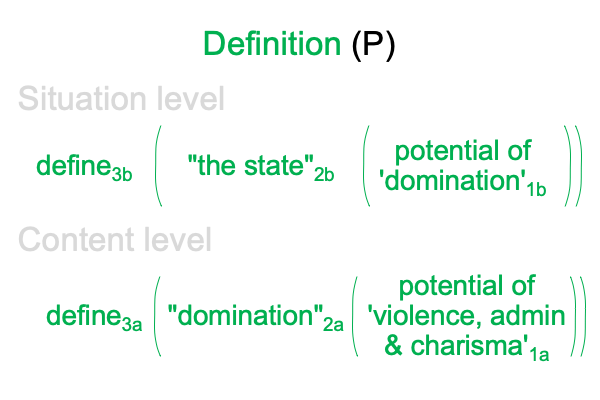
0005 According to the above figure, academics may confound the state2b with sovereign acts and decrees2bC.  The “state”2b is defined.  What is defintion?  Definition3 is the normal context bringing the actuality of a spoken word2 into relation with the potential of meaning, presence and message1.

The state2b‘ is a term arising from the presence of domination1b‘.  But, domination2a must also be defined.  The term, “domination”2a, emerges from (and situates) the possibilities inherent in the sole legitimate use of violence (similar to presence)1a’, the administration of information (like meaning)1a and the promotion and guidance of charismatic influence(like message)1a.  I call policing, bureaucracy and maintaining reputation, “the three imperatives1a“.  The three imperatives1a underlie domination2a.

0006 Here is a picture of the way that Graeber and Wengrow define “state”.  This is the path of definition (P).

Figure 02

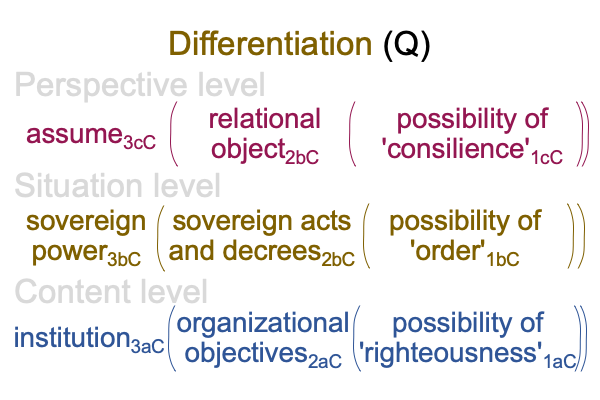
0007 The way of differentiation is developed in the chapter on presence in Razie Mah’s masterwork, How To Define The Word “Religion” (available at smashwords and other e-book venues).  Even though the differentiation of an originary, undifferentiated, social world follows the logic of Peirce’s categories, the process is also historic.  Since the start of our current Lebenswelt, the societyC, organizationB and individuals in communityA have historically differentiated into three tiers of interscopes.  As a result, realization of the two types of religion, corresponding to organizational objects2aC and a relational object2cC, follows the logic of the differentiation of category-based nested forms and occurs in history.

Here is a picture of the three-level interscope for the societyC tier.  This is the path of differentiation (Q).

Figure 03

0008 Needless to say, neither Graeber and Wengrow nor Karatzogioanni and Robinson are aware of the the path of differentiation.  So, they are not aware that they confound P and Q.

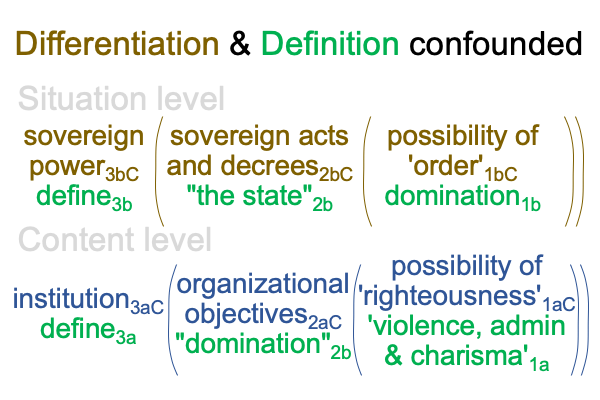
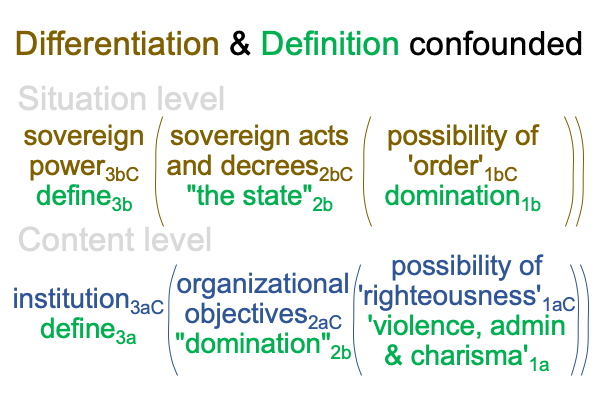
For example, in the introduction, the latter authors suggest that the securitisation discourse (the administration of information, P21a) by the state2b’ arises from the perception of “new threats” (charismatic influence outside of state supervision, P31a) and attempts to fix network flows  (through violence, P11a).  This also means that the normal context of sovereign power3bC brings the actuality of sovereign acts and decrees2bC into relation with the potential for ‘order’1bC. However, now sovereign power2bC is confounded with definition3b.  The state2b is mixed up with sovereign acts and decrees2bC.  Plus, ‘domination’1b is entangled with ‘order’1bC.

0009 Here is a picture of how the confounding seems to play out.

Figure 04

0010 Karatzogianni and Robinson immediately go on to say that their argument is based on a distinction between states and networks.  Furthermore networks divide into two forms, such as affinity-active and non-affiliating-reactive, as well as between schizoid (non-affiliating active) and paranoic (non-affiliating reactive).  Then, they discuss the ramifications in detail.

To me, the distinction between the state2b and its domination2a of organizational objectives2aC of insitutions3aCredefines3b institutions3aC as networks3a.  Order1bC melds with efforts to control the content level1b.  While “order” sounds legitimate.  “Control” does not.

Order1bC establishes peace among instituions3aC working2aC independently based on their own righteousness1aC.  Plus, that righteousness1aC does not pay tribute to the perspective level actuality2bC of fear.  

Control1b envisions threats emanating from the open space of active desire1aC and aims to moderate these through domination2a (using P1, P2 and P3 of the three imperatives underlying the definition3a of domination2a).  Consequently, attempts2b to supervise2b and narrow the space1b of righteousness1aC, sanction2b and outlaw2b objectsorg2aC, and wage war2b on institutions3aC that do not conform to state2b control1b expand into the fabric of everyday life.

0011 The state’s2b acts and decrees2bC are not oriented to protecting civilians or non-state actors.  So, the normal context is not sovereignty3bC, but a defining power3b (responsible to a higher loyalty2cC, so to speak).  Yet, this defining power3bspeaks the language of sovereignty3bC, just as Graeber and Wengrow do.

0012 But, who is doing the defining here?

Look at the perspective-level actuality2cC.

Fear2cC is not an emotion.  Fear2cC is a demiurge, a relational object, an object that brings everyone into relation.

Fear2cC defines3b the securitisation state2b.

04/1/23

Looking at Karatzogianni and Robinson’s Article (2017) “Schizorevolutions Versus Microfascisms” (Part 4 of 4)

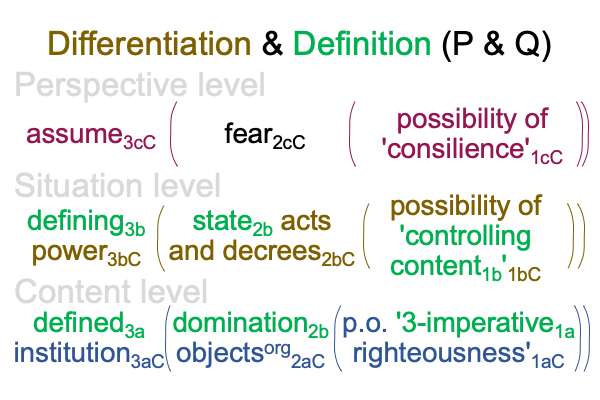
0028 This article appears in the Journal of International Political Theory (2017, vol 13(3), 282-295).  So far, my examination describes how the weird confounded diagram developed in the commentary on David Graeber and David Wengrow’s Book (2021) “The Dawn of Everything” is relevant to Karatzogianni and Robinson’s argument.  This blog retells the story.

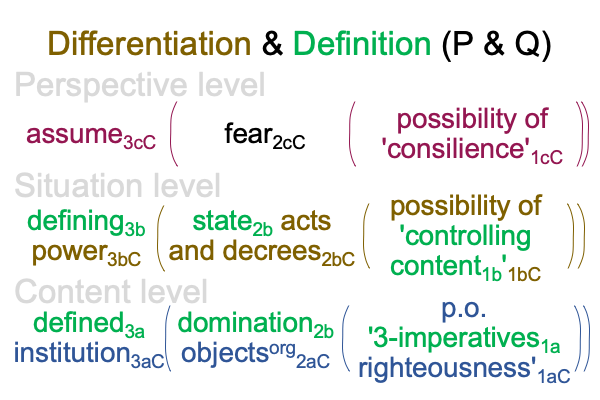
The weird diagram confounds two independent paths of articulation.  The path of Graeber and Wengrow is the way of definition (P).  After all, they are academics.  Academics are devoted to defining their terms.  The path of Razie Mah is the way of differentiation (Q).  The differentiation of a nested form into the societyC, organizationB and individual in communityA tiers takes place in the chapter on presence in the masterwork, How To Define the Word “Religion”.

Here is a picture of the situation and content levels of definition (P) confounded with the same levels of the societyC tier (Q).

Figure 08

0029 The above diagram does not include the perspectivec level of the societyC tier (Q).  Karatzogianni and Robinson open by describing the securitisation state as exploiting and promoting an atmosphere of fear.  Fear is the object that brings everyone into relation2cC.

Consequently, this confounding (P and Q) is put into perspective by a demiurge2cC, an entity standing above sovereign power, and this demiurge2cC defines the state2b.

Figure 09

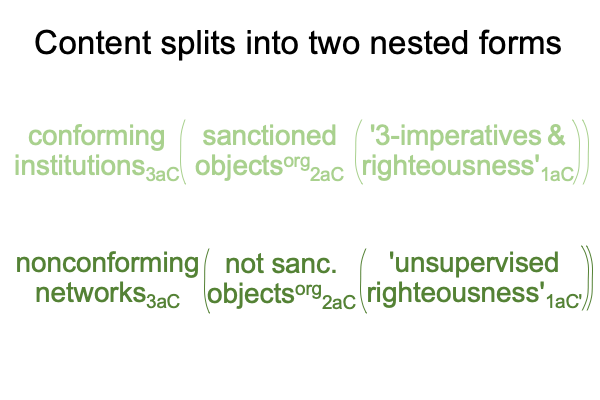
0030 This configuration produces a split in the content level of defined3a institutions2aC.

Figure 10

Some institutions3b’ attempt to work with the state2b.  These conforming institutions3b’ bring sanctioned organizational objects2b’ into relation with the potential1b’ of the three imperatives of domination1c’ as well as the institution’s original righteousness1b.  This is useful for the state2c’, which relies on conforming institutions3b’ to situate institutions3a’ that (for whatever reason) cannot or will not conform.

Conforming institutions3b’ perform microfascist activities for the state2c’, increasing the possibility of state control1c’through forcing choices, limiting and misleading information, as well as protecting reputations.  These activities are built into sanctioned organizational objectives2b’ that presumably emerge from (and situate) the potential of the institution’s original righteousness1b’.  According to my reading this article, Karatzogianni and Robinson do not clearly ideate this side of the splitting. 

Other institutions are downgraded (often, by state interference) into networks3a’.  Nonconforming networks3a’ bring unsactioned organizational objectives2a’ into relation with the potential of ‘unsupervised righteousness’1a’.  Conforming institutions3b’ are ofted viewed by the anarchy level as state apparatuses3b’ whose organizational objectives2b’ are compromised by the fact they follow the rules, even when not necessary, lie and cover up1b’.

0031 How do nonconforming networks3a’ respond?

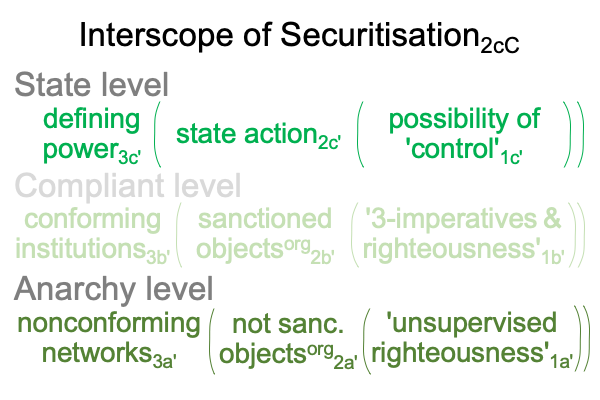
Not as the state2c’ would like them do.  The state2c’ now occupies the perspective level of an interscope that expresses the path of definition.  Remember, the perspective level typically comes into play on;y when there is a failure on the situation level.  In other words, the perspective level is taken for granted, until something goes wrong.

Here is the interscope of securitisation2cC.

Figure 11

0032 Once again, what about the response of noncomforming networks3a’ on the anarchy level?

Unsupervised righteousness1a’ inspires organization objectives2a’ that appear schizophrenic (they are listening to the voices in thier heads instead of the state) or paranoid (they think that the state is the one to fear, rather than the demiurge that defines the state).  Consequently, the two actors of importance in Karatzogianni and Robinson’s article belong to the state and the anarchy levels.

0033 So, what is lacking in this article?

Situation-level institutionsb’ end up being drained of their original righteousness1b’ due to their compromise with the defining power3c’.  Conforming institutions3b’ lose respectability by enforcing the three imperatives that underlie the word, “domination”1b’.  Conforming institutions3b’ lose respectablity by sacrificing their original righteousness1b’ in the process of enforcing the three imperatives1b’.  Yet, conforming institutions3b’ maintain respectablility by being the only ones whose organizational objectives2b’ are sanctioned by state decree2c’ and therefore less likely to suffer capricious state action2c’.

0034 It makes me wonder what the word, “respectable”, really means.

The sociological and psychological dynamics of the compliant level are ripe for exploration.

Coloration tells the story.

Figure 12

0035 So much for the political theory aspect of Karatzogianni and Robinson’s article, what about the “international” aspect?

After all, the article appears in the Journal of International Political Theory.

Well, in the introduction and the conclusion, the authors speculate that the security state may be a response to the anarchy generated by… or may be a strategy to control the wealth and innovations produced by… or may aim to wrest control from…

… global capitalism.

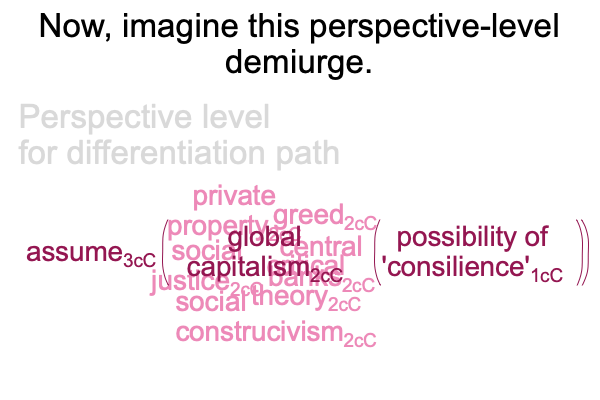
Which makes me wonder, “Could global capitalism be a demiurge, just like securitisation?”

If so, then Graeber and Wengrow’s weird confounding diagram is relevant.

And, the prior steps should apply to the following perspective-level nested form.

Figure 13

0036 The rest is left as an exercise for the intrepid inquirer.

03/31/23

Looking at David Graeber and David Wengrow’s Chapter (2021) “Why The State Has No Origin” (Part 1 of 13)

0180 If David Graeber and David Wengrow’s recent book, subtitled, A New History of Humanity, is a breakthrough in postmodern anthropology, then it is so because it displays a semitic textual structure, instead of a greek textual structure.

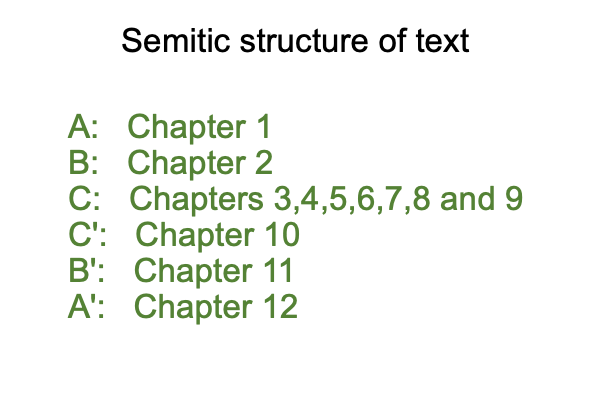
These two styles are discussed in An Instructor’s Guide to An Archaeology of the Fall.  Rather than eliminating possibilities in order to arrive at the most likely correct interpretation, these authors play literary tricks, coupling chapters one and twelve, A:A’, chapters two and eleven, B:B’, and chapters three through nine and chapter ten, C:C’.

Figure 24

0182 The semitic structure is A:B:C:C’:B’:A’.  In Comments on David Graeber and David Wengrow’s Book (2021) The Dawn of Everything (by Razie Mah, available and smashwords and other e-book venues), the work is discussed in the pattern A:A’, B:B’ and C:C’.  Notably, the bulk of the book covers the last layer, C:C’, and balances seven chapters (three through nine, C) against one chapter (ten, C’).  Chapter ten is twice as long as any other chapter.

0183 Plus, chapter ten stands on its own, allowing me to place an examination in Razie Mah’s blog, with the title Looking at David Graeber and David Wengrow’s Chapter (2021) “Why The State Has No Origin”.  If the reader first encounters the blog, the commentary is available.  If the reader first purchases the commentary, then the reader can call the blog to the attention of others.

03/15/23

Looking at David Graeber and David Wengrow’s Chapter (2021) “Why The State Has No Origin”(Part 13 of 13)

0255 Graeber and Wengrow’s exploration of the dawn of everything ends with a cruel joke.

The “state”2b, as defined by social science, cannot indirectly emerge from (and situate) righteousness1aC, while, at the same time, manifesting the characteristics of “domination”2a.

So, how is the contemporary left’s dream of achieving the virtues of liberty, equality and fraternity through the apparatus of the state2b going to work?

Thus ends the third layer, C:C’, of the author’s wide-ranging exercise in the semitic textual style.  The Dawn of Everythingis contemporary postmodern social science at its finest.  The authors start by searching for the origins of social inequality.  They end with the promise of a new history of humanity.

These authors do not know what they do not know.  But they do suspect this…

0256 …A new history of the world awaits.  There is a new way to describe the dawn of everything, where “everything” corresponds to “our current Lebenswelt”.

Yet, their explorations play out as a dark joke, almost as cruel as the joke that, long ago, a talking serpent plays on a naive young woman.

My thanks to the authors.  My condolences as well, on more than one level.

These comments provide views that dramatically re-present the vistas intimated in David Graeber and David Wengrow’s book.  Welcome to a new age of understanding: The Age of Triadic Relations.

10/1/22

Fantasia in G minor: A Speech Written for Gunnar Beck MEP

0001 Gunnnar Beck of the Alternative Fur Deutschland Party, a member of the European Parliament, schedules a speech for the current session.  A few members mill about an almost empty chamber.  The speech lasts for around fifteen minutes.  In that brief span, this statesman provides a true alternative for Germany, as well as all of Eurasia.

He reads the following text.

0002 “Today, I want to address a topic that has recently come to my attention.  The topic concerns the start of our current Lebenswelt.  The topic should be of interest to all Europeans.

Remember the stories of Adam and Eve?  

(laughter by the few in attendance)

We know that they are myths.  But, we cannot imagine what the myths are about.

So I ask: Can we imagine that these myths point to a scientific project that calls all the nations in Eurasia to contribute?

0003 During the past dozen years, a literary figure, Razie Mah, has published a dramatically new approach to human evolution.  He offers three works: The Human Niche, An Archaeology of the Fall and How to Define the Word “Religion”. The Human Niche covers the Lebenswelt that we evolved in.  An Archaeology of the Fall introduces the first singularity.  How To Define the Word “Religion” explores our current Lebenswelt.

0004 I will briefly elaborate the proposals of this scholar.

Here is the first hypothesis.  Our current Lebenswelt is not the same as the Lebenswelt that we evolved in.  The transition from the latter to the former occurs in recent prehistory and is called ‘the first singularity’.

0005 The second hypothesis concerns the Lebenswelt that we evolved in.

We are all familiar with the biological principle that natural selection brings adaptations into relation with a niche.

0006 I ask, ‘What is a niche?’

A niche is the potential of something independent of the adapting species.  Typically, the niche is a material condition, say, the presence of a predator or an environmental influence.  For humans, the niche is not a material condition.  The human niche is the potential of triadic relations.

The philosopher Charles Peirce initiates the study of triadic relations in the modern era.  Examples includes signs, mediations, judgments and category-based nested forms.  Triadic relations encompass mechanical cause and effect, even as they transcend it.  Triadic relations are immaterial, yet they entangle the material.

0007 Consequently, triadic relations offer a new avenue for investigating the Lebenswelt that we evolved in.  The book, The Human Niche, plus its attending commentary, starts the inquiry.

0008 The third hypothesis concerns our current Lebenswelt.

Consider the spoken word, “religion”.  This spoken word belongs to a system of differences.  “Religion” is not the same as “spirituality”.  “Spirituality” is definitely not the same as a “church”.   A “church” is not the same as “a popular belief that there is more to reality than material being”.  In short, the word, “religion”, is purely symbolic and symbols belong to systems of differences.

0009 Do systems of differences have anything to do with language?

Yes, according to Ferdinand de Saussure, language consists of two related systems of differences: parole (or talk) and langue (or thought).

When parole is speech-alone talk, its relation to langue is arbitrary.

If speech is arbitrarily related to thought and if words compose systems of differences, then how do we know what a spoken word refers to?

0010 This is a difficult question.

Razie Mah proposes that we project meanings, presences and messages into spoken words.  Then, we construct artifacts that validate our projections.

In How to Define the Word “Religion”, Razie Mah projects purely relational structures into the meaning, presence and message of the word, “religion”, creating artifacts that validate the term.  But, the artifacts do not quite match what most of us think when we say the word, “religion”.

0011 Remember Eve in the Garden of Eden?

She performs the identical operations.  She sees the fruit.  She names the fruit with a spoken word.  She projects meaning, presence and message into its name.  Then, the fruit becomes an artifact that validates her projection.  Until, of course, the moment that she bites into it.

Then, her eyes are opened.

This story should be familiar to all Europeans, because, right now, the eyes of many citizens are being opened, as our artifacts fail to live up to our projections.  Indeed, we find that our artifacts are not at all what we think they are.  We have tasted the fruit of the tree of the knowledge of good and evil.  And, we realize that we are naked and exposed.

0012 There is a foundational problem with our current Lebenswelt.

This problem does not operate in the Lebenswelt that we evolved in.

So, what is the difference between our current Lebenswelt and the Lebenswelt that we evolved in?

0013 This brings me back to Razie Mah’s first hypothesis.

What is the nature of the first singularity?

Let me start with this.  The evolution of talk is not the same as the evolution of language.

Hand talk is practiced in the Lebenswelt that we evolved in.  Speech is added to hand talk at the start of our species, over two-hundred thousand years ago.

The semiotics of hand talk is crucial.  Manual-brachial word-gestures image and point to their referents.  So, the referent stands before the gestural word.  Hominins cannot project meaning, presence and message into their gesture-words.  Such projections require symbols.  Manual-brachial gestures are icons and indexes.

0014 Consequently, our distant ancestors cannot perform explicit abstraction.  Rather, abstractions are implicit.  Implicit abstractions build our bodies and our minds.  Implicit abstractions build our social circles.  This is the way that we evolved to be.

Language consists of symbolic operations.  Symbolic operations start to function beneath the icons and indexes of hand talk.  Consequently, language evolves in the milieu of hand talk, as symbolic operations become more and more routine.  General grammar appears after the domestication of fire.  Hominins prosper with fire and linguistic hand-talk.  When humans evolve, speech gets added to hand talk.

Anatomically modern humans practice hand-speech talk for two-hundred thousand years.  Humans settle all habitable continents.  Then, around seven-thousand eight-hundred years ago, something strange happens.  A new culture appears on the edge of the Persian Gulf.  That culture practices speech-alone talk.  That culture is the Ubaid of southern Mesopotamia.

0015 At the beginning of the first singularity, the Ubaid is the only culture practicing speech-alone talk.  All surrounding cultures practice hand-speech talk.

Today, all civilizations practice speech-alone talk.

0016 Obviously, speech-alone talk expands from the Ubaid to all the world.  It does so, through mimesis.

The transition is easy.  All that a hand-speech talking culture needs to do is drop the hand-talk component of its hand-speech talk.

The motivation?

Speech-alone talk increases labor and social specialization.

Speech-alone talk makes people wealthy and powerful.

Speech-alone talk allows explicit abstraction.  Speech-alone talk permits people to project meanings, presences and messages into purely symbolic words.  Speech-alone talk encourages people to construct artifacts that validate those projections.  Consequently, speech-alone talk places no constraints on social complexity.  Speech-alone talk potentiates civilization.

 0017 The hypothesis of the first singularity explains why our current Lebenswelt is not the same as the Lebenswelt that we evolved.

If the hypothesis of the first singularity is plausible, then our appreciation of ourselves will never be the same. 

0018 Here, I get down to business.

The hypothesis of the first singularity mandates an intercivilizational research project.  Can we visualize the spread of speech-alone talk, from the Ubaid to all the world, in recent prehistory?  We are looking for signs of increasing social complexity, eventually leading to civilization in various regions of the world.  But, that is not all.  The adoption of speech-alone talk leads to many other trends that appear in recent prehistory, such as the Indo-European and the Austronesian language expansions.  The question opens wide vistas.  Archaeologists of the world, hear our plea.  Nations of the Eurasia, hear our voice.

We look to Iraq, the site of the Ubaid, the Halaf, and the Hassuna cultures.  History begins in Sumer.  We look to Iran, the site of the Susa culture, showing signs of social complexity, then, collapsing in the face of a Uruk expansion.  We look to Egypt.  Could speech-alone talk have spread to Egypt from Mesopotamia, potentiating civilization along the Nile?  We look to the nations of the Aegean.  Could the adoption of speech-alone talk contribute to the rise of Bronze Age civilizations.  We look to Europe.  Could the secondary farming expansion have spread speech-alone talk?

We look to Russia, as the site where the Proto-Indo-European culture coalesces.  What is the prehistory of the Kurgan culture?  We look to Pakistan and India, asking them to explore the prehistoric cultures giving rise to the planned cities of the Harappan culture.  We look to China, for signs of increasing social complexity, leading to the Longshan culture, among others.  We look to Japan, for the emergence of social complexity during the Jomon period.

We look to China, Taiwan, Philippines, New Guinea, and other nations of the eastern Pacific, asking them to investigate the nature and the timing of the Austronesian language expansion.  We look to Peru and Ecuador, site of the oldest civilizations in the Americas.  We look to Mexico and central America for signs leading to Mesoamerican civilizations.  We look to North America, for the archaeology of the mound-building cultures.

0019 We propose that The First Intercivilizational Conference on the First Singularity be held, in the year 2025, in Berlin.  Within two years, archaeologists can collate existing information with the hypothesis in mind.  The intent of this conference will be to establish collaborative intercivilizational research programs.  Seven years later, a second conference should give the world an indication as to the credibility of the hypothesis of the first singularity.

0020 Razie Mah offers three works, The Human Niche, An Archaeology of the Fall and How to Define the Word “Religion”.  These three works transform our vision of human evolution.

First, our current Lebenswelt is not the same as the Lebenswelt that we evolved in.  The transition from the latter to the former is called “the first singularity”.  The first singularity involves a change in the way humans talk.

Second, the human niche is the potential of triadic relations.

Third, the semiotics of speech-alone talk potentiates unconstrained social complexity.  Unconstrained social complexity defines our current Lebenswelt.

0021 These three hypotheses should be of interest to all Europeans.  They address issues of intellectual concern throughout Western civilization.  What if the stories of Adam and Eve are fairy tales about social developments in the Ubaid of southern Mesopotamia?  What if our ancestors adapt to a niche that is unlike any other mammal’s niche?  How do we accept the claim that our spoken words encourage us to construct artifacts that then validate our spoken words? The implications are profound.

0022 Most of all, the hypothesis of the first singularity should inspire this body, the European Parliament, to address the continent of Eurasia, and ask, “Will you help us investigate?”

Archaeologists from all parts of Eurasia are called to participate in an intercivilizational research project. Can archaeological investigations of our local prehistories allow us to imagine the adoption of speech-alone talk as the historical condition that potentiates unconstrained social complexity?  This is a huge question.  This question extends beyond Eurasia.  However, the question applies first to Eurasia.

Further details of this proposal will be forthcoming.

0023 I thank you for the privilege of addressing this chamber.”