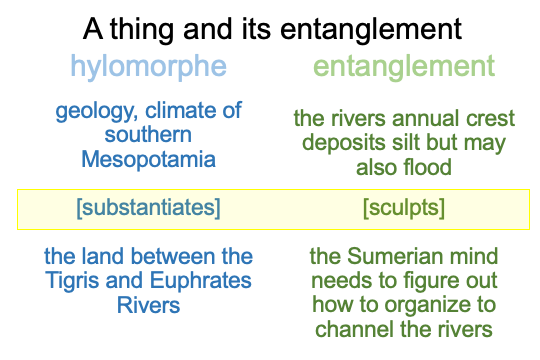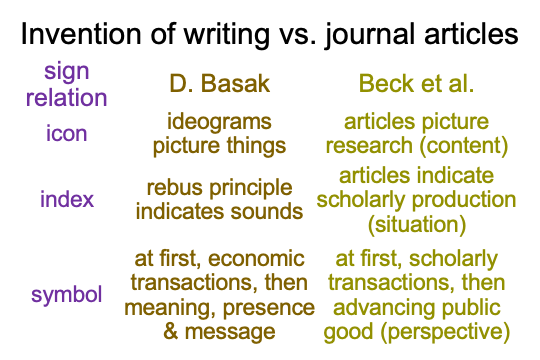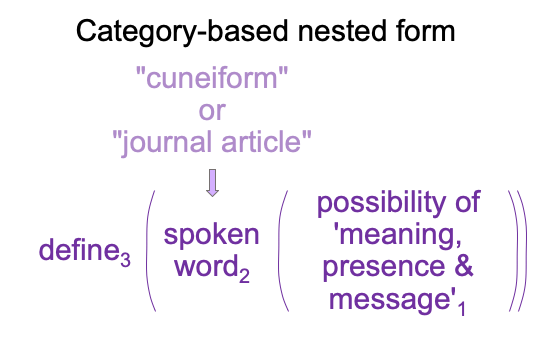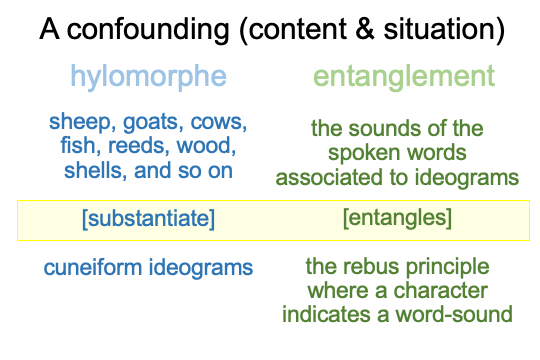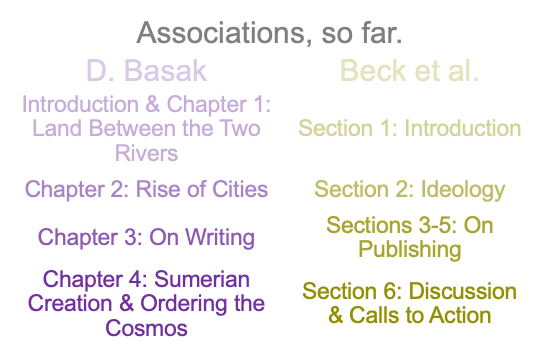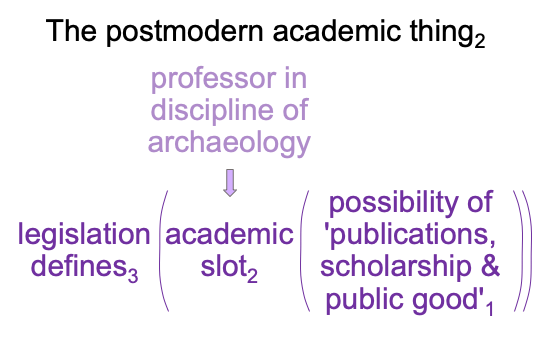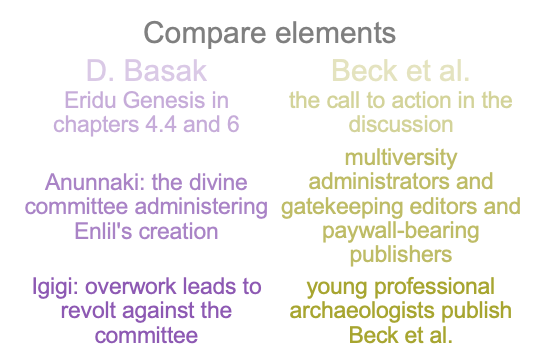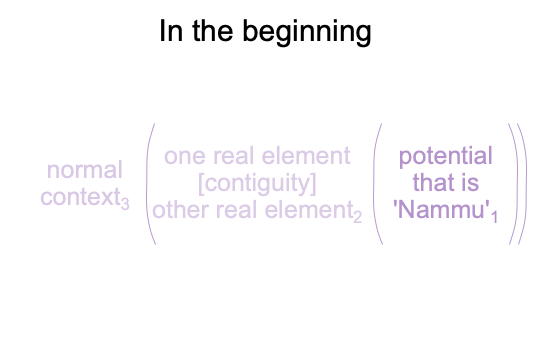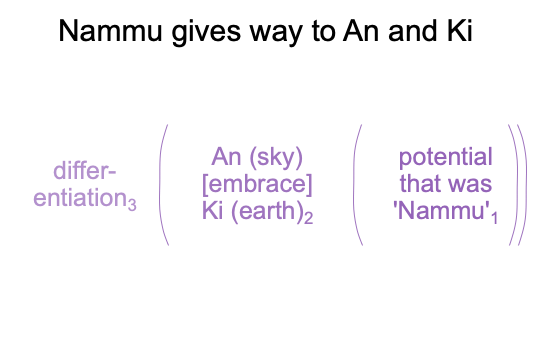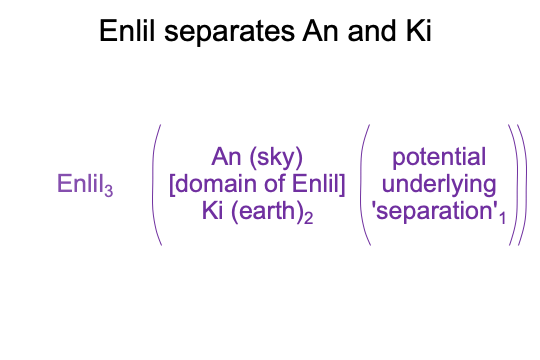
01/1/26

Looking at Melinda A. Zeder’s Article (2025) “Unpacking the Neolithic” (Part 3 of 4)

0031 The story does not end here.

This is what the article under examination is all about.

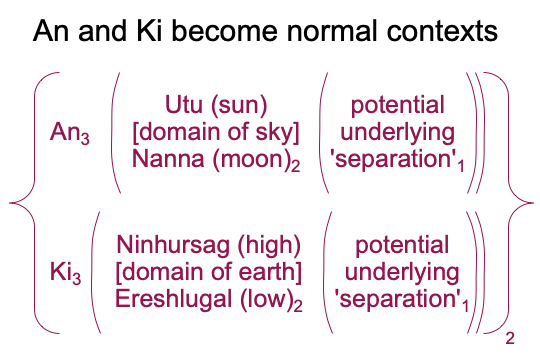
0032 The formal cause for Braidwood’s actuality2 involves the normal context of novel interglacial ecologies3.  The neolithic archaeological period flowers at the end of the previous ice age.  New ecologies allow humans to figure out how to live in one location and engage in domestication.  The substance of [location & domestication] defines the essence of the neolithic human condition2f.

The final cause might be labeled ‘settling down’.  Complementary seasonality1 (different ecologies assessible at one location) and insurance1 (through domestication) support efficient causes that cohere to the final cause of ‘settling down’1.  

0033 Indeed, complementary seasonality and domestication may be reified into the contiguity between the real elements for Braidwood’s material arrangements2m and neolithic human conditions2f.

As soon as this is done, then the normal context3 of interglacial ecology3 is destabilized.  An interglacial ecology3 does not contextualize the final cause that arises from the potential to ‘settle down’1.

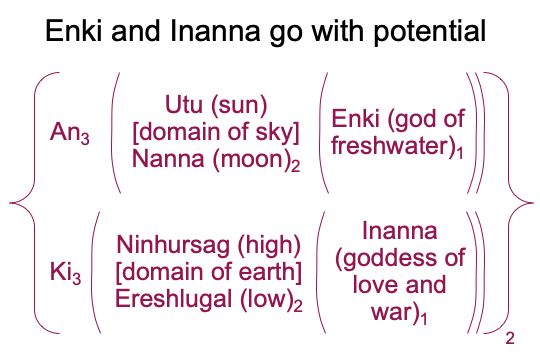
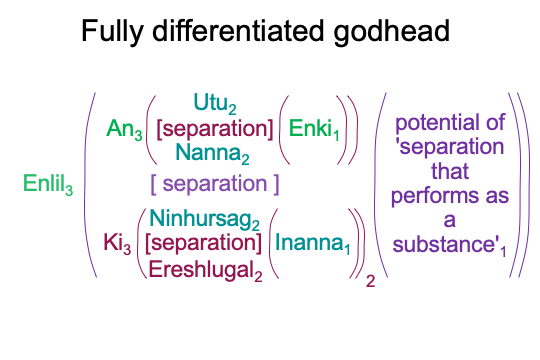
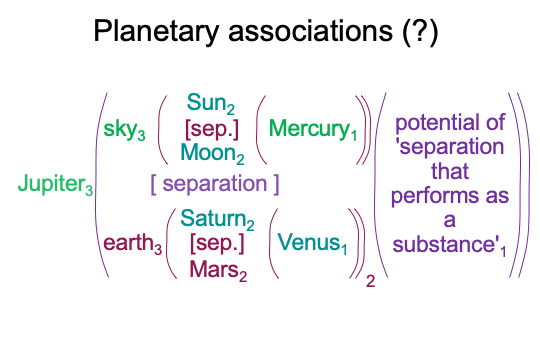
0034 Here is a picture.

0035 Although, the author’s history of “neolithic” (A) does not articulate the resulting confounding, the storyline suggests the following.

0036 The matter of a bauplan, a fairly well conceptualized unfolding pattern (such as embryo development) seen over and over in evolutionary biology, is now entangled with the form of the neolithic condition.

This is the agenda hidden within the article under examination.  The idea of bauplan is introduced in the third section (C), but the idea colors the presentation of current information about neolithic emergences throughout the world (B).

Or does it?

0037 Of course it does, because the author’s interest shifts from the efficient causalities that rely on the potentials1underlying sedentism2, that is, complementary seasonality1 (at one location) and insurance1 (in the style of domestication), to final causalities such as ‘settling down’.  Why would a species that is used to traveling settle down?  Well, certain locations offer the proper affordances.

However, these locations cannot be recognized and the affordances cannot be cultivated if there is no… how to say it?.. unfolding of ‘something’ within the species (humans) that is settling down.  Can location somehow consolidate human social circles?  Can plants and animals apply to the potential of settlement1?

These are very good questions.

0038 The evolutionary biologist who retains an interglacial ecology3 as the normal context for the neolithic condition2fcannot explain the development of ‘something’1 implicit to the archaeological data (B).

0039 What is the bauplan?

The bauplan3 situates the interglacial3 in so far as the emphasis shifts from efficient causes, where ecological and environmental features of the interglacial1 potentiate material arrangements2am, to final causes, where the substances of enhancing complementary seasonality (say, by building sheds to store food) and actualizing domestication (say, by doing what the animals and plants want them to do) makes2 the neolithic… um… “revolve”.

0040 Or, maybe, I should say, “Spiral.”

“Spiral” portrays the character of final causality, every bauplan unfolds according to the intentions built into the formal design.  Efficient causes do not have to be coordinated.  They only need to influence one another, as if trying to achieve the same ends, for the bauplan to spiral into actuality.

0041 The author frames her proposal that the normal context3 is (some sort of) bauplan3 with the term, “middle way”.  The middle way covers the span from the start of a spiral to its terminus.  The spiral starts in our current interglacial with a change in stone tools2m, along with all sorts of other arrangments2m, working to actualize the potential of ‘settling down’1.

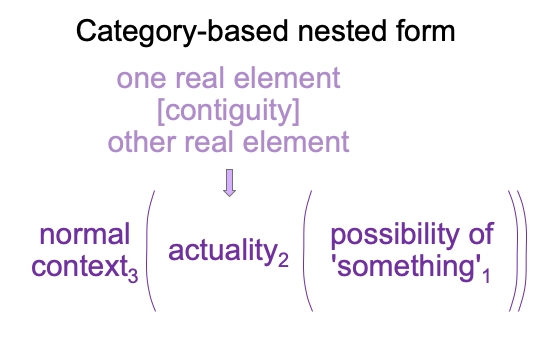
0042 The following diagram depicts the author’s paradigm as a category-based nested form.

0043 The normal context of a spiraling middle way3 (characteristic of a bauplan3) brings the dyadic actuality, {arrangements based on final causes2m [complementary seasonality and insurance] neolithic human conditions2f}, into relation with the potential of ‘a convergence of final causes, such as settling down’1.

At least, that is what I (C).

0044 The sections summarizing recent research on the Neolithic (B) walk the reader towards two conclusions.

0045 First, each region follows a different trajectory, due to efficient causalities pertinent to that ecology and environment.  Nevertheless, all regions fall within the expectations of the author’s middle way3.  The potentials inherent in efficient causalities are reified into a substance2 that stands between the matter of the settler’s arrangements2m and the form of the neolithic human condition2f.  The potentials inherent in final causalities1 undergird a bauplan3.

Efficient causalities vary.  Final causes are held in common.

0046 Second, I may ask, “How does the educated expert investigate the neolithic bauplan3 and its potentials1?”

0047 Well, a top-down reduction of matter and substance (what a Latin-speaking scholastic would call, “esse“, or being substantiating) does not assist, because… well… the mechanical philosophers rejected final causation back in the 1600s.

A bottom-up theoretical construction of substance and form completely misses the normal context3 and potentials1, which harken back to evolutionary biology.

0048 The author admits the impossibility of reductionist and social constructionist approaches by singling out Uchiyama’s NEOMAP cultural landscape framework as exemplar.  The project synthesizes data from the so-called “inland seas” of China, Japan, Korea and Eastern Russia with the intent of identifying convergent (efficient causal) factors.

Oops.

It’s the final causes that give rise to behavioral arrangements as matter that are convergent.

0049 Now, I could stop here and return to my cocktail, but there is a third conclusion.

Really, it is an observation about the second movement (B).

An irreversible transition towards unconstrained social complexity occurs within each region that the author discusses.

0050 The clue is found in a figure that accompanies each region (southwest Asia, China, Japan, Eastern North America, Mesoamerica and the Pacific Northwest of North America).  The horizontal axis is time.  The vertical axis divides according to Braidwood’s complex of material arrangements.

The spiral (inherent to any bauplan3) is indicated by the thickness of a horizontal line, which widens until a point of… shall I say?… no return.  There is a line for each material arrangement.  When the width of the dotted line reaches its maximum, an irreversible transition has taken place.

0051 Here is a picture of what I am saying.

0052 Irreversible transition?

The author emphasizes the concept that the early neolithic is reversible, tentative, and subject to dynamic change, especially in response to climate.  In other words, the early neolithic (when the dotted lines are narrow on the pertinent figures) slowly constellates according to an emerging bauplan3.  The fact that the final causes for all regions are the same makes possible the trend toward the thickest line for each of Childe’s and Braidwood’s material arrangements.

0053 Here is another observation.

In each region, the various horizontal lines do not become thickest at the same time for all material arrangements.  In most regions, maximum thickness is achieved for some arrangements in a first wave, then for all arrangements in a second wave.

0054 Here is a picture of my estimates.

0055 Do I give myself away in the titles of the above figures?

The second and terminal wave marks the start of a new Lebenswelt. This living world fosters unconstrained social complexity.

The first and prophetic wave marks the end of the Lebenswelt that we evolved in.  The living world exhibits constrained social complexity, but not for long.

01/1/26

Looking at Melinda A. Zeder’s Article (2025) “Unpacking the Neolithic” (Part 4 of 4)

0056 Okay, I will continue drinking my cocktail in the following exposition.

I regard the last two figures, along with the figures that appear in the article under examination.

0057 There is something in B that suggests two bauplans3.  Early Neolithic Bauplan 1 marks the terminus of the Lebenswelt that we evolved in.  Late Neolithic Bauplan 2 denotes the start of our current Lebenswelt.

0058 Bauplan 1 looks like this.

The early Neolithic bauplan3 does not permit untrammeled social and labor specializations.  Rather, all social circles2m (family (5), friends (5), teams (15), bands (50), and community (150)) are optimized2f in the pursuit of the final cause of ‘settling down’1.  It is the same way that different organs and organ systems are optimized for ‘settling down’ into an individual.

Details of optimization will be specific to each location (because efficient causes differ), yet produce something ‘general’, that manifests in excavation sites as varied as Catal Hoyuk and Tepe Gobekli.  Domestication includes the local geography, plants and animals.  Domestication may even include settlements more than a day’s walk away.  Domestication may include the heavens.

0059 Once rendered in this manner, the slow, seemingly reversible, spiral into the neolithic thing2 gets depicted as thin dotted horizontal lines along the axes of arrangements versus time.

0060 The late Neolithic bauplan3 permits individual social and labor specializations.  Something significant has changed.  The key final cause of ‘settling down’ remains relevant.  However, another key final cause cannot be ignored.  The optimization of the early Neolithic somehow breaks down and the late Neolithic initiates a search for order1 that continues to this day.

0061 Here is a picture of what Bauplan 2 might look like.

0062 It is as if an individual, having been formed by a bauplan 1 gestation, gets born.

What a rude awakening.

0063 What about the timeline?

If I replace the increasing boldness of the horizontal dotted lines with a slowly rising bauplan 1 slope, and if I depict the most bold horizontal dotted lines as a bauplan 2 phase transition, then I get the following graph.

0064 What does this imply?

Obviously, bauplan 1 ends in a twist, that is, bauplan 2.

I noted this slogan at the start of my examination.

0065 Less obviously, the Neolithic revolution is not in the actuality of {material arrangements [substantiating] the neolithic condition}2

“The Neolithic Revolution” involves a transition from the Lebenswelt that we evolved in to our current Lebenswelt.

0066 Fortunately, for the author, the American Marxist academic candle is about to exhaust itself, just as the Soviet Marxist illumination did decades ago.

Yes, the crisis begins.

0067 The impending change of cognitive grounds will be at least as great as the following transition from Karl Marx (1818-1883) to Juri Lotman (1922-1993).  This transition goes sigmoidal in 1989.

0068 The following hylomorphic transition is derived in Razie Mah’s blog for December 2025, titled Looking at Igor Pilshchikov and Mikhail Trunin’s Article (2016) “The Tartu-Moscow School of Semiotics”.  

0069 Marx’s actuality2 is supposed to arise from the potential of scientific models1, even though the actuality2 served as doctrine, rather than a mechanical or mathematical formulation.  Remember, Marx’s actuality2 conforms to the structure of Peirce’s secondness.  Secondness is the realm of actuality.  How easy is it to confuse this actuality with the realness of a mechanical or mathematical model?  Yet, they are not the same.

0070 Lotman’s actuality2 arises from the potential of the semiosphere1, the universe of sign-relations.  Semiotic arrangements are not the same as material arrangements.  They are not even close.

0071 So, what am I saying?

The author senses that ‘something’ is coming and she figures out that it must concern a bauplan.

After all, bauplan is a term that is familiar to evolutionary biologists.

0072 Happily, the semiotician, Razie Mah, has already explored human evolution from the point of view of Peirce’s categories.  The human bauplan is an adaptation to the niche (or the potential) of triadic relations.   Plus, human evolution comes with a twist.

Here is a list of works by Razie Mah that pertain to Bauplan 1 and Bauplan 2.

0073 Surely, this is a lot to unpack.  But, that is precisely what Melinda Zeder’s article calls for.

My thanks to the author for publishing this thought piece.

Happy New Year.

12/31/25

Looking at Igor Pilshchikov and Mikhail Trunin’s Article (2016) “The Tartu-Moscow School of Semiotics” (Part 1 of 27)

0001 The article before me is published by Sign System Studies (44(3) (2016) pages 368-401) by two professors, Igor Pilshchikov and Mikhail Trunin, hailing from Tallinn University in Estonia.  The title is “The Tartu-Moscow School of Semiotics”. The subtitle is “A transnational perspective”.

0002 The abstract promises to situate the Tartu-Moscow School of Semiotics of the 1960s through 1980s.  The article delivers more than promised.

How so?

0003 The authors sketch dynamic developments among intellectual circles within the (now former) Union of Soviet Socialist Republics.

0004 The term, “transnational”, indicates that there are nations within the former Soviet Union.

During this period in history, the governments of Estonia and Russia (along with Czechoslovakia and Poland) owe fealty to an empire with the title, “Socialist”, in its name.

So, “transnational” tells me that the article looks back from the present, into a past era, with the intent of portraying ‘something’ historical, without acknowledging that the “Union” and the “Socialist” descriptors no longer apply (at least, not in the way that they once did).

0005 “Transnational” applies to the Union of Soviet Socialist Republics (USSR, 1918-1989) as well as the upcoming… um… Eurasian convergence?

Here is a picture with three city-sites.  Tartu and Moscow belong to the title.  Tallinn is the location where the authors write their article.  The blue is the Baltic Sea.

0006 “Transnational” steps over the boundaries depicted in black in the above figure.

Never mind the fact that the above territories reside behind, what American pundits once called, “the Iron Curtain”.

0007 Perhaps, one must appreciate an ambiguity to the term, “transnational”, given that there is another transit.  This transit is in time.  Or, even better, this transit is across a boundary between battles among Enlightenment gods.

Consider where the time period of 1960s to 1980s resides in the following timeline of Western civilization in the twentieth century.

Also consider the year when the article under examination is published.

Notice the boundary.

0008 The Tartu-Moscow School of Semiology constellates within one battle, as a transnational collaboration.

The TMS is remembered during another battle, which is not resolved, and so cannot be objectified as “historical”.  I suppose that it can be objectified as “cultural”.  Better yet, “theodramatic”.

Already, there is more to this article than meets the eye.

12/30/25

Looking at Igor Pilshchikov and Mikhail Trunin’s Article (2016) “The Tartu-Moscow School of Semiotics” (Part 2 of 27)

0009 Where does “semiotics” enter into the picture?

Of course, the TMS is all about semiotics.

But, what is “semiotics”?

0010 According to Charles S. Peirce, a sign is a triadic relation.  A sign-vehicle stands for a sign-object in regards to a sign-interpretant.

Peirce dies in 1914.

According to Ferdinand de Saussure, a sign is a dyad, composed of a signifier and a signified.

Saussure dies in 1913.

0011 May I now weave the two definitions of sign into Peirce’s category of secondness, the realm of actuality?

0012 According to Peirce, all existence comports with three categories.

0013 Firstness, the monadic realm of possibility, contains only one element.  That element may be simple or complex.

0014 Secondness, the dyadic realm of actuality, contains two contiguous real elements.  

For notation, I place the contiguity in brackets, rendering secondness as the dyad, {one real element [contiguity] other real element}.

Aristotle’s hylomorphe serves as an example. The two real elements are matter and form.  The contiguity is “substance”, yielding the hylomorphe, {matter [substance] form}.

Saussure’s characterization of sign accords to secondness, in so far as both the signifier and the signified are real elements.  The contiguity, however, is missing. Perhaps, the contiguity is “arbitrary relation”.  But, for the moment, I will leave the contiguity as a blank. For now, Saussure’s hylomorphe is the dyad, {signifier [contiguity] signified}.  Here, the signifier is like matter and the signified is like form.

Uh-oh.  What are the technical terms, “parole” and “langue”, doing there?

Also, isn’t parole more like form and langue more like matter?

Hmmm.

Dyadic actualities include the topics that science investigates.

Saussure’s semiology is considered to be scientific (more or less).

0015 Thirdness, the triadic realm of normal contexts, mediations, signs, judgments and so forth, contains three elements, one from each category.

A sign-vehicle stands for a sign-object in regards to a sign-interpretant.

Peirce’s sign relation is paradigmatic, except for one rather unexpected twist.

The sign-interpretant belongs to thirdness.  Both the sign-vehicle and sign-object belong to secondness, the realm of actuality.  So, what is left to associate with firstness?  The only words that are not accounted for are “stands for” and “in regards”.  “Stands for” can be classified as a possibility “in regards” to a sign-interpretant.  So, “stands for” may be an aspect of the sign-interpretant that belongs to firstness.

So, the sign-interpretant belongs to both thirdness and firstness.

0016 If that makes any sense, please take note.

A sign-vehicle (in secondness) stands for a sign-object (in secondness) in regards to a sign-interpretant (in both thirdness and firstness).

Of course, the sign is a triadic relation.

But, can the sign also be depicted as a dyadic actuality?

0017 What I am about to do may be considered a travesty.

The sign-vehicle and the sign-object may be considered real elements.  So, the contiguity must include the sign-interpretant, “in regards to” and “stands for”.  “Stands for” goes with the realm of possibility.  “In regards to” goes with the realm of normal contexts.

0018 May I say that in terms of Peirce’s categories?

Two real elements, the sign-vehicle and the sign-object, belong to secondness.  The sign is a triadic relation.  It brings all three categories into relation.  So, the contiguity – the “substance” – manifests both firstness and thirdness, which I package as [stands for (according to a sign-interpretant)].

0019 Here is a picture of two permutations of secondness.

Oh, there are the terms, “signifier” and “signified”.

0020 Obviously, both diagrammatic representations are incomplete, especially in regards to the contiguity.  Saussure’s contiguity is not labeled.  Peirce’s contiguity looks like a mess.

The real elements may be productively compared.  A sign-vehicle corresponds to a signifier. Both seem to be like matter, in so far as both pour into (?) the sign-relation.  A sign-object goes with the signified.  Both seem to be like form, in that they both manifest the shape (?) of the sign-relation.

0021 But, what about semiotics and history?

The figure on the right originally associates to the term, “semiology”.

Peirce’s sign-relation associates to the term, “semiotics”.

So, is it fair to associate the figure on the right to the term, “semiotics”?

I suppose that it is.

The title of the article testifies to the fairness of the association.

0022 Plus, if both Peirce and Saussure die right at the start of the first battle among the Enlightenment gods, then this pair of confounded associations takes over a century to clarify.

0023 This is a very curious historical muddle.  The transnational subtitle, which is the explicit subject of the article, and the transit from the first to the fourth battles among the Enlightenment gods, which is implicit, coincide.  Actuality is visualized by a pair of dyads in the mold of Aristotle’s hylomorphe, manifesting Peirce’s category of secondness and hybridizing the explicit (labels) and the implicit (relational diagrams).

Explicit transnational transits in space entangle implicit intramodern transits in time.  Implicit transits in timesubstantiate explicit transits in space.

It makes me wonder whether there is an even wider gyre, an upwelling that goes back centuries, that moves within the bowels of the authors’ story.

Is it like some sort of civilizational fart, that just comes out in the end?

12/29/25

Looking at Igor Pilshchikov and Mikhail Trunin’s Article (2016) “The Tartu-Moscow School of Semiotics” (Part 3 of 27)

0024 While considering the abstract, I drift into an expectation.  This article may touch base with three historical transits, each operating on a different level and each entangling the others.  

Here is a picture.

0025 But, what is “entanglement”?

I wonder.

The authors use the term to point to the meetings of minds from different states within the Union.  “Entanglement” occurs as one mind influences another.  In this way, academics studying aesthetics get tangled up with semiological notions (such a structuralism) and then get caught up with a general theory of culture.

To me, this sequence may work in the following manner.

And, this is confounding.

0026 Aesthetics is already a form, when semiology is introduced as matter.  I could say that aesthetics as formentangles semiotics as matter, since aesthetics already exists when Saussure proposes his breakthrough ideas on the scientific nature of spoken language.  But, the result is notable, because the ‘thing’ that has the matter of semiology and the form of aesthetics has a label: “structuralism”.  

Surely, “structuralism” sounds “scientific and progressive”, as opposed to “formalism” which sounds “traditional and backwards”.

0027 Later, structuralism, as a thing composed of matter and form, entangles another field of inquiry, cultural studies.

Here, a technical difficulty arises, since the discipline of cultural studies is already appropriated by the Marxist dialectic.

0028 Nonetheless, I have arrived at another definition of “entanglement”.

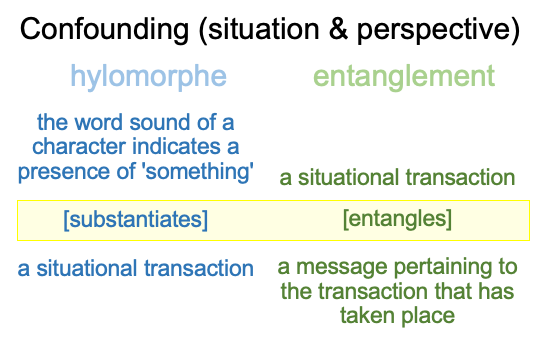
Entanglement mirrors the hylomorphe, as shown in the following diagram.

0029 Aristotle’s hylomorphe describes a thing.  

Does Aristotle’s entanglement do the same?

If so, then a “thing” may manifest as matter that substantiates form or as form that entangles matter.  

0030 To me, it seems that the former leads to a thing, according to classic (or timeless) Greek philosophy.  If the latter leads to a thing, then the originating matter sustains the form and the form entangles matter, until the confounding resolves.  If the resolution favors entanglement, the once-entangled matter substantiates the form.

And, the weird part is this:  One form may relate to two matters, one originating and one entangled.

0031 Finally, in addition to confounding (which is admittedly a little odd), a thing may enter a hylomorphe as matter, as shown in the following diagram.

I say, “Watch out when anyone uses the terms, ‘confounding’ and ‘incorporation’.”

There is no telling what type of flatulence is about to escape.

12/27/25

Looking at Igor Pilshchikov and Mikhail Trunin’s Article (2016) “The Tartu-Moscow School of Semiotics” (Part 4 of 27)

0032 The article is neatly segmented into eight (8) sections.

I will number sections as I go along.

0033 In the first portion (1), the authors give an overview.  They see four waves of paradigms sweeping over the linguistic academic communities in Russia, starting around the time when Peirce and Saussure pass to their rewards.

0034 Formalist breakthroughs?

The earliest modern academic paradigms approach literature and language from a typological point of view.  The paradigms start in Germany and pass to Poland and Russia.  Aesthetics may be formally regarded as an appreciation of the craft of the author.  So, formalism [substantiates] aesthetics.

0035 This period corresponds to a time when science is a subject of intense philosophical scrutiny.  For example, Edmund Husserl (1859-1938) works on phenomenology in Germany.  Jakob Von Uexkull (1864-1944) postulates the concepts of “sign-worlds” called the “Umwelt” for animals and “Lebenswelt” for humans.

0036 Later, Saussure’s Course on Linguistics shocks the field of linguistics by proposing a scientific definition of language.  Spoken language consists of two arbitrarily related systems of differences, parole (or speech talk) and langue (what goes on in one’s head in order to decode and encode speech talk).

0037 So, what is a spoken word?

A spoken word is a placeholder in two (arbitrarily related) systems of differences.

Saussure reveals a structure to language.

I can depict that structure as a hylomorphe.

This hylomorphe may then go into academic matter that substantiates a modern discipline of aesthetics or “art appreciation”.

0038 For the hylomorphe depicted above, parole is like matter and langue is like form.  The study of the structure of the spoken word (semiology) serves as matter that substantiates the form of the discipline of aesthetics.

0039 So, what am I suggesting?

Is semiology all that different from formalism?

Both are academic ways of thought.

Or, is “aesthetics” just a spoken word?

12/26/25

Looking at Igor Pilshchikov and Mikhail Trunin’s Article (2016) “The Tartu-Moscow School of Semiotics” (Part 5 of 27)

0040 The authors mention two Russian scholars working in language studies at this time.  One is Jan Mukarovsky (1891-1975).  The other is Roman Jacobson (1896-1982).  Both start as literature scholars.  Both turn towards structuralism and semiology during the second wave of paradigms.

The timeframe includes the First (1914-1918), Second (1939-1945) and the start of the Third (1945-1989) Battles among the Enlightenment gods.

0041 Here is a picture of the three transits, tailored to this specific timeframe.

0042 The question bears asking, “What moves Soviet academics in literature towards semiology and away from formalist analysis? 

0043 During the first half of the twentieth century, science appears triumphant.  The new government of the Soviet Union advertises itself as a scientific style of governance.  And, Europe does not need to advertise, having fought the First Battle Among The Enlightenment Gods with mechanized infantry, chemical gas warfare, and other technical novelties.  Technology and science embody the Zeitgeist.  Even propaganda acquires its own technology and empirio-schematics.

Saussure is not the only science-minded luminary.  The discipline of quantum mechanics catches the imagination of many.  So does psychoanalysis.  Niels Bohr (1885-1962) runs a physics circle in Copenhagen.  The first celebrity psychoanalyst, Sigmund Freud (1856-1939) operates out of Vienna.  Carl Jung (1875-1961) applies psychoanalytic concepts to cultural domains.

0044 Russian and Polish formalists are already reacting to the civilizational conditions of the first Battle among the Enlightenment gods.  Science catches the eye of both Mukarovsky and Jakobson.  They move towards integrating semiology into the study of literature.

0045 Or rather, they move towards the use semiology as matter in order to substantiate a modern form of aesthetics.

Unfortunately, as soon as they do so, aesthetics as form gets entangled.

Didn’t I warn about the word, “confounding”?

0046 Yes, there is a hidden problem that does not appear with formalism.

Saussure’s paradigm models speech-alone talk as two contiguous real elements, parole (the speech act) and langue (the associated mental act).  The contiguity is a purely arbitrary relation.

But, what is a purely arbitrary relation?

It is a purely conventional habit.

Culture consists of purely conventional habits.

0047 Suddenly, aesthetics as form [entangles] culture as matter.

Once aesthetics is conceptualized as a scientific form in {semiological matter […] aesthetic form}, the dyadic reality of {aesthetics [entangles] culture} becomes more and more apparent as a noumenon (a thing itself).

0048 The problem?

Well, Marxist dialectics already lays claim to an understanding of culture as the dyadic actuality of {material arrangements [account for] human conditions}.  Plus, the Soviet regime considers that causality to be both foundational and scientific.

Here is a picture of the dilemma.

0049 What does that imply?

Is the dog of Marxist materialism wagging the tail of the academic discipline of aesthetics?

Welcome to the USSR.

Professors in literature in Soviet academies want to become more scientific in order to comport with the socialist program and they entangle cultural studies as matter, and, in doing so, they confront a possibility that the confounding will resolve in favor of the entanglement.

0050 How curious.

The authors tell a story of the adoption of semiology by formalists within the Soviet Empire, where Marxism is the state ideology.  The authors do not mention that their story comports with a very interesting proposition presented in Sign System Studies.

History itself is semiotic.

0051 Nor do the authors consider the nature of science itself.

What the hell is “science”?

At this time, some western philosophers are trying to figure science out.   Others are certain that they know what it is,even though they cannot clearly define what it is.

0052 Edmund Husserl (1859-1938) participates in the debate.  So do the members of the so-called “Vienna Circle” (meeting in the 1920s and 1930s).  Husserl invents “phenomenology”.  The Vienna Circle promotes the doctrine of “logical positivism”.

These are not the only philosophers wrestling with the issue.  In Paris, the French Catholic, Jacques Maritain (1882-1973), and (at the same time, in the same city) the Russian Orthodox, Nicolay Berdyayev (1874-1948), struggle to address the question, “What is science?”

0053 Razie Mah writes two reviews on books by these authors.

One is Comments on Jacques Maritain’s Book (1935) Natural Philosophy.

The other is Comments on Nicholas Berdyaev’s Book (1939) Spirit and Reality.

Both are available at smashwords and other e-book venues.

12/24/25

Looking at Igor Pilshchikov and Mikhail Trunin’s Article (2016) “The Tartu-Moscow School of Semiotics” (Part 6 of 27)

0054 In section two (2), the authors mention the formalist breakthroughs in the 1910s and the initiation of the Moscow Literary Circle, starting in 1915, right before the Russian Revolution.  End-of-century Germans engage in formal art criticism, which conveys all the clinical qualities of a dissection of a literary text.

Clinical?

Shall we isolate and identify the various rhetorical and linguistic devices used by an author?

0055 Needless to say, at the time, the German chemical industry is unsurpassed in dissolving materials and isolating chemical substances.

So, why not literary things?

0056 Roman Jakobson is the first president of the Moscow Literary Circle (MLC).  The Prague Circle, concentrating on linguistics and literature, starts in 1926.  Jan Mukarovsky is a member.  Of course, the Second World War changes everything, except the categorical nature of science.

0052 So what is science?

Science is the Positivist’s judgment, as noted in Comments on Jacques Maritain’s Book (1935) Natural Philosophy.

0057 Okay, what is a judgment?

A judgment is a triadic relation containing three elements: relation, what ought to be, and what is.  When each of these elements is assigned to a unique Peircean category, the judgment becomes actionable.

0058 The Positivist’s judgment is a difficult relational structure.  It is a judgment that contains a judgment as what ought to be.

Here is picture.

0059 A positivist intellect (relation, thirdness, M) brings an empirio-schematic judgment (what ought to be, secondness, N) into relation with the dyad, {the thing itself [cannot be objectified as] its observable and measurable facets} (what is,firstness, O).

0060 Let me dwell on each element (M, N, O).

The positivist intellect (relation, thirdness, M) has a rule.  Metaphysics is not allowed.  Such is the way of science.  Science promotes truncated material and efficient causalities.  “Truncated”?  Yes, “shorn of formal and final causalities”.

0061 Say what?

Consider a thing.

A thing is a hylomorphic actuality.

Material causality operates within the contiguity between matter and form2.

The Aristotelian mind supplements material causality with formal causality.  The formal cause operates between the normal context3 and actuality2.  Formal causes build a category-based nested form.  Formal causation contextualizes material causality.

(In case of confusion, consult A Primer on the Category-Based Nested Form and A Primer on Sensible and Social Construction, by Razie Mah, available at smashwords and other e-book vendors).

0062 Here is a picture of how difficult the separation of material causality from formal causation can be for an example in literature studies.

0063 Only the normal context3 and actuality2 appear in this figure.  The actuality2 displays a model, fashioned in the style of Aristotle’s hylomorphe.  The two real elements are language as matter2m and literary text as form2f.  The contiguity… the “substance”… consists of technical devices.

Doesn’t that sound scientific?

0064 Imagine how difficult it would be to find the material causality associated with rhetorical devices when the formal cause is neglected.  For example, imagine a publication with an introduction, methods, data, results, and conclusion as its literary devices2.  Of course, the inquirer can readily guess the genre of this literary work3.

It’s an opinion piece on the benefits of capitalism or socialism.

(See Razie Mah’s multi-part e-book, Original Sin and the Post-Truth Condition, to appreciate that joke.)

0065 Also, the Aristotelian mind supplements efficient causality with final causality.

Both contribute, in distinct and complementary manners, to understanding the entire nested form.

0066 The triadic normal context of the type of literary work (formal)3 brings the dyadic actuality (material) of {language (as matter) [literary devices] literary work (as form}2 into relation with the monadic potential of ‘the author’s style (efficient) and intention (final)’1.

0067 The efficient cause couples the actuality2 with its underlying potential1.

But, the efficient cause makes no sense when divorced from its final cause, because the author’s intent1 is to construct a particular type of literary work3.

0068 Without a final cause, sociological reductionists may replace an ‘author’s intent’ with ‘social conditions’.   In doing so, the sociologist assigns the efficient cause to the author’s social conditions and loses harmony among all three elements in the category-based nested form.

Psychological reductions may replace the ‘author’s intent’ with ‘psychological powers and dispositions’, as well as ‘ideological fixations’ (or perhaps, ‘neurochemical imbalances’.)

A communication reductionist may replace the ‘author’s intent’ with ‘a signal-based paradigm of {source [transmission] receiver}’.

0069 In sum, extracting formal and final causationfrom scholarly inquiry into language and literature turns the discipline into a branch of sociology, psychology, communicology, or some other reductionist science.

12/23/25

Looking at Igor Pilshchikov and Mikhail Trunin’s Article (2016) “The Tartu-Moscow School of Semiotics” (Part 7 of 27)

0070 Of course, academics in the Department of Slavic Languages and Literature reject this option.

Consequently, if investigators of literature are going to take on the mantle of science, they have to sneak in Aristotle’s formal and final causes under the guises of material and efficient causalities.  Their models must include hylomorphes as actualities2.  Then, an unstated normal context3 and a potential1 will accompany that actuality2.

0071 So, the positivist injunction outlawing Aristotle’s metaphysics must be reconfigured into a refusal to entertain religious mumbo-jumbo.

The positivist intellect (relation, thirdness) of a Professor of Literature must encourage models that (1) are not religious (that is, Christian) and (2) (somehow) allow formal and final causalities.

0072 So far so good, what about the other two elements of the Positivist’s judgment (N and O, see point 0060)?

Let me turn to what ought to be (secondness, N).

0073 The empirio-schematic judgment (what ought to be, secondness) should belong to thirdness, but it does not.  It is a judgment that is imbued with secondness (the dyadic realm of actuality).  To many scientists, the empirio-schematic judgment is more real than the thing itself.

In the empirio-schematic judgment, disciplinary language (relation, thirdness, N3) brings mechanical and mathematical models (what ought to be, secondness, N2) into relation with observations and measurements of phenomena (what is,firstness, N1).

0074 The disciplinary language of aesthetics (relation, thirdness, N3) adopts explicit terminology that implicitly evokes formal and final causalities.  Metaphysics is apparently excluded.  “Metaphysics” characterized as “religious thinking”, is definitely excluded.  In the West, the definition of “metaphysics” has trended from “excluding Aristotle’s formal and final causalities” to “not religious”.

0075 The model (what ought to be, N2) is doubly dipped in actuality.  The model is assigned to secondness in the empirio-schematic judgment.  The empirio-schematic judgment is assigned to secondness in the Positivist’s judgment.  If one poses dyadic models (expressing the relational structure of Peirce’s category of secondness), then the elements in dyadic models may be explicitly formulated, while retaining implicit connotations of formal and final causalities.

0076 How so?

Dyadic actualities entail material and efficient causalities.  These causes may be explicitly abstracted using a disciplinary language.  These causes are required for modeling.

At the same time, a dyadic actuality2 must be contextualized by a normal context3 (formal causality) and potentiated by possibilities1 (efficient and final causalities).  These causes are implicit abstractions that are difficult to explicitly label.  These causes contribute to understanding.

0077 What about observations and measurements of phenomena (what is, firstness, N1)?

The disciplinary languages of literary science (relation, thirdness, N3) discuss observable and measurable facets of the thing itself (what is, firstness, N1), in a critical manner, as to support or undermine a dyadic model as a hypothesis(what ought to be, secondness, N2).

0078 What is (firstness, O) of the Positivist’s judgment is even more curious.

The dyad, {the thing itself [cannot be objectified as] its observable and measurable facets}, appears to belong to secondness, since secondness consists of two contiguous real elements.  But, it does not.  It belongs to firstness, the monadic realm of possibility.  Indeed, the noumenon and its phenomena label the same entity from different points of view.

0079 Philosophy considers the noumenon and initially seeks to portray the thing itself as a hylomorphic structure, similar to Aristotle’s dyad {matter [substance] form}.

And that is confusing, because science totally ignores the noumenon.

Science observes and measures phenomena.  Science presumes that… um… there is a noumenon.  Phenomena are the observable and measurable facets of a noumenon.  So, as long as the scientist has observations and measurements… then the noumenon must exist… right?

0080 Here is a picture of the Positivist’s judgment, unfolded into a category-based nested form.

The subscript, “p”, stands for the Positivist’s judgment.  Plus, the labels M, N and O will no longer be used as guides.

The normal context of the positivist intellect3p brings the actuality of the empirio-schematic judgment2p into relation with the potential of the dyad1p, {the thing itself [cannot be objectified as] its observable and measurable facets}1p.

0081 Section three (3) discusses the history of the Moscow Linguistic Circle (MLC, starting in 1915).  The participants do not appreciate that they wrestle with the Positivist’s judgment.  But, they do know that the author’s intent cannot be reduced to social conditions (as proposed by sociologists) or conscious or unconscious processes (as proposed by psychologists).  All factions of the MLC agree that a literary text is a noumenon, and not a phenomenon produced by social, personal, or other truncated material and efficient causalities.

In short, the text (the noumenon) cannot be objectified by its observable and measurable facets (its phenomena).

Without the text, literary phenomena do not exist.

0082 What about the empirio-schematic judgment (what ought to be, secondness)?

By 1929, the disciplinary language of structuralism (relation, thirdness) brings systemically and hierarchically arranged material, formal, efficient and final causes (what ought to be, secondness) into relation with observations of textual phenomena (what is, firstness).  These causes are not mechanical.  They are organic.

In short, a literary text is like a living thing.  So, the normal context of inquiry3 focuses on the construction of a system3.  Or, is that “a systemic construction3“?  Or, could I say, “system of constructions”3?

0083 Do not let me forget the not-religious intellect3.

Here is a picture of the Literary Positivist’s nested form.

0084 The issue of reductionism, once again, cannot be avoided.

The term, “structuralism”, what does it mean?

I recall that the ‘thing’ that has the matter of semiology and the form of aesthetics has a label: “structuralism”.

0085 Obviously, the disciplinary language of “structuralism” satisfies the positivist intellect’s injunction by redefining “metaphysics” as “religious mumbo-jumbo”.

Structuralist models are not truly reductionist because the disciplinary languages of semiology and aesthetics (secretly) incorporate Aristotle’s formal and final causes, through the fact that dyadic models (hylomorphes) are actualities2 that demand a normal contexts3 and potentials1.

0086 In contrast, the sociological, the psychological and the communicational reductionist can propose models (based on truncated material and efficient causalities), where the observable and measurable facets of a thing itself (the literary text) are accounted for by cultural, psychological and communicative arrangements (all materialist, of course).

Sociologists, psychologists and communicational reductionists satisfy the positivist’s injunction according to its original formulation, where “metaphysics” refers to “Aristotle’s formal and final causalities”.

12/22/25

Looking at Igor Pilshchikov and Mikhail Trunin’s Article (2016) “The Tartu-Moscow School of Semiotics” (Part 8 of 27)

0087 Perhaps, the terminology is not really clear.  Formalism and structuralism are not identical.  Neither are they completely different.

In section three (3), the authors quote Jakobson, writing in 1971, that the term, “structuralism” belongs to modern science in all its manifestations.  The same cannot be said for the term, “formalism”.

0088 What does this imply?

The label, “structuralism”, should apply to the models.  “Formalism”?  Not so much.

Nevertheless, the models (whatever they are called) include formal and final causalities. In sum, they contain a dyadic actuality2.  Plus, a triadic normal context3 and monadic potential1 are along for the ride.

Once again, the subscript “p” stands for the Positivist’s judgment.  The subscript “e” signifies the empirio-schematic judgment.

0089 Let me first consider potential1p for the Positivist’s judgment.

The noumenon should be the literary text.

The triumphalist scientist proposes to substitute a successful model for the noumenon.

Then, the model substituting for the noumenon [can be objectified by] its phenomena1p.

0090 Now, I turn to the empirio-schematic judgment2p for the Literary Positivist.

The terminology is most difficult, because both “formalism” and “structuralism” denote models that are “not religious” (fitting the mandate of “no metaphysics”), yet implicitly evoke formal and final causations.

0091 After all, “structuralism” is “semiology [substantiating] aesthetics”.  So the disciplinary language of structuralism3e, while sounding “not metaphysical”, contextualizes dyadic relations2e (and triadic relations disguised as dyadic relations) that are naturally (and for humans, instinctively,) contained in category-based nested forms.

0092 So, how does “structuralism” as part of a disciplinary language3e operate on the possibility of ‘observations of phenomena within a text’1e?

Structuralism situates semiology in terms of the aesthetics of systems.  If semiology is the study of spoken language, where “spoken language” consists of two arbitrarily related systems of differences, parole and langue, then each habitual association between one parole and one langue (or “sign”) must be situated by a structure or a system.

0093 Consequently, the structure3 is a normal context3.  Its potential1 is ‘the laws of a system’1.  The actuality2 is a dyadic structure that takes semiological matter into a form that emerges from (and situates) that potential1.

A structuralist model2e (what ought to be, secondness) within an unfolded empirio-schematic judgment2p manifests all four of Aristotle’s causalities (material, formal, efficient and final).

0094 Yes, that is well and fine, but I still do not have a diagram of what goes into a structuralist model2e.

That is because there is something about the structuralist model2e to keep in mind.

0095 If one follows triumphalist scientists, then this model of the text2e may serve as a substitute for the text itself1p.  That is, the model of the text2e (what ought to be, secondness) may re-present the noumenon1p in the Positivist’s judgment (what is, firstness).

After all, the model2e, in its empirio-schematic reality2p, encompasses the phenomena of the literary text1p.

0096 The following figure color-codes that message.

0097 In section three (3), the authors distinguish two schools of formalism in Russia: The Society for the Study of Poetic Language (in St. Petersburg) and the Moscow Linguistic Circle (MLC, with Jakobson as president).  The two branches aim to adhere to the Positivist’s judgment, with the literary text as the thing itself.

Marxist or Freudian or communication-based reductionist paradigms are discouraged.  Holistic approaches are encouraged.  Formalist and finalist models cannot be fragmented into merely mechanical processes, acting as truncated material and efficient causalities.

0098 Do the terms, “formalist” and “finalist” have anything to do with the most metaphysical of Aristotle’s four causes?

Of course they do.

0099 So, I wonder, “Can one satisfy the positivist’s rule by building models that explicitly use mechanical and efficient terminology while implicitly recruiting formal and final causalities?”

Hmmm.

Did I already answer that question?

0100 Section three (3) reports that Juri Lotman (many years later), in his Lectures on Structural Poetics (appearing in the first issue of Sign Systems Studies, published in 1964), criticizes previous so-called “formal methods” that focused on the matter of language and the form of the literary text.  “Formalists” discern various literary devices in the text.  These devices work in a mechanical fashion and are not “structuralist”, in so far as they do not elucidate interdependent and hierarchical wholes.

0101 As far as I can see, during the first transit (1910s-1930s), academics in linguistics and literature widen their focus of inquiry to include two contemporaneous European trends, logical positivism (the interests of the Vienna Circle) and phenomenology (the return to the “noumenon” proposed by Edmund Husserl).

Within these European trends, a subtle replacement is both encouraged (by the logical positivists) and challenged (by the phenomenologists).  Noumena, which cannot be objectified by their phenomena, are increasingly veiled by successful models, which can be objectified by their phenomena.

0102 But, disagreement mounts.

Logical positivists (or “triumphalist scientists”) want to replace each noumenon with its mechanical or mathematical model.  This gives birth to the academic laboratory sciences.

Phenomenologists rely on a method, devised by Husserl, to figure out what the noumenon must be.  This path supports further observations and measurements of phenomena that objectify what the noumenon must be.  This fuels the social and psychological sciences.

0103 As far as I can see, literature studies and linguistics are more akin to biology (where phenomenology seems more relevant) than chemistry and physics (where triumphalist scientists are hard to dismiss).

But, my opinion does not stand in the way of triumphalist science.

0104 So, let me take a closer look at this structuralist model2e.

0105 While scientists and intellectuals in the West snip formal and final causalities away from their material and efficient causalities, the linguistic circles in what becomes the Soviet empire unwittingly embrace Aristotle’s trickery.  The structuralist model2e contextualizes a lower-level category-based nested form.

0106 On the upper line, the empirio-schematic unfolds into a nested form.  The triadic normal context of the language of formalism (where “formal” touches base with Aristotle’s formal and final causalities)3e brings the dyadic actuality of structuralist models2e into relation with the monadic potential of ‘observing phenomena in a literary text’1e.

0107 Then, on the lower line, the structuralist model2e itself harbors an Aristotle-friendly category-based nested form,as if it3(2e) belongs to the adjacent lower category.  If the structural model2e belongs to the perspective level, then the adjacent-lower category-based nested form belongs to the situation level.

This situation-level nested form reads like this: The triadic normal context of a structure (or system)3(2e) brings the dyadic actuality of {language as matter [substantiates] literary text as form}2(2e) into relation with the monadic potential of ‘laws within the system’1(2e).

0108 Does that category-based nested form look like an answer the the question, “What is “structuralism”?

The subscript “2e” designates the higher-level structuralist model2e.  This subscript will soon change to “c”, standing for a perspective-level of a three-level interscope.

0109 More on that later, because I would like to cast my eyes upon hylomorphes and entanglements and confoundings.  The form in the dyadic actuality at the core of the structuralist model2e (the form in the actuality2(2e) within the actuality2e) entangles matter2p that engages the normal context3p and the potential1p of the Positivist’s judgment.

To this confounding, I attend.