03/7/26

Looking at Augustin Fuentes’s Article (2016) “The Extended Evolutionary Synthesis…” (Part 13 of 16)

0136 The question that I failed to address is this, “Does the author’s figure 2 comport with the two-level interscope for natural selection?”

0137 What if I replace “natural selection” with “cultural selection”?

Here is a picture.
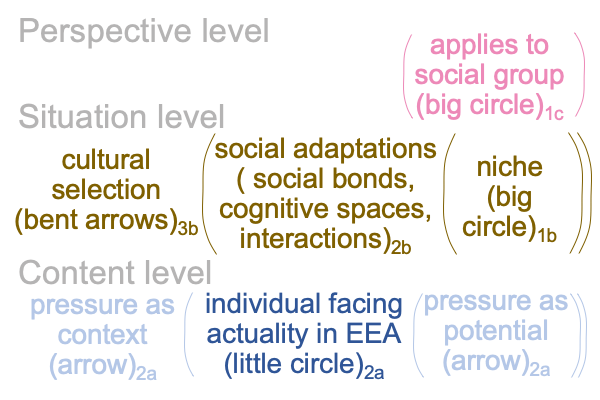
0138 The normal context of cultural selection3b brings the actuality of social adaptations (including social bonds, cognitive spaces and cooperative interactions)2b into relation with a social niche1bdefined as the potential1b of individuals facing natural selection pressures in the environment of evolutionary adaptation (EEA)2a.

0139 Of course, these social adaptations2b potentiate the social group1c, which, as noted earlier, includes the social circle that is under the most significant selective pressure.

At the same time, I may say that the potential of the social group1c creates the situation where social beings2b are adaptive.

0140 Next, imagine that the salient social circle is the team (15).  Over generations, the team1c encourages social adaptations2b that rewards individuals with phenotypes that are appropriate to that team2a.  In other words, successful teams2a, as the medium responding to evolutionary pressures associated with obligating collaborative foraging,produces a selection pressure3b on the individual2b.
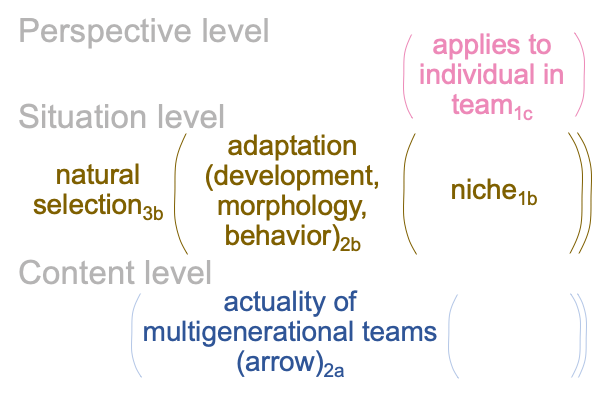
One of the social adaptations2b is protolinguistic hand-talk2b.  The semiotics of protolinguistic hand-talk2a become the actuality independent of adapting individuals (species)2a.  Individual adaptations2b encourage sensible constructionduring team activities.  Hand-talk facilitates sensible construction.

0141 Next, imagine that, during the domestication of fire, cooking changes everything.  Cooking with fire unlocks hitherto sequestered nutrients.  More teams can be successful.  More teams means larger brains and larger groups.  Bands (50) grow into communities (150).  Communities are teams of teams.

Enough versatility exists among teams that ecological pressures are mediated by organizational capacity.

In short, the salient social circle is now the community (150).

0142 The author’s next set of feedback loops is collective action, which roughly corresponds to the interactions within a community and its environment.
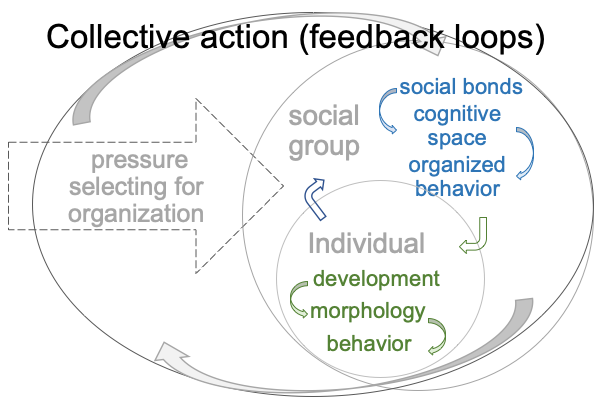
0143 This set of feedback loops demands that a perspective level comes into play.  The situation-level might be family (5), friends (5), team (50) and band (50), as well as mega-band (500) and tribe (1500).  A perspective-level adapts to the community (150).

After all, that is what Robin Dunbar’s correlation between human brain size and group size predicts.  Human brains are adaptive for groups with a size of 150.  But, a community contain smaller groups, so one of the jobs of the community is to bring harmony among the teams, friends and families.  One of the other jobs is to face outwards towards other communities (that is, mega-bands and tribes).

0144 Well, if I add a perspective level to the two-level interscope, then a whole new typology of social bonds, cognitive spaces and cooperative interactions2c manifests.  If Dugin is correct, these actualities2c fall under the label, “ethnos”, for the Lebenswelt that we evolved in.

0145 Here is the three-level interscope.
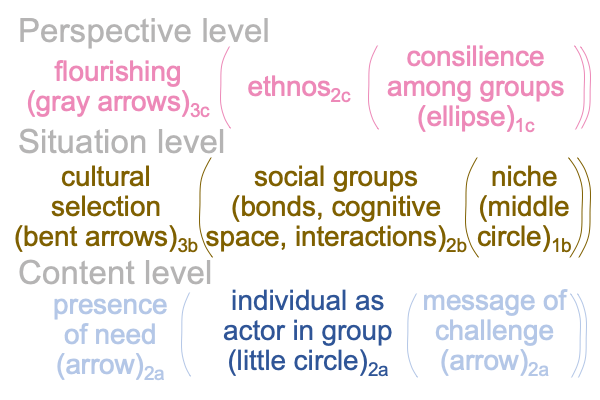
On the perspective level, the normal context of hominin flourishing3c brings the actuality of the ethnos2c into relation with the potential of harmony among all social circles, including those smaller and larger than the community1c.

On the situation level, the normal context of cultural selection3b brings the actuality of social groups2b into relation with the social niche2a, consisting of the potential of individuals in community2a.

On the content level, the presence of need3a brings the individual in community2a into relation with the potential of meeting a challenge1a.

0146 One question is, “Who constructs this content-level normal context3a and potential1a?”

Plus, how are these normal contexts3 and potentials1 constellated in niche construction?
03/6/26

Looking at Augustin Fuentes’s Article (2016) “The Extended Evolutionary Synthesis…” (Part 14 of 16)

0147 Here is another question.

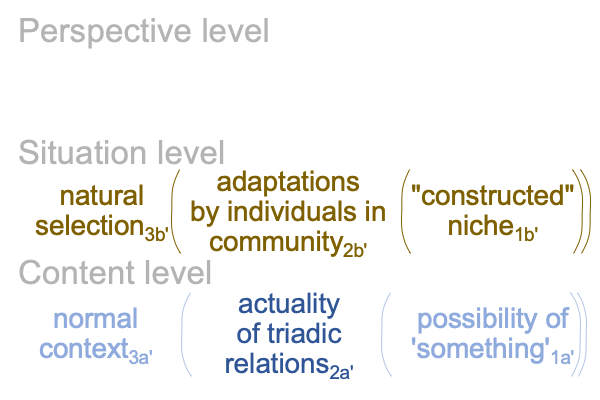
0148 What situation-level potential1b’ are these individuals in community2b’ manifesting?

What is the actuality independent of the individual in community2a’ that defines the human niche1b’ in the normal context of natural selection3b’?

The answer is the thesis of Razie Mah’s masterwork, The Human Niche.

The answer is triadic relations.

0149 Section eight of this article seeks to establish that aspects of the author’s conceptual framework are already in practice.

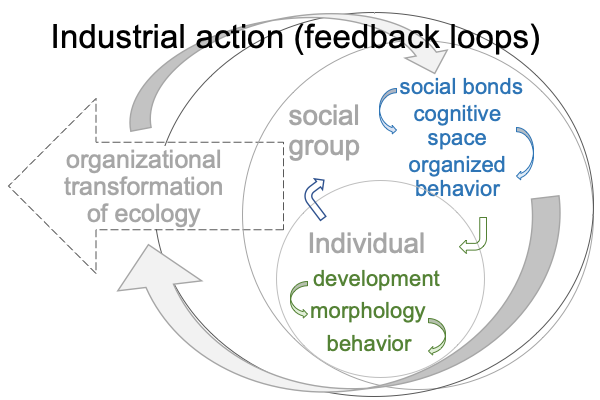
0150 Indeed they are.  The author offers Figure 4, concerning human capacities to modify local ecologies.  The figure is re-illustrated here.  But, be warned.  Organizational capacities significant enough to change local ecologies (other than the selective use of fire and some other tricks, like laying stones that encourage animals to migrate into a trap) are not that relevant to the Lebenswelt that we evolved in.  They are relevant to our current Lebenswelt, because the organizational capacity of humans is no longer constrained after the first singularity.

0151 Remember the Genesis condemnations leveled by God to Adam after the Fall, while still in the Garden of Eden?

God’s curse is the law of diminishing returns.

Why does God level such a curse?

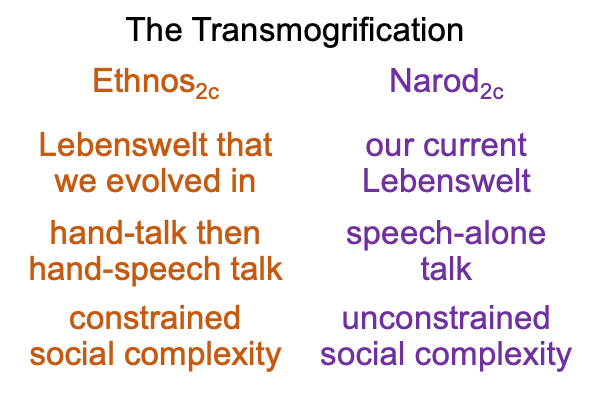
Adam is a mythical figure that is created in the Lebenswelt that we evolved in, but transmogrifies into a creature that introduces all humanity to our current Lebenswelt.

The law of diminishing returns applies to the times when humans are so organized that they can transform the ecology and environment.

That is our times.

0152 “The first singularity” is the label that I apply to the transmogrification of the ethnos to the narod, at the dawn of history.

0153 See The First Singularity and Its Fairy Tale Trace (for a brief presentation) and An Archaeology of the Fall (for the dramatic exposition) for more information.  Both are by Razie Mah and available at smashwords and other e-book venues.

Or, the inquiring person may explore Razie Mah’s blogs.

The years since 2019 are particularly notable.

03/5/26

Looking at Augustin Fuentes’s Article (2016) “The Extended Evolutionary Synthesis…” (Part 15 of 16)

0154 Section nine offers some parting thoughts.

The author proposes an integrated anthropology.

Integrated with what?

An extended evolutionary synthesis.

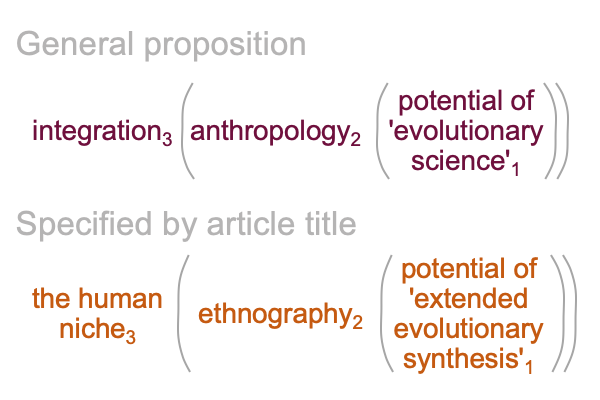
0155 Recall that the full title of the article is “The Extended Evolutionary Synthesis, Ethnography, and the Human Niche: Toward an Integrated Anthropology”.

The proposition of an integrated anthropology and the title associate to a category-based nested form.

0156 The problem?

Anthropology2 does not constellate under the normal context of the human niche3 and within the potential of ‘the niche-construction version of an extended evolutionary synthesis’1.

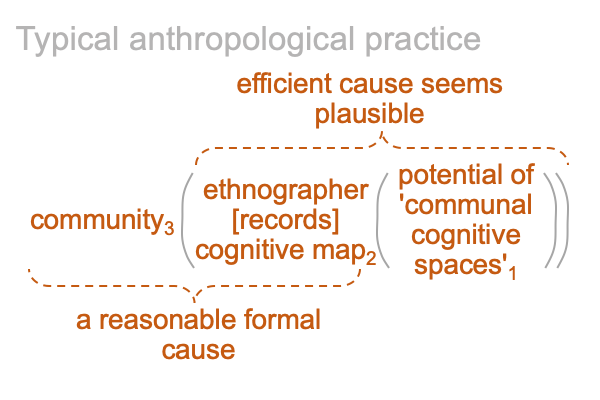
Instead, ethnography2 is anthropology’s adaptation to the normal context of community3 operating on the potential of ‘communal cognitive spaces’1.

0157 This makes sense, in terms of Aristotle’s causalities, which are cleverly re-imported from philosophy into scientific inquiry by the academic discipline of Anthropology.

0158 Yes, humans evolve.  So, it seems that contemporary anthropology2 should be contextualized by a need for integration3 with the potential of ‘evolutionary science’1.

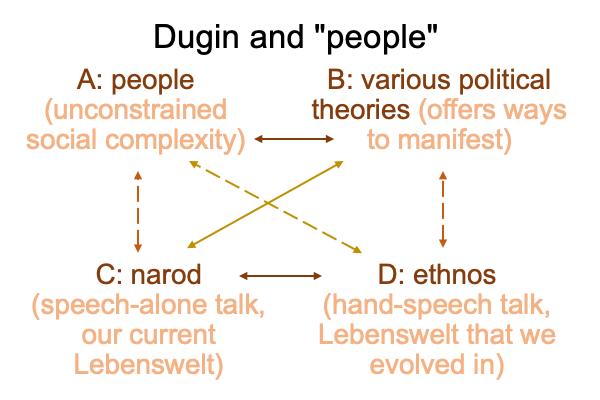
0159 This expectation brings in a second problem, corresponding to the Greimas square of Dugin’s typology in Comments on Alexander Dugin’s Book (2012) The Fourth Political Theory (by Razie Mah, available at smashwords and other e-book venues).

0160 This examination of Augustin Fuentes’s article adds value by elaborating the elements within this Greimas square.

0161 The people (A) are here represented by the ethnographer, operating within an institution (of “the people”), that manifests its organizational objectives in terms of contemporary political theories (including notions (B) on how the discipline of anthropology should train ethnographers capable of receiving (and mapping) the cognitive spaces within a narod (C)).

0162 In other words, the ethnographer as anthropologist (A) contrasts with the various theoretical apparatuses (B) that sustain the academic discipline.

Plus, these various theoretical social constructions (B) are what makes a people capable of practicing a level of social complexity that appears as wealth and power in the view of the limitations of any particular community or narod (C).

Finally, the narod (C) is a traditional society in our current Lebenswelt that cannot return to a corresponding ethnos (D) that would exist in the Lebenswelt that we evolved in.

03/4/26

Looking at Augustin Fuentes’s Article (2016) “The Extended Evolutionary Synthesis…” (Part 16 of 16)

0163 Consequently, a pattern of domestication and entanglement is an appropriate darwinian model for the adaptations involved in discipline of ethnography.

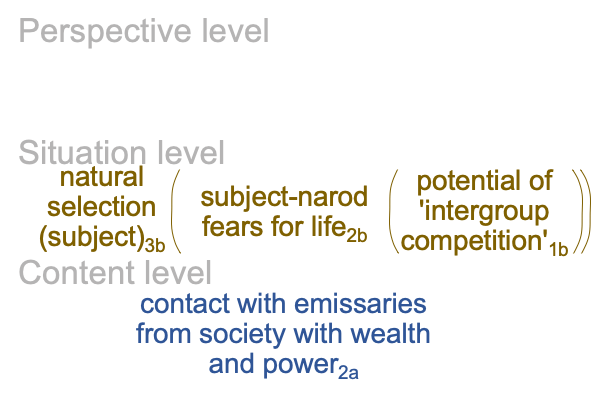
0164 On one hand, the ethnographer is an emissary from a society with wealth and power and serves as an actuality independent of the adapting narod-folk2a.

The potential of intergroup competition1b says that fear should be the appropriate adaptation2b, in the course of natural and cultural selection3b.

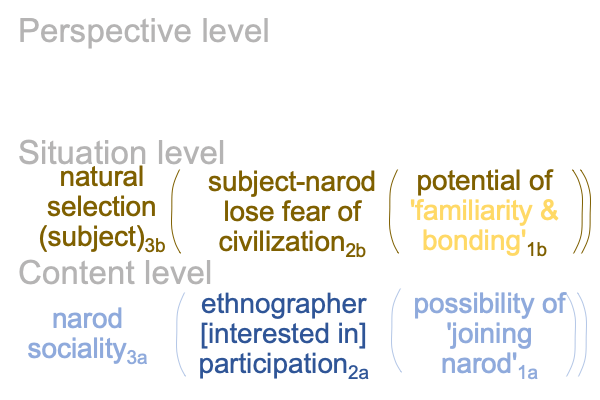
0165 But this does not happen.  Instead, the narod-folk3b,1b adapt by losing their fear of the ethnographer’s society2b.  This is the nature of domestication.

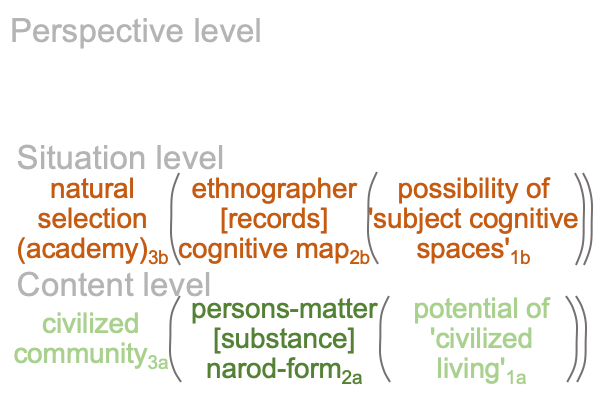
0166 On the other hand, the narod-folk2a are the actuality independent of the adapting species for anthropologists within Western academies3b who are trained by (and train) ethnographers on the methods of mapping the cognitive spaces of narod-folk1b.  The very act of mapping the cognitive spaces of a narod (whether historically given or spontaneously generated) exhibits the anthropology of substantiation and entanglement.

0167 I conclude by returning to the snarky comment at point 119 and apologizing.

Yeah, semioticians have teeth.

0168 The author notes, in the final paragraph, that the human niche is a basal framework that enables the inquirer to include the salient features, forces and processes at multiple levels of… um… organization.  Surely, that description fits the idea of using the purely relational structure of the category-based nested form as a tool for inquiry.  All that this examiner has done is transpose elements from the author’s argument into the empty slots of a category-based nested form.

This suggests that category-based nested forms satisfy Bourdieu’s enigmatic phrase, of “structured structures predisposed to function as structuring structures”.  Category-based nested forms are purely relational (triadic) structures that gather material through the intuitive use of association, followed by an exploration of the implications.

0169 My thanks go to the author of this article, who undoubtedly has published more academic literature since this work from 2016, without the value that this examination adds.  Perhaps, this 2026 review may add to a re-illustration of the envisioned integrated anthropology.