0001 The article before me is published by Sign System Studies (44(3) (2016) pages 368-401) by two professors, Igor Pilshchikov and Mikhail Trunin, hailing from Tallinn University in Estonia. The title is “The Tartu-Moscow School of Semiotics”. The subtitle is “A transnational perspective”.
0002 The abstract promises to situate the Tartu-Moscow School of Semiotics of the 1960s through 1980s. The article delivers more than promised.
How so?
0003 The authors sketch dynamic developments among intellectual circles within the (now former) Union of Soviet Socialist Republics.
0004 The term, “transnational”, indicates that there are nations within the former Soviet Union.
During this period in history, the governments of Estonia and Russia (along with Czechoslovakia and Poland) owe fealty to an empire with the title, “Socialist”, in its name.
So, “transnational” tells me that the article looks back from the present, into a past era, with the intent of portraying ‘something’ historical, without acknowledging that the “Union” and the “Socialist” descriptors no longer apply (at least, not in the way that they once did).
0005 “Transnational” applies to the Union of Soviet Socialist Republics (USSR, 1918-1989) as well as the upcoming… um… Eurasian convergence?
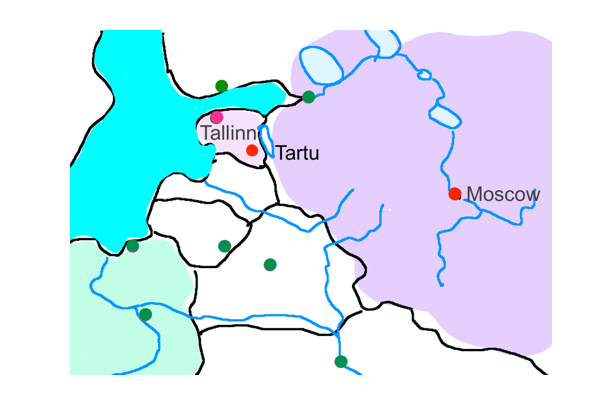
Here is a picture with three city-sites. Tartu and Moscow belong to the title. Tallinn is the location where the authors write their article. The blue is the Baltic Sea.
0006 “Transnational” steps over the boundaries depicted in black in the above figure.
Never mind the fact that the above territories reside behind, what American pundits once called, “the Iron Curtain”.
0007 Perhaps, one must appreciate an ambiguity to the term, “transnational”, given that there is another transit. This transit is in time. Or, even better, this transit is across a boundary between battles among Enlightenment gods.
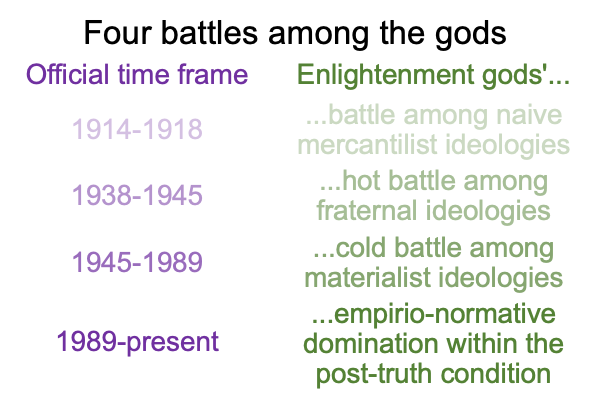
Consider where the time period of 1960s to 1980s resides in the following timeline of Western civilization in the twentieth century.
Also consider the year when the article under examination is published.
Notice the boundary.
0008 The Tartu-Moscow School of Semiology constellates within one battle, as a transnational collaboration.
The TMS is remembered during another battle, which is not resolved, and so cannot be objectified as “historical”. I suppose that it can be objectified as “cultural”. Better yet, “theodramatic”.
Already, there is more to this article than meets the eye.
0348 In section eight (8), the authors discuss the third post-Soviet approach, that of Juri Lotman.
The title of Lotman’s 1990 book is The Universe of Mind.
The title is somewhat funny, since the mind associates to the normal context and a universe resides in the corresponding potential.
0349 How so?
The “universe” is not the closed totality of material arrangements.
The “universe” is the open totality of semiotic arrangements.
0350 Open to what?
Messages.
Another term for “the universe of messages1” is “the semiosphere1“.
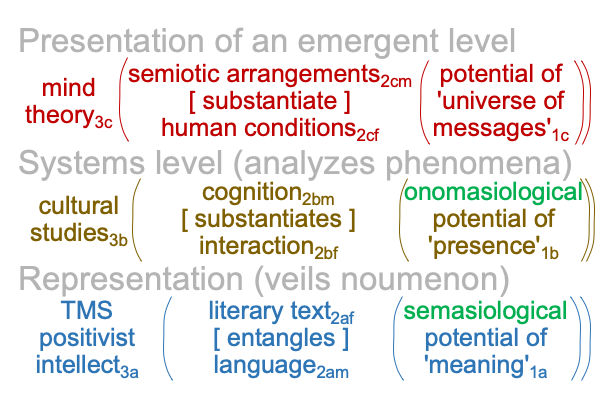
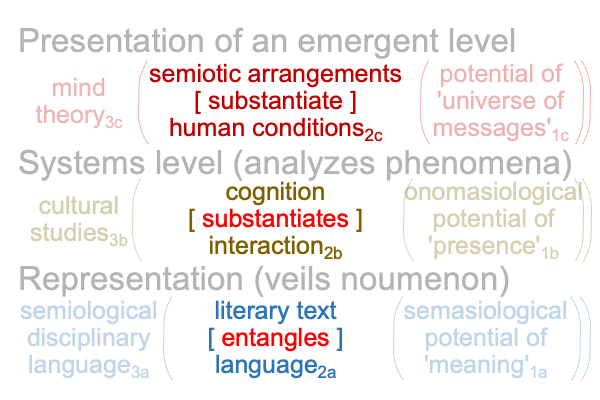
0351 On the content level, the normal context of a TMS positivist intellect3a brings the actuality of the dyad2a, {literary text2af [entangles] language2af}, into relation with the potential of ‘(positivist) meaning’1a.
On the situation level, cultural studies3b brings the dyad2b, {cognition2bm [substantiates] social interaction2bf}, into relation with the potential of ‘(civilizational) presence’1b.
On the perspective level, mind theory3c brings the dyad2c, {semiotic arrangements2cm [substantiate] human conditions2cf}, into relation with the potential of ‘the semiosphere’1c.
0352 Lotman’s derivative interscope stands right in line with Charles Peirce’s theory of evolutionary love.
The Universe of Possibility defines the category of firstness. Firstness contains a universe of messages.
The Universe of Actualities includes semiotic arrangements and belongs to the category of secondness.
The Universe of Mind3c brings the Universe of Actualities2c into relation with the potential of the Universe of Messages1c.
0353 Mind theory3c brings the dyadic actuality of {semiotic arrangements [substantiating] human conditions}2c into relation with the ‘semiosphere’1c.
Marxist theory3c brings the dyadic actuality of {material arrangements [substantiating] human conditions}2c into relation with the potential of ‘something to do with message’1c.
0354 Surely, Juri Lotman, as an old man, does not suspect that his mind theory3c stands as an alternative to Marxist theory3c.
Marxist theory3c contextualizes the message of Soviet communism1c.
The Universe of Mind3c contextualizes the semiosphere1c.
Welcome to the Fourth Age of Understanding.
0355 The concept of the semiosphere1c is an organic development of Juri Lotman and his collaborators of the Tartu-Moscow School of Semiotics.
This explains why I claim, in point 0008, that there is more to this article than meets the eye.
This examination adds value to the authors’ article, in ways hitherto unimagined.
0356 In the following figure, the virtual nested form in the category of secondness is highlighted.
0357 The perspective-level dyad, {semiotic arrangements [substantiate] human conditions}2c virtually brings the situation-level dyad, {cognition [substantiates] cultural interaction}2b, into relation with the potential of the content-level dyad, {literary text [entangles] an aesthetic and positivist language}2a.
0358 Likewise, in the virtual nested form in the category of thirdness, mind theory3c brings cultural studies3b into relation with the possibility of the TMS positivist intellect3a.
0359 Finally, in the virtual nested form in the category of firstness, the semiosphere1c, the universe of messages1c, brings civilizational presence1b into relation with positivist meaning1a.
0360 The authors briefly discuss Lotman’s later books, which are translated into English long after his death. The authors note that these books treat issues that are rarely associated with the Tartu-Moscow School of Semiotics, even when they place its collegial collaborations in perspective.
0361 Nonetheless, some scholars wag an accusatory finger and assert, “He turned into a post-structuralist.”
0362 “Post-structuralist”?
Technical terms are so important, especially when they mean ‘something’ that common folk don’t think they mean.
There is a gap, which cannot be crossed, especially by those subject to empirio-normative domination.
Well, at least, that is what the experts on television tell me.
“Post-structuralist” is a derogatory label.
Only experts know what the label means.
0363 The authors offer a quick summary of the questions that Lotman raises in these last works. First (1), can inquirers devise a common approach to natural, social and spiritual phenomena? Second (2), how is a mind theory3c paradigmgoing to handle evolutionary (think, Lebenswelt that we evolved in) and explosive (think, our current Lebenswelt) cultural transitions. Third (3), does artistic labor serve as a workshop that builds semiotic arrangements (as matter) into the human condition (as form)?
0364 Surely, these are appropriate questions.
And, not surprisingly, the pen of Razie Mah offers literary texts that touch upon these questions. They are (1) How to Define the Word “Religion”, (2) The Human Niche and (3) An Archaeology of the Fall.
0365 The authors conclude that a global history of semiotics will tell Lotman’s tale, as well as the complicated intriguescultivating semiotic awareness beneath the watchful eyes of Soviet Socialist ideologues.
But, as far as this examiner is concerned, these modern histories may also be viewed through a lens that focuses on an illumination that harkens back to the beginning.
A light dwells deep within Slavic civilization.
0366 I wonder. Is there is an unconceived reason for why the Virgin Mary appears in Portugal, in a town bearing the name of Fatima, the daughter of the Prophet Mohammed and Khadija, and calls for the Catholic Church to consecrate her Immaculate Heart to Russia?
The visions happen in 1917, right before the Russian Revolution.
0367 In 2022, a Latin-tradition-despising pope, along with his reform-fixated Vatican-Two-promoting bishops, do precisely that. They consecrate the Immaculate Heart of Mary to Russia on March 25, 2022, at the same time when Russian (no longer Soviet!) troops enter into Ukraine. They invade in order to stop… what? Everybody in Russia apparently knows. Does anyone know in the Collective West?
0368 Perhaps not.
Is there a gap, which cannot be crossed?
Will a curtain of propaganda become transparent?
Or what?
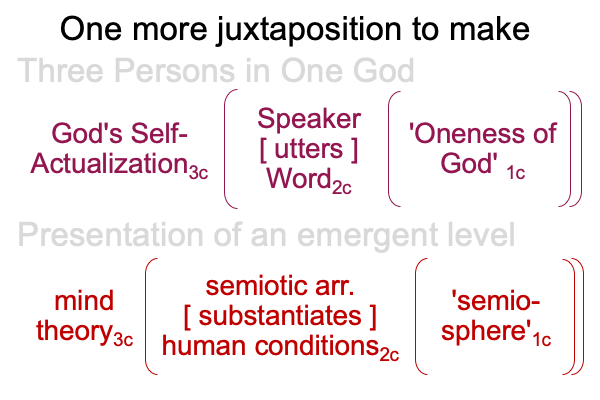
0369 There is one more juxtaposition to make.
0370 The lower line should look familiar.
The triadic normal context of Lotman’s mind theory3a (now transcending Marxist theory3c) brings the dyadic actuality of {semiotic arrangements [substantiate] our current Lebenswelt}2a into relation with the monadic ‘semiosphere’1a,where the “semiosphere” is the potential of ‘the universe of messages’1a.
0371 The upper line is introduced in points 0355 though 0371 in Razie Mah’s e-book, Comments on Mariusz Tabaczek’s Arc of Inquiry (2019-2024) (part 1, available at smashwords and other e-book venues).
The triadic normal context of God’s Self-Actualization3c brings the dyadic actuality of {the Person who Speaks [utters] the Person who is the Word}2c into relation with the ‘Oneness of God’2c, where the “Oneness of God” is the monadic potential1c underlying God’s Self-Actualization3c.
0372 What does this juxtaposition inspire me to imagine?
Does it seem that the Speaker2c occupies the space for semiotic arrangement2cm?
Does it seem that Word2c, who creates the Lebenswelt that we evolved in (see Genesis 1-2.3) as well as our current Lebenswelt (see Genesis 2.4-10), occupies the space for the human condition2cf?
0373 Does it seem that God’s Self-Actualization3c encompasses a theoretical Universe of Mind3c?
Does it seem that the Oneness of God1c manifests the omnipresence and the omniscience of a universe of messages1c?
0374 It almost makes me wonder whether there is a post-post-truth condition.
0375 There is a story. It goes like this.
After the famous Russian philosopher, Marxist academic and scholar to be reckoned with, Juri Lotman, dies, he finds himself in a waiting room, in what looks to be an old Basilica. After a few minutes, the wooden door creaks open and he is greeted by St. Methodius, himself.
Lotman, confident of his own genius even in death, says, “Methodius, what can you tell me that I don’t already know?”
Methodius grins and says, “You’ve been working for us all along.”
0376 I thank the authors for this essay, published a decade ago, and fresh enough to support the fermentation of this examination.
0001 Jack Reynolds, Professor in Arts and Education at Deakin University, publishes a book with the subtitle, “A Hybrid and Heretical Proposal”. The book concerns two views that seem to resist hybridization: phenomenology and naturalism. Why? Does each regard the other as heretical?
Plus, where does that leave science?
Hmmm.
0002 Razie Mah examines Reynolds’ book in Comments on Jack Reynolds’ Book (2018) “Phenomenology, Naturalism and Science”, available at smashwords and other e-book vendors. The commentary is part of a series, “Phenomenology and the Positivist Intellect”.
0003 Phenomenology has an awkward relationship with science. It situates hands-on natural science. Yet, it competes for that role with visionary science.
Visionary science takes what is most precious to practicing scientists, the empirio-schematic judgment, and unfolds it into a situation-level nested form.
Phenomenology competes with and excludes visionary science.
0004 Consequently, phenomenologists and visionary scientists despise one another.
Both work to situate hands-on natural science, represented as a content-level nested form.
Each offers its own situation-level nested form.
0005 Perhaps, this is why Reynolds’ proposal directs attention away from the point of contention.
Hands-on science is naturalism. Hands-on science may be portrayed as the unfolding of the Positivist’s judgment into the content-level of an interscope.
Phenomenology and visionary science situate first-order natural science in very different ways.
0006 Phenomenology wants to consider phenomena in order to elucidate what the thing itselfmust be.
Visionary science wants to take an established scientific model and coronate it as what the thing itself must be.
0008 Why are Catholic philosophers interested in phenomenology?
In Comments on Joseph Trabbic’s Essay (2021) “Jean Luc Marion and … First Philosophy”, a second incentive is proposed.
0009 If phenomenology situates science, then what puts phenomenology into perspective?
0010 In 1995, the French Catholic phenomenologist, Jean-Luc Marion, comes very close to naming that “what”. “What” coincides with the givenness of things themselves.
0011 Marion’s identification of givenness offers an opportunity for Catholic philosophers. But, the concerns of the positivist intellect remain. The positivist intellect rules out metaphysics.
As far as science is concerned, givenness is irrelevant.
0012 But, there is a twist.
The naming of givenness illuminates the potential underlying phenomenological reduction.
The noumenon1a, the thing itself1a, is a mind-independent being.
The noumenon1b, what the thing itself1a must be1b, is a mind-dependent being, that one can take to be mind-independent.
0013 Does that reflect the awkward nature of givenness?
One can give, with no expectation for return.
Can one take, with no expectation of reciprocity?
Can the gift be given, even when the giver and the recipient are nowhere to be found?
0014 Why are Catholic philosophers interested in phenomenology?
In Comments on Richard Colledge’s Essay (2021) “Thomism and Contemporary Phenomenology”, a third incentive is proposed.
0015 Colledge reads a 2006 book by German phenomenologist, Gunter Figal, entitled Objectivity, The Hermeneutical and the Philosophical.
Colledge wonders, “Is this a phenomenological realist open to Christian anti-reductionism?”
Can we talk?
0016 Figal admits that the thing itself1a should be mind-independent. If this is the case, then metaphysics should be allowed. Aren’t the mathematical and mechanical models of the empirio-schematic judgment mind-dependent beings? Don’t mind-dependent beings transcend (while entangling) physics? Doesn’t that fit the definition of metaphysics.
Well, yes, this becomes apparent when phenomenology reveals what the thing itself1a must be1b and then a novel empirical science2a arises to investigate its1a(1b) phenomena1a.
0017 Why do Catholicphilosophers (who are curious about phenomenology) not mention science?
This is a very good question, since Aristotle’s and the Positivist’s judgments are structurally similar.
Well, they are different, because the three elements of judgment are imbued with different categories.
0018 The similar structures, along with different categorical assignments, benefit phenomenology. Phenomenology can sneak Aristotelian metaphysical constructs into the laboratory by reifying hylomorphes into what the thing itself1a must be1b. Phenomenology appropriates illicit metaphysical constructs then cleans them of metaphysical terminology.
0019 For example, in terms of physics, a one Euro coin may be reduced to its constituent metal and minted shape. To me, this looks like matter and form.
At the same time, in terms of phenomenological reduction2b, a one Euro coin1a is money1b. Money1b is what the Euro coin itself1a must be.
0020 What happens when what the thing itself1a must be1bis not the thing itself1a?
Is phenomenological reduction at work?
0021 If the one Euro coin as money is a mind-independent (formerly mind-dependent) being, then novel laws of “physics” apply. The coin1a(1b) now exhibits the phenomena of value1a and fiat currency1a.
The novel “social” science of modern economics investigates the phenomena1a that objectify this noumenon1a(1b).
0022 Okay, so far in this sequence of blogs, I have discussed three incentives for why Catholic philosophers may be interested in phenomenology. I have also raised a question concerning why these philosophers do not mention science.
0023 The answer to the latter question is located in the relation within the Positivist’s judgment. A positivist intellect (relation, thirdness) brings an empirio-schematic judgment (what ought to be, secondness) into relation with observations and measurements (what is, firstness). The positivist intellect has a rule. Metaphysics is not allowed.
0024 What is the result?
Catholic anti-reductionists are excluded from discourse… er, polite scientific society in this modern Age of Ideas.
The positivist intellect says, “No.”
So, why even try?
Why not discourse with the ones who might want to talk, the phenomenologists?
0025 Do I see Gunter Figal heading to the exit?
Professor Figal is interested in objectivity, not givenness.
0026 Are Catholic philosophers so alienated from science that they are willing to talk through the mouthpiece of phenomenology?
Are there other ways to enter into discourse in this modern Age of Ideas?
Why does the hylomorphic structure of reality constantly get co-opted in the pursuit of science?
Are phenomenologists implicated?
0027 Doctor Figal imagines a gap3c, whose interpretive polarity1c sparks the exteriorization2c of what the thing itself1amust be1b, thereby generating a noumenon1b(1a) that can be objectified as its phenomena1a, according to “social” scientific discipline2a. He labels the operation, “objectivity2c“.
Is objectivity metaphysical?
Or, does it sound like “electricity”?
0028 Colledge is fascinated. What marvelous transformations occur in the laboratory of Professor Figal. Metaphysics alchemically mutates into the stuff of physics.
0029 Comments on Richard Colledge’s Essay (2021) “Thomism and Contemporary Phenomenology” offers value to the originating essay. Not only is science brought into the picture, but the re-vision is rooted in Comments on Jacques Maritain’s Book (1935) Natural Philosophy. Colledge has more than he knows.
003 It is wonderful to see striking similarities between Marion’s naming of givenness2c and Figal’s enumeration of objectivity2c.
Peirce’s categories offer ways to diagram that vision.