0001 In the December 2018 issue of Perspectives on Science and Christian Faith, Amos Yong reviews the compilation, Evolution and the Fall, edited by William T. Cavanaugh and James K. A. Smith (2017, Eerdmans: Grand Rapids, MI, ISBN: 9780802873798).
0002 The book is the product of a three year initiative asking the following if-then question:
(A) If humanity emerges from nonhuman primates, as suggested by genetic, natural historical and archaeological evidence…
(B) …then what are the implications for Christian theology’s traditional account of origins, especially the origin of humanity (B1) and of sin (B2)?
0003 To this question, I attend.
0004 First, the masterwork, The Human Niche, proposes that the ultimate human niche is the potential of triadic relations (B1). Triadic relations are independent of genes and the environment of evolutionary adaptation. Even though these play roles in the actualization of triadic relations, they do not alter the nature of the relations (A).
Triadic relations explain why archaeological evidence exists in the first place (B1, A). Physical evidences are signs of human evolution, to the beholders, that is, ourselves. Obviously, we are adapted to look for and to participate in sign-processes. Signs are one type of triadic relation.
0005 Second, the masterwork, An Archaeology of the Fall, dramatizes the coming to awareness of a recent twist in human evolution (B1 and B2). Our current Lebenswelt is not the Lebenswelt that we evolved in. I call the transition: the first singularity. The first singularity begins around 7821 years ago. It leaves a fairy tale trace.
0006 The hypothesis of the first singularity (B1 and B2) raises novel questions concerning our current living world (B2). What is this the nature of our current Lebenswelt (B2)?
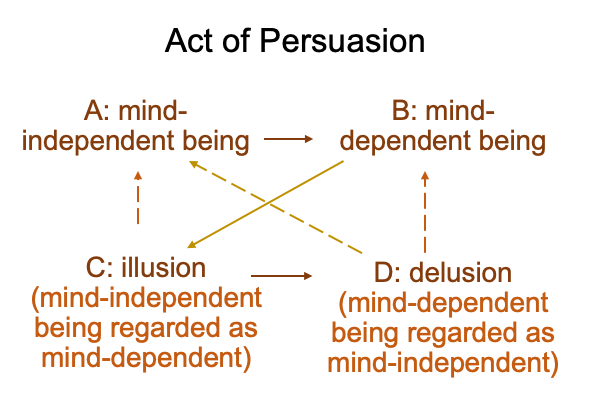
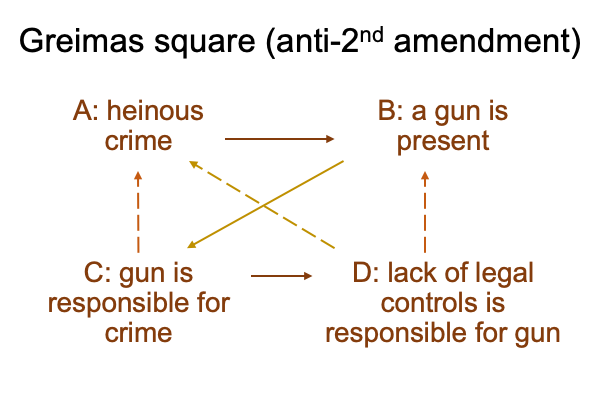
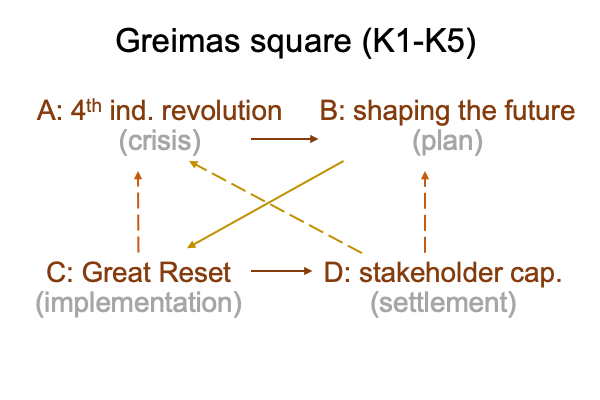
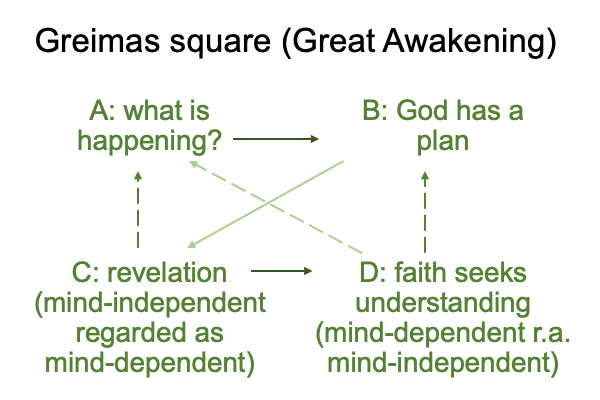
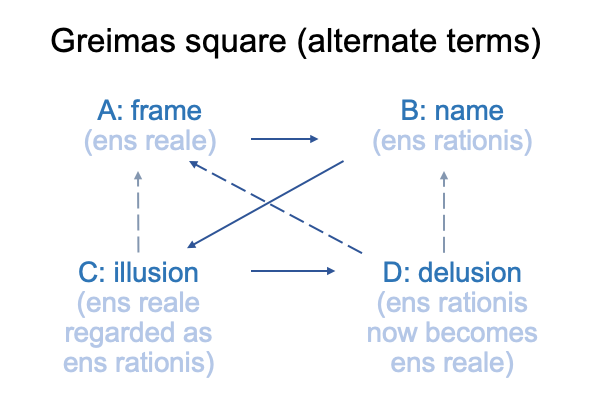
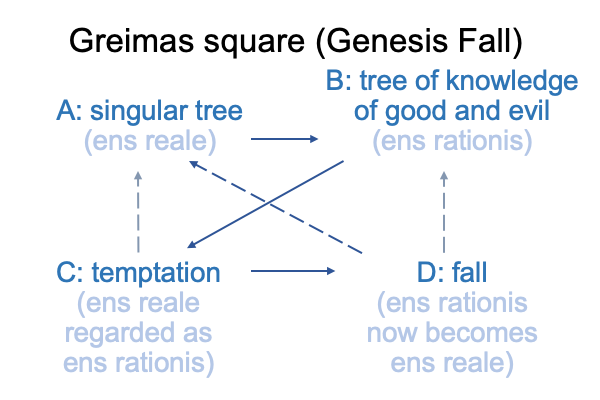
0001 The Greimas square is introduced in Comments on Gregory Sandstrom’s Essay (2013) “Peace for Evolution”, available at smashwords. This purely relational structure is introduced as a way to visualize langue as a system of differences. This is not the only way to visualize the word-in-mind. But, it is useful in labeling a word as a node in a symbolic order.
0002 Here is a picture of the Greimas square.
Figure 1
0003 Philip Marey is a senior US strategist at Rabobank. He contributes to the website, Zerohedge. On Friday, January 8, 2021, at 18:25, Tyler Durden posts Marey’s short work, commenting on recent events. The title consists of one word: insurrection.
0004 “Insurrection2a” should go into slot A1, as the focus of attention. However, the situating actuality2b is causality2b. Marey’s post considers the projection of causality into the term. What explains the presence of insurrection2a?
0005 The first cause that Marey raises comes from academics, in particular, economists. The primary cause of insurrection is economic.
“Economic causes” go into slot A1.
0006 In contrast, Marey offers an alternate cause: identity. His researchers show that the US political system becomes increasingly polarized after the 1964 Civil Rights Act. This demonstration is a red herring, because polarization is already present in the 1964 presidential contest between Barry Goldwater (populist, “insurrectionist”) and Lyndon Johnson (party insider, “statist”). The 1964 Civil Rights Act is a symptom, not a cause.
The cause is the expansion of the federal government, with its attendant religion, Big Government (il)Liberalism (BG(il)L).
0007 Perhaps, the relevant factor for the growth of identity politics in the US is to be found in the rapid expansion of state university systems in the 1950s and early 1960s. New positions and fields of inquiry germinate a novel brand of Marxism. Cultural Marxism exploits cultural distinctions, rather than economic.
0013 Here is the complete Marey square, once again.
Figure 4
0014 Do I see a problem?
Modern economists advocate for federal policies to reduce income inequality (A2) as a way to keep the peace (A1). In other words, inequality (A2) feeds into economic causation (A1).
Does the same pattern apply to the contrasting elements (B1 and B2)?
Should modern economists also address the contribution of identity?
Or does that responsibility rest with a different suite of experts?
You know, the one’s who argue that “identity” is fully malleable, yet behave as if it is fixed.
0015 Does the proposed solution of reducing economic inequality (A2) create an unintended consequence of forcing equality (B2) onto identity (B1)?
Is there a word that describes forcing equality (B2) onto identity (B1)?
How about the term, “conformity”.
If, identity cannot be fashioned out of the creative expression of experts, then identity is not something that readily changes. Identity is not so easily altered.
0016 What happens to the proposed solution?
Reducing economic inequality entails conformity, which explains government and private-public sector behaviors subsequent to the incident in Washington DC on January 6, 2021, the so-called “insurrection”.
The US Congress passes legislation to crack down on “domestic terrorists”, that is, people who do not conform. They also impeach, for a second time, a figurehead that serves as the “other”, the one who does not conform. Onto this other, they project their own crimes.
Private-public sector companies purge their platforms of people who do not conform with their corporatist stance, where the federal government handles the problem of economic inequality. In doing so, they promote equality of identity for those remaining on their platforms. Those who remain are complicit in purging those who do not have identities worthy of equality. Of course, those who are unworthy of equality do not believe the experts.
0017 Marey’s square identifies two experts. One drives the broadcast conversation, attributing social unrest (insurrection) to economic causes, particularly inequality. The other drives a hidden conversation, where favored identities conform to the narrative. In the latter case, experts are cultivated in order to chastise those who do not conform and to justify exclusion from public-private platforms.
0018 In short, Marey’s brief article hones in on a serious entanglement, which cannot be discussed, binding a BG(il)L public narrative (A1) with a hidden agenda concerning identity (B1). Forced conformity (B1, B2) is as disturbing as economic inequality (A1, A2).
0001 Does astrology begin with the first singularity?
The first singularity potentiates civilization, by opening the door to unconstrained labor and social specialization.
Astrologists exemplify a certain type of specialization.
0002 How does astrology work?
Astrology offers a primary causality, associated to the celestial realm, as a way to appreciate the secondary causality of our mundane realm.
0003 In sum, astrology provides context and potential to events that we experience in the here and now.
Figure 01
0004 Yes, this structure parallels the primary and secondary causalities appearing in scholastic philosophy.Primary and secondary causes are discussed in Comments on Fr. Thomas White’s Essay (2019) “Thomism for the New Evangelization”.
0005 The normal context3 and the potential1 for astrology2 depend on another actuality2, consisting of what we see in the celestial spheres, the motions of the sun, moon, planets, constellations and other stars.
This gives rise to the astrologer’s vision, where a reading of celestial events1b expresses the potential1b of celestial arrangements, transits and so on2a.
Figure 02
0007 Now, there are two actualities. On the content level, there are celestial arrangements. On the situation level, there are various civilizational events, including personal dramas.
There is no apparent material or instrumental causality connecting the two, even though the sun, the moon, and the planets have gravitational influence. The sun also determines space weather. Plus, the sun orbits the galactic center.
The tradition of astrology offers final and formal causes, cobbled together over time through correlations between planetary motions and mundane events.
0008 The discovery of planets beyond human sight contributes to modern astrology. An entirely new branch of astrology looks at historic events and trends in relation to the motions of the outer planets, Jupiter, Saturn, Uranus, Neptune, Pluto and now, Erin. This branch of astrology considers civilizations as beings.
0009 Conjunctions of Jupiter and Saturn, the outermost visible planets, occur in a every 20 years. One lifetime may see 4 conjunctions.
However, the pattern extends beyond one lifetime. The conjunctions of Jupiter and Saturn occur in one type of sign for around 200 years. The typology of signs is earth, air, fire and water. So, every 800 years, the cycle completes.
The last conjunction between Jupiter and Saturn occurred in an earth sign. The 2020 conjunction takes place in an air sign, Aquarius.
0010 The Jupiter-Saturn cycle of 800 years, belongs to both ancient and modern astrology.The recent Saturn-Pluto conjunction, in January of 2020, belongs to modern astrology.
0011 In April 2020, I posted a series of blogs about the Saturn-Pluto conjunction in Capricorn, with Jupiter co-present (but not in conjunction). This celestial event in January, 2020, marks the start of one of the most bizarre plagues of modern medical history. Even though the novel coronavirus from 2019, has a fatality rate of less than 5% for people over 75 years old (and for people with co-morbidities, including asthma), the responses of governments throughout the world has been amazing.
Rather than protecting old folks, health-care bureaucrats locked down entire populations.
0012 How did the crisis start?
The novel coronavirus initially spread after the City of Wuhan held a huge banquet commemorating the upcoming lunar New Year, the Year of the Rat. Already, the easily transmitted RNA-based virus had infected many. This was its opportunity. When Wuhan’s residents returned to their native homes for the Lunar New Year, the disease spread throughout China. Also, the disease passed through international air terminals to the rest of the world.
0013 This mundane event coincides with the Saturn-Pluto conjunction. Capricorn is the sign of government and organization. Saturn is the planet of time (as in, ‘your time is up’ or ‘your time has come’). Pluto is the sign of the underworld.
Is it any coincidence that health-care experts come out and declare this novel coronavirus to be a grave disease?
Here is a picture.
Figure 03
0014 As discussed in my blogs in April, 2020, the imagery of the sign of Capricorn touches base with the first singularity.Thus, the conjunction of Saturn and Pluto in Capricorn resonates with the dawn of astrology, as a specialization within our current living world.
0015 Does Aquarius touch base with the first singularity?
Capricorn is half-goat and half-fish, which corresponds to the dual earth-water origin of the Ubaid culture, 7821 years ago.
The Greeks do not capture this image with their story of Pan being caught in an alternate chimerism.
0016 Neither do the Greeks capture the nature of how Aquarius resonates with the origin of astrology within our current Lebenswelt.
Ganymede is a youth so handsome that he is taken up to be the cupbearer for the Greek gods. So Aquarius is symbolized by a youth pouring water from a jug onto earth.
0017 Ah, it turns out that in Babylon, the god Ea carries an overflowing vase of water. This is the same Ea that is associated with both land and sea in Capricorn. And, this is the same Ea that is associated with the primordial waters.
0018 So, bearing jugs of water for the gods?
In one Mesopotamian origin myth, humans are created in order to do the work that the gods were tired of doing.
Is that what is in store for the next 200 years?
0019 Against this speculation, the sign of Aquarius is an air sign, rather than an earth or a water sign. So, where does Ea fit in with the creation of the air.
What does pouring water have to do with giving birth?
In one ancient Mesopotamian myth, Enlil, the god of the air, is born from the union of Aku, the sky, and Ea, the water.
0020 Ah, that is more like it.
Aquarius touches base with the birth of unconstrained social complexity. Unconstrained social complexity has the character of the weather, the air, the storm and the wind. There is no telling how the spirit moves. But, drop a coin into an astrologer’s hand and you may hear how the sun, the moon, the planets and the constellations put your turbulence into a celestial perspective and divinized opportunities.
0021 So, the conjunction of Jupiter and Saturn, in the sign of Aquarius, in December 2020, also resonates with the start of our current Lebenswelt. Enlil is born again.
0001 Yoram Hazony publishes a six part opinion piece, concerning the relation between Enlightenment traditions and Marxism. on August 16, 2020, in the Quillette website (http://vlt.tc/41uo). The essay is eye-catching for its portrayal of the capture of liberal institutions by marxists (now, with a small “m”) during the past three-score years. Marx is back in a big way.
0002 In the prior blog, discussing the Be Little Men movement, two actualities come to the fore. The first is a slogan2a, based on righteousness1a, that addresses the mirror of the world3a. The second is an organizational objective2b, telling what the slogan means to the marxist3b. This objectorg2b arises from the possibility of submission1b. Submission1bvirtually situates (and emerges from) marxist righteousness1a.
0003 Here is a picture of the two-level interscope, composed of two nested forms, following the style in A Primer on the Category-Based Nested Form.
0004 According to Hazony, marxists have infiltrated American media companies, universities, government bureaucracies, courts, so-called profits, so-called non-profits and churches. Classical liberals have lost control of their own institutions. Classical liberals do not have the intellectual or spiritual resources to combat the threat.
0005 How should I define the righteousness of the classical liberal?
The classical liberal entertains a perspectivec that occludes the foundational world of Christianity. The classical liberal extols3cequality, freedom and fraternity2c. These2c are the means to human fulfillment1c.
The American Bill of Rights declares life, liberty and the pursuit of happiness. Equality is the right to life and justice. Freedom is the liberty to make one’s own choices. Fraternity involves private property. One must own the possessions that one shares with family, friends, teammates and other social circles. Otherwise, one usurps.
0006 The classic liberal perspective-level nested form looks like this.
Figure 2
0007 Surely, this perspectivec level does not contextualize marxist contenta and situationb levels.
Why?
Hazony speaks of two steps. In the first step, the Enlightenment covers up Christianity. In the second step, Marxism occludes the Enlightenment.
So, let me start at the first step.
Christian social virtues describe what God reveals about human sociality. Saint Paul discusses equality in his letters. Christ frees humans from the chains of original sin. The body of Christ, the Church, possesses an object that brings all into relation. Finally, all these actualities emerge from the potential that a human can attain eternal life with God, the ultimate fulfillment.
The Enlightenment makes these virtues immanent.
0008 What does this immanence entail?
How does the Enlightenment perspective play into situation and content levels?
0009 First, let me simply slide the normal contexts of the situationb and contenta levels of the marxist sensible construction underneath the Enlightenment perspectivec level. Here is the resulting three-level interscope, a relational structure discussed in A Primer on Sensible and Social Construction.
Figure 3
0010 Second, I fill in the blanks.
The content level actuality2a turns extols3c into a dream2a, an object associating with an individual’s future, choices and companions. The individual’s dream2a arises from talents and dispositions1a.
What possibility1b situates the individual’s dream2a?
Of course, there must be opportunity1b.
Then, with hard work and luck, one realizes2b that dream2a.
0011 This sounds so American. Here is the interscope.
Figure 4
0012 The French Enlightenment, on the other hand, rots as it ripens. Unlike eighteenth-century America, France is loaded with god-defying intellectuals, salon-attending little royals and cunning lawyers, who dream of running political affairs without the burden of king and church. They have talents and dispositions1a toward promoting organizational objectives2bbased on reason1b. Reason1b gives opportunity to righteousness1a. As such, their dreams2b,2a are tautological.
The Marxist frame, perceptively delineated by Hazony, develops in situ within French Enlightenment civilization. The sarcastic godless intellectuals, self-absorbed gossip-bearing little nobles and the reason-worshipping lawyers consider themselves to oppressed by the oppressors, king and church. King and church express a false consciousness. The system works for them, not everyone else, especially the discontented. Revolution will reconstitute society and the inherent ironies of the present regime will disappear.
0014 Part 3 concerns the attractions and power of marxism.
The individual is attracted to classical liberalism.
The discontented are attracted to marxist (il)liberalism.
The current iteration of marxist religion is Big Government (il)Liberalism (BG(il)L).
0015 What do marxists have that liberals do not?
Here is a picture of the marxist’s sensible construction
Figure 6
0016 Where is the perspective levelc?
Is it too horrible to view?
The Enlightenment perspective-level actuality (equality, freedom and fraternity2c) addresses three important aspects of human sociality in our current Lebenswelt.
0017 According to Marx, these are not sufficient.
What else is required?
First (A), people form cohesive classes or groups. May I call them, “institutions”? Second (B) these classes or groups invariably oppress and exploit one another, culminating in one (the state) enforcing order. Third (C), the state eventually functions as an instrument of the oppressing class.
0018 Weirdly, Marx’s insight is captured in the chapter on presence in the masterwork, How To Define The Word, “Religion”. The three elements appear in the institution (content) and sovereign (situation) levels of the societyC tier.
Figure 7
0019 In theory, Enlightenment liberalism achieves order1b, while using the fewest official acts and decrees2b. It cultivates personal commitments2a to life (equality), liberty (freedom) and the pursuit of happiness (fraternity)2c. Civic culture consists of various fraternal institutions3a, some Christian (“religious”) and some not Christian (“not religious”)1a, pursuing diverse objectives2a.
Righteousness1a does not arise from within Enlightenment liberalism. Rather, Enlightenment liberalism is conducive to a wide variety of inspirations. Liberal righteousness1a demands that each individual pursues opportunities1b offered by competing civic institutions3a according to their talents and dispositions1a.
0020 In contrast, the Marxist vision proposes that a number of otherwise civic institutions3a (A) will pursue organizational objectives2a (B) that require official acts and decrees2b for their implementation1b (C).
0021 Hazony offers examples.
Ideally, public education should be implemented through a general decree stating that all individuals over a certain age must pass a civic exam in order to gain citizenship. The exam would be offered by (not one but) a suite of competing voluntary institutions, each operating with transparency due to competition. Education may be subsidized by vouchers to parents.
In practice, modern education engages unionized teachers (A) who demand a monopoly over “public” instruction and examination, as well as a host of other organizational objectives (B), that require state enforcement through official decrees (C).
In sum, Big Government (il)Liberal education exemplifies the Marxist vision.
0022 Hazony offers other examples. But, the point is clear. Marxist righteousness1a sensibly constructs organizational objectives2b, that, on one hand, arise from directly from the potential of submission by a target (individuals or institutions)1b, and, on the other hand, are virtually situated by official acts and decrees2b in the sensible construction of societyC.
0023 One reason why Marxist ideas are so attractive is that they promote a righteousness1a that both demands submission from others1b and entangles sovereign power3b.
The task of identifying like-minded individuals is relatively easy, since conservatives, Christians, nationalists and (above all) enlightened liberals espouse other styles of righteousness1a. All institutions in a modern civic society are vulnerable to infiltration by marxists.
In sum, marxists can easily identify one another, selectively promote one another, and humiliate perceived competition within each institution. Those who are not marxist within each institution are increasingly expected to toe the party line and to promote entanglements with sovereign power.
0024 Amazingly, Enlightenment liberals find themselves dispossessed by the very institutions that they built.
Does this imply that the marxists hold a perspective-level actuality2c that (if you will excuse the pun) trumps equality, freedom and fraternity2c?