Looking at Ian Hodder’s Book (2024) “Entangled.” (Part 19 of 22)
0247 Chapter seven (C7) discusses entanglements and affordances. These topics do not come to mind when considering the dig at Catal Hoyuk.
Spoken words are a little quirky.
I suppose that there are nuanced differences between “dig” and “excavation”.
One must not dismiss the sensitivities (and the vocabulary) of others.
0248 The author (S2C7) recalls an episode in a book by art historian and critic, Ernst H. Gombrich (1909-2001). The “H.” is for Hans Josef. Trained in art history at the University of Vienna, he held academic appointments at Oxford University, Harvard and Cornell, while working at the Wahrburg Institute until his retirement in 1976. His most popular book is a text, published in 1950, titled, The Story of Art.
0249 Another book, The Sense of Order, contains the episode, where an expert sums up the shift of artistic expression during dynastic Egypt as trending from “tactile” to “optic”. In a similar way, after the Middle Ages, the art of the West trends from “religious” to “decorative”. Gombrich wonders whether the same laws of stylistic development apply to these two observations?
I ask, “Was there a change in artistic dispositions1a?”
0250 If so, a change of artistic disposition would not influence content-level matter2am as much as the content-level form2af.
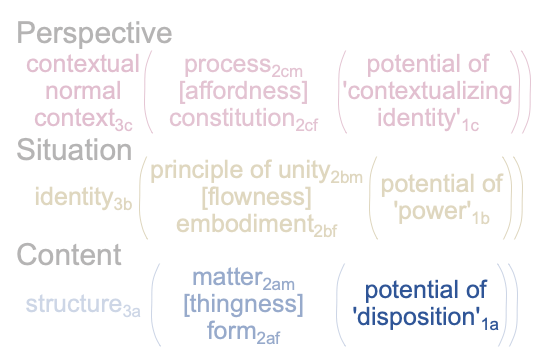
0251 Gombrich mentions another art critic who distinguishes Renaissance from Baroque styles of art on the basis of how each made him “inwardly dance”.
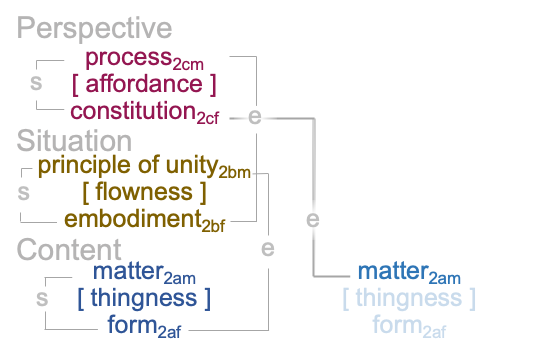
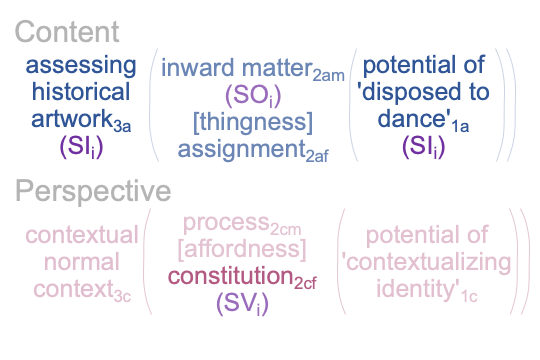
0252 To me, this art critic has processed so many works of art2cm, that he constituted a perspective level form2cf (SVi) that stands for an inward matter2am (SOi) in regards to assessing a historical work of art3a operating on his potential of ‘being disposed to dance’1a (SIi).
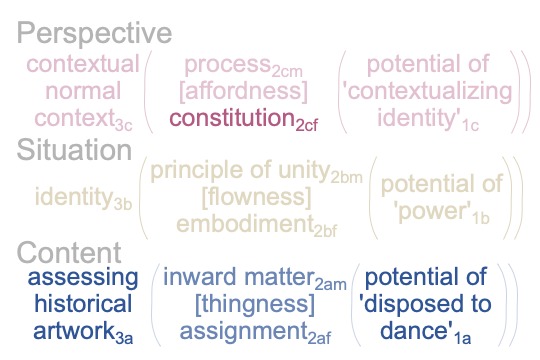
0253 In this example, the interventional sign-relation manifests. The sign-vehicle is the perspective-level form2cf. The sign-object is content-level matter2am. The sign-interpretant is the content-level normal context3a (structure3a) operating on its potential (dispositions1a).
The interventional sign concludes one three-level interscope and initiates another. Perspective-level form2cf “writes” content-level matter2am by… how?.. precipitating an appropriate normal context3a and potential1a?
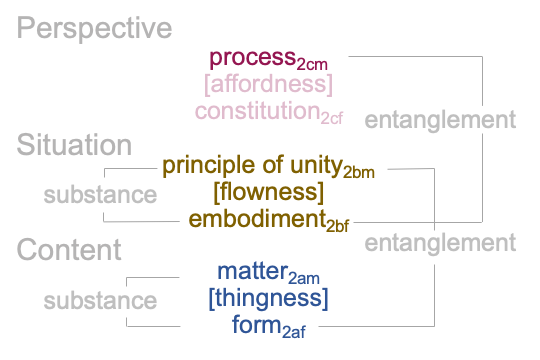
0254 Here is another way to diagram the interventional sign-relation.
0255 In S4C7, Hodder discusses burials in the floors of the houses and the recovery of (some, not all) heads for plastering and display. The honored skulls uphold the walls of the house (so to speak).
0256 Here is a picture of the associated interventional sign-relation.
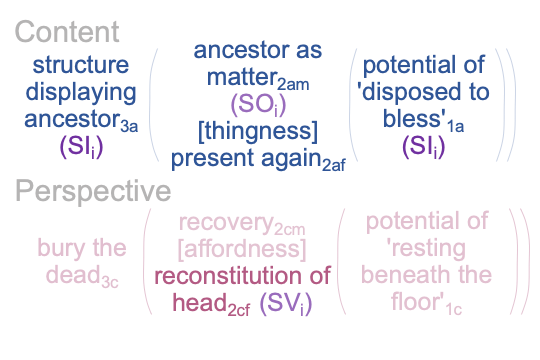
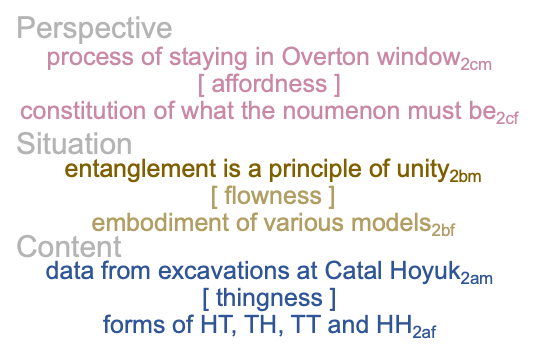
0257 The reconstitution of the head long after burial2cf (SVi) stands for the ancestor as matter2am (SOi) in regards to the structure of a display3a operating on the potential that ‘the ancestor is disposed to bless the family’1a (SIs).
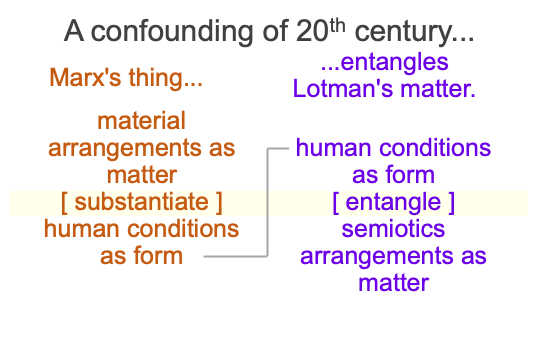
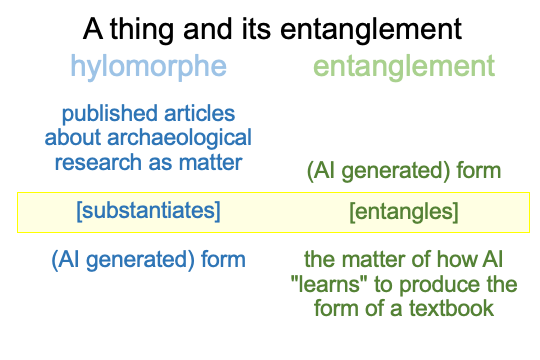
The interventional sign resolves a confounding. The perspective-level thing is {recovery2cm [substantiates by way of affordance] the reconstitution of a deceased’s head2cf}2c. Plus, the form of reconstitution2cf [entangles] the ancestor as matter2am.
0258 Let me step back and present the perspective-level thing2c from point of view of its three-level interscope.
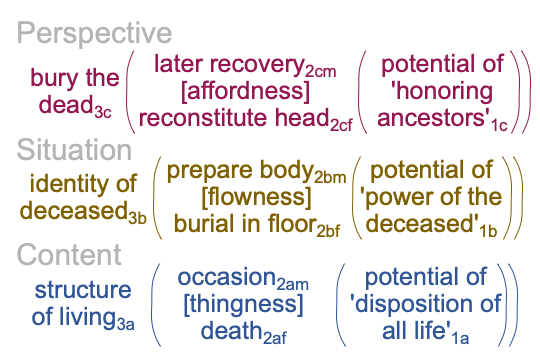
The reconstituted head2cf entangles the ancestors as matter.
0259 The associations in the above figures are not fixed. They are not models. They are guesses as to what the noumenon must be.
If the above figures represent the noumenon of the handling of the dead in Catal Hoyuk, then do the observed phenomena allow one to build an archaeological model that makes sense?
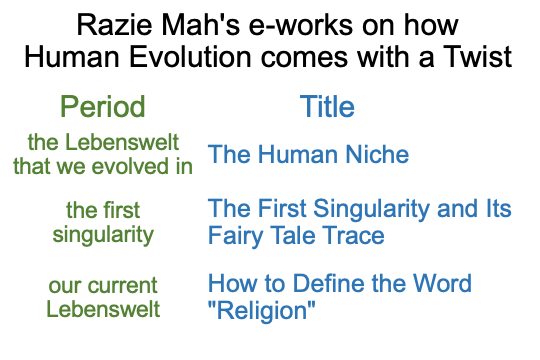
0260 Chapter 8 (C8) offers two examples regarding the onset of domestication in China and the Middle East. The reviewed research covers radiocarbon dates prior to 6800BC. These dates do not cover the strangest entanglement of all: the semiotic transition that starts with the Ubaid of southern Mesopotamia.
Consider Razie Mah’s four blogs, Looking at Melinda A. Zeder’s Article (2025) “Unpacking the Neolithic”, published on January 1, 2026.