0002 In 2012, the European Science Foundation convened an exploratory workshop, titled, “The Neolithic of Arabia: New Paradigms and Future Perspectives”. The schema is available online.
In the section on the main objectives of the workshop, the organizers (Dr. Remy Crassard and Dr. Phillipp Drechsler) note that the fragmentary characteristics of scientific knowledge to date favors the persistence and acceptance of current theories and precludes the development of new paradigms, along with comprehensive and coherent approaches to the Neolithic.
0003 This “favoring” and “precluding” is intrinsic to a recent essay in the journal, Prehistory, which is examined in Razie Mah’s blogs on January 1, 2026, titled Looking at Melinda Zeder’s Article (2025) “Repackaging the Neolithic”.
0004 While the workshop organizers do not call for a novel global vision, they do call for a synthetic approach that encourages the integration of diverse research on the topic.
0005 This open letter calls for more comprehensive research into the link between the early Holocene infilling of the Arabian Gulf and the emergence of two spheres of interaction for the Ubaid (southern Mesopotamia and the western Gulf littoral). The addendum provides an introduction.
0006 How comprehensive?
0007 Consider the questions raised by Razie Mah in the e-book, The First Singularity and Its Fairy Tale Trace.
0008 First, does the forced migration induced by the early Holocene marine transgression explain the ‘Ubaid phenomenon, where this culture may be considered to be the first to practice speech-alone talk?
0009 Second, does speech-alone talk spread from the Ubaid, along established paths of down-the-line trading, to the rest of Eurasia? Why do all hand-speech talking cultures adopt speech-alone talk after coming into contact with a speech-alone talking culture? Are there archaeological markers indicating that, not only has contact occurred, but the transition is underway. Artifacts that might demand labels, like copper, certain types of pottery (such as the white pottery of the Archaic Hassuna), changing habits of lithic-tool knapping, might serve as markers.
0010 Third, what are the semiotic natures of hand-talk, hand-speech talk and speech-alone talk? Does hand- and hand-speech talk constrain social complexity? Does speech-alone talk potentiate unconstrained social complexity?
0011 These questions can be bundled into one grand question, which, ironically, is what the workshop specifically forbade.
Is our current Lebenswelt the same as the Lebenswelt that we evolved in?
Are we who we evolved to be?
0012 I hope this call is heard by all people of good will. The time has come to set aside the swords and pick up where European Science Foundation’s exploratory workshop left off.
0010 Earnestly yours,
The Desk of Razie Mah
September 2-15, 2026
0011 Addendum: Looking at Richard Cuttler’s Article (2013) “Considering Marine Transgression as a Mechanism for Enforced Migration and the Littoral Gulf ‘Ubaid Phenomenon” in Razie Mah’s blog, September 1, 2026
0001 The citation for this article is: Cuttler, R. (2013). Considering marine transgression as a mechanism for enforced migration and the littoral Gulf ʿUbaid phenomenon. Arabian Archaeology and Epigraphy, 24(1), 37–43.
I obtained my copy from Wiley online. Thank you.
0002 In the early 2010s, Dr. Richard Cuttler smells a very interesting intellectual aroma, but is unable to sense where the trail leads. What is the link between the infilling of the Persian Gulf and the appearance of the Ubaid culture of southern Mesopotamia?
0003 The titular “consider” is one way of saying, “Imagine the possibility.”
If the marine transgression into the Arabian… or is it Persian?.. Gulf enforces a migration of the people who originally settled the fresh water marshes of the Ur Shatt (that’s “Ur Schatt” for Germans) waterway, then does that account for the Ubaid appearing in both Mesopotamia and on the shoreline of central Arabia?
0004 Why would an archaeologist consider such an if-then scenario?
During the glacial period, the Euphrates and Tigris Rivers flowed together into a waterway, the Ur-Shatt, that fed a corridor of lakes and marshes (now underwater “basins”) into the sea. Such a concourse would be a favorable place for Epipaleolithic enthnoses to settle, taking advantage of diverse natural resources.
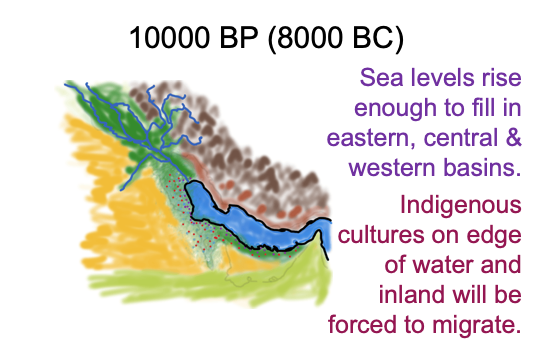
0005 Little did they realize that the Ur-Shatt waterway, a veritable oasis during the glacial period, would slowly be covered with around 70 meters of sea-water. By “slowly”, I mean thousands of years. At the same time, the rise in sea-level has a horizontal dimension. After filling the basins, sea-water spreads into a shallow geological bowl.
0006 Here is a picture of the scenario once the low-lying basins are full.
The indigenous settlements are represented by red and purple dots.
The sea-rise will force these people to migrate.
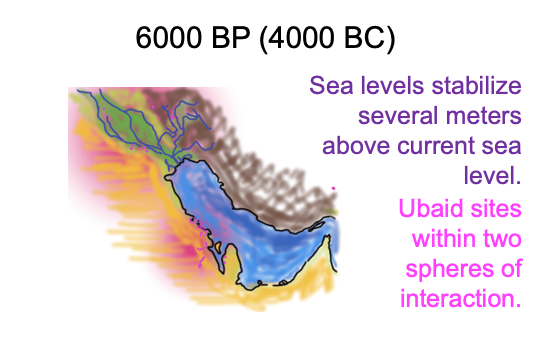
0007 Here is a picture once the Gulf is filled to the brim (as far as the sea-rise would go, which is several meters above the present sea-level).
The Ubaid settlements are represented by magenta dots. Plus, the background color has taken on a magenta hue, denoting two spheres of interaction, the central Arabian Gulf and southern Mesopotamia. This is my rendition of Figure 1 of the article.
0008 How does anyone know that there are two spheres of Ubaid settlements?
Originally, the term, “Ubaid”, labels a type of pottery found in excavations throughout southern Mesopotamia. Why did archaeologists not also look at the central Arabian Gulf region?
The author is perhaps too embarrassed to say that late-nineteenth and early-twentieth century archaeologists focused on this region because… well… that is where the Garden of Eden is supposed to be. That is where Noah’s flood took place. That is where Judah was taken into exile in ancient times. So, of course, Protestant Christians are going to pay for exorbitant excavations in order to reveal… you know… something about justification by faith alone, scripture alone, and grace alone.
0009 Okay, I am just guessing on that one.
0010 Then, in 1968, G. Burkholder discovers Ubaid pottery in the western Gulf littoral.
0011 What a surprise.
The Ubaid is the lowest level excavated in southern Mesopotamia, which means that it has the deepest time horizon. Now, the Ubaid shows up near Bahrain. Doesn’t that smell like a great research project? To an archaeologist, it sure smells good… but, how does one follow the scent when the trail goes under the waters of the Gulf?
Professor Richard Cuttler, who I am sure has some good stories to tell, seeks funding for seismic reflection maps of the Gulf’s underwater landscape, in order to obtain better placed sediment cores of the sea-floor. He wants to investigate, but he does not know that there is another component to the puzzle. Also, big funding is hard to come by.
0012 If the project is funded, what will he find?
Among other points, the sediment cores would provide pollen-based clues to the changing climate of the time.
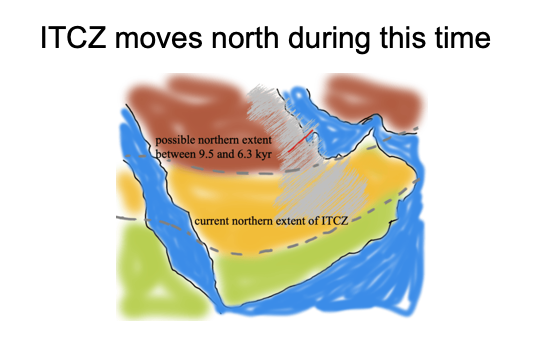
0013 At the start of the current interglacial, the Inter-Tropical Conversion Zone (ITCZ) shifts north, then back, then north again, in a most fickle manner. For the time under consideration, the ITCZ moves north, but not as far north as the gulf-to-be.
Here is a picture.
0014 The two dotted gray lines indicate the furthest extend of the ITCZ currently, and between 9.5 and 6.3 thousands of years ago (kyr). South of the line, the monsoons deliver plenty of rain water. North of the line, the westerlies lose all their water before arriving in Arabia.
0015 Curiously, all the Ubaid sites develop north of the early Holocene ITCZ line, suggesting that water was not a crucial issue. That makes no sense. Southern Mesopotamia obviously has lots of fresh water because of the Euphrates and Tigris and other rivers. What provides water to the pre-Ubaid sites in the central western Gulf?
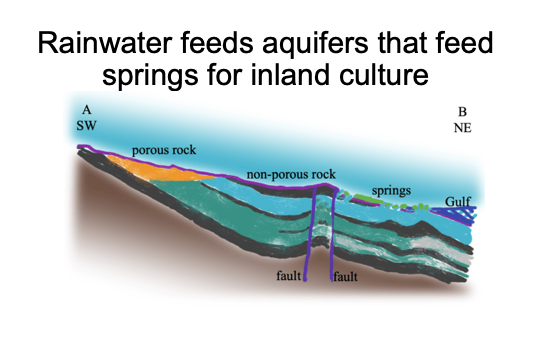
0016 Take a look again at the above figure. The gray brushstrokes and the red line denote a massive aquifer that is tilted. It is high in the west and low in the east. The Dammam label is a concatenation of the saying, “That’s a damn aquifer, ma’am.” Am I kidding? This aquifer relies on a huge tilted fault-riddled plate of non-porous rock supporting porous layers that allow rain water, falling south of the northernmost ITCZ line, to flow underground and come to surface in springs that stand outside the low-lying basins.
0017 Here is my version of the article’s Figure 2.
Note how water flows downhill in the Dammam aquifer then comes up in springs further inland from the sea-water filled basins.
0018 Why is this so important for this examination?
This examiner wants to show that… in the land surrounding the freshwater marshes and salt-water depths of the basins at 10,000 BP… there are two cultures: a Mesolithic culture that lives right along the water and uses fresh and salt water resources and a Neolithic culture that exploits the water from Dammum-fed springs to engage in rudimentary agriculture and stockbreeding.
0019 The question is, “Why would I want to establish two disparate cultures in the same region?”
Wouldn’t that just complicate the story of an enforced migration?
0020 Here, I review.
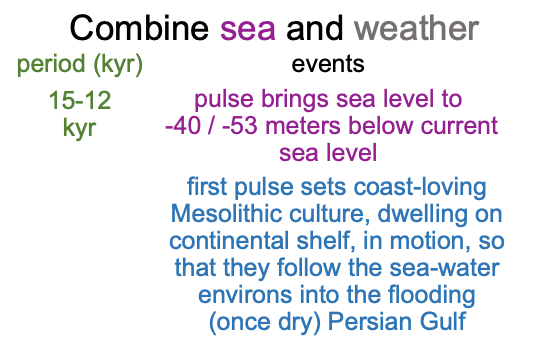
0021 First, the sea level starts to rise, if there is not a paleolithic culture already on the fresh-lakes of the Ur-Shatt waterway, then a Mesolithic culture displaced from living on the continental shelf could enter into the environs. Such a culture would simply follow the water into the eastern, central and western basins, since they already know how to exploit fresh-water and marine resources.
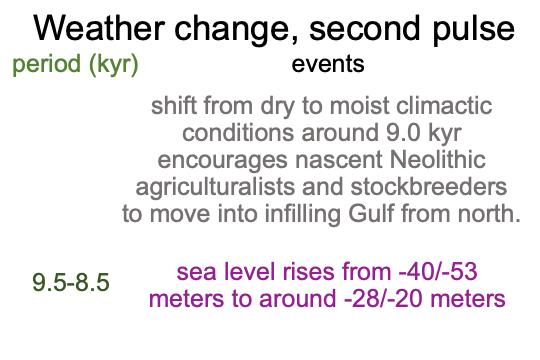
0022 Second, there is a shift from dry to wet climactic conditions, as the intertropical convergence zone (ITCZ) shifts north. Does it shift north enough to provide water directly to lands around the infilling Gulf? The author establishes that even if it does not, the ITCZ shifts north enough to feed the Dammum aquifer which would provide fresh water to a Neolithic agricultural and stockbreeding culture that migrates in from the north and settles in the dry-lands just beyond the marshes.
0023 Then the sea-level rises more, overfilling the basins and entering into the flat-bowl terrain of the surrounding landscape. Now, both the Mesolithic and Neolithic culture are forced to migrate in response to the rising seas.
0024 Here is where I introduce an idea that Dr. Cuttler did not think of and may have never heard about until this moment.
The economies of the Mesolithic and the Neolithic culture are different. They do not depend on the same resources. Practical reason predicts that these cultures should mingle with one another and eventually become one.
However, each culture practices its own hand-speech talking language. That means that they have a serious impediment to talking with one another. Both practice a dual-mode style of language. How are they going to get around that?
0025 Let me step back and say that the evolution of talk is not the same as the evolution of language. Almost every book available on human evolution discusses the evolution of language as a facet of hominin communication. Only Razie Mah’s books discuss the evolution of talk as a semiotic adaptation.
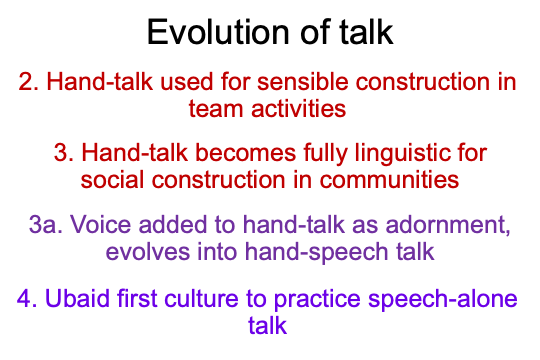
0026 Here is a brief overview.
0027 The first period ranges from the separation of the chimpanzee and human lineages (around 7 Myr) to the start of bipedalism (around 3.5 Myr). The hominin lineage communicates in two small and one larger social circles. The small social circles are family (5) and friends (5). The larger social circle is the band (50).
0028 The second period ranges from the start of bipedalism to the domestication of fire (around 0.6 Myr). Michael Tomasello says that this period is dominated by “obligatory collaborative foraging”. That means that the social circle under the most intense selection pressure is the team (15). Hominins forage in teams. Pre-linguistic hand-talk is an adaptation to team work. Pre-linguistic hand-talk relies on sensible construction. Sensible construction relies on content and situation.
0029 The third period ranges from the domestication of fire to the first singularity (around 9kyr). The social circle under the most intense selection pressure is the community (150), the team of teams. This period is dominated by, what Razie Mah calls, “obligatory social-circle harmonizing”. Hand-talk becomes fully linguistic as an adaptation to the semiotic dynamics of social construction. Social construction involves content, situation and perspective.
0030 Prior to the evolution of Homo sapiens, the voice comes under voluntary neural control for singing. Why sing? There are two social circles larger than the community, the seasonally gathering mega-band (500) and the occasionally gathering tribe (1500). Their episodic gatherings require rapid synchronization. The voice was recruited to do precisely this. Singing identifies each participant within these larger social circles as belonging to the group. Plus, singing synchronizes all participants to the tasks at hand.
Sexual selection does the rest.
0031 With the evolution of Homo sapiens, the voice is systematically adapted for use as an adornment to hand-talk. In liminal lighting, communal hand-talk is difficult to instantly recognize. The voice is added as an adornment. Sound-word adorns gestural-word. The semiotics of the union remains grounded in hand-talk. However, the semiotic qualities of the sound-word (speech) are unique. So, cultural evolution produces two independent channels of talk, hand and speech talk, that are highly socially regulated.
In short, the transition from the voice as an adornment to hand-talk to fully elaborated hand-speech talk occurs over hundreds of thousands of years during the Paleolithic. My guess is that archaeological evidence of adornment parallels the development of this cultural adaptation.
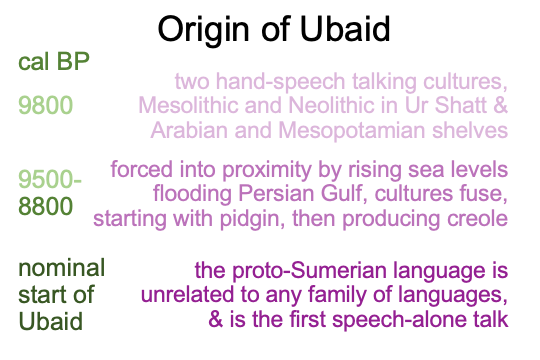
0032 The fourth period begins when two hand-speech talking cultures, one Mesolithic and one Neolithic, are forced into the same migration. These cultures have different economies, so they do not fight over resources. Rather, they trade and get along. They intermarry. They engage in interactions familiar to anthropology. They start with a pidgin. Then, later generations establish a creole. That creole is the proto-Sumerian language. Sumerian is unrelated to any large family of languages.
0033 Plus, that creole is the first speech-alone talk on Earth.
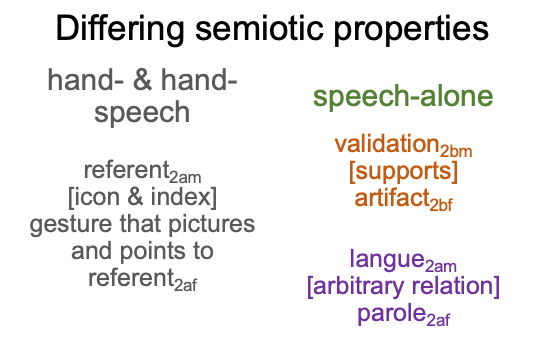
The semiotic properties of hand- (and hand-speech) talk and speech-alone talk are significantly different. The following figure presents dyads (characteristic of the Charles Peirce’s category of secondness) that may be read as Aristotle’s dyad of {matter [substance] form}.
0034 Hand- (and hand-speech) talk requires only one hylomorphe. A referent as matter substantiates, by way of icon and index, a manual-brachial word-gesture as form. The fact that word-gestures become routinized, and thereby instantly recognized, does not detract from this semiotic grounding. The referent precedes the hand-talk word.
0035 Speech-alone talk requires two hylomorphes, one on the content and one on the situation level. In terms of content, Ferdinand de Saussure (1859-1913) defined spoken language as “two arbitrarily related” systems of differences. What I think is arbitrarily related to what I say. So, where does the referent come in?
The referent comes on the situation-level, because each content-level word-utterance2af must be validated2bm(as situation-level matter) by the form of an artifact2bf. The spoken word precedes its referent.
0036 While this explanation sounds like gibberish to any newcomer to the field of semiotics, including many anthropologists and archaeologists in 2026, there is clearly method to the madness.
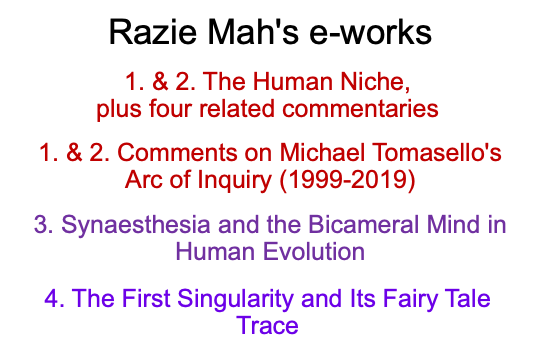
0037 Here is a list of Razie Mah’s e-works that are pertinent to this topic.
0038 The bottom line?
Hand- and hand-speech talk constrain social complexity.
Speech-alone talk facilitates unconstrained social complexity.
0039 This is precisely the theory that Dr. Cuttler needs in order to bring his research proposals to the next level.
0040 The origin of the Ubaid is the first step in a huge research project that is intrinsic to The First Singularity and Its Fairy Tale Trace.
0041 Cuttler’s analysis concerns the material arrangements that set in motion a dramatic shift in semiotic reality.
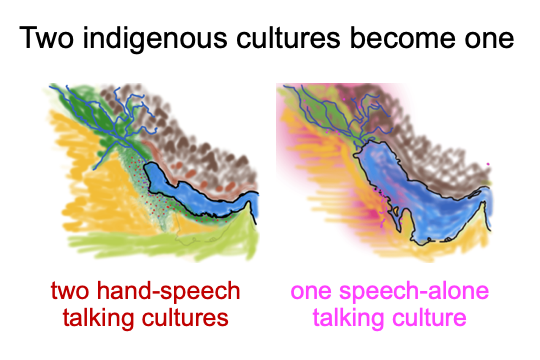
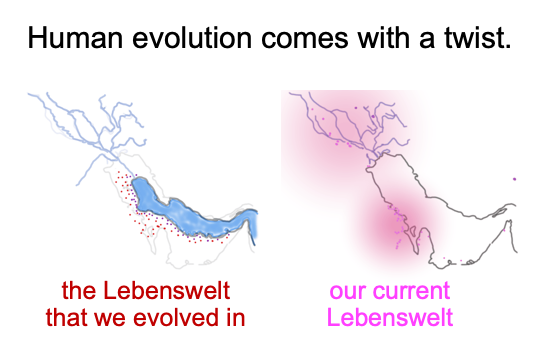
0042 Our current Lebenswelt is not the same as the Lebenswelt that we evolved in.
The image on the left represents two hand-speech talking cultures that belong to the Lebenswelt that we evolved in.
The image on the right represents one speech-alone talking culture that initiates our current Lebenswelt.
0043 I suspect that the Ubaid narod knows that they are different. They are surrounded by ethnoses that are poor and disorganized, in comparison to the wealth and the power that comes from (even a little) labor and social specialization.
The Ubaid does not know why it is special, it only knows that the surrounding hand-speech talking cultures talk with their hands. The hand-speech talking culture cannot help but notice the inverse. The Ubaid emissaries do not talk with their hands. However, they have the best dried fish. Plus, they want to give us their pottery, but it seems that they expect something in return.
Soon enough, the Ubaid strains at maintaining communality, or whatever it was that they had before their creation. Meanwhile, their way of talking encourages them to create artifacts that validate their spoken words, condemning them to further social complexity.
0044 It is hard to imagine what it was like, when every youth is ready to move past the tired artifacts that validate their grand-parent’s words.
Or, maybe it is not hard to imagine.
0045 Nor is it hard to imagine Abdullah Hassan Masry’s 1974 “sphere of interaction” hypothesis. Each Ubaid site belongs to a sphere of interaction, where it takes on its own “specialties”, its own gods, and its own ways of accommodating its labor and social specializations.
Doesn’t that sound like the contemporary term, “multipolar world”?
0046 Here is a picture.
0047 What is the second research project demanded by the hypothesis of the first singularity?
From the spheres pictured above, speech-alone talk spreads to the four corners of the world.
Imagine the research project needed to establish whether that claim is plausible!
0048 Dr. Richard Cuttler, the door is open. Follow your nose. Thank you for publishing your considerations.
0001 This essay comments on a 2017 book by biologist, Dennis Venema, and theologian, Scot McKnight. The title is Adam and the Genome: Reading Scripture after Genetic Science. The publisher is Brasos Press in Grand Rapids, Michigan.
The book consists of two equal parts. The geneticist shows that Adam and Eve cannot be a single pair who founded the human species. The theologian wrestles with how to read Genesis in light of modern archaeology.
0002 My goal is to supplement these arguments in two ways. I will re-articulate ideas about evolutionary biology using the specialized language of the category-based nested form. I will present a scientific hypothesis that re-images the Adam and Eve stories as ancient Near Eastern fairy tales.
Perhaps, at the end of these comments, I can declare, “The old historical Adam is dead. Long live the new historical Adam.”
0003 Before I begin, I attend to some housekeeping items.
‘Words that belong together’ are denoted by single quotes or italics.
Suggested readings include Primer on the Category-Based Nested Form (#1), Primer on Sensible and Social Construction (#2), and the chapter on message in How to Define the Word “Religion”. These works, by Razie Mah, are available at smashwords and other e-book venues, along with the compilation of this blog, titled, Comments on Dennis Venema and Scot McKnight’s Book (2017) Adam and the Genome.
0004 In order to see where many evangelicals are coming from, consult the September 2010 issue of Perspectives in Science and Christian Faith. This particular journal of the American Scientific Affiliation presents a snapshot of some of the difficulties posed by the early chapters of Genesis.
0005 The 2017 book, Adam and the Genome: Reading Scripture after Genetic Science, addresses one conundrum with a simple admission: Adam and Eve cannot be the progenitors of all humans, as proposed by Saint Augustine, 1600 years ago. The admission rebukes Christians striving to locate the primal couple in a genetic bottleneck event between 50 and 150 thousand years ago.
0005 Unfortunately, their solution provides little defense for Christian doctrine. Big government (il)liberals (BGilLs) claim that evolution disproves the second creation story in Genesis, just like the mercantilists, fascists and communists before them. BGiLs also insist that the Bible is the stuff of myths.
0006 Evangelical communities continue to bleed students.
Why?
Original Sin.
Christians think it describes the human condition.
BGilLs do not.
0007 Christians believe that humans are disoriented. Jesus provides orientation. Jesus is the way.
For BGilLs, the human condition is perfectible through a never-ending revolution by an administrative state. The human condition may be fulfilled by knowing one’s self. Or, is it – constructing – one’s self?
With Original Sin, we are actors in a theodrama that transcends critical theory. Indeed, critical theory may typify the corruption of Original Sin.
Without Original Sin, we are foolish players strutting on the world’s stage, full of sound and fury, signifying nothing. So why not accept the ministrations of a totalitarian government? Why not construct oneself?
Here is another online course on the same subject matter. All parts appear in Razie Mah’s blogs. Click on the month, then scroll downwards.
0012 These are sample courses. So, one may pick and choose points and reviews as one pleases.
Plus, there are lots of pictures. Pictures can be interesting and informative.
How so?
For the most part, the pictures are diagrams of purely relational structures.
0013 What am I selling?
Three online courses that cover the topic of human evolution. All are offered by Razie Mah. All are available at smashwords and other e-book venues. Merely purchase the e-books, print the pdf or read on a tablet. Each point can be discussed. The texts are designed to read and discuss.
A Course on the Human Niche contains the masterwork, plus four commentaries. This course introduces the Lebenswelt that we evolved in.
A Course on An Archaeology of the Fall, contains the masterwork, plus outside reading (Paul’s letter to the Romans and Sura 5). An instructor’s guide is available. This course pertains to the hypothesis of the first singularity.
A Course in How To Define the Word “Religion” contains the masterwork, plus 10 primers. This course concerns our current Lebenswelt, which is not the same as the Lebenswelt that we evolved in. A “how-to” instruction appears in Razie Mah’s blog in December 2022.
0014 With that said, here is the second online course on this topic.
One: Looking at William Lane Craig’s Book (2021) “In Quest of the Historical Adam”
(September 31-1, 2022, 21 blogs, 120 points)
Two: Looking at John Walton’s Book (2015) “The Lost World of Adam and Eve”
(August 30-1, 2022, 22 blogs, 192 points)
Three: Looking at Andrew Kulokovsky’s Overview (2005) “The Bible and Hermeneutics”
(May 27-16, 2022, 10 blogs, 85 points)
Four: Looking at Carol Hill’s Article (2021) “Original Sin with Respect to Science”
(February 25-7, 2022, 15 blogs, 72 points)
Five: Looking at Roy Clouser’s Article (2021) “… Support of Carol Hill’s Reading…”
(March 8-1, 2022, 6 blogs, 34 points)
Six: Looking at Mark S. Smith’s Book (2019) “The Genesis of Good and Evil”
(January 31-13, 2022, 16 blogs, 100 points)
0015 Total: 90 blogs, 603 points, 10 hours at 1 minute per point.
Maybe, this online course lasts around 2 weeks.
Enjoy this sample and consider purchasing Razie Mah’s online courses.
0001 The full title of the book before me is Rescuing Inerrancy: A Scientific Defense (2023, Reasons To Believe Press, Covina California). The author, Hugh Ross, is an excellent writer and a Christian scientist. The qualifier is crucial here, because biblical inerrancy is mysteriously conjunct the modern construct of scientific inerrancy. “Conjunct” means “stuck with”.
0002 The book has both a greek and a semitic architecture. As noted in The Instructor’s Guide to An Archaeology of the Fall (by Razie Mah, available at smashwords and other e-book venues), the two literary styles represent different types of recognition.
The greek argument presents a variety of opinions, weeds out the inadequate ones, then proclaims the one left standing, the winner. One might call it “linear thinking”. The greek style dominates the second half of the book (chapters 12 through 20), concluding with the proposal of a “model approach”.
The semitic style presents various rhetorical tricks, aiming to induce the reader to recognize a possibility. Am I saying that the Bible is full of rhetorical tricks? I suggest the reader look at the appendix of Ross’s book on that one. Or, consider the Genesis use of the word, “day”, in the Creation Story. The word leads to a flight of fancy, so to speak, asking the reader to recognize that the reported events are themselves, a flight of… what?… not of fancies, but of revelations… or significations… that become more and more esoteric (or hidden) even as they appear more and more exoteric (or obvious).
0003 What about Adam and Eve, fashioned from dust and rib, respectively?
Oh, they end up getting fooled by a talking snake.
0004 Christians are fine following the exoteric lessons and scratching their heads about some of the esoteric implications.
The problem is that Christians are stuck with the sciences. Conjunct! Science is all about truncated material and efficient causalities. Truncated? Scientific causalities are shorn of formal and final causation. Formal and final causes are metaphysical (a step beyond physics) because they concern triadic relations. It is like being able to account for all the motions (the truncated material and efficient causes) of a mechanical clock without acknowledging that the clock has a design (formal cause) and purpose (final cause)
And, the purpose has ‘something’ to do with us!
0005 The positivist intellect has a rule. Metaphysics is not allowed.
So Christians are conjunct with a positivist intellect who has no idea that the purpose of the Genesis text may have something to do with us, right now, not as we once were at some time in the not-so-distant past. The positivist intellect cannot consider that the first chapter of Genesis may be like a clock or whatever mechanical analogy one wants to use. Is it a story designed to set the “time”? The time of what?
Truncated material and efficient causalities cannot ideate what Christians observe (and sort of… measure, in the sense of “weighing”) in Scripture. Christians struggle to discern what the early chapters of Genesis could possibly reveal. Plus, those possibilities are not obvious at all. Even a plain reading of these stories tells the inquirer, “A plain reading of this text is not enough.”
0006 The Chicago Statement on Biblical Hermeneutics, published in 1982, says as much. Ross lists the relevant articles in chapter three.
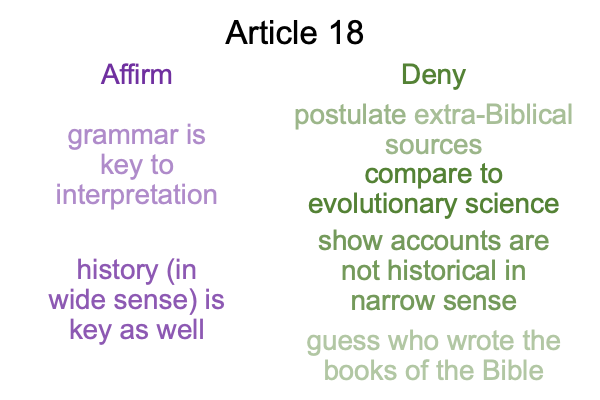
For example, in article eighteen, the convening theologians confirm that the text of Scripture is to be interpreted by grammatical and historical exegesis, so that Scripture is used to interpret Scripture. Then, they reject the legitimacy of various modern quests, including postulating extra-Biblical civilizational sources, relativizing the text by comparing it to evolutionary science, demonstrating that the accounts are not “historical” in the modern sense of the word, and rejecting the Bible’s claims to authorship.
Here is a picture.
0007 I ask, “Are these theologians affirming that Genesis 1-11 confronts the reader with the possibility of ‘something’, and that ‘something’ is not obvious from a plain reading of the text?”
They say, “Look at the grammar. Look at what the stories are saying in regards to history, in the widest sense of the term.”
0008 I ask, “Are these theologians denying that Genesis 1-11 can be assessed, compared to, and explained by scientific empirio-schematic inquiry?”
It sure looks that way.
And, that is a problem in a civilization where science appears triumphant.
0001 The book before me is published by Archaic Lens Publishing (North Carolina). The author posts podcasts on youtube, writes on twitter, and has a website, www.archaiclens.com. The book’s subtitle is The Thread that Connects the Ancient World.
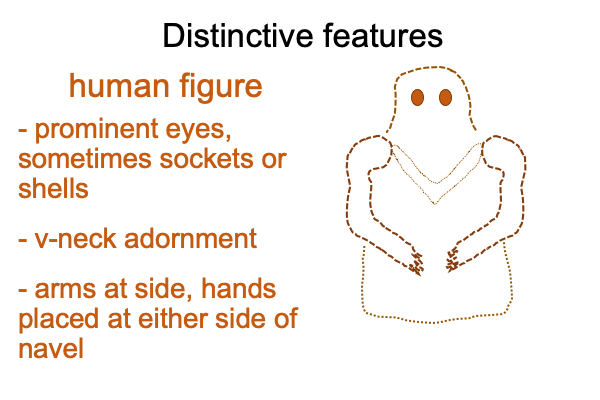
0002 The author documents navel idols that are readily identifiable to the human eye on the basis of several characteristics, as shown below.
0003 They appear at the dawn of history, in regions that will end up civilized, but before any advances in the direction of labor and social specializations. Later, the idols will associate to the Chalcolithic (the Copper Age), corresponding to the era before the Bronze Age (when copper is mixed with other ingredients to create effective weapons).
The oldest navel figure is Urfu man, recovered from Gobekli Tepe in Turkey (Anatolia) and dating to around 10,000 B.C. This is long before the end of the last interglacial. The megastructure site associates to the pre-pottery Neolithic, which comes before the pottery Neolithic. Subsequent Neolithic cultures throughout southwestern Asia will be labeled and identified on the basis of their pottery.
Also, Gobekli Tepe is not associated with a sedentary settlement, such as the contemporaneous Catal Huyuk.
0004 So, what am I saying?
Gobekli Tepe, Catal Huyuk and similar sites do not end up constellating into a tangle of unconstrained social and labor specializations, where social circles transmogrify into networks of economic and political-religious affiliations.
0005 In the section on Turkey, the author makes an interesting point. The body habitus of Urfu man appears in statuary and figurines in early civilizations around the world. The further from Gobekli Tepe, the later in time these navel idols appear.
Ironically, this point is precisely the rule of thumb held by archaeologists during the early twentieth century. The further from southern Mesopotamia, the later an early civilization forms.
0006 Coincidence?
Or is one observation swept up in the other?
0007 In the section on Turkey, the author includes a watercolor image of an awkward looking small artifact, with enormous alien-like eyes, v-neck adornment and hand on either side of navel. This clay figurine dates to around 5,000 B.C., during the copper age, according to the British Museum.
This artifact dates to 5,000 years after Gobekli Tepe.
The prehistoric cultures associated with the later artifact occur on the cusp of civilization, where the term, “civilization” is characterized by unconstrained labor and social specialization.
0008 A look at the sections on the Kosovo, Serbia and the Balkans support this association. The navel idols of the Vinca culture (5850-5750 B.C.) appear similar to the latter Turkey artifact. The Vinca culture practices farming, animal husbandry and copper smelting. A similar pattern occurs in Bulgaria. These cultures are on their way to increasing social complexity.
0009 The pattern will hold for all navel idols found to the west of the Aegean Sea. The navel idols and the Chalcolithic and other features, such as astronomy-related megalithic arrangements, spread west from southwestern Asia.
Since Gobekli Tepe is pre-pottery and pre-Chalcolithic, it cannot be the direct inspiration for the navel idol figures located the West, five millennia later. So, the old archaeologists’ saying of the early 20th century applies. Something from southern Mesopotamia sends out emissaries bearing the news of not talking with one’s hands, as well as copper manufacture and astronomy.
Indeed, it may be that the cultural efflorescence that builds Gobekli Tepe and other Anatolian sites spreads into northern, then southern Mesopotamia as the glacial climate gives way to the Wet Neolithic of southwestern Asia and northern Africa.
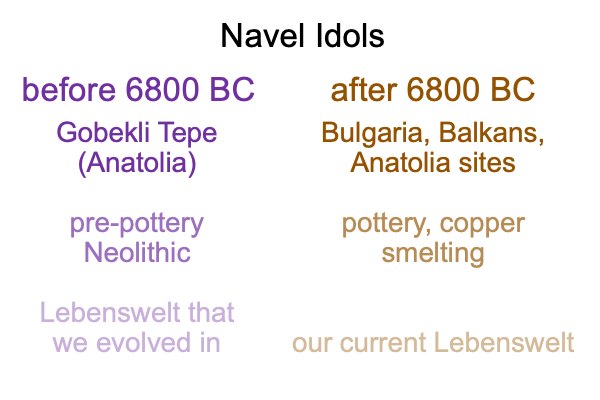
0010 The sea-level rise serves as a good way to demark the navel idols before pottery and copper and the navel idols after.
0030 To the immediate west of Mesopotamia, the navel idols of Israel, dating to 4500-3500 B.C., look like they correspond to the first message. The Canaanite coffins of 1300-1200 B.C. look as if they are inspired by the latter message. The coffins do not contain emissaries from Mesopotamia, they contain Canaanite elites who benefitted from trends towards unconstrained social complexity.
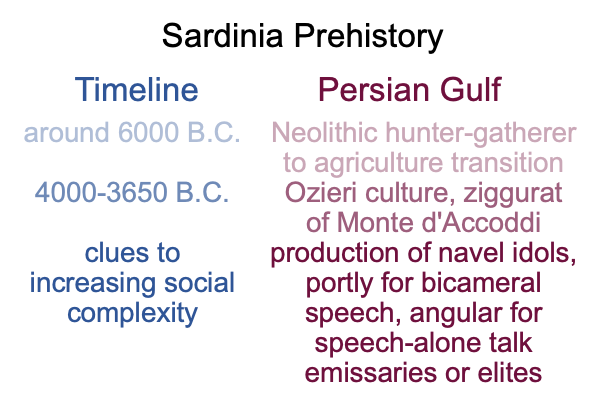
0031 In Sardinia, the messages separate into more than one style of navel icon..
0032 Here, this examiner leaves the reader to use the speculative structure of two messages to appreciate the many navel icons that the author presents in this well-appointed art-book.
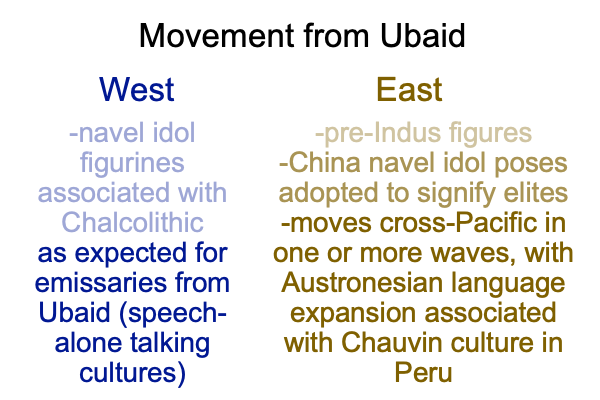
To me, the overall picture is clear for the West and for the East (as far as Eurasia is concerned).
The navel icons, as well as their speech-alone talking emissaries, are next involved in establishing a foothold in South America, but the messages are confounded with a trend already occurring in China. The same pose and adornment of the original navel icons are adopted as indications of elite status.
0033 Here is a picture.
0033 The conclusions… er… speculations of this examiner now set forth, I wonder whether the author will agree.
Of course, in this book, the author never entertains the idea that the navel icons are associated with either the bicameral mind (message 1) or the first singularity (message 2).
However, the author hints that intentional diffusion may be a reasonable explanation. The navel icons spread at the cusps of early civilizations throughout Eurasia and the Americas. Plus, there are other novel trends associated with the spread of the navel icons. These include copper metallurgy and… well… something to do with tracking celestial bodies. Oh, I should not forget v-shaped neck adornments.
0034 My thanks to the author for gathering evidence that is obvious to the eye, yet very difficult to account for. Perhaps, this examination, based on two works by Razie Mah, may assist.
0211 This examination adds value to Ross’s project in five ways.
First, it introduces a history that encompasses the modern conundrum presented in this text.
Hugh Ross and the Reasons To Believe Team are actors in a theodrama that is at least 800 years old.
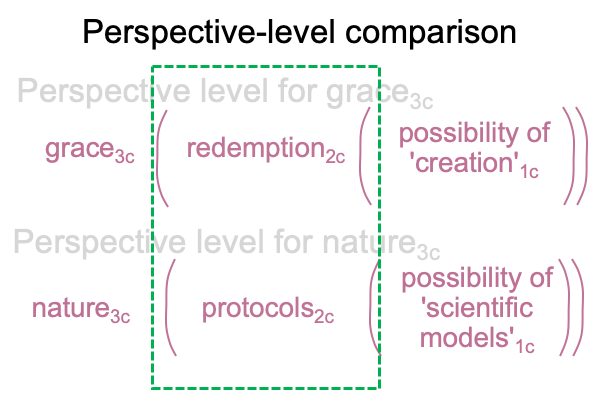
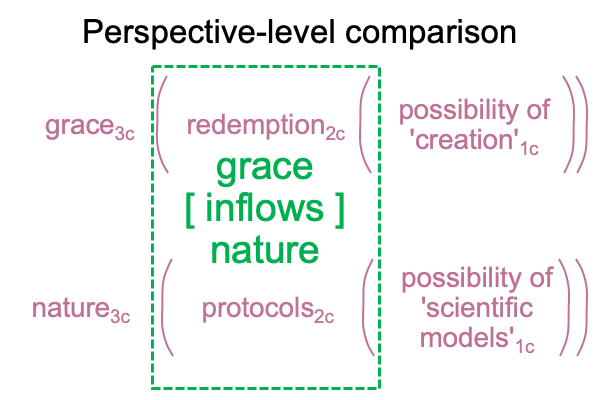
Plus, that theodrama is about to undergo a pivot that is captured in the following figure.
0212 Yes, the redemption2c offered by the party that exalts grace3c over nature3c and the protocols2c offered by the party that exalts nature3c over grace3c, are now entangled because, on the content level, the Creation Story is a sign of the evolutionary record and the Primeval History is an insider’s view of the start of our current Lebenswelt.
0212 Second, this examination offers a semiotic way to view what Ross is trying to articulate. Theologians should be interested in sign-relations. Scientists take sign-relations for granted. Ross’s book is titled as if a scientific defense will rescue Biblical inerrancy. This makes no sense unless its taken from a semiotic point of view. Inerrancy draws the Bible, especially Genesis 1-11, into hitherto unimagined triadic relations with scientific inquiry. The empirio-schematics of artistic concordism and the first singularity are variations of what ought to be for the Positivist’s judgment.
When, you think about it, signs tend to share certain characteristics with the term, “inerrancy”. Every sign-vehicle stands for its sign-object in regards to its sign-interpretant. Even if the interpretant is camouflage, the sign-relation purports to be flawless and honest in its own way. Indeed, all signs are “inerrant” in the eyes of God.
0213 Third, this examination offers a way of appreciating how Ross’s efforts aesthetically derive from the Positivist’s and the empirio-schematic judgments. Indeed, Ross’s project towers head and shoulder above other projects in the Venn diagram of science and religion because his aesthetics are one step away from the ways that scientists operate.
0214 Fourth, this examination offers a slightly different version of concordism than Ross. Mah’s artistic version may assist Ross’s moderate version in future research. In particular, I pray for a science book on the Earth’s evolutionary history to accompany Exercises in Artistic Concordism. Wouldn’t that be fantastic?
Fifth, this examination offers a wonderful endpoint, in the form of a label for the single actuality implied by the intersection of redemption2c and protocols2c. The early scholastics knew this label well. And now, perhaps, the following dyad will be born again.
0215 My thanks to Hugh Ross and this team at Reasons To Believe for publishing a book worthy of examination.
0001 Loren Haarsma is an old man, a physics professor and a Christian. As a fellow of the American Science Affiliation, he has lectured on the intersection of science and faith. He is a scholarly voice in the Biologos network.
The full title of his book is When Did Sin Begin: Human Evolution and The Doctrine of Original Sin (2021, Baker Academic, Grand Rapids, MI).
If one goes to the resources page for the Biologos.org website, then selects the topic, “Bible”, and the subtopic, “Adam and Eve”, one will find an extensive collection of essays on the concerns in Haarsma’s title: timing, evolution and original sin.
0002 How do these concerns fit into a category-based nested form?
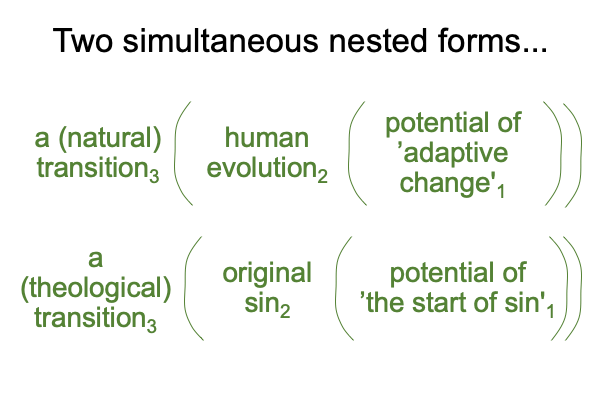
Timing calls forth a normal context3. The question, “when?”, implies an event. Here, the event is a transition. For evolution, the transition is a topic of natural inquiry. For original sin, the transition is a topic for theologians.
Human evolution and original sin belong to the realm of actuality2.
The only item not mentioned is potential1. Here, the question mark applies. For human evolution2, the potential must be adaptive change1. For original sin2, the potential is the start of sin in our current Lebenswelt1.
0003 To me, these concerns yield two category-based nested forms.
Here is a picture, following the recipe in A Primer on the Category-Based Nested Form.
Figure 01
0004 These two normal contexts exclude one another.
0005 The upper normal context3 associates to evolutionary science. The focus of attention is on natural history and genetics.
Typically, an adaptive change produces speciation. However, in human evolution, an adaptive change may be cultural. Human evolution is both biological and cultural. Since natural history and genetics do not adequately describe culture, they may not be enough to scientifically describe human evolution. Indeed, no natural science convincingly addresses cultural change.
0006 The lower normal context3 associates to theological science. The focus of attention is on special and general revelation.
Special revelation includes Genesis 1-11. Genesis 1-11 divides into two parts. In the Primeval History (chapter 2:4-11), Adam is brought to life as the first human, even though um… in the Creation Story (chapter 1-2.3), humans are already intended, created and blessed, in the framework of six days of creation.
General revelation includes Greek philosophy, among other traditions. Greek philosophy is useful for resolving contradictions. For example, some theologians resolve the contradiction inherent in the two parts of Genesis 1-11 by claiming that Adam (in Genesis 2.4-4) is the male and female “them” that God intended, created and blessed (in Genesis 1).
Say what?
In the Creation Story, God creates them, male and female. So, Adam must have had some sort of divided consciousness, one operating in his mind and the other working in his ribs.
Just kidding.
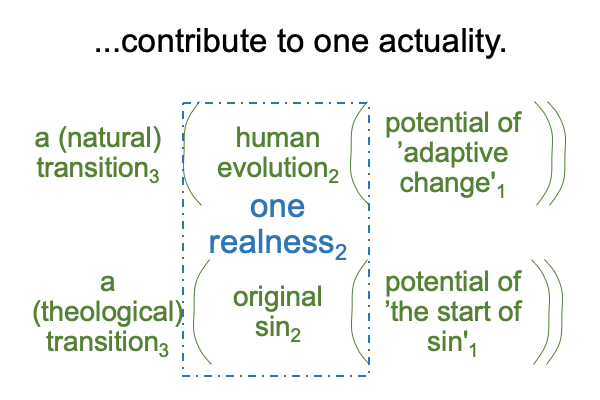
0007 Greek philosophy’s usefulness is not limited to resolving contradictions, no matter how silly the resolution may be. Greek philosophy may also be used in situations where contradictions cannot be resolved. Such a situation occurs here. Human evolution2 and original sin2 belong to a single actuality. They both pertain to one realness2.
Here is a picture.
Figure 02
0008 Two (apparently independent) category-based nested forms intersect in the realm of actuality2. The two constituting actualities cannot escape the one realness, because they constitute the one realness. Certain contradictions are accidental. Certain contradictions are essential. Greek philosophy is useful for separating the accidental from the essential. A set of essential contradictions is called “a mystery”.
0001 William Lane Craig publishes a work of erudition, titled, In Quest of the Historical Adam: A Biblical and Scientific Exploration (Wm. B. Eerdman’s Publishing, Grand Rapids, MI, ISBN 978-0-8028-79911-0). The bibliography contains over 250 references.
Part One discusses what is at stake.
Part Two covers the Biblical “data” concerning Adam and runs 210 pages.
Part Three covers scientific evidence about the start of humanity (broadly defined) and runs 117 pages.
0002 Overall, the first two-thirds of the book discusses the importance of the historical Adam and explores what types of stories are contained in Genesis 2.4-11. Then, the final one-third addresses the question, “If humanity descends from a single couple, then where would we locate that couple in the scientific story of human evolution?”
0003 Clearly, this professor would have been assisted by glancing at the masterworks in the Razie Mah series, The Human Niche, An Archaeology of the Fall and How To Define the Word “Religion”, available at smashwords and other electronic book venues.
0004 Why?
Every sentence in this book is well composed and carefully reasoned. But, Craig’s quest ends at a location that is anything but. He writes (more or less), “Adam may be plausibly identified as a member of Homo heidelbergensis, living 750,000 years ago.”
The quest ends where the book should have started.
Then, the title could have been, “What if Adam and Eve are really the first humans?”
What if, indeed.
0006 Craig’s argument presumes, all along, that Adam and Eve are the first humans.
In this examination, I do not neglect the opposing question, “What if they are not?”