0276 Chapter nine (C9) is on method. Chapter ten (C10) considers an “entangled string theory” as well as other approaches. Chapter 11 (C11) draws a short conclusion.
All these chapters deal with the issue of what the noumenon must be, in order to conduct the most informative archaeological inquiry.
0277 In this examination, I conclude that the conceptual apparatus of entanglement corresponds to a phenomenological presentation of what the noumenon of archaeology must be.
0278 The basis for such a conclusion is found in Razie Mah’s four part e-work Biosemiotics as Noumenon (2025).
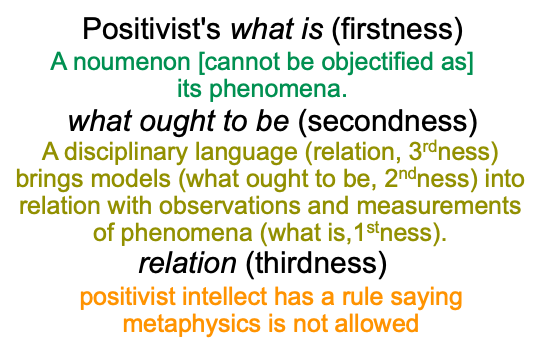
0279 Here is a picture of the Positivist’s judgment, which ground natural scientific inquiry.
0280 A judgment brings what ought to be into relation with what is. The three elements are what is, what ought to be, and relation. In the above figure, the positivist intellect belongs to the relation (and the relation is imbued with the category of thirdness). The empirio-schematic judgment belongs to what ought to be (and is imbued with the category of secondness). The dyad of the noumenon and its phenomena belongs to what is (and is imbued with the category of firstness).
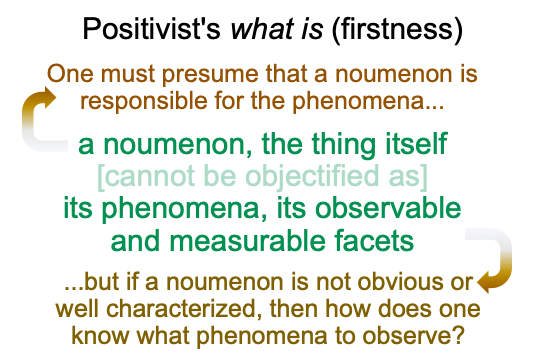
0281 From this, I would expect a benefit from a robust conceptualization of the noumenon.
Otherwise, the noumenon is simply the thing that must be responsible for the phenomena.
But, what does that imply?
Obviously, one wonders whether what one is measuring really corresponds to phenomena of a real noumenon or an imaginary one.
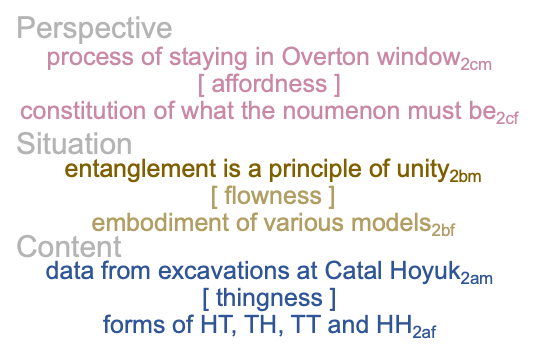
0282 In other words, Hodder’ entanglement is relevant because it reveals what the noumenon must be.
Here is my picture of his theory as an exercise in thingness, flowness and affordance.
0283 Chapter 9 discusses methods as if the noumenon is not under question. He mentions tanglegrams (S2C9), formal networks (S3C9), sequencing concerns (S4C9) and other diachronic aspects (S5C9), as well as other interpretations (S6C9) without mentioning that… well… what exactly is the thing itself?
0284 I wonder whether all the other approaches elucidated in chapter ten (C10) confront the conundrum that I am trying to articulate.
If scientific appreciation of what the noumenon must be stands within the Overton window of Hegel’s and Marx’s things, then what if that is not enough?
0001 The full title of the book before me is Sumerian Mythology, Ancient Civilizations, and the Epic Search For Humanity’s Origins. That is a great title. This publication is the 13th in a sequence of 37 books downloaded into the Amazon product line between the end of July, 2025, and the start of January, 2026. This literary output is staggering.
0002 Plus, it raises a question in my mind.
How does one identify an artificial intelligence (AI) produced article or book?
0003 Every sentence is well constructed. The text is highly segmented.
Are these clues?
0004 For example, the preface divides into A (5 subsections) and B (1 subsection). Each subsection contains two paragraphs. The preface also includes additional material, C, informing the reader what to expect, why this is essential reading, and how this qualifies for understanding.
Of course, this is standard textbook formatting.
However, the two clues, well-constructed sentences and high segmentation, still apply to the question at hand.
0005 Here are some other clue.
Flat statements contain no wordplay. The entire book consists of (1) direct statements and (2) a negative followed by an affirmative. No, I don’t mean to be negative, it is obviously better to be positive.
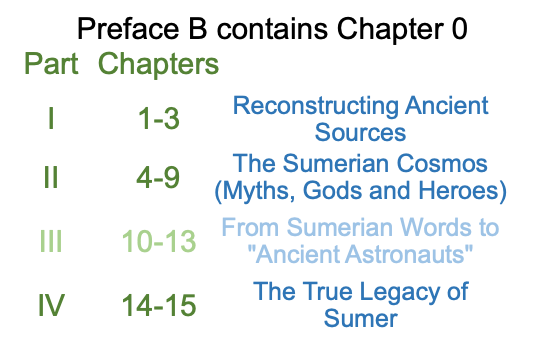
Fractal repetitions appear within the book’s organization. For example, the preface’s B subsection constitutes (what may be called) “Chapter 0”, which recapitulates the topics of the subsequent 15 chapters.
0006 Here is a picture of the list of chapters.
0007 Even though the text itself does not state that it is AI generated, one may raise the question and ponder the clues. These clues do not prove an answer, one way or another. But, they do raise another question.
If the work at hand is AI generated, then what does that imply?
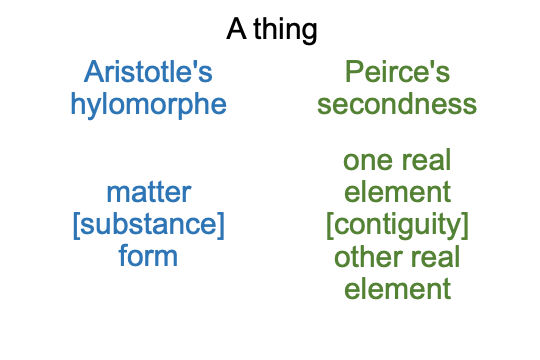
0008 The postmodern scholastic will start with Aristotle’s hylomorphe, which is an exemplar of Peirce’s category of secondness. These concepts may be derived from Razie Mah’s e-books A Primer on the Category-Based Nested Form and A Primer on Sensible and Social Construction.
The book that I have before me is a thing. A thing is composed of two contiguous real elements. For Aristotle, the real elements are matter and form. The contiguity is placed in brackets for clear nomenclature.
0009 Here is a diagram.
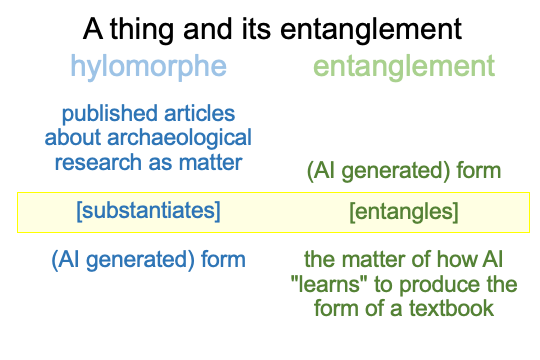
0010 My question as to whether the book is AI generated and what that implies is called “an entanglement”. The following diagram is sort of confusing (something that an AI would avoid), because two expressions are linked in that they have the same form.
0011 In the hylomorphe, describing the book before me, the phrase, “AI generated”, is put into parenthesis because the question remains open. The form is a book.
In the second (upside down, so to speak) thing, the (AI generated) form entangles another matter. That “other matter” is a question about how the AI learns what it is going to say. Obviously, the answer will include the originating matter. One may wonder, “What else?”
A thing and its entanglement consists in two matters (one originating and one entangled) and one form. The technical name for this pair is “confounding”.
0012 With the above confounding in mind, I may consider Chapter 1.
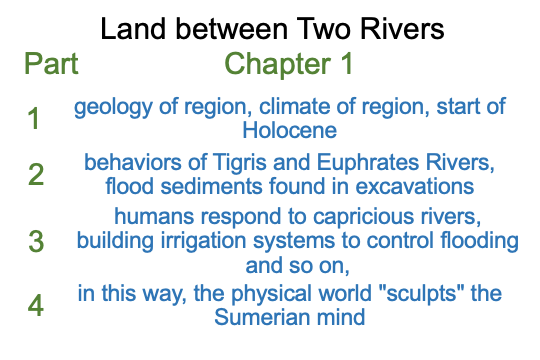
Here is a list of the learning objectives.
0013 This list suggests that the search for humanity’s origins, involving the Sumerian civilization and its mythology, arises in response to the precarious and fertile landscape between the Tigris and Euphrates Rivers. Annual floods from both rivers deliver silt. They can also deliver floods and destruction.
Excavations at locations in southern Mesopotamia find strata associated to floods during the Ubaid, Uruk, and Sumerian Dynastic archaeological periods.
0014 The irrigation systems control the rivers and redirect their water into productive agricultural uses. These systems require large scale labor under central (yet local) authority.
0015 To me, these conclusions are precisely what an AI program would deliver, after processing the literature (web-pages) cited at the end of the chapter. But, these are my suspicions. I have no proof.
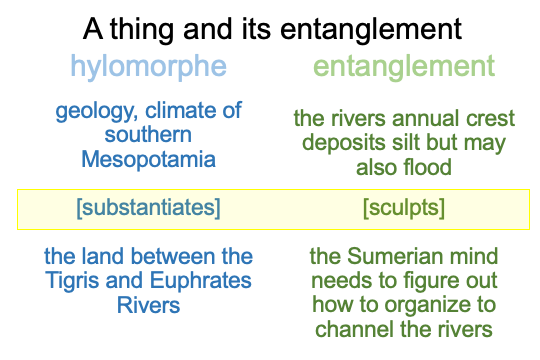
0016 However, I can construct a confounding. There is one form, the land between the Tigris and Euphrates Rivers. These rivers are subject to annual crests that deposit silt and may cause catastrophic flooding. The originating matter is the geology and climate of southern Mesopotamia during the Ubaid, Uruk and Early Sumerian Dynastic archaeological periods. The entangled matter is the mind of the Sumerian people, who celebrate the mythology that this book addresses.
0017 Here is a picture of the confounding.
0018 The confounding leaves this reader with a hypothesis. Sumerian mythology is an ideological component of an organizational imperative. The Sumerians must figure out how to organize to channel the rivers in order to irrigate their fields and to avoid catastrophic flooding.
In the process, the organizational imperative captures the Sumerian imagination.
0020 Well, I have another manuscript before me. The article appears in Current Anthropology 67(1), pages 155-180 (https://doi.org/10.1086/739789). The essay goes online in February, 2026, which is around the time when Dr. D. Basak finishes downloading his 37 books on various topics in human evolution, origins and archaeology. Surely, none of the 23 authors of the proclamation in Current Anthropology know about Dr. Basak’s efforts. Artificial intelligence is barely mentioned.
0021 If AI is not the future of publishing in Archaeology, then what is this lead essay about?
Young academics in the field of archaeology are getting crushed by their dual mandates of teaching and research.
0022 The article reminds me of when I heard about the beveled-rim bowl of Uruk. This standardized hastily spun pottery found popularity as towns were becoming cities. Some speculate that the bevel-rimmed bowl was used to measure rations of grains.
0023 The exploitation of labor by a religious and political system is not new. Archaeologists, of all experts, should know that. The irony of the contemporary complaints is startling. Postmodern academics are caught in the same dilemma as the laborers who dredged canals or cast bricks of mud and clay, thousands of years ago.
0024 The first sentence of the article reads like a manifesto. It is time to change academic publishing in archaeology.
If Dr. D. Basak has his way, it has already changed.
0025 The complaint is serious. Twenty-three authors sign the manifesto. These include Jess Beck (University of Ireland), Rowan Flad (Peabody Museum, Harvard University), Bridget Alex (Peabody Museum,), Ari Caramanic (Vanderbilt), Andre Costopoulis (University of Alberta), Nicholas Kawa (Ohio State University), Ben Marwick (University of Washington), Christina Warinner (Peabody Museum), Lewis Borck (University of Oklahoma), Kristina Douglas (Columbia Climate School), Alan Farahani (University of California, Los Angeles), Mackinley FitzPatrick (Peabody Museum), Lars Fogelin (University of Arizona), Laura F. Heath-Stout (Stanford), Scott R. Hutson (University of Kentucky), Matthew Magnani and Natalia Magnani (University of Maine), Ana Cecilia Mauricio (Pontificia Universidad Catolica de Peru), Lisa Overholtzer (McGill University), Mattaus Rest (University of Fribourg), Daniel Scott Souleles (Copenhagen Business School) and Renata Verdun de Silva Carmo (Universidade Federal do Rio de Janeiro).
I type each author’s name because each deserves a citation, adding to a number that… um… administrators might use in their promotion considerations.
0026 A citation is like a scoop of grain using a bevel-rimmed bowl.
Ironically, these academics are the winners in a “publications arms-race”. They teach. They write. They review. They work over forty hours per week. Are they investigating what they love to study? Do they feel that they are flourishing? Or are they keeping the canals clear of sediments and the dikes capable of withstanding turbulent waters?
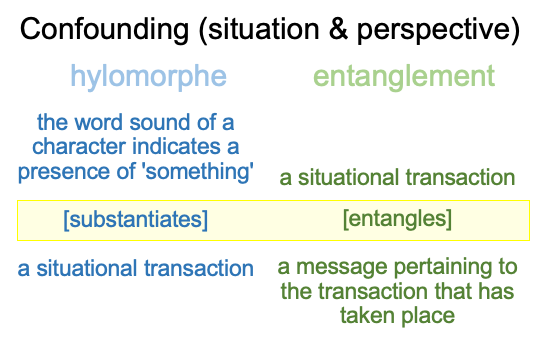
0027 What are these academics hoping for?
They hope that their activities further their academic careers. Their rimmed-bowls of citations carry the promise of security. Some call it “tenure”. Some call it a false hope amidst economic turmoil.
0028 At the end of the introduction, the authors elevate three “tensions”.
First (1), the theory of publishing to communicate results to other scholars clashes with the practical incentives to please hiring, promotion and granting committees.
Second (2), on one hand, papers are supposed to be presentations of knowledge. On the other hand, papers are products that publishing corporations leverage for profit. There is a price that the author (or the author’s institution) must pay in order to establish open access. Otherwise, the article goes behind a paywall.
Third (3), the academic must teach classes (and perform other pedagogical duties), which are not as valued (by the aforementioned committees) as productive (paper publishing) research.
0029 To me, by the end of the introduction, these young upcoming academics in archaeology articulate the same complaints as the corvee laborers during the Uruk period, saying (more or less), “We are compelled to labor in an exploitative system that extracts profits without compensation, restricts research results from the public and biases stories about the human past.”
0030 Biased stories?
Yeah, look at chapter 1 of Dr. D. Basak’s book, which could serve as a textbook for any classroom on the subject of Sumerian mythology, ancient civilizations, and the epic quest for the origins of humanity.
0031 Perhaps, a sense of humor is required in order to appreciate the following comparisons.
0032 Dr. D. Basak, in the introduction to Sumerian mythology, claims that folk in the Ubaid, Uruk and Sumerian Dynastic periods respond to the challenges and the opportunities posed by living in the land between the Tigris and Euphrates Rivers. They do so by building a system of canals to irrigate agricultural fields and to mitigate (to some extent) flooding by annual crests of the rivers. This requires labor and organization.
Jess Beck et al., in the introduction to a manifesto on academic publishing, responds to the challenges and the opportunities posed by living in the world of postmodern academics. They do so by entering into a publication arms-race that is riddled by three (already mentioned tensions).
0033 To me, the Uruk corvee laborer and the hard-working postmodern academic do not seem so different.
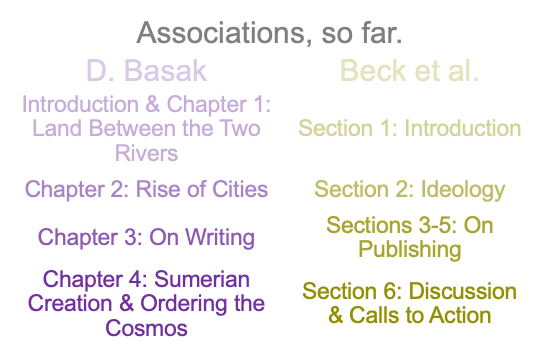
0034 Chapter 2 of Dr. D. Basak’s book concerns the rise of cities as the birth of the urban cosmos.
Section 2 of Jess Beck et al.’s essay concerns ideology.
0035 Coincidence?
Dr. Basak starts with the city as a divine idea. The city is not merely a place to live. The city allows humans to forge their identities and their relation with the divine.
Does Jess Beck et al.’s section on ideology resonate?
0036 These authors survive as specialists within the walls of a multiversity, which has one ideology in common among its multiple universes. Peer-reviewed publications are now an end in themselves. Broad dissemination of research results is not a primary goal. Citations are. Pity the academic whose publications languish behind corporate publisher paywalls. Pity the academic’s lack of pay, worries about getting a job in the field, and fears of the various gatekeepers (peer reviewers, editors, and so on, who may be better paid because they are one or more steps further up the “food chain”).
0037 Does that sound like life within the Uruk township?
The gatekeepers seem to be in charge. Every specialist works to exhaustion for the privilege of serving the gods (and making a living in the process).
0038 The Beckians (if I may so label the authors, using a word that no AI would concoct, except by hallucination) are not unaware. They tell a history… perhaps… a “fable” about the rise of the professional pre-publication review process. The process is a recent observable and measurable facet of a noumenon, the early modern journal, arising in Europe in the 1700s.
0039 Early on, every scholar was allowed to submit. Some were more invited than others, of course. Lots of crazy ideas go into print. The gatekeepers are friendly, since the journal is run among friends who are interested in the topics at hand.
0040 After the revolutions of 1848 and the legislation for American land-grant colleges, new systems devote themselves to progress (science) and higher education (promoting the best minds). These are “sold” as public goods. They tried to be meritocracies (hence, exclusive). They did so through mandarin-style testing.
Unfortunately, every system can be gamed.
0041 One benefit of the idea that the university is a public good is that academics could come from poorer families because professors get paid. The salaries are small, but tenure provides security. A poor professor with tenure has more academic freedom than a rich specialist in a modern corporation. This explains why the tenure system is a target of corruption and competition, just like any occupation serving the gods within the township of Eridu or Ur or Nippur.
0042 The tenure system, like all systems, can be gamed. There is a distinction between competition and cheating. Standards become necessary. In 1915, the American Association of University Professors lay ground rules for modern tenure. The scholar… er… university teacher… needs to display recognized scholarship and research productivity. That translates into peer-reviewed publications and citations for the audit culture that comes decades later. Hiring, promotion and tenure is done by committee so that no one gets the blame for failing a candidate.
0043 Even worse, in the eyes of academic deans (who have guarantees greater than tenure), non-tenure track instructors are depersonalized units, serving as economic resources whose productivity and performance is to be rewarded by one scoop from a mass-produced bevel-rimmed bowl, just like during the Uruk archaeological period.
0044 Chapter 3 of Dr. D. Basak’s book concerns the invention of writing.
A grand cognitive leap takes three steps (E, F and G).
0045 At first (E), cuneiform ideograms, incised onto carefully prepared clay tablets, reported transactions, not unlike journal papers. Indeed, some early modern journals take the label “transactions”, such as the “Transactions of the Philological Society”. An ideogram presents an icon of its referent.
0046 According to Charles Peirce (1839-1914), an “icon” is a sign-relation whose sign-object is based on the principle of similarity, imagery and so forth. An “index” is a sign-relation whose sign-object is based on the principle of contiguity, pointing, indication and so forth. A “symbol” is a sign-relation whose sign-object is based on the principle of habit, convention, rules, law and so forth.
0047 Later (F), the ideograms become indexes for spoken-word sounds. In comparison, journal publications become indexes of scholarly productivity to academic deans, whose appointments represent an elite standing above the tenured (or tenure-track) scholar.
0048 Beck et al.’s sections 3, 4 and 5 (Publishing Dynamics in North America, Publishing Pathways, and Publishing Dynamics in Latin America) discuss the transition from journal article as an icon (of research content) to an index (of academic productivity).
Was the transition inevitable?
Once the bureaucrat (like the cuneiform-writing scribe) realizes the indexal principle, then there is no return to the original configuration. Journal articles as indexes usurp (maybe, “re-organize”) journal articles as icons. Rules and guidelines abound in the use of indexes to grant tenure.
Finally (G), the icon and index are repackaged as a symbol representing a public good.
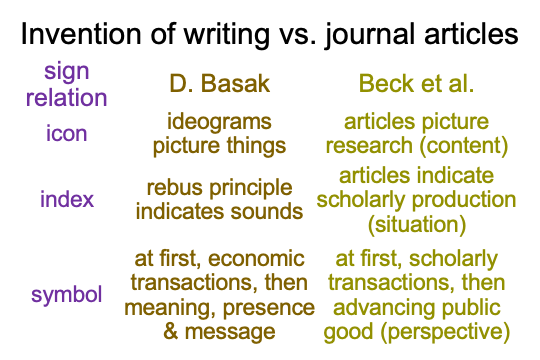
0049 Here is a diagram.
0050 Surely, the above comparison is not so far fetched.
The comparison says that both cuneiform and journal articles pass through distinct historical unfoldings. First and foremost, they are pictures of content. Then, they become indications, bound by rules and guidelines. Finally, these pictures (meanings) and indicators (presences) support a symbol (message). The unfolding engages content, situation and perspective.
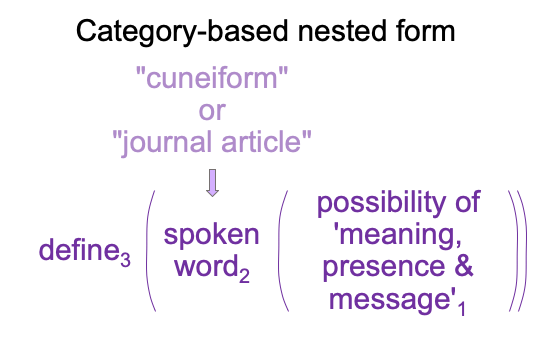
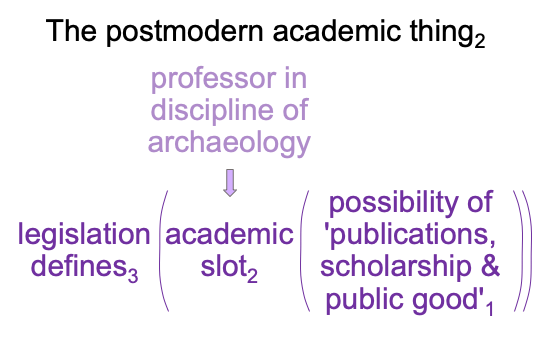
0051 The progression calls to my mind the category-based nested form corresponding to the definition of a spoken word, as presented at the opening of Razie Mah’s e-book, How To Define The Word “Religion”.
The normal context of definition3 brings the actuality of a spoken word2 into relation with the potential of ‘meaning (content), presence (situation) and message (perspective)’1.
0052 For chapter 3 of Dr. D. Basak’s book, the spoken term2 is “cuneiform writing”.
For sections 3, 4 and 5 of Beck et al., the spoken term2 is “journal article”.
0053 The comparison between the early chapters of a (potentially AI-generated) book and a cry from the heart of professional archaeologists early in their careers tells me that the emergence of new specializations during the Ubaid, Uruk and Early Dynastic periods in Sumer are similar to the historical emergence of professional archaeologists in modernity.
0054 I wonder whether the emergence of civilization in the land between the rivers millennia ago is really due to the opportunities and the dangers of the Tigris and Euphrates Rivers.
Could it be due to a dynamic still unfolding in history in the present day?
0055 Consider the two confoundings that seem to be embedded within the potential that underlies a definition of a spoken term1.
I take Basak’s treatment of cuneiform as the example. The reader can translate this into Beck et al.’s treatment of journal articles.
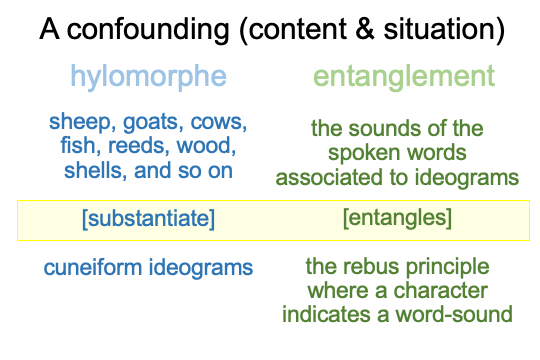
0056 A first confounding will resolve into the content and the situation levels of an interscope (a category-based nested form composed of category-based nested forms).
For the following hylomorphe, various things (as matter) substantiate cuneiform ideograms (as form). At the same time, the spoken words associated to the names of things (as form) entangle the rebus principle (as matter).
0057 A second confounding will resolve into the situation and the perspective levels of an interscope.
Again, the hylomorphe corresponds to the two real elements that characterize Peirce’s category of secondness.
For the following hylomorphe, the word-sound (in speech-alone talk) indicates the presence of ‘something’ (as matter) that substantiates the situation realness of a transaction (as form). Spoken words as content that are expected to be situated as transactions. Then, that situation-based transaction (as form) entangles a perspective-based message pertaining to the transaction that has taken place (as matter).
0058 For Beck et al. these confoundings indicate how vulnerable their occupations are, given what is stated in their own article. Not only are young experts in archaeology being crushed by competition within their own disciple (a publication arms-race corresponds to the situational transaction), but they also face the challenges of a new technology (represented by an individual or a special-interest using AI) that may harvest their articles in the privatization of a “public good”.
0059 Chapter 4 of Dr. D. Basak’s book is titled, “In the Beginning: Sumerian Creation and the Ordering of the Cosmos”.
Section 6 of Beck et al. is titled, “Discussion”. This section contains calls for action.
0060 So far, I have drawn the first three comparisons. I am about to consider the fourth.
0061 In the discussion, Beck et al. note that demands for ever-increasing academic productivity yield decreasing research quality and professional satisfaction. A system founded on uncompensated labor is not inevitable, sustainable or effectual. A re-alignment is necessary.
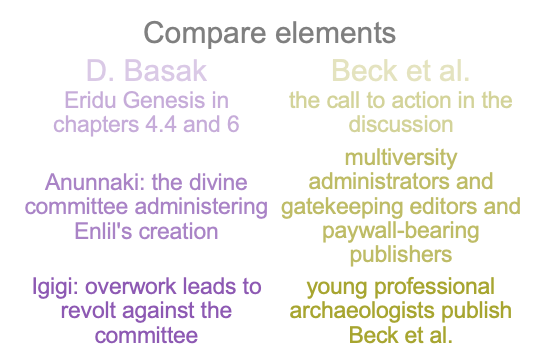
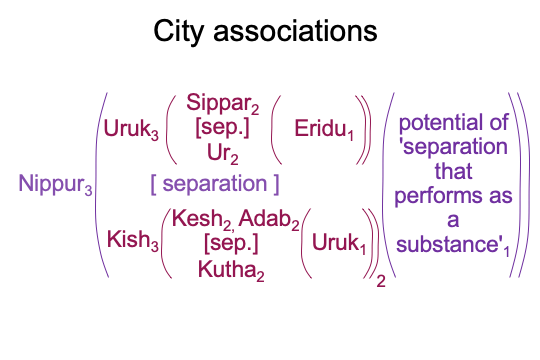
Basak’s chapter 4.4 reports on an amazing cuneiform tablet found in 1893 in the holy city of Nippur by an expedition from the University of Pennsylvania. Translated in 1912 by Assyriologist Arno Poebel (1881-1958), the story is now called “The Eridu Genesis”. The cuneiform dates to around 1600 BCE. But, the oral tradition is undoubtedly older.
0062 The Eridu Genesis frames the creation of humanity as a clever solution to a labor dispute among the gods. The topic is covered in chapters 4 and 6 of Basak’s text.
0063 The senior gods (the Anunnaki, but also administrators of postmodern universities) and the junior gods (the Igigi, but also the post-docs, visiting professors, instructors, and tenure-track faculty) are not getting along. The Igigi are tasked with the maintenance of the cosmos (or one discipline in a multiversity). They are overworked (in precisely the same manner as early-career professional archaeologists).
The Igigi rebel.
0064 The labor dispute ends up locking down Enlil’s cosmos (multiversity). Enlil is the god of the storm. The present cosmos is created when Enlil separates his father (An, the sky) and his mother (Ki, the earth) and establishes his own jurisdiction (the air).
I suppose that the Igigi come around to fill in the empty slots created by Enlil’s system, just as scholars filled in the academic slots created by the post-1848 and land-grant universities. These are the universities that situate the potential of ‘public good’.
0065 Here is a picture.
0066 Around one orbit of Neptune later (165 years), young professional archaeologists are the Igigi. University administrators and publishing houses are the Anunnaki. The solution in the Sumerian myth comes from Enki’s suggestion that the gods fashion humans in order to do the Igigi’s work. Then, the Igigi can rest on their laurels (sort of like tenured faculty) while the humans do all the labor required to keep Enlil’s cosmos working properly.
0067 Enki is the god of subterranean flows, especially spring water. Whenever fresh water flows, Enki is present. So, Enki is in the annual crests of the rivers and in the canals and dikes that control these turbulent flows. Enki is in the freshwater springs that can be found in brackish waters. After rains fall on distant mountains, the waters enter Enki’s domains.
0068 Humans are created to do the work of the overtaxed Igigi.
0068 Who is going to be created to do the work of the over-burdened young professional archaeologists?
A clue comes from the elaborate Table 3, consisting of one and one-third pages, in Beck et al.’s discussion. The table covers the potential consequences of three levels of engagement between a researcher and mass media.
0070 If the labor problem concerns the difficulties for advancement that arise when young archaeologists are compelled to publish in peer-reviewed journals that restrict public views behind a paywall, then a new specialization (corresponding to the creatures that Enki proposes to ease the working conditions of the Igigi who are compelled to satisfy the administrating Anunnaki) should be fashioned out of clay from the Abzu, the primordial freshwater abyss of opportunity in a world of unconstrained social complexity.
0071 Always read paragraphs by ignoring the parentheses, then consider the same paragraph with the parenthetical statements.
0072 In this fusion of ancient and postmodern solutions, Ninmah (an earth goddess) shapes a figure, using a creative mold, corresponding to the new human who will bear the burden of the Igigi’s difficulties.
Who are these humans?
0073 In the Sumerian myth, the humans who are created to do the work of the Igigi are called “lullu”.
For the postmodern version, can the reader guess who the lullu are?
0075 Meanwhile, I doubt whether any of the commentators of the article in Current Anthropology know that Dr. D. Basak has scooped information from publicly available internet sources, therefore performing a function similar to podcasting. Unfortunately, many of Basak’s references are from Wikipedia and other collating on-line venues, rather than from actual researchers.
0076 The lullu podcasters will solve that defect.
All twenty-three researchers who contribute the Beck’s manifesto should network with podcasters who are (1) interested in the material, (2) humble and (3) willing to ask questions.
0077 A comment by Aja M. Lans is on target in this regard, questioning whether multiversities are “public goods”. The term, “public good”, sends a message. The multiversity deserves sovereign support. The sovereign supports the Anunnaki-level administrators, not the Igigi-level yet-to-be-tenured faculty.
If the label, “public good”, acts as a thesis, and if “the Anunnaki-level administrators who claim that their institutions serve the public good” operate as an antithesis, then, as long as the potential for a synthesis is subverted, the status quo will remain.
Something will break. The Igigi will rebel. But, does that bring the synthesis out of the realm of possibility?
0078 Shall we ask Enki?
Is Ninmah available to fashion the podcaster, who will do the heavy labor of interviewing the young professional archaeologists?
The podcasters will be the humans that sustain a world where the Igigi can do what they really want to do: research into the origins of humanity.
0079 In sum, the mythic structures of the ancient Eridu Genesis and a recent (2026) publication concerning academic publishing in archaeology are not only similar, but the comparison allows this examiner to make a prediction. As soon as podcasters fill the role of the newly created lullu, then the nature of professional academic archaeology will transform.
0080 Here is a comparison of mythic and dramatic elements.
0081 This type of comparison of mythic structures is integral to chapter 1 of Razie Mah’s fiction, titled An Archaeology of the Fall. The Sumerian myth of world creation can be compared to the founding of the United States of America. I call the Sumerian creation myth, “the differentiation of Nammu”. This myth is discussed in chapters 4 and 5 of Basak’s book.
Chapters 4 and 5 of Basak’s book present Sumerian origin myths of the world and of humans. These myths are recorded in cuneiform tablets recovered by archaeologists. It is amazing that the tablets survived.
0083 I start with the world.
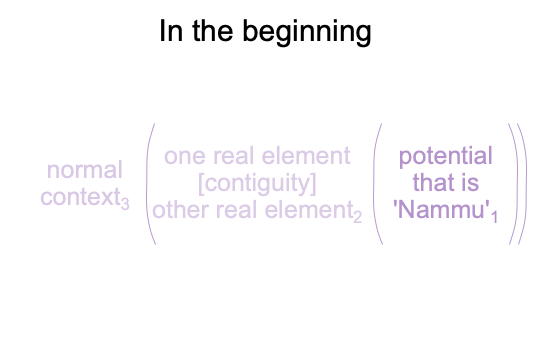
In the beginning, Nammu is the uncreated oneness.
Oneness describes Peirce’s category of firstness. Firstness is the realm of possibility.
0084 According to Peirce, all existence can be portrayed in terms of three categories. He names the categories on the basis of the number of elements. Thirdness has three. Secondness has two. Firstness has one. Each category exhibits its own logic. Thirdness follows the logics of exclusion, complement and alignment. Secondness exhibits the logics of contradiction and noncontradiction. Firstness is inclusive and allows contradictions. Finally, each higher-level category prescinds from the adjacent lower category. Thirdness prescinds from secondness. Secondness prescinds from firstness.
0085 The category-based nested form is one of the simplest examples of thirdness.
Thirdness bring secondness into relation with firstness.
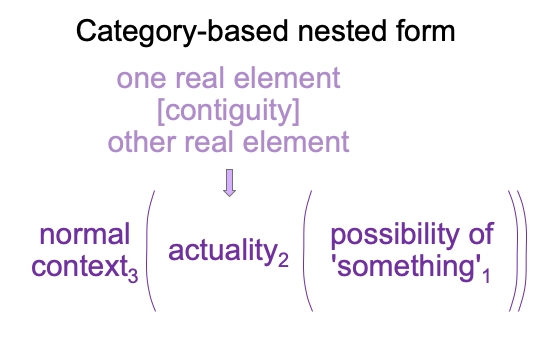
A triadic normal context3 brings a dyadic actuality2 into relation with the possibility of ‘something’1.
Here is a picture.
0086 To me, Nammu, the undifferentiated god at the start of the Sumerian origin myth, corresponds to firstness.
Here is a diagram.
0087 The Sumerian creation story continues.
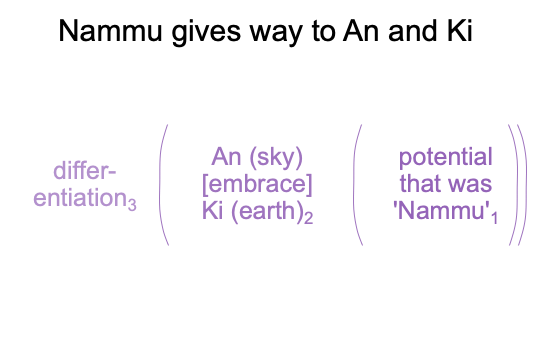
Nammu differentiates into two real elements, An (a male principle and the waters above) and Ki (a female principle and the waters below). These occupy the slot for actuality2 when the normal context is differentiation3. They embody a principle of duality, undergird by the lingering unity of Nammu, from which they came. The contiguity between An and Ki bears the label “embrace”.
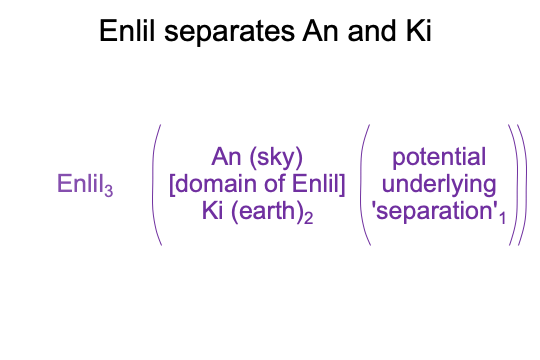
0088 Then, An and Ki conceive. Ki gives birth to Enlil. Enlil goes about separating his parents.
[Embrace] gives way to [the domain of Enlil].
0089 Here is a picture.
0090 An2 associates with the celestial domain.
Ki2 associates with the mundane domain.
Enlil’s domain2 is the contiguity between heaven and earth.
0091 I ask, “Does this sound like a nested form that is ’caused’ by living in the fertile land between two capricious, creative and destructive rivers?”
Or, does this look like something that anthropologists have never looked at before?
0092 Enlil2 is the god of the air, as well as the storm. His realm is pure substance, standing between the fixed domains that people can picture and point to, the sky (An) and the earth (Ki).
Does that substance have anything to do with rivers or land or anything material?
Or does that substance entangle rivers and land and grain and clay and all sorts of materials?
0093 How can separation, as a potential, empower Enlil’s domain which a substance in the realm of actuality?
0095 The potential of ‘a separation that performs as a substance’1 supports further differentiation.
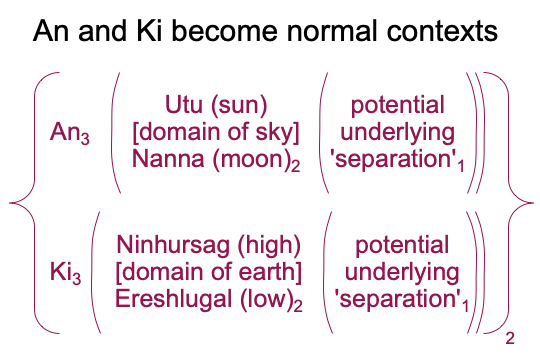
An (the sky)2 becomes the normal context3 for Utu (the sun)2 and the Nanna (the moon)2 who arise from the potential of ‘separation as a substance’1.
Ki (the earth)2 becomes the normal context for Ninhursag (the mountains)2 and Ereshlugal (the underworld)2 who arise from the potential of ‘separation as a substance’1.
0096 Of course, Sumerian mythology does not describe the creation of minor gods in precisely this way. So, I extrapolate from the origin myth at hand.
Here is a picture.
0096 [The domain of sky] is the substance that arises from a celestial potential of ‘a separation that performs as a substance’1.
0097 I ask, “What domain of the sky somehow captures a celestial phenomenon that associates to ‘a separation that performs as a substance’1?”
Is rain a good candidate?
Rain falls from the domain of the sky to the earth where it enters into domains associated to the trickster god, Enki. Enki is the god of freshwater that flows in streams and in underground passages that come to the surface as springs. All that underground fresh water is called “the Abzu”.
0098 [The domain of earth] is the substance that arises from a mundane potential of ‘a separation that performs as a substance’1.
0099 I ask, “What domain of the earth captures mundane phenomena that associate to ‘a separation that performs as a substance’1?”
Is fertility a good candidate? What about competition? What about the pursuit of love? What about grasping for power?
Perhaps, I may consider the goddess, Inanna, as the personification of ‘a separation that performs a substance’1.
Innana is the goddess of love and war. To me, that designation sounds like the two extremes of earthy, organic desire. Humans are animals, after all.
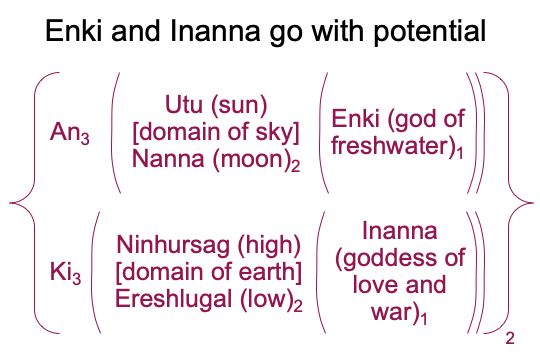
0100 In brief, I associate An2 and Ki2 to normal contexts3 dwelling within the actuality2 of Enlil3. Further, I associate the potentials1 underlying An3(2) and Ki3(2), to Enki (the god of freshwater and the Abzu) and Inanna (the goddess who drives people together and drives people apart). Enki1(2) and Innana1(2) label potentials that reside in the realm of Enlil3‘s actuality2.
0101 Here is a diagram of the actuality2. The overall normal context is Enlil3. The potential1 is ‘a separation that empowers a substance’ or ‘a separation that performs as a substance’ or ‘a separation in potential that supports a substance in actuality’.
0102 An3, the sky god, belongs to the realm of actuality in Enlil’s nested form, yet serves as a normal context3 that is separated from Ki3, the earth goddess. The separation of An3 and Ki3 is not pictured in the above figure. [Separation] is the contiguity between these two gods. [Separation] is the substance of Enlil’s domain.
0103 Four gods belong to the realm of actuality in the normal contexts of An3 and Ki3.
Utu, the god of the sun, is separate from Nanna, the goddess of the moon. That separation is like a substance, belonging to the domain of the sky.
Ninhursag, the goddess of the mountains and other highlands, is separate from Ereshlugal, the goddess of underground places, including the resting place of the dead. The separation is like a substance, belonging to the domain of the earth.
0104 Two gods belong to the realm of potential within the actuality in Enlil’s nested form.
0105 Enki is the god of fresh water in streams and running underground.
Why do I associate him with the potential underlying Utu2 (the sun) and Nanna2 (the moon)?
The freshwater in streams and underground waterways comes from rain. Rain occurs when the sun and the moon are not visible. They are behind clouds. When the sun and moon are visible, then there is no rain. Rain is fresh water. The fresh waters are in motion, on land in streams and under land in passageways leading to springs.
Of course, my association is counter-intuitive. The logic of actuality2 is that of contradiction and non-contradiction. The logic of actuality applies to Utu and Nanna. The logics of possibility1 are counterintuitive. Firstness allows contradictions and is inclusive. We can see by the lights of Utu and Nanna. But, we cannot drink their sky-water. Their sky-water must come to earth.
Enki is like a substance that supports a separation in the domain of the sky.
0106 Innana is the goddess of love and war.
To me, a goddess that represents such a direct contradiction must belong to the category of firstness. I have two options. Enki goes with the sky. So, Innana goes with the earth.
Innana potentiates the gods of the earth, Ninhursag (the goddess of highland places) and Ereshlugal (the goddess of underground places). Why would the goddess of love and war pertain to the mountains and the caverns? Perhaps, love and war reflect desire and desire is what makes mountains (out of molehills) and pitfalls (out of stumbles).
Innana is like a substance that supports a separation in the domain of the earth.
0107 These associations in the category of firstness are highly speculative.
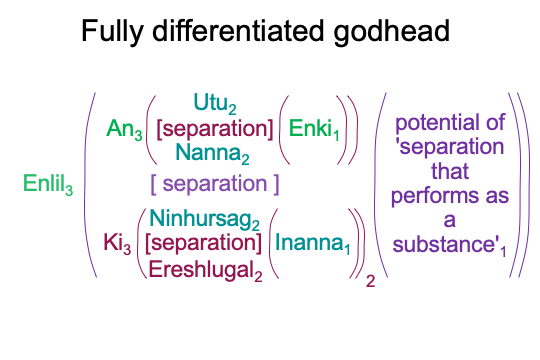
The fact that Enlil’s actuality2 consists of two category-based nested forms suggests a highly differentiated godhead. The only potential that is not labeled is the potential1 underlying Enlil3, which is the potential1 that ‘a separation can serve as a substance’. This potential1 is inverted in the potentials that I associate to Enki1(2) and Innana1(2).
0108 Enki1 labels a substance that has the potential of separation from the sky. That substance is rainwater.
Innana1 labels a substance that separates from the earth, yet is as grand as the mountains and as dangerous as the underground. We (humans) are grounded in desire.
0109 The only spot that does not contain the label for a god is the potential1 underlying Enlil3.
Otherwise, there is a god labeling every slot of a fully differentiated godhead. How many generations does it take to reach this level of inferential expression? That is a good question.
For now, here is a diagram of the fully differentiated godhead, containing the original members of the divine council, called the “Anunnaki” by the Akkadians.
0110 The three big name gods are in green. The remaining four lesser name gods are in blue-green. Notably, Ki3 and Ereshlugal2 are out of the Anunnaki club. Ki3‘s appears to hybridize with Ninhursag2 within the name of Ninmah3(2). Ereshlugal2 eventually becomes queen of the underworld.
0111 Are there any clues that support these associations?
0112 Let me first look for a clue in the heavens.
0113 I asked google-based AI to search for an article about the Sumerian gods and celestial beings. It came up with a work by Enn Kasak and Raul Veede titled “Understanding Planets in Ancient Mesopotamia”. The article appears in the electronic journal, Folklore (vol. 26 (2001) doi: 10.7592/FEJF2001.16.planets). The search software even offered an AI summary.
Planetary assignments are not always clear, since the systematic observations of the heavens is not standardized among the competing city-states for the longest time. Also, associations change over time. Some planets are very apparent to the naked eye (Mercury, Venus, Mars, and Jupiter) and some are less so (Saturn).
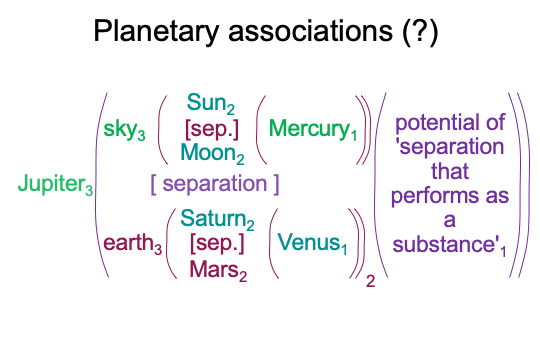
0114 Kasak and Veede offer a Table 2 that is geared to the Sumerian period from 3500 to 2300 BC. My reproduction of the table is not accurate, in so far as I substituted Enki and Ninhursag for Sumerian gods that Dr. D. Basak does not mention. These gods are Simut for Mars and Ninurta for Saturn.
With that said, here are my associations.
0115 Once again, these associations are speculative. They show that this godhead differentiated sometime before the Sumerian Dynastic. Each god is distinct enough to associate to a wandering star (more or less). Plus, the association of Enlil3 with Jupiter3 is astrologically appropriate and historically associates to the lead god of a pantheon.
0116 Another match comes from chapters 0 and 5 from Basak’s text. Each Sumerian city associates to a god.
0117 The holy city of Nippur3 associates with Enlil3. The first city is Eridu1, associating to Enki1. The dual-affiliated city of Uruk3and1 associates to An3 (one district) and Inanna1 (another district).