06/8/21

Looking at Kirk Kanzelberger’s Essay (2020) “Reality and the Meaning of Evil” (Part 16 of 18)

0063 What is the catch?

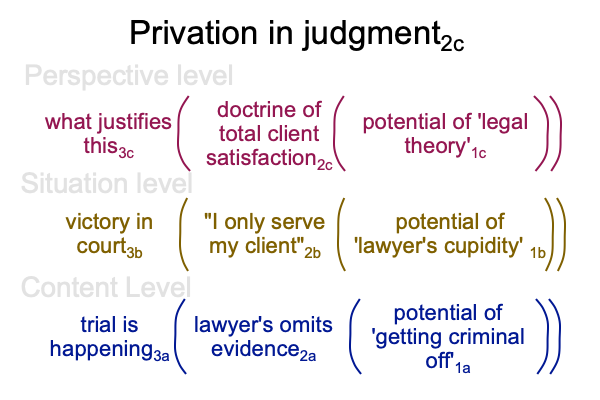
Alternate legal theories2c cannot endure in the absence of the original truth of justice1c.  There are two types of immoral actors.  The practitioners of concupiscence2b, like crooked lawyers, struggle with self-justification1c.  The self-justified2c, like opportunistic legal theorists, strain to defy right reason and divine law1c.  They offer better alternatives2c.  They3coffer them2c in droves.  A multitude of alternatives2c swarm with betterness.

Kanzelberger writes, “Purposeful evil is not a matter of ignoring the moral context of courses of action, but a semiotic disorder involving… a fictive construction… that functions as… an imagined future.”

0064 You mean, like that approaching cloud of legal locusts?

Imagine a world where the rule of reason2c and the divine laws1c are partially, then totally, eclipsed by a swarm of organizational objectives2c, each declaring its own righteousness1c, each supported by its own theoretical imperatives1c and each relying on the power of the state to enforce its dictates.

Imagine a world where certain words1a are made flesh2a, and this winged flesh2a fills the air with what is happening3a, so that all things and events2a actualize theory-distorted subjectivities1a.  

Imagine a world where our phantasms2b are not grounded in truth, but in the projection of meaning2b into once truth-filled speech-alone words2a.

0065 Surely, we have eaten from the tree of the knowledge of good an evil.

Like locusts.

There will be hell to pay.

06/7/21

Looking at Kirk Kanzelberger’s Essay (2020) “Reality and the Meaning of Evil” (Part 17 of 18)

0066 Kanzelberger writes, “Moral evil is a dark image.  It weaves a web that bewitches its author, then ensnares others.”

But, the author and the ensnared do not necessarily stand on the same level.

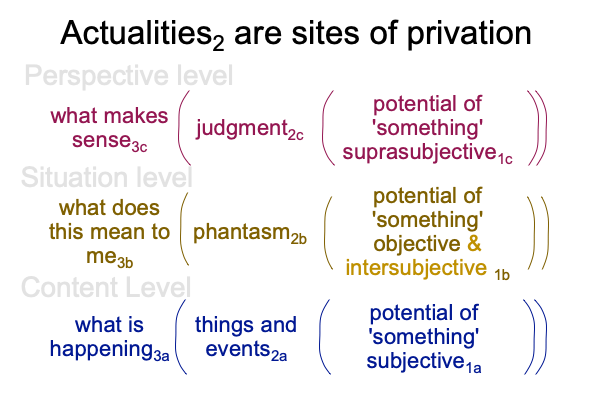
0067 Natural evil makes no sense.  Natural evil is privation of the subject.

Moral evil makes sense.  Moral evil is privation in phantasms.  We selectively use word-symbols deprived of their fullness.  We seek agreement1a, not wisdom1c.

Metaphysical evil defies moral sense, by willfully projecting its own relations between what is and what ought to be2c, into spoken words2a, which cannot image or indicate on their own.

0068 Imagine a nest, full of duly-appointed avian-philic crooked lawyers, passing a law decreeing the latest innovation of their premier legal theorist.  All cats are to be banished from the sovereign realm, because they are symbols of human maliciousness and cruelty.

Here is a brood worthy of Kanzelberger’s philosophical consideration.

06/6/21

Looking at Kirk Kanzelberger’s Essay (2020) “Reality and the Meaning of Evil” (Part 18 of 18)

0069 Kirk Kanzelberger joins Thomas Aquinas with a basic acknowledgment: Evil is a privation of a good.

He then considers natural and moral evil.

In moral evil, he locates a semiotic disorder, in addition to a privation.

He considers the nature of the sign, as formulated by Charles Peirce.

0070 He publishes his argument in a journal worthy of the reader’s support.

Reality: A Journal for Philosophical Discourse

0071 My comments are not so different.  They thread through both Peirce and Poinsot.  They pass through the two loops brought to light by John Deely.

Yet, the are different, in that they offer diagrams based on Peirce’s categories.

0072 Typically, Razie Mah’s comments are published in the smashwords website and carried by a variety of e-book vendors.

Start with A Primer on the Category-Based Nested Form.

Add A Primer on Sensible and Social Construction.

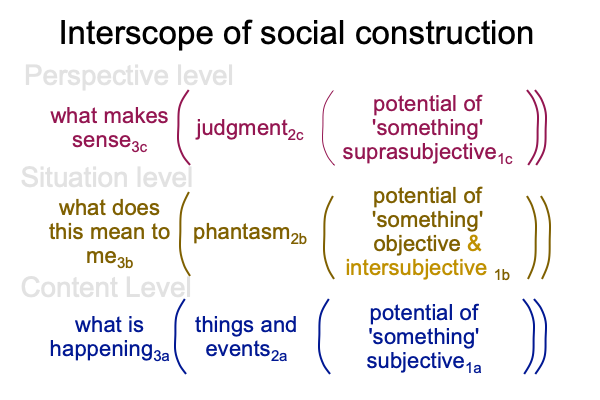
That is all that is needed to introduce oneself to the interscope of social construction.

Figure 09

0073 The three-level interscope appears in the chapter on meaning in the masterwork, How To Define the Word “Religion”.

The three-level interscope plays a role in A Primer on the Individual In Community.

The three-level interscope serves as a model of langue, in Comments on Robert Berwick and Noam Chomsky’s Book (2016) Why Only Us: Language and Evolution.

0074 All these works are available at the smashwords website.

So concludes this look at Kanzelberger’s foray into both Aquinas and Peirce, concerning reality and the nature of privation.

Look to Reality.

God bless.

03/25/21

Looking at Daniel Turbon’s Article (2020) “…Human Being in Evolution” (Part 1 of 11)

0001 Daniel Turbon, hailing from the University of Barcelona, publishes an article in the journal, Scientia et Fides(8(2)/2020, pages 65-94).   The essay is available online.  The full title is “The Distinctive Character of the Human Being in Evolution”.  I place only the second focus in the header of my comments, while noting that the first character cannot be ignored.

0002 When I look at this essay, what do I see?

Does the title translate into a category-based nested form?

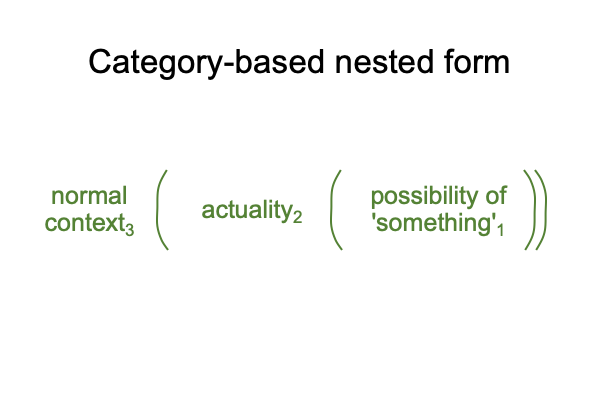
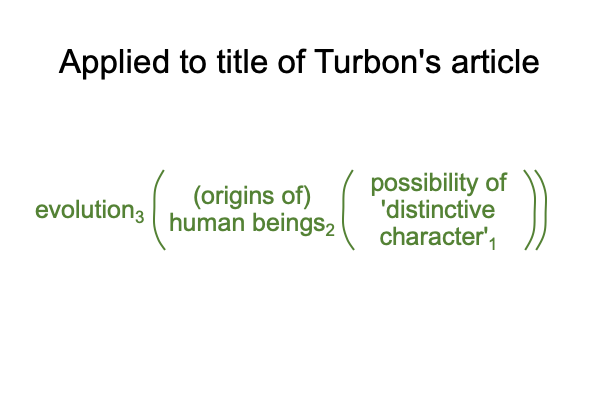
Here is a diagram, following the script in A Primer on the Category-Based Nested Form.


Figure 1

0003 Each of the above terms constitute an empty slot.

So, I ask, “How would words in the entire title correspond to the above empty slots?”

My answer is necessarily both speculative and synthetic.

The normal context3 is evolution3.

The actuality2 is (the origin of) human beings2.

The potential1 is a distinctive character1.

0004 The resulting application looks like this.

Figure 2

0005 The category-based nested form contains four statements.  The fourth is paradigmatic: The normal context of evolution3 brings the actuality of the origin of the human being2 into relation with the potential of a distinctive character1.

When I read the title of Daniel Turbon’s article, this is what I see.

03/24/21

Looking at Daniel Turbon’s Article (2020) “…Human Being in Evolution” (Part 2 of 11)

0006 From the prior blog, I know that evolution3 is the normal context for Turbon’s article.  The logics of the normal context include exclusion, complement and alignment.  One normal context will tend to exclude, complement or align with another.

Turbon’s abstract ends with a plea that is not re-iterated in the body of the article.  As scientists labor to “cook up” human natural history, they must strive to ensure that the essence of human evolution does not become “indigestible”.

0007 What on earth does this mean?

Do humans evolve to grasp metaphors?

Or, do humans adapt into the niche of grasping essentials?

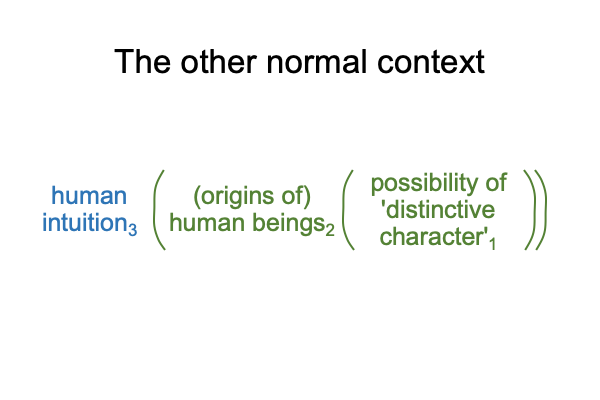
0008 Does scientific inquiry into our natural history3 exclude human intuition3?

Of course it3 does.

A simple substitution shows as much, as shown below.

Figure 3

0008 To me, the crux of Daniel Turbon’s entire article is captured by the last sentence of the abstract.The normal context of human intuition3 (guided by philosophy) ought to be able to digest what the normal context of evolution3 (guided by science) provides.

03/23/21

Looking at Daniel Turbon’s Article (2020) “…Human Being in Evolution” (Part 3 of 11)

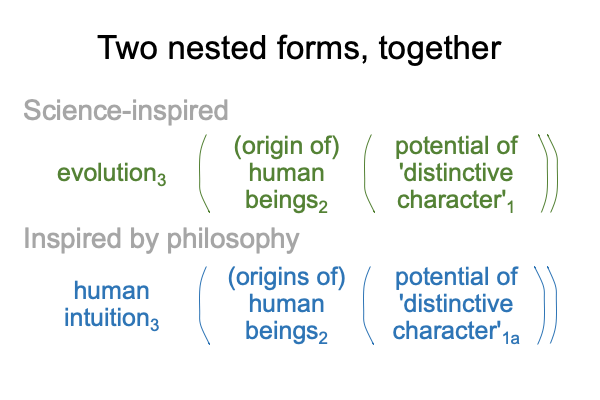
0009 The last sentence of Turbon’s abstract presents the crux, the point and the inspiration for the entire article.  Two category-based nested forms stand side by side.  The question now becomes, “Do these normal contexts exclude, complement or align?”

0010 Here they are.

Figure 4

0011 They look like the same cards of different suites, say clubs and hearts.

Can clubs exclude hearts?

0012 Clearly, Turbon does not publish an essay in the journal, Scientia et Fides, in order to support exclusion.  Exclusion is already in the cards.  The deck is stacked.  Science excludes human intuition.

Why is this so?

0013 One reason is formulated in Comments on Jacques Maritain’s Book (1935) Natural Philosophy.  Scientific judgment relies on the positivist intellect.  The positivist intellect rules out metaphysics.  What is the advantage?  The rule assists in distinguishing a noumenon from its phenomena.  Phenomena are subject to empirio-schematic judgments. Their noumenon is not.

0014 Science measures, models and discusses phenomena, the observable facets of a thing.

Philosophy guides inquiry into the thing itself, the noumenon.

Consequently, a noumenon cannot be objectified as its phenomena.

Yet, a noumenon is necessary for phenomena to exist.

0015 So, exclusion is not in the cards.  What about complement?

Clubs and hearts are suites with similar cards.  They complement one another.  They exist in the same deck.  But, if clubs are like science and hearts are like philosophy, and if science focuses on phenomena and philosophy explores their noumenon, then what about the contiguity?

The contiguity between a noumenon and its phenomena is “cannot be objectified as”.

Clubs cannot be objectified as hearts.

Philosophy cannot be objectified as science.

Is this what Turbon aims to tell the reader?

I don’t think so.

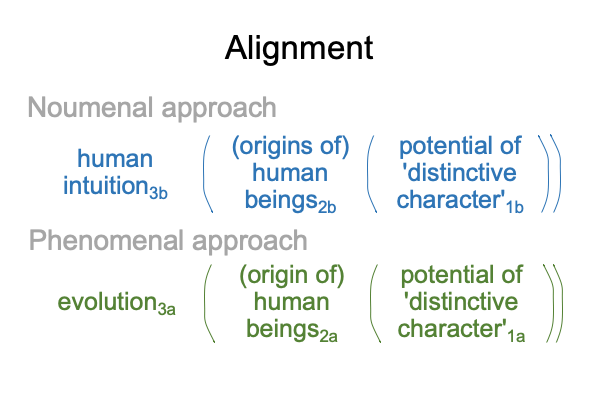
0016 Intuition3 and evolution3 cannot exclude or complement one another.  So, they must align.

This is Turbon’s deal.

03/22/21

Looking at Daniel Turbon’s Article (2020) “…Human Being in Evolution” (Part 4 of 11)

0017 In alignment, two category-based nested forms generate a two-level interscope.

Before rushing headlong into that fact, I want to pause to appreciate another aspect of Peirce’s philosophy: the category of secondness.

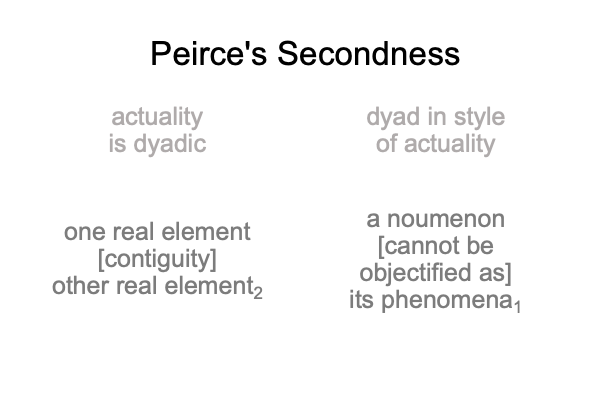
Peirce’s secondness is the realm of actuality.  Actuality consists in two contiguous real elements.  It2 may be written: one real element [contiguity] other real element.

0018 Cause and effect is one expression of this contiguity.  “Causality” is what most envision as the contiguity between any two real elements.  The dyad, cause [contiguity] effect, exhibits the logic of noncontradiction.  If nothing else, real causes do not contradict their real effects.

However, even though we (humans) typically (an perhaps, innately) anticipate causality to present itself as a dyadic actuality, one wonders what happens when two elements are juxtaposed in a speculative fashion.  This is an old philosophical problem.  Nothing demonstrates it as well as the contiguity between a noumenon and its phenomena.

Figure 5

0019 A noumenon is a thing itself.

Phenomena are observable and measurable facets of the thing.

Actuality2 is dyadic.  So is the contiguity between a noumenon and its phenomena.  But, obviously the word “not” presents a problem, casting the dyad into the realm of possibility, which exhibits the logics of inclusion and befuddlement.  Phenomena cannot exist without a noumenon.  Yet, they cannot objectify that noumenon.

Many of the causalities in evolutionary science are dyads in the style of actuality, because the contiguity is speculative.

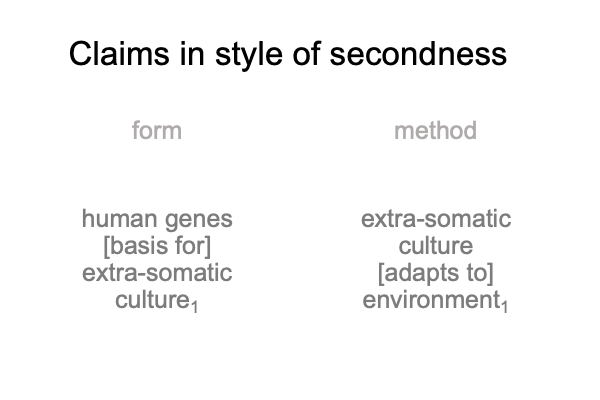
0020 For example, Turbon states that human genes form the basis of extra-somatic culture and extra-somatic culture is an effective method for adapting to the environment.  Here is a picture of these two speculations.

Figure 6

0021 Does this observation, that Turbon’s causal chains follow the style of secondness, assist in figuring out the alignment between philosophy and science?

Surely, the observation suggests that philosophy situates science.So, if the two nested forms combine into a two-level interscope, following the script of A Primer on Sensible and Social Construction, then noumenon-oriented philosophy should situate phenomena-oriented science.

03/20/21

Looking at Daniel Turbon’s Article (2020) “…Human Being in Evolution” (Part 5 of 11)

0022  From the prior blogs, I arrive at a two-level interscope.

0023 The crux of Turbon’s article resides in the last sentence of the abstract.

Whatever2a makes humans distinctive1a in the normal context of evolution3a should be “digestible” by whatever2b makes humans distinctive1b in the normal context of our own intuition3b.

0024 Turbon’s appeal fails when evolution3 excludes intuition3.

Turbon’s appeal will succeed when evolution3a and intuition3b align.

0025 In order to be “digestible”, scientific origins of human beings2a ought to be capable of being virtually situated by a coherent origins2b, arising from the potential of ‘something distinctive’1b, in the normal context of human intuition3b.

What disciplines guide human intuition3b?

Philosophy and theology.

03/19/21

Looking at Daniel Turbon’s Article (2020) “…Human Being in Evolution” (Part 6 of 11)

0026 I now make a slight adjustment to the previous two-level interscope.  I replace the content-level “character” with the scientific term, “adaptation.

Here is a diagram of the result.

Figure 8

0027 In the realm of possibility, ‘something distinctive’1b virtually situates ‘distinctive adaptations’1a.

 I do not find a ‘distinctive something’1b in Turbon’s article.

Instead, I find a litany of ‘distinctive adaptations’1a.

0028 I examine section one, titled “The Essentials of the Evolution of Humankind”.  The section opens with a question, asking, “How can the technological and scientific output of different modern peoples be explained?”

Surely, that is a historical question.

0029 What about the time before history?

What about earlier species in the Homo genus?

For 700,000 years, australopithecines and early Homo used Oldewan stone tools.  Then, for 1,000,000 years, middle Homo erectus used Acheulean stone tools.  Finally, around 500,000 years ago, late Homo heidelbergensis and later, Homo neadertalis used more sophisticated suites of stone tools, again for a very long time.  Around 100,000 years ago, stone tools become very sophisticated and the Upper Paleolithic Revolution dawns.  The Upper Paleolithic associates to anatomically modern humans.

0030 Ah, that sounds more like an essential.  Stone tool use must be a distinctive adaptation1a.

Here is where Turbon introduces the two previously-noted dyads in the style of actuality.

Figure 9

0031 Stone tools belong to extra-somatic culture.   Plus, stone tools are adaptive.  Stone tools allow humans to do activities that they otherwise could not.

Changes in human genetics must have facilitated a mind and a body that are capable of manufacturing and using stone tools.  However, the facilitation takes many, many generations, suggesting that stone tool use was one of many clever survival techniques practiced by Homo habilis, “handy man”, and other members of the Homo genus.

0032 So, I wonder, “Do all these clever survival techniques, these extra-somatic adaptations, have ‘something distinctive’ in common?”

03/18/21

Looking at Daniel Turbon’s Article (2020) “…Human Being in Evolution” (Part 7 of 11)

0033 The last blog adds more nuance to the ongoing two-level interscope.

Figure 10

0034 Evolutionary scientists propose adaptations that solve problems in the Pleistocene environment.  Human genes somehow allow the phenotypes that carry these adaptations.

One adaptation is the use of Oldewan, then Acheulean, then more sophisticated stone tools.  This is not the only adaptation.  More on that later.

The body of Turbon’s article provides a litany of adaptations.

0035 In Section 1, hominins become smarter in general, with special intelligences mixed in.  So, a person can not only talk (which is smart) but knows a lot about something that is of interest (which is special intelligence).

Surely, both DNA and the environment of evolutionary adaptation, genetics and natural history, are relevant.  But, there is something more, as noted later in Turbon’s article, as well as in Comments on Steven Mithen’s Book (1996) Prehistory of Mind.

0035 In Section 2.1, language is an adaptation that increases adaptability.  

Here, Turbon refers to “language” as speech-alone talk.  Today, many evolutionary scientists acknowledge that it is difficult to formulate how language evolves in the milieu of speech.  However, as discussed in Comments on Robert Berwick and Noam Chomsky’s book (2016) Why only Us?  More likely, “language”, evolves in the milieu of hand talk.I continue Turbon’s list in the next blog.