0228 Of course, I am not finished with section four (4).
Why?
At the start of section four, the authors drop a highly technical linguistic term, “semasiology”, in their description of how some logical positivists in the Moscow Linguistic Circle want to build models of poetics based on material modes,such as phonology.
0229 Curiously, “semasiology” has a partner word, “onomasiology”.
Semasiology starts with a spoken word and asks, “What does this word mean?”
Onomasiology starts with a what… a meaning… and asks for the proper word.
0230 Now, if I were a gambler, I would say that onomasiology studies the ways of the situation-level actuality of the following two-level interscope.
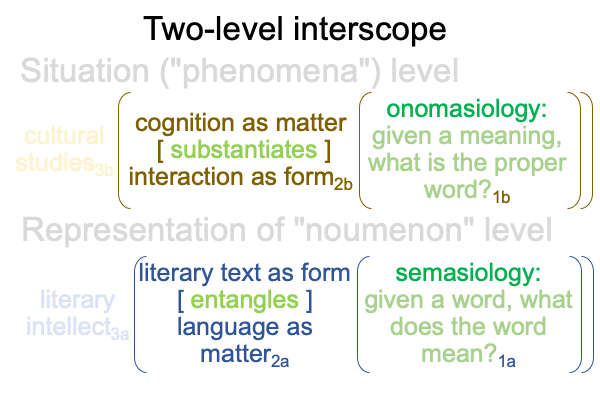
Of course, that means that semasiology studies the ways of the content-level actuality of the above two-level interscope.
0231 Semasiology, operating on the content-level, considers a word from a literary text and asks, “What does this word mean?”.
Given a parole2af, then what is its proper langue2am?
Does this apply to the instance where the fundament entangles the derivative?
The potential of meaning1a underlies the way that the form (or the written words) in a literary text2af [entangle] the matter of language2am in the normal context of the Tartu-Moscow School as an expression of the positivist intellect3a.
0232 On the content level, the contiguity between a literary text as form2af and a language of aesthetics as matter2am,is [entangled].
0233 What entity… er, possibility… might associate with [entanglement]?
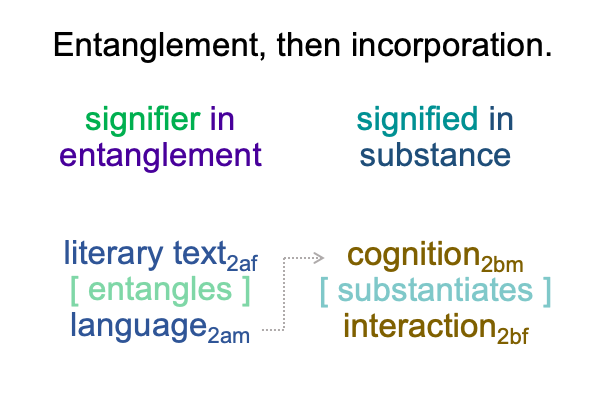
It seems like the answer would be, “The signifier.”
The signifier conjures a signified, in the form of spoken words in a language2am of aesthetic (perhaps, “normative”) meaning1a.
Does this apply to the instance where a fundament entangles its derivative?
Does that make any sense?
Or is this a bridge too far?
0234 What are the words2am that semasiology takes for given?
Given a positivist3a language2am, what do the written words2af mean?
I thought that what words mean corresponds to… um… langue2am.
Is that the same as language as matter2am?
0235 On the situation level, the contiguity between cognition as matter and social interaction as form2b is [substantiates].
Based on these assignments, language as matter2am is virtually situated by cognition as matter2bm.
0236 What does cognition as matter2bm [substantiate]?
Does social interaction2bf correspond to something like… ummm…. parole2af?
0237 Can onomasiology1b be inquiry into the ways that cognition as matter2bm [substantiates] cultural interactions as form2bf?
Especially, when the cultural interaction2bf involves speech2af.
If so, then onamasiology recapitulates the content-level of the fundament interscope.
Given a langue2am, then what is the proper parole2af?
Does that suggest that the presence1b underlying the actuality of cognition2am (in the derivative interscope) offers a cultural avenue to situate the possibility1a underlying language2a, as defined by Saussure as two arbitrarily related systems of differences3a (in the fundament interscope)?
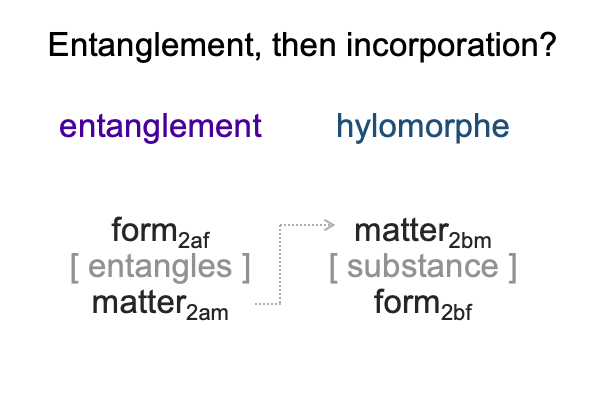
0238 As if to certify that the focus of inquiry shifts from structuralist things to cultural things2b, consider Aristotle’s hylomorphe and entanglement as exemplars of the Peirce’s category of secondness.
0239 Here is the general configuration.
0240 Here is this application.
0241 The study of cultural interactions3b virtually situates the science of appreciating the meaning of texts3a.