0242 The so-called “Prague Spring” (the Czech and Slovakian restlessness that inspires a Soviet (Russian) crackdown) sends ripples through the academic world. While some circles unwind, the Summer School at Tartu commences. The coordinators? Juri Lotman and fellow travelers are responsible. The waters of anxiety rise. The waters fall and there the TMS stands, an unexpected treasure box full of memories, unpublished works, and intellectuals with passports.
Some of those intellectuals port their way to outside the Soviet Empire.
0243 1968 is a fate-filled year.
Section five (5) concludes and six (6) begins on the construction of linguistic (and other academic) circles during this turbulence in the Slavic civilization. The authors mention many names. The names shift in and out of focus. These people do not portray the third paradigm-wave. They embody it.
In section six (6), the authors point out that Summer Schools at the Universities of Tartu and Tallinn continue to serve as an intermediary among Central Europe, Eastern Europe, and Russia, especially in the disciplines of Slavic Studies. The authors bewail the lack of historical research. For example, a comparative analysis of Polish, Russian and Estonian versions of semiology has never been undertaken. Also, correspondence has not been edited and published.
0244 Whether the Tartu-Moscow School of Semiology serves as the administration of an “invisible college” or as an actor in “The Soviet Empire of Signs” does not capture the issue.
Why?
Do these other approaches fail to take a transnational point of view? Do they neglect the sequence of battles among enlightenment gods? Do they miss the lesson that semiotics is history?
Or should I say… “history is semiotic”?
0245 The next black swan event occurs in 1989.
No, it is not the replacement of the word, “semiology”, by the term, “semiotics”, even though Saussure’s dyadic sign-configuration shifts into Peirce’s triadic sign-formula.
Yes, an event changes the map of Europe.
More on that, later.
0246 Section six (6) concludes by noting that the scholarly legacy of the Tartu-Moscow School of Semiotics is yet to be adequately described. The authors mention three issues in particular: Poldmae’s theory of verse (in section seven (7)), Mint’s interpretation of intertextuality (7) and Lotman’s concept of “semiosphere” (8).
0247 What is the historical riddle posed in section six (6), which covers the transition from Moscow and Prague linguistic circles to Summer School at the University of Tartu?
How does Juri Lotman and his collaborators negotiate the trauma of the events of 1968 when the perspective level of academic inquiry is something like the following?
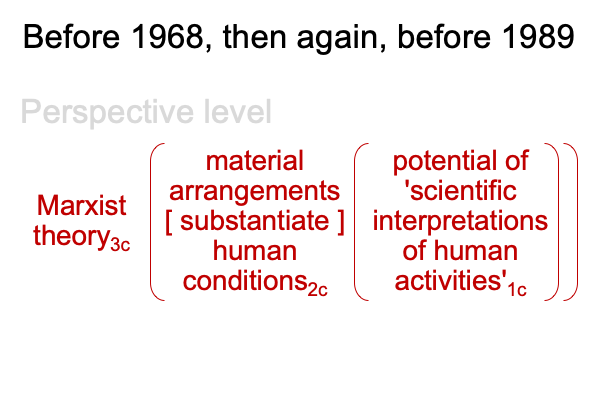
0248 In the triadic normal context of Marxist theory3c, the dyadic actuality of {material arrangements [substantiate] human conditions}2c emerges from (and situates) the potential of ‘scientific interpretations of human activities’1c.
0249 The answer may be strangely familiar.
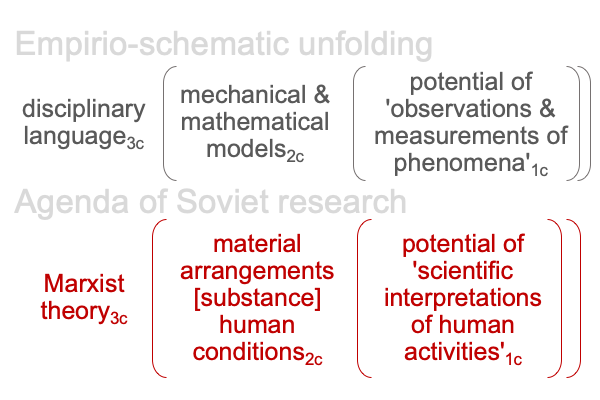
Compare this Soviet nested form to the unfolded empirio-schematic judgment, corresponding to what ought to be(secondness) in the Positivist’s judgment.
0250 What do I see?
I see almost exactly what the academic experts in Slavic civilization have been doing in the Soviet Socialist Union of Republics.
0251 Academics in Slavic Studies configure their models, not as mechanical and mathematical constructions devoid of formal and final causality, but as holistic Aristotelian hylomorphic structures, embedded within a category-based nested form.
Marxist theory3c also brings a hylomorphic structure2c into relation with the potential of ‘a scientific approach to cultural practices’1c. Plus, the term, “scientific”, indicates “not religious (no Christian faction)” rather than “no metaphysics (Aristotle’s formal and final causalities)”.
0252 Weirdly, this pattern also applies to the proliferation of specialized “sciences” in Western academies after the fall of the Soviet Union. Just supplant the term, “Marxist”, with whatever “ism” that seems to be the academic fashion of the day.
That includes “capitalism”, by the way, as well as “communism”.
0253 Marxist theory involves a technical vocabulary. This vocabulary confuses common folk, because familiar terms are given specialized definitions. Consider the word, “investment”. The meaning, presence and message underlying the word changes whether one is common folk, a capitalist or a socialist.
The capitalist thing2c is {oligarchal arrangements [substantiate] human conditions}.
In socialist thing2c, is {the arrangements of a coercive administrative state [substantiate] human conditions}.
0254 All “-ismist” theory3c requires book-learning. To speak the lingo appropriately, one needs academic certification. The process of acquiring academic certification weeds out those who fail to accept that {material (or oligarchic or bureaucratic) arrangements [substantiate] human conditions}2c. The losers trip on the fact that the positivist intellect exercises a rule. Metaphysics is not permitted. And, “metaphysics” now means “religious mumbo-jumbo”.
0255 The above actuality2c is not a mechanical or mathematical model2c, even though Marxist theoreticians attempt to frame their models by collecting and analyzing data. The reason? In order to collect observable and measurable facets of human history or civilization, one must… shall I say?… narrow the field of inquiry to… well, phenomena that can be observed and measured, which is really quite limited. For example, a survey brimming with multiple choice questionsor fill in the blanks does not do justice to the human experience.
Okay, “justice” is not the issue, here.
0256 For example, from what I heard, the rumor is… the closer that one lives to an electric transformer substation, the more likely one is to develop cancer.
0257 A secular academic may feed the statistical data into a materialist dyad2c that arises from the potential ‘scientific sounding interpretations of human activities’1c.
Then, that scholar may generate a scientific sounding explanation… er… “model” that can be used by other ideologically driven government authorities as an excuse to implement a policy regulating the distribution of electric substations in the interest of public health.