0216 Semiotics is history.
The article under examination celebrates the third wave of paradigms.
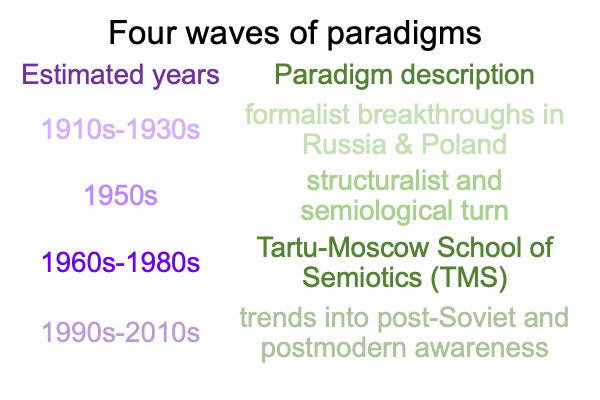
0217 Plus, the third period exhibits transits in several domains.
Soon after Lotman publishes in 1967, the Zeitgeist shifts.
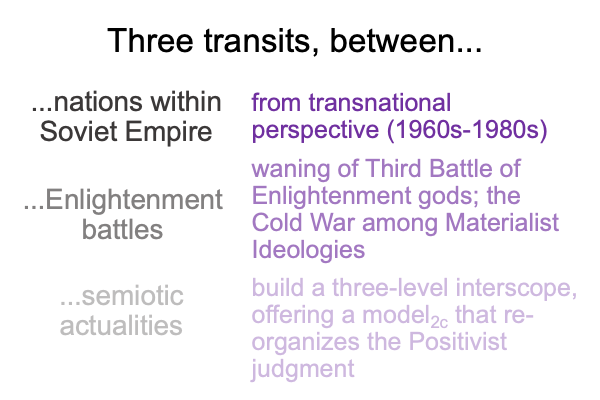
0218 Of course, the initial advantage offered by a remake of the Positivist’s judgment comes from the fact that inquiry into cybernetics3b is ready-at-hand to virtually situate the Tartu-Moscow School of Structuralism and Semiology as a positivist intellect3a.
0219 However, some scholars in Slavic language and literature are not so interested in codes (or machines, for that matter).
They are eager to pursue inquiries closer to aesthetics, as traditionally understood.
So, during the third paradigm-wave, collaborators in the Tartu-Moscow School propose research projects aiming to expand linguistic and semiotic methods into literary and cultural theory2b. Vigorous debate follows. The authors do not say what really happened.
0220 Section four (4) concludes.
Section (5) begins by mentioning how members of the Tartu-Moscow School work on preserving and cultivating the legacy of the Prague Linguistic Circle (involving both Mukarovsky and Jakobson).
Hmmm.
What was going on in Prague?
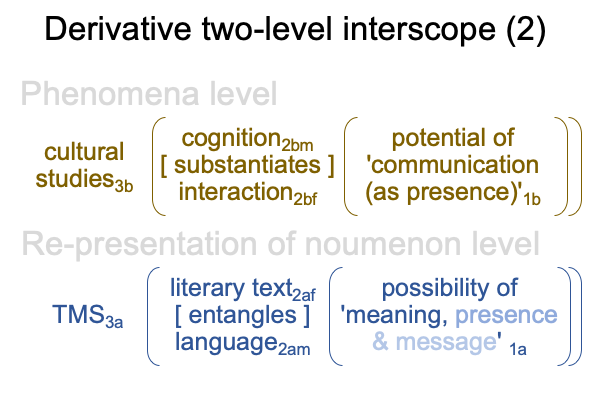
Do I anticipate further development of the following two-level interscope?
0221 How about the following guess?
What linguist is interested in cybernetics?
0222 During the 1960s, Lotman labors, along with other academics, on a two-volume edition of Mukarovsky’s writings. He notes (in a text published after his death) that Mukarovsky’s functionalism (think “doctrines of formal and final causalities”) sounds quite modern. Mukarovsky moves from contemporary semiology as the science of deciphering texts to a general theory of generation, storage and functioning of information in human society (in short, a study of culture).
Mukarovsky describes every civilization as a hierarchically organized structure of functions. Some of the functions are performed by texts. Culture… er… “civilization” is a dialectical unity.
0223 Uh-oh. Where have I heard the term, “dialectics”, before?
Was the qualifier, “materialist”?
0224 Surely, this paean to Mukarovsky comports with the two-level interscope portrayed above, where cultural phenomena2b (on the situation level) objectify literature and language2a.
But, this2am is not the language2bm of the literary text2bf. This is the language2am that the literary text2af (or is it2af the object2af that the semiological3a structuralist3b model2c stands for?) entangles2a.
0225 On the content (or presentation of “the model as the noumenon” level), the triadic normal context of the positivist intellect of the Tartu-Moscow School3a brings the dyadic actuality, {literary text (as form) [entangles] language (as matter)}2a into relation with the potential of ‘meaning1a, presence1b and message1c‘.
On the situation (or phenomena level), the triadic normal context of cultural studies2b brings the dyadic actuality of {cognition [substantiates] societal interactions}2b into relation with the monadic potential of ‘communication (as the presence virtually situating meaning)’1b.
Perhaps, the term, “communication1b” is a label for the process whereby positivist language2am becomes virtually situated by cognition2bm.
To me, it seems that “communication” is more culture-friendly than “code”.
0226 surely, the normal context of cultural studies3b is not the same as the normal context of inquiry into cybernetics3b.
Indeed, the logics of thirdness includes exclusion, alignment and complement.
The two normal contexts3b of cultural studies3b and cybernetics3b do not align, nor do they complement.
Will the new-fangled “artificial intelligence” change that?
0227 In 1968, a black swan event occurs. The Soviet Empire suppresses political ferment in Czechoslovakia. The accelerant for the political exuberance comes from a citizenry jealous of the raucous protests happening on the other side of the Berlin Wall. Intoxicants and false expectations are provided by wealthy Western political and financial manipulators. The popular press puts a romantic label on the event: “The Prague Spring”.