0116 By the end of the preface, Santner sets the stage for his two lectures.
Here, I want to review and tie some strings together.
0117 To start, look at the partially complete interscopes of early modern political theology (the dual body of the king) and modern political economy (the nature of citizenMarat).
The first looks like this:
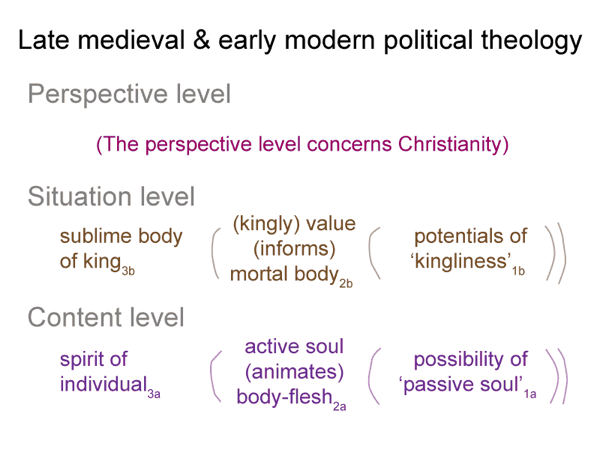
Here, the actualities of both nested forms are written as dyads. These actualities are king2b and subject2a.
The second looks like this:
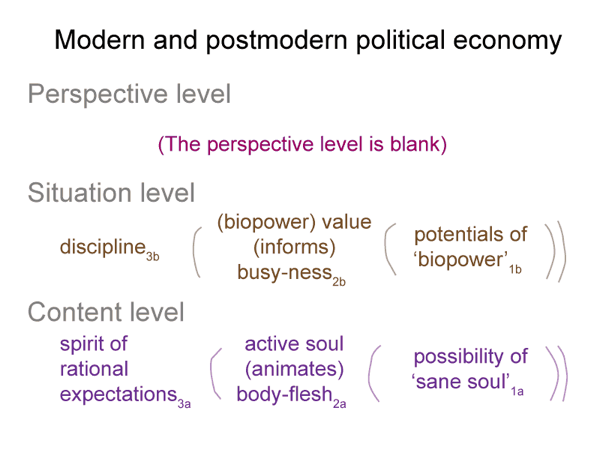
Again, the actualities of both nested forms are written as dyads. These actualities are citizenMarat and citizenregular.
0118 Santner’s thesis goes like this:
The late medieval and early modern glory of the sublime body of the king has been dispersed, in middle and late modernism, to all citizens in the modern political economy.
0119 The category-based nested forms (that associate to terms in Santner’s discussion) suggest that the logic may be framed as a historic transition from one partial interscope to another.
In other words, there is an historic transition in primordial images.
0120 Next, the general form of the society tier looks like this:
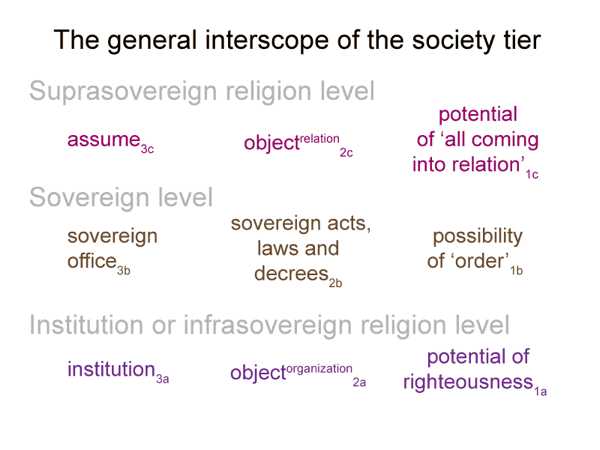
0121 The previous two models resonate with the general interscope of the society tier, as developed in the foundational work How to Define the Word “Religion”.
For example, the early modern sublime body of the king3b and the modern normal context of discipline3b resonate with sovereign office3b.
0122 What does this imply?
The story begins with Christianity as a suprasovereign religion.
But, this beginning does not appear in Santner’s inquiry.