0253 Chapter 35 discusses Theodore Roosevelt (1858-1919), who serves as president at the turn of the century (1901-1909). His presidency starts with the assassination of William McKinley. At the time, Roosevelt is Vice President.
Bullets are in the air during this time. Lakota leader Sitting Bull (dies 1890), New Orleans Police Chief David Hennessy (1890), Lamatta Chief White Bird (1892), US Chicago Representative Carter Harrison Sr (1893), President of France Marie Francois Sadi Carnot (1894), King Umberto in Italy (1900), and so on.
0254 Thoreau’s option reaches a nice optimum, with the people2bm remaining Protestant as they take the form of democracy2bf. The people2bm amend the Constitution, now that the states are reunited and… um… redeemed. Americans are still walking3a to settle the frontier, but now they can take trains out west. Some Americans are driving automobiles. Some are taking mechanized passenger ships back to Europe, for “vacation”.
So, walking3a stands in for what Thoreau does, that is, ideating reality3a.
Here is a picture of Thoreau’s option, as the western frontier comes to a close.
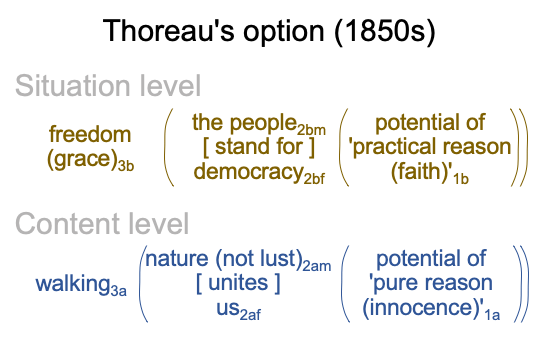
Notice that ‘pure reason (innocence)’1a occupies the same slot as ‘gun’1a. By not carrying a gun1a, one signals one’s virtue2am (and the nature2am that unites us). By deploring people who carry guns, one denounces their lack of virtue2am.
What does this imply?
When the people2bm [stand for] themselves2bf, the selves2af that the people2bm stand for are the virtuous ones2af, not the ones who carry guns.
If that makes sense, then you might be a candidate to become an expert.
0255 Teddy Roosevelt promotes sports and sportsmanship. Democracy is so successful that Protestant people2bm will be supplanted by our nation2bm. Plus, our nation2bm stands for “a muscular Christianity2bf“. Muscular Christianity2bf virtually situates our attitudes2af in the normal context of winning3a arising from the potential of ‘fair play’1a.
Here is a diagram.
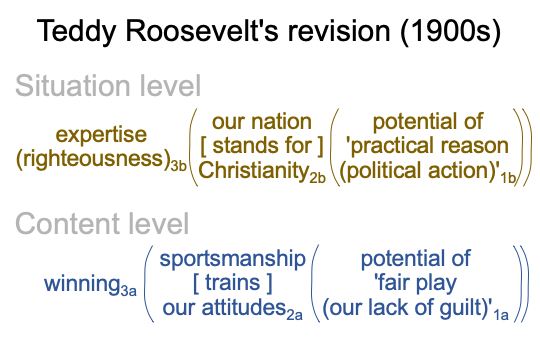
0256 Notice how ‘fair play (our lack of guilt)’1a occupies the same slot for ‘gun’1a in the original American identity. Teddy Roosevelt is known for his “gunboat diplomacy”. So, guns have not really left the realm of possibility1a. Rather, ‘the gun as a talisman for some opaque transcendental that is too terrifying consider’ retains its charisma, since guns are employed for assassinations by criminals (1890, maybe 1893), anarchists (1894, 1900, 1901, 1914) and agents of the state (1890, 1892).
So, what is the point?
‘Guns’1a have no place in ‘fair play’1a. At the same time, ‘guns’1a serve as indicators for a lack of fair play1a, so to speak. The use of ‘guns’1a defies practical reason1b in a nation2bm that stands for Christianity2bf in the normal context of expertise3b.
0257 Chapter 37 discusses an example of how expertise3b develops at the turn of the century. The artisan is eclipsed by the industrial designer.
0258 Chapter 38 discusses the closing of the American frontier in the popular (or… rather, the literary class’s) imagination. A key event is the Columbia Exposition in Chicago in 1893. Jones reports on a speech by Frederick Jackson Turner at this spectacular “World Fair”. He announces that frontier opportunities had come to a close.
According to Jones, Theodore Roosevelt personifies a new American identity, characterized by the above diagram. Situation-level matter2bm veils the federal government, as a centralizing state, beneath the tapestry of nationalism2bm. Our nationalism2bm stands for a strenuous Christianity2bf in the normal context of expertise3b and arising from the potential of practical (that is, “not religious” reason)1a. Protestant Christians2bf virtually situate the sportsmanship2am that trains healthy attitudes2af.
0259 At the same time, Protestant Christians2bf increasingly become wage slaves to a managerial class3b(1b) working for oligarchs2c, such as the Mellons, the Rockefellers and the corporations that they own.
0260 Part 2 (The Rehabilitation of “Nature”) leads to Part 3 (The Return of the Satanic Wilderness).
The first wilderness stretches out from the fortress edge of the Massachusetts Bay Colony.
The second wilderness stretches to the north (Canada), the south (Mexico and Central and South America), the east (across the Atlantic to Europe and the Middle East) and west (across the Pacific to the Far East).
That sounds like an empire to me.
The second “wilderness” is tamed by the American empire.
0261 Chapter 39 discusses the writer, Jack London (1876-1916). London comes to age in San Francisco. He reads European authors of the day. He circulates in Bohemian circles. His novel, Sea Wolf (1904), serves as a witness to Darwinism replacing Calvinism as the hidden grammar of the nascent American empire.
I wonder, “Where have I seen the term, ‘hidden grammar’, before?’
Oh, it2a labeled the contiguity in the content-level actuality2a.
I wonder, “Can I adjust Teddy Roosevelt’s revision to embrace Darwinism?”
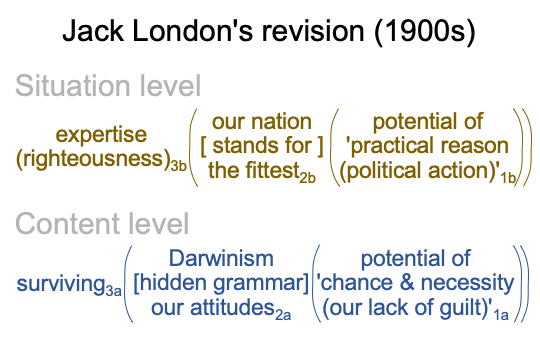
This serves as a good template for reflecting on the author’s review of Sea Wolf.
0262 Chapter 40 discusses the writer Ernest Hemmingway (1899-1961), who was born in Oak Park, Illinois. That is a nice suburb of Chicago.
Henry Adams dies in 1918, when the First World War ends. Adams’s autobiography, The Education of Henry Adams comes on market. At the same time, Hemmingway is recovering from wounds that he received while driving an ambulance in the First World War. After the war, he makes his way to Paris, where he meets Ezra Pound and other literary figures of the so-called “Lost Generation”.
0263 Jones sets the scene by discussing the birth of modern art. “Modern art” involves a clever and subversive re-definition of the term “visual arts”, from decorative to… well… transgressive.
I suppose this indicates that neither Protestantism, nor nationalism nor Darwinism are adequate to appreciate the end of the world as everyone knew it.
Oh, I meant to say “the First World War”.
0264 What is left?
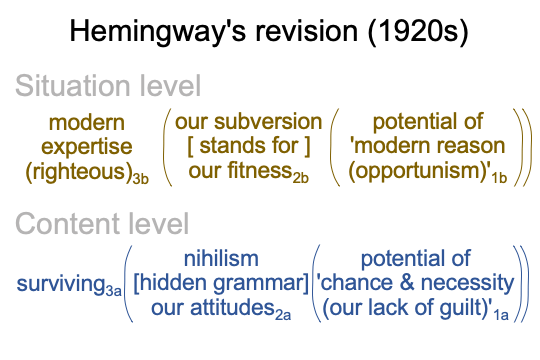
Science, of course. Modern expertise3b carries a certain righteousness3b, as well as certain freedoms3b. Modern reason1b accesses opportunities1b that practical reason1b does not. For example, consider the logics of modern finance, quantum mechanics, industrial-production, and mass-marketing. All these fields develop in the interwar period, along with the ideologies of Marxism and Fascism.
0265 What do these ideologies have in common?
They both rely on modern experts3b operating of opportunities1b.
Of course, their subversions2bm are um… “value neutral”1bf.
0266 Here is how I associate Hemingway’s “Lost Generation” approach to Jack London’s revision.
0267 Chapter 41 covers William Falkner (1897-1962), who writes a novella titled, “The Bear”.
This portion of Jones’s book looks back at the American identity and wonders, “How have we sold our identity?”
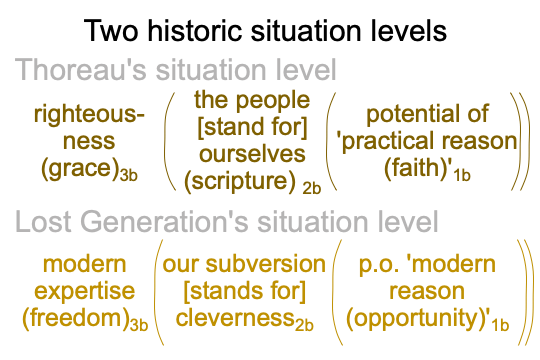
0268 It seems that Americans sold their identity3b for a bowl of porridge.
Or something like that.
Americans pass from sola fide3b, sola sciptura2b and sola gratia1b to the following nested forms, as well as everything in between.
0269 The student should read Chapters 43, 44, 46 and 47.