0246 Eight years after Mark Twain publishes Innocents Abroad, Henry James (1843-1916) publishes The American.
0247 The year is 1877.
One author represents the attitude of the west, which is still the frontier. The other author expresses the attitudes of the east, which looks across the ocean… or is it the Jordan River?… at the civilization that Americans left behind.
0248 In Chapter 30, Jones discusses Henry James’s novel in detail.
In Chapter 31, Jones turns his attention to Henry Adams (1838-1918), the Old Man of the East, who is not Henry James. The switch of focus is a little disorienting, because both men are named “Henry”.
0249 But, the year is still 1877.
In this year, federal troops withdraw from the South, ending Reconstruction. The new post-war era is to be called, “Redemption”. Three decades later, the war itself would get a new label, “the Civil War”. It is amazing what a change in labels can accomplish.
In this year of 1877, the American labor movement surfaces with a surprising railroad strike.
In this year, a descendent of President John Quincy Adams, Henry Adams, resigns from his professorship at Harvard, disappointed that his dream of a unique American Mandarin class had not come to fruition. If he had only lived another half of a century. Once science encourages the birth of “expertise”, Henry Adam’s dream becomes a reality.
He must have known what was coming, because he writes an autobiography that is published right after his death and after the conclusion of the so-called “First World War”.
Jones tells the story of unfortunate Henry.
0250 The War of Southern Rebellion and the War of Northern Aggression derails the American experiment, as well as Henry Adam’s career as a public intellectual. Even his professorship at Harvard does not seem to give him a lift.
0251 Chapter 33 covers what happens to Henry Adam’s wife, and how Henry spends his end of days.
At this juncture, I would like to mention an American philosopher whose life (more or less) overlaps with Henry Adams. This philosopher is Charles Sanders Peirce (1839-1914). Charles is the son of a Professor of Mathematics at Harvard University. Tremendous intellectual ferment occurs during the latter half of the nineteenth century. Very little of that turmoil influences the westward expansion of the Re-united United States or the migration of Catholic Europeans to the East Coast (Italians join the incoming Irish and Germans).
Peirce does not concern himself with Protestant or Catholic concerns. Rather, like Henry Adams, he recognizes that everyone is talking as if science is the key to all knowledge worth knowing. The century-long contests between Catholic and Protestant doctrines are no longer relevant, since science surpasses both. Unlike Henry Adams, he reads the Baroque scholastic, Francisco Suarez (1548-1617), then arrives at the same definition of sign-relation as John Poinsot (1589-1644).
So, while Henry Adams ends his days writing paeans (in effect, aesthetic travel guides) to Catholic European tourist destinations, Peirce wrestles with the causalities inherent in sign-relations. The diagrams in this examination are products of Peirce’s postmodern reclamation of Baroque scholastic thought.
0252 The student should read chapters 35, 37, 38, 39, 40 and 41.
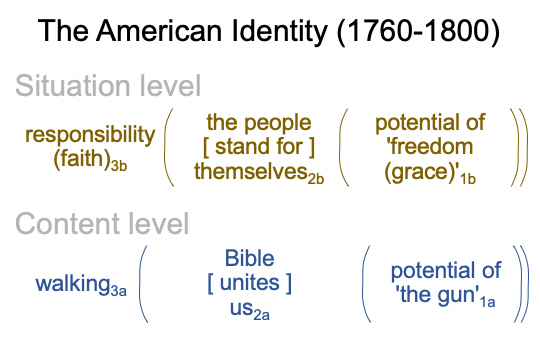
Keep in mind the following two-level interscope.