
0232 Why would John Calvin (1509-1564) have advocated for the Catholic Church to condemn “Americanism”?
What happened after the Catholic Church condemned Martin Luther (1483-1546)?
Being condemned can be good for business.
0233 Chapter 22 raises a question about two contending options for American identity3b during the second half of the 1800s.
The Northern abolitionists unite against the lack of virtue of the Southern plantation owners.
The Northern transcendentalists unite against the undisclosed transcendental that is implicated by the gun.
Finally, the literary classes of America cannot wrap their heads around how such beautiful European art1a can come from a civilization that lacks modern expertise3b and wallows in superstition2b and Dark-Age philosophy2b.
0234 Here is a comparison.
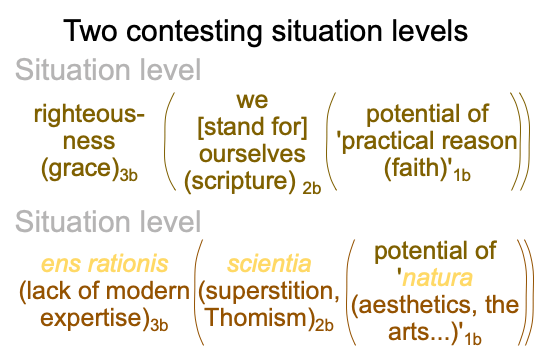
Surely, adopting one normal context entails rejecting the other.
0235 The irony is that ethnic Catholics develop a hybrid identity, under an “ethnic-American” label. So do clergy. As a result, Americanism covertly identifies with the abolitionists (who are against the lack of virtue of others), the transcendentalists (who signal their lack of guilt by not owning guns), and the literary classes of America (who have faith in practical reason and marvel at how these Catholic ignoramuses could have produced such magnificent art).
0236 Chapter 25 starts with artistic license, so to speak.
During the War of 1860-1864, if a soldier in the Connecticut regiment goes on holiday, then he can use a handy manual, The Gentleman’s Guide, to the arts of New York City.
While there, the soldier can subscribe to mail order pornography, thus giving new meaning to the term “first-class mail”.
0237 The abolitionist Henry Ward Beecher (1813-1887) is the son of one of the last great Puritan ministers in America, Lyman Beecher (1775-1863). Jones tells the story. The son moves west, first from Connecticut to Ohio. Here, he composes articles repudiating Catholicism. Then, he moves to the real west, Indiana. He begins to preach in the Methodist style. He learns to speak like Emerson, while using different words.
Emerson says, “Self-reliance.” Henry Beecher says, “The great law of Liberty.”
0238 Then, Beecher receives an offer to become pastor of a church in Brooklyn.
He accepts the offer and adopts a theatrical slogan.
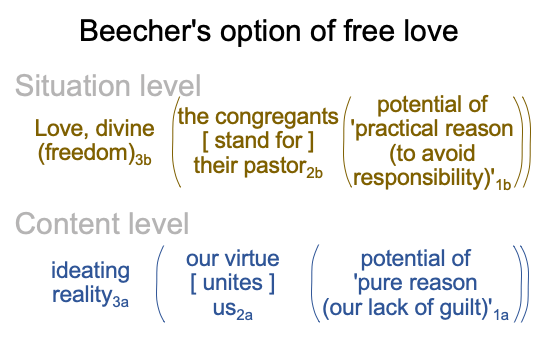
Salvation comes from love, rather than obedience to the law.
0239 In the 1850s, gold from California arrives in New York. 60% of New York’s population is born in another land. New York is cosmopolitan. New York already offers ideal subject matter for a gentleman’s guide.
Beecher’s practical experience out west1b inspires him to make freedom the cornerstone of his ministry3b.
Freedom for what?
Well, he may have picked up a copy of The Gentleman’s Guide.
0240 Here is a picture of my associations.
0241 In Chapter 26, the author tells what happens next.
That story ends around the year 1867.
0242 Chapter 27 tells the story of Mark Twain (1835-1910), who arrives in New York shortly after the birth of… um… someone related to Henry Beecher.
“Mark Twain” is a technical term used by steamboat operators on the Mississippi River.
Mark Twain is the label for a man of the west, at ease with the ribald humor of Americans, as well as their Civil War-related moral decline.
Does Henry Beecher hire Mark Twain to be his publicity agent?
0243 Mark Twain takes a European vacation on a tour that Beecher arranges, but does not attend.
The tour takes him through some of the most beautiful cities in Europe.
He uses his notebooks to write The Innocents Abroad.
0244 Chapter 29 concerns a verdict.
Who is guilty? Who is found innocent?
0245 The student should read Chapter 30, 31 and 33.