0270 Chapter 43 opens with a quick synopsis. By 1902, the American frontier had been replaced by eye-catching progress. Also, popular novels fictionalize the failure of Protestant America to envision a common identity.
This makes sense, in so far as, in the Protestant movement, every literate person is granted equal disposition1a to read the Bible2am, and render his own interpretation2af. That interpretation2af generally falls within established congregations (the Puritans, the Methodists, the Presbyterians, and so on). The American Revolution accommodates the various powers1b by establishing a relatively weak tripartite central (or “federal”) government over strong state governments1b. This political arrangement is a practical solution1b, allowing people of certain faiths1b the freedom3b to self-segregate into their own jurisdiction2b.
0271 Here is a picture of (what I will call) the Virginian’s option.
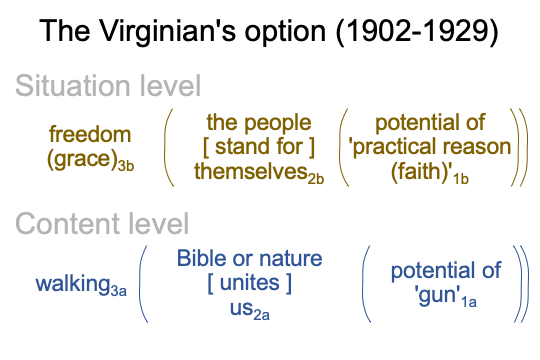
0273 What is this potential of ‘gun’1a?
It is easy to understand how the Bible (for Christians) or nature (for Transcendentalists)2bm unites individuals of like minds2af.
But how does the ‘gun’1a potentiate that actuality2a?
0274 Well, when one is walking3a with a ‘gun’1a, one is conveying a meaning1a, a presence1b and a message1c.
The meaning1a has something to do with the possibility of self-defense1a, especially in regards to mortal conflict. A gun1a cannot help finding water. A gun1a can help when a rustler is “guarding” the water hole.
The presence1b has something to do with the possibility of practical reason1b. Practical reason1b allows the people2bm to stand for themselves2bf, in the normal context of freedom3b. Practical reason1b is another label for ‘responsibility’1b. Recall that freedom and responsibility constitute a “co-opposition”. When one is the normal context3 the other informs the potential1. Responsibility associates to faith. Freedom associates to grace.
0275 The message1c?
That is a good question, since the perspective level does not even appear in the above figure.
I can say the following from the clues offered in the examination.
0276 Whatever the perspective level is, I must assume its normal context.
In other words, a perspective-level “assume3c” virtually brings a situation-level identity3b into relation with the potential of content-level structure3a. The logics of thirdness are exclusion, complementarity and alignment.
In the Virginian’s option pictured above, I must assume3c that situation-level freedom3b (or grace3b) situates content-level walking3a (or ideating reality3a).
0277 More crucially, I assume3c the perspective-level actuality2c.
Of course, the most magnificent assumption3c pertains to the object that brings all into relation2cC. That2cC includes “God”. And, perhaps I can add, “us”, as participating in this object2cC.
According to the twentieth-century German philosopher and historian, Eric Voegelin (1901-1985), Christians come up with the most differentiated expression of the society-tier perspective-level actuality2cC, sometime between the 600s and 1000s, centuries before the so-called “Reformation”.
0278 Finally, I somehow intuitively grasp the potential1cC that there can be an object that brings all into relation2cC.
I wonder whether this is where the gun1a comes into the picture, as a talisman for consilience1c in the face of a failure of practical reason1b. When practical reason1b fails, then the people cannot stand for themselves2b in the illumination of their freedom to assemble3b, and live3b, and express themselves3b.
0279 Where are we to go when people who live without a sense of guilt1a actualize attitudes2af that express the hidden grammar of nihilism2am in the normal context of their survival3a?
It is a jungle out there.
0280 Here is a diagram containing that question.
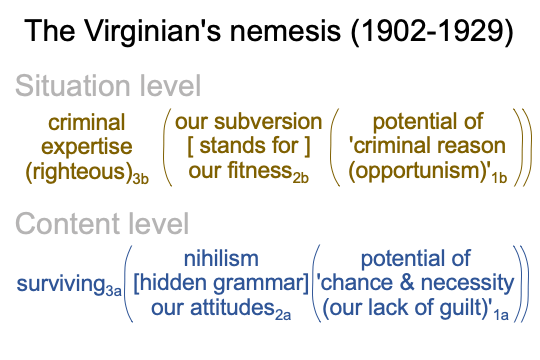
0281 On the situation level, the normal context of criminal expertise (the righteousness of criminals and their lawyers)3b brings the actuality2b, {the principles of our subversion2bm [substantiate] our fitness over our victims2bf}, into the possibilities inherent in ‘criminal reason, which is opportunistic to the core’1b.
0282 In Chapter 44, Jones looks at The Virginian, a novel by Oren Wister (1860-1938).
The book is published in 1902. The movie comes out in 1929.
0283 In Chapters 46 and 49, Jones considers movies starring Clint Eastwood (1930-present).
0285 The student should read Chapters 42 and 45.