0284 Chapter 42 reports on Walter Lippmann (1889-1974), born in a wealthy Jewish family in New York. He receives a classical education at a private school. In 1922, after America’s victory in the First World War, “the war to end all wars”, he publishes a book titled Public Opinion.
Perhaps, he knows that the similarly positioned Edward Bernays (1891-1995), nephew of renown psychotherapist, Sigmund Freud, is hot on the same topic, publishing Crystallizing Public Opinion (1923) and Propaganda (1928) in quick succession. After the Second World War, Bernay capitalizes on his fame by writing Public Relations (1952) and The Engineering of Consent (1955).
0285 I like to call the First World War, 1914-1918, the First Battle Among the Enlightenment Gods, The War Among Naive Mercantilists.
During this time, Lippman works for the intelligence section of the Allied Expeditionary Force in France. He helps draft President Woodrow Wilson’s Fourteen Point Speech. He hears about the success of George Creel’s Committee on Public Information, America’s first propaganda ministry. Creel (1876-1953) later wrote a tell-all titled, How We Advertised America (1920).
0286 Lippmann concludes that identity3b may be framed as a typology, based on (what E. Michael Jones calls) categories of the mind.
Plus, the subtlest and most pervasive influencers create and maintain these categories, using broadcast media.
0287 Now, I pause to remind myself of the contemporary Thomist construct of identity3b and structure3a in order to consider the situation and content levels actualities that get packaged into a stereo- (two) -type (actualities).
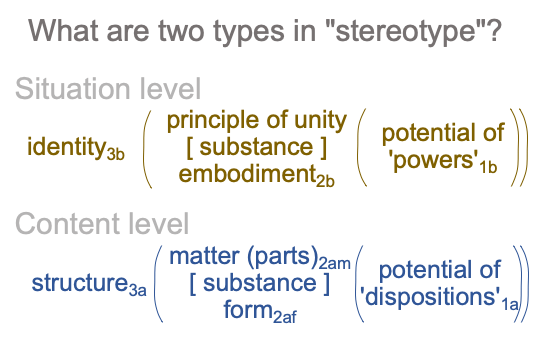
Here is a diagram.
What is a stereotype?
The first type in “stereotype” dwells in content-level matter2am. It2am substantiates a form2af, corresponding to the way that we experience the world2af. We are structured3a to be disposed1a to certain attitutes2af that are informed by one or another stereotype2am. The task of propaganda1b is to situate our attitudes2a by placing a typology in content-level matter2am.
Then, the form2af that we have been structured3a to experience2af is situated according to a principle of unity2bm that substantiates an embodiment2bf. The task of propaganda1b is to prime2bm a response2bf through the second type of “stereotype”, dwelling in the situation-level principle of unity2bm.
The two types in stereotype play the same music through different level matters.
The result sounds so real.
0288 Lippmann writes at the dawn of popular acceptance of moving pictures.
0289 Moving pictures?
In the realm of image processing, a sequence of slightly different images2am substantiate the form of a mechanically driven display of one image following the other2af. Then, the human mind has the power to apply a principle of unity2bm that substantiates the embodiment of motion2bf.
Then, sequences of moving-picture clips2am may be strung together2af and the audience will apply another principle of unity2bm to appreciate a scene2bf.
This constitutes the first type in “stereotype”.
Scenes portray the content-level matters2am of action and plotline2af, and the audience spontaneous situates the content-level form2af using an implicit principle of unity2bm into a cognitively embodied “narrative”2bf.
This constitutes the second type in “stereotype”.
The result looks so real.
0290 It is almost as if identity3b, powers1b, structure3a and dispositions1a are simply going along for the ride.
Why would this be the case?
Is this how humans evolved to be?
0291 So, what happens when stereotypes are promulgated (through cinematic narratives manufactured in order to serve… how shall I say it?… “special interests”)?
Indeed, Jones wonders whether Ernest Hemingway and the Lost Generation are stereotypes manufactured by Madison Avenue (New York) and Hollywood (Los Angeles) as expressions of American cultural imperialism.
A new system arises in order to manipulate public opinion2bm and orchestrate the accumulation of power and money2bf through the invention and the promulgation of stereotypes1am.
The vessel3b(1b) that accrues both power and money is a network of big(il)lib power brokers who fashion themselves as “liberal” (that is, freedom-oriented) but are really interested in using the authority of government to suppress anyone who would hold them to moral account (that is, responsible). In other words, this vessel is a contradiction in terms, being simultaneously liberal and illiberal.
Consequently, I label this network, “big-government (il) liberalism”, or “big(il)lib” for short.
0292 Here is a picture of Walter Lippmann as a nemesis to the American tradition of walking with a Bible and a gun.
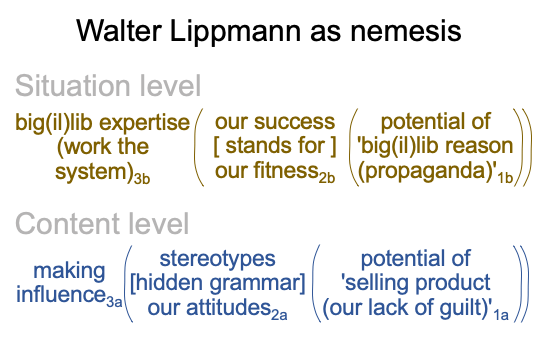
0293 On the situation level, the normal context of working the system3b brings the actuality2b where {our success in accumulating money and power2bm stands for our fitness over the goyim2bf} into relation with the potential of using propaganda1b as a style of public reasoning1b that cultivates the hidden grammar of stereotype2am-fueled attitudes2af.
On the content level, the normal context of manufacturing consent3a brings the actuality of propaganda1b-situated stereotypes2am substantiating public attitudes2af into relation with the potential of ‘selling an agenda, as if we do not benefit from moving the product’1a.
Jones frames this nemesis as an inversion of Jeffersonian democracy, where the people stand for themselves2b.
0294 Chapter 45 mentions Ayn Rand (1905-1982), the author of Atlas Shrugged, (1957), as a teaser for his real intent, which is to discuss the fates of the movie-star, Gary Cooper (who plays the role of The Virginian in the movie) and the literary-star, Ernest Hemingway (who acts as an author of American literature as the tradition turns into a curation by the mavens of modern art).
0295 The student should read chapters 47 and 48.